

Exam Anxiety GCSE Classical Civilisation Guide
Exam anxiety GCSE Classical Civilisation advice for revising sources, planning essays, practising papers and staying calm before and during OCR exams.
The hardest moment is not always opening the exam paper. Sometimes it arrives weeks earlier, when you look at a pile of myths, ancient sources, temples, characters and essay plans and wonder how any of it will stay in your head.
If you are looking for exam anxiety GCSE Classical Civilisation support, the practical answer is this: reduce the course to small source-based tasks, practise retrieving evidence without notes, rehearse timed responses and prepare a simple routine for moments when your mind goes blank. Anxiety becomes more manageable when the next action is clear.
This matters especially in Classical Civilisation. You are not merely recalling a story. You may need to identify details, interpret literature or material culture, place evidence in context, compare Greece and Rome, and sustain a judgement. The breadth can feel intimidating, but the paper itself gives your revision a structure.
A calm revision checklist
Use this as your starting point:
- Confirm your exact OCR component choices with your teacher.
- Divide each component into literature, visual or material culture, context and themes.
- Build a compact evidence bank rather than rewriting entire textbooks.
- Practise recognising and analysing sources, including unfamiliar ones.
- Plan and complete timed responses using the correct mark allocation.
- Mark your work and record why marks were lost.
- Revisit weak material after a short gap.
- Tell a trusted adult if anxiety is disrupting sleep, attendance, revision or everyday life.
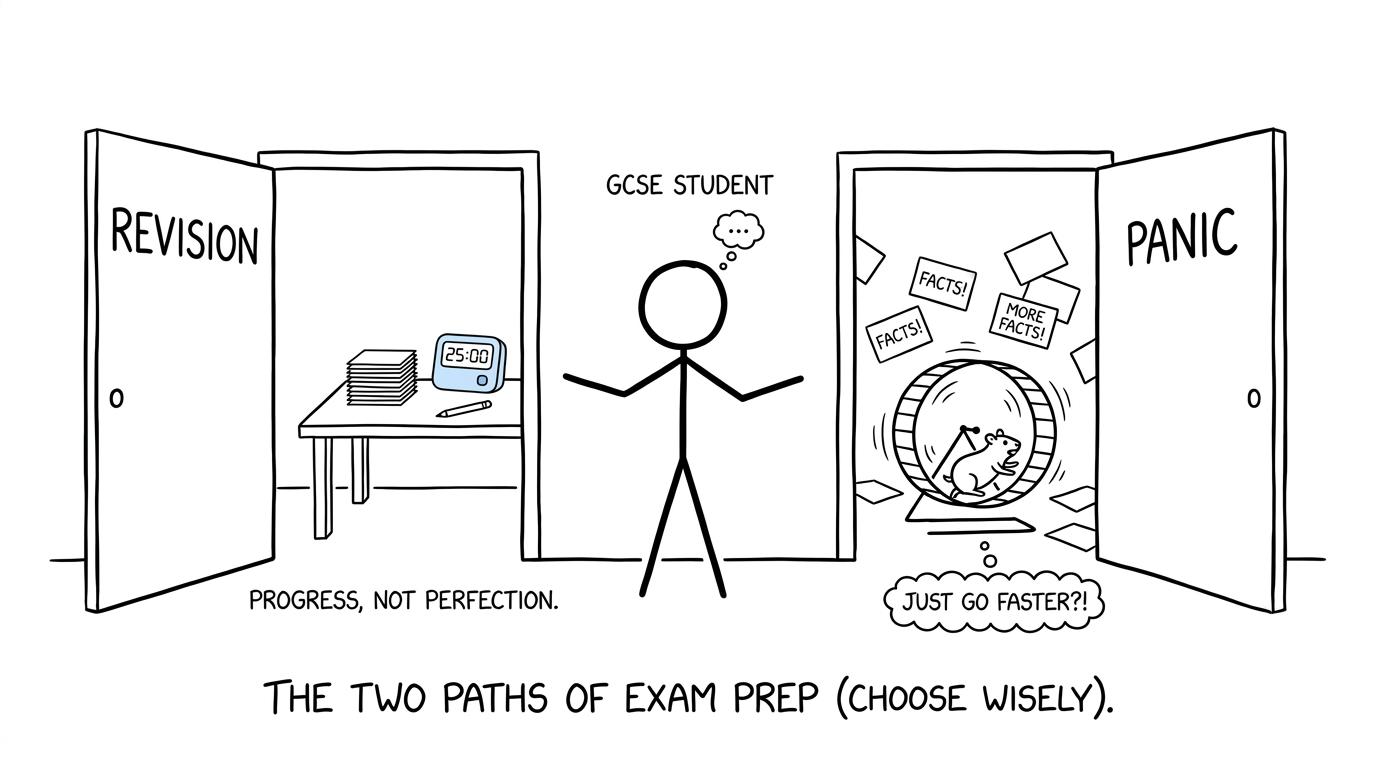 A student choosing between a calm revision desk and a hamster wheel of panic
Understand what the Classical Civilisation exam demands
Under the current OCR GCSE Classical Civilisation J199 specification, students take one Thematic Study and one Literature and Culture component. Each written paper lasts 111 hour 303030 minutes, is worth 909090 marks and contributes 50%50\%50% of the qualification.
The Thematic Study options are Myth and Religion or Women in the Ancient World. Literature and Culture options are The Homeric World, Roman City Life, or War and Warfare. Your school chooses a route, so revise only the components you have actually studied.
The assessment combines shorter questions with extended responses. It can involve prescribed literature, visual or material culture and unseen sources. OCR assesses knowledge and understanding through AO1 and analysis and evaluation through AO2. Across the qualification, AO1 carries 60%60\%60% and AO2 carries 40%40\%40%.
That structure explains a common source of anxiety: knowing many facts does not automatically make a response analytical. Equally, an elegant argument cannot earn all the available marks if it lacks accurate classical evidence. Revision must train both.
Create four headings for each part of your course:
- Knowledge: people, events, practices, objects and narratives.
- Source detail: what can be seen or identified in the prescribed material.
- Context: what the source suggests about its society, values or audience.
- Interpretation: how the evidence supports, complicates or limits an argument.
This turns a large specification into visible categories. It is the same principle behind finding your weakest GCSE topics: diagnose precisely before doing more revision.
Replace rereading with source retrieval
Rereading can feel reassuring because everything looks familiar. The problem appears when the book closes. Classical Civilisation exams require you to produce relevant knowledge and use it, not simply recognise it on a page.
Make source cards with the image, object, passage title or episode on one side. On the other, record only:
- three observable or memorable details;
- the relevant cultural context;
- one theme or argument the source could support;
- one possible limitation or alternative interpretation.
Then test yourself aloud or on paper. If you cannot retrieve a detail, check it, close the notes and try again. Keep uncertain cards in a separate pile and revisit them. This is more useful than repeatedly decorating notes you already understand.
For literature, organise evidence by themes and characters rather than trying to memorise pages in sequence. For material culture, practise moving from observation to inference: first identify what is present, then explain what it may reveal. Do not jump directly to a broad claim without grounding it in the source.
Short sessions make this easier to begin. MathsGenie’s 20-minute GCSE revision routine was designed for maths, but its rhythm transfers well: retrieve, answer, check and choose the next small target.
Make essay planning feel predictable
Extended responses often create more anxiety than short questions because the blank page offers too many possible directions. A repeatable planning process removes some of those decisions.
Before writing, identify:
- the command word;
- the exact claim or comparison in the question;
- your overall judgement;
- the strongest evidence for different sides;
- the order in which your paragraphs will develop the argument.
A useful paragraph has a clear claim, specific classical evidence, an explanation connecting that evidence to the question, and evaluation where required. Comparison should be direct. Do not write everything about Greece and then everything about Rome while leaving the examiner to find the relationship.
You do not need to produce a perfect essay plan every time you revise. Alternate between quick plans, single analytical paragraphs and complete timed responses. Gradual exposure is calmer and more sustainable than avoiding essays for weeks and then attempting several full papers at once.
Practise unfamiliar sources without fearing them
An unseen source is not a trap. It is an opportunity to apply knowledge to evidence placed in front of you. The safest first step is observation.
For a visual or material source, note figures, clothing, posture, objects, setting, scale and composition before interpreting them. For a written extract, identify the speaker or perspective where possible, tone, significant language, relationships and the values being presented.
Separate three questions in your mind:
- What does the source actually show or say?
- What might that detail suggest?
- What contextual knowledge makes the interpretation convincing?
If you feel stuck, return to the visible evidence. A modest, well-supported interpretation is stronger than a dramatic claim the source cannot sustain.
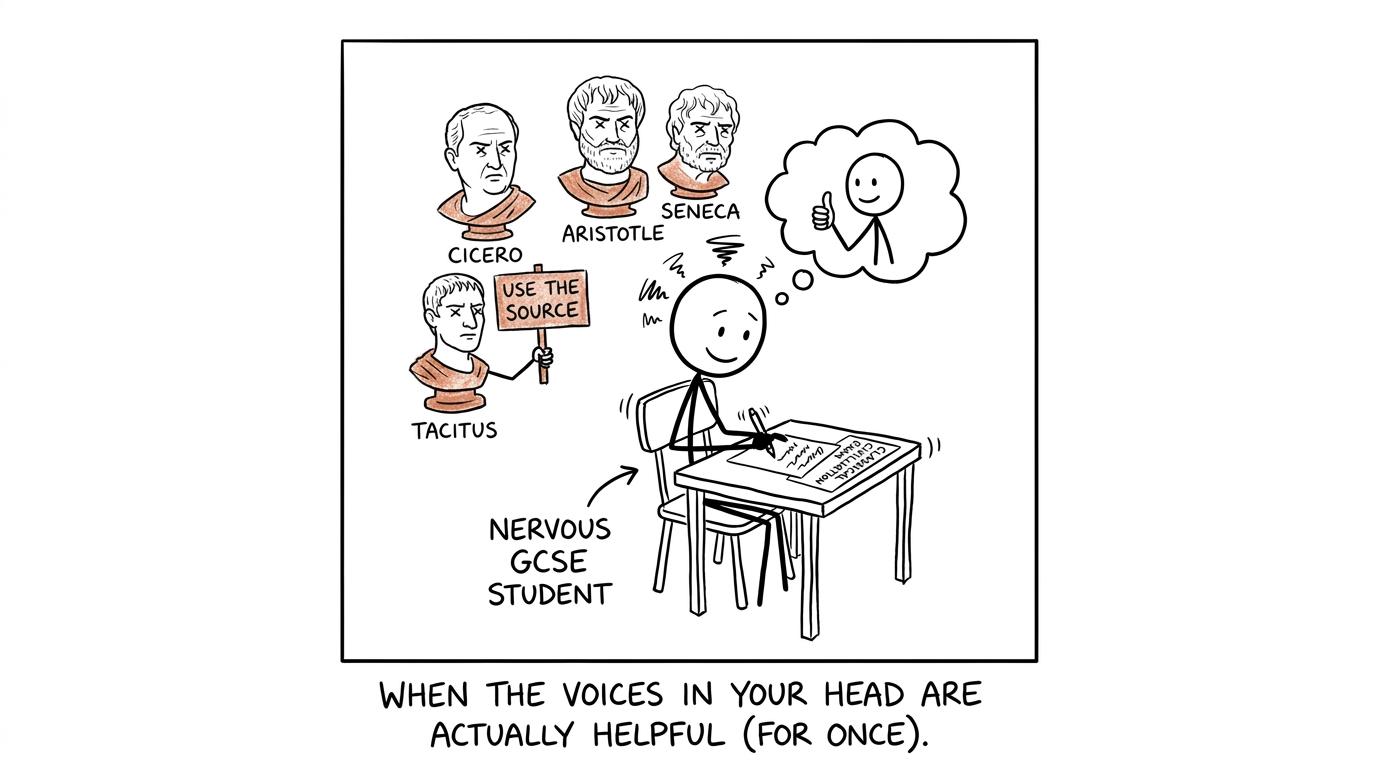 A Classical Civilisation statue reminding a nervous student to use the source
Use timed practice to reduce uncertainty
Timed practice is not only a test of knowledge. It teaches your brain that an exam has familiar stages: read, select, plan, write and check.
Begin with one timed question rather than a complete paper. Once that feels manageable, combine several questions and eventually complete a current paper under realistic conditions. Use the number of marks and guidance on the paper to make proportionate timing decisions, while leaving a small checking margin.
Afterwards, use the official mark scheme and teacher feedback. Record whether each lost mark came from:
- missing knowledge;
- vague or inaccurate evidence;
- insufficient source analysis;
- weak comparison;
- an unsupported judgement;
- misunderstanding the command word;
- running out of time.
This turns a disappointing mark into a repair list. Maths students can use exactly the same process with GCSE maths past papers, where free papers, questions and solutions make weaknesses visible. The subject content differs, but the calm cycle remains the same: attempt, mark, correct and retest.
For pacing your preparation, the guidance on when to start GCSE past papers explains why shorter timed sections should usually come before repeated full papers.
What to do when anxiety rises in the exam
If your mind goes blank, do not treat the blankness as proof that you know nothing. Anxiety can temporarily make retrieval harder. Pause, place both feet on the floor, relax your jaw and shoulders, and breathe slowly for a short period. Government and NHS exam guidance recommends controlled breathing, manageable planning and moving to another question if recall does not return.
Then make the task smaller:
- underline the command word;
- circle the topic or named source;
- write down one relevant fact or observable detail;
- decide what that evidence suggests;
- begin with the clearest part of your answer.
If one question remains blocked, leave space and return later. Another question may trigger related knowledge. Keep your attention on the paper rather than trying to predict your grade while the exam is still happening.
The night before, avoid trying to relearn the entire ancient world. Check a small set of weak sources, review your response structure, pack your equipment and stop at a planned time. The GCSE night-before revision plan offers a useful model for reducing last-minute decisions.
Build a revision plan that includes maths
Students preparing for Classical Civilisation are usually balancing several GCSEs. Anxiety grows when every subject appears to demand the whole evening.
Give each session a narrow outcome: retrieve one group of prescribed sources, plan one comparison, or review one marked response. Schedule maths separately by topic and tier. The MathsGenie GCSE maths revision hub covers major boards including Edexcel, AQA, OCR and Eduqas, with board-specific papers and free practice resources.
A weekly plan should include learning, retrieval, exam practice, marking and return visits to previous material. MathsGenie’s one-month GCSE revision plan shows how to balance focused topic sessions with timed practice without making every day a full mock exam.
Common mistakes that make anxiety worse
Revising every source equally
Some material is already secure. Spend more time on sources you cannot identify, contextualise or use in an argument. Evidence, not guilt, should decide the next task.
Memorising essays word for word
A memorised answer may not fit the wording of the real question. Learn flexible evidence and practise building arguments around different claims.
Avoiding unseen material
Avoidance preserves fear. Use short, low-pressure source drills so observation and interpretation become routine.
Treating the mark scheme as a verdict
A mark scheme is feedback about what the response demonstrated. Use it to identify the next correction rather than as a judgement of your ability.
Completing papers without reviewing them
Practice alone can repeat the same habits. Mark carefully, rewrite weak plans or paragraphs and return to the relevant content.
Waiting too long to ask for support
If anxiety is persistent or significantly affects daily life, speak to a parent or carer, teacher, form tutor, pastoral lead, GP or another trusted adult. Schools can discuss appropriate support. Formal access arrangements must be based on evidence of need and a student’s normal way of working; ordinary examination nerves do not automatically qualify. Raise concerns early rather than assuming an arrangement will be available on the day.
Turn uncertainty into the next small action
Classical Civilisation can feel enormous because its stories and societies are enormous. The exam, however, is finite. It asks you to retrieve selected knowledge, pay attention to sources, explain context and construct supported judgements.
Reduce anxiety by making those actions familiar. Build concise evidence banks. Practise unseen sources. Plan arguments. Complete timed questions. Mark them honestly and return to the precise weakness you uncover.
Then apply the same disciplined routine to maths. Start with MathsGenie’s free GCSE revision resources, use revision lessons and practice questions to repair individual topics, and build confidence through mini tests, past papers, predicted papers, mark schemes and video solutions. You do not need to feel completely calm before beginning. Begin with one clear task, and let familiarity do some of the calming for you.











