Should You Drop GCSE Food and Nutrition Mid-Year?
Drop GCSE Food and Nutrition only after checking workload, NEA, school rules and future options. Use this calm guide to make an informed mid-year choice.

A difficult subject can make your whole timetable feel too heavy. One unfinished portfolio becomes three. Maths revision gets pushed to tomorrow. Soon, dropping a subject feels like the cleanest way to create breathing room.
If you are considering whether to drop GCSE Food and Nutrition, the short answer is this: it may be sensible when the course is seriously harming your progress elsewhere and a supported recovery plan has failed. But do not leave simply because you have had a difficult month. First check your school’s rules, how much non-exam assessment you have completed, what qualification you would lose and exactly how the released time would be used.
Food Preparation and Nutrition is usually an optional GCSE, but dropping it mid-year is not a decision a student can normally make alone. Speak to your subject teacher, head of year, exams officer and parent or carer before changing anything.
Your decision checklist
Before asking to leave the course, find clear answers to these questions:
- Which awarding body are you following: AQA, OCR or Eduqas?
- What percentage of your non-exam assessment, or NEA, is complete?
- Is the problem knowledge, practical work, writing, attendance or organisation?
- What support and catch-up opportunities are available?
- Has your school already entered you for the examination?
- Would dropping reduce the number of qualifications on your record?
- Does your sixth form, college or intended course require a particular number of GCSEs?
- Where would the released timetable and homework time go?
- Could a short recovery plan solve the problem without losing the qualification?
The purpose of this checklist is not to keep you in a subject at any cost. It is to replace panic with information.
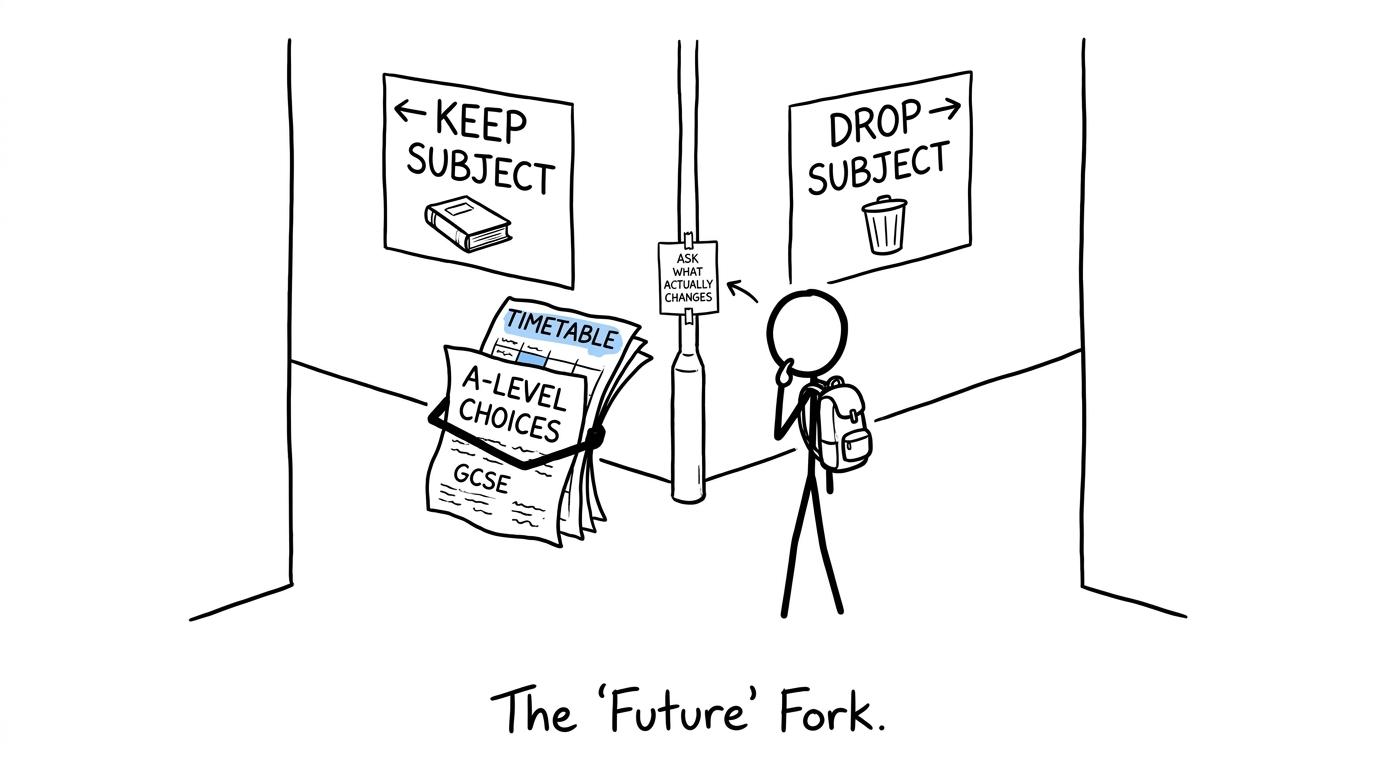 A student finds a third path between keeping and dropping a subject
Understand what the GCSE actually involves
The official specifications matter because Food Preparation and Nutrition is not assessed only through a final written paper. Across the current AQA, OCR and Eduqas qualifications, the written examination contributes 50%50\%50% and NEA contributes the other 50%50\%50%.
The NEA includes a food investigation and a food preparation task. The regulated assessment model allocates 15%15\%15% of the qualification to investigating the properties of ingredients and 35%35\%35% to planning, preparing, cooking and presenting food. Exact timings, paperwork and component names vary by awarding body, so your teacher should confirm the requirements for your course.
This balance explains why falling behind can feel different from missing lessons in an entirely examination-based subject. You may be trying to recover practical evidence, analysis, photographs, planning and evaluation while the class moves towards another controlled task.
It also means that completed classwork does not automatically become half a GCSE. The qualification is awarded through the required combination of assessments. If your school withdraws your entry, you would not normally receive a partial qualification for the work already completed.
Are you actually in over your head?
Feeling overwhelmed is real, but it is not always proof that the course is unrecoverable. A useful distinction is whether the difficulty is temporary, specific or structural.
Signs that recovery may still be realistic
You may need support rather than withdrawal if:
- one missed deadline has created most of the pressure;
- you understand the content but struggle to organise written evidence;
- your practical skills are developing, even if your confidence is low;
- your teacher can identify a short, achievable catch-up list;
- attendance or illness caused a temporary gap;
- the subject feels difficult mainly because several deadlines have arrived together.
Ask your teacher to define the minimum viable recovery plan. It should state what must be completed, what can no longer be recovered, when support is available and what standard is realistically achievable. “Catch up on everything” is not a plan.
Signs that dropping deserves serious discussion
Withdrawal may be reasonable when several of the following remain true after support has been tried:
- a substantial amount of compulsory NEA evidence is missing;
- practical assessments cannot be repeated or completed within the school’s schedule;
- persistent absence means your work cannot be authenticated properly;
- the weekly workload is damaging progress in English, maths, science or several other subjects;
- the course is seriously affecting your wellbeing;
- your teacher believes completion is no longer realistic;
- the school has a structured alternative for the released lessons.
One bad practical lesson is not enough evidence. A repeated pattern, confirmed by the adults who know the course and its deadlines, is much more meaningful.
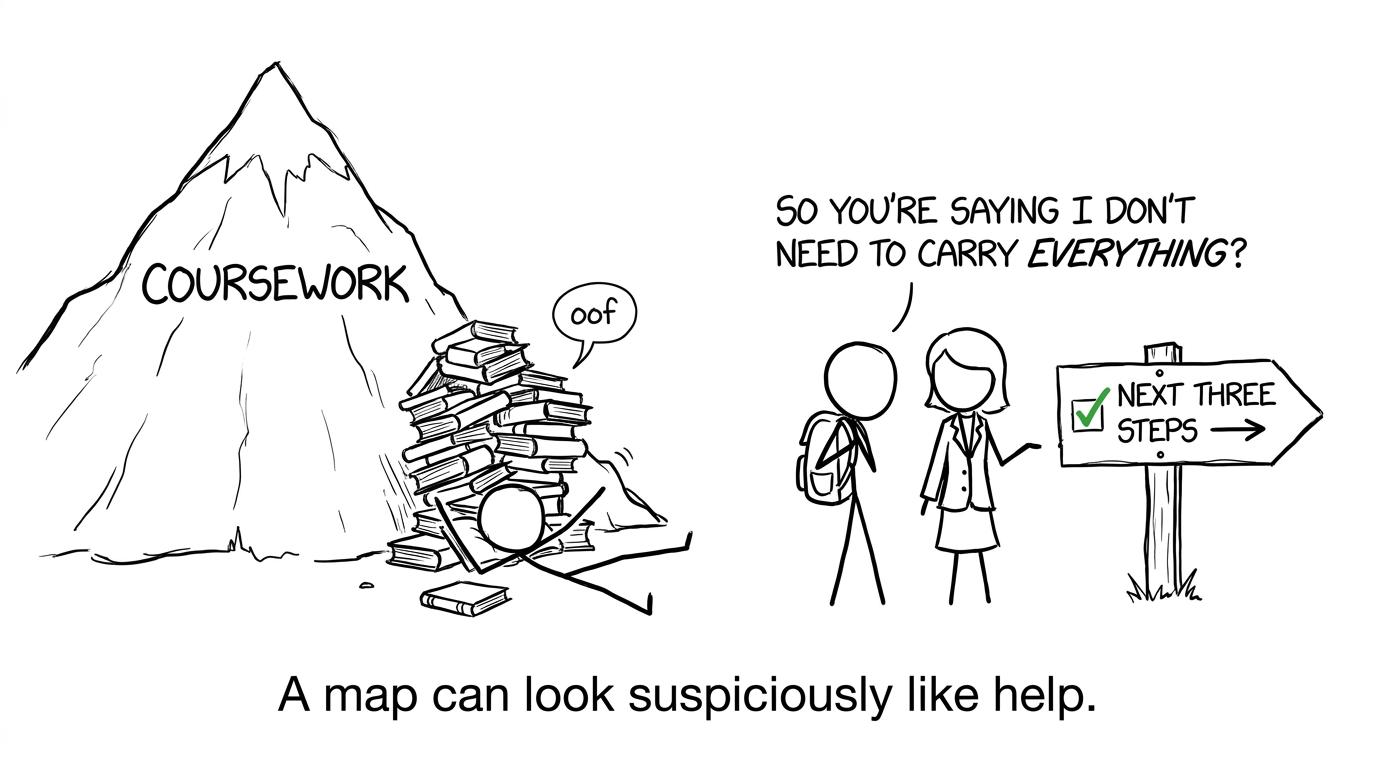 A coursework mountain becomes manageable when a teacher provides the next three steps
Use evidence rather than the feeling of being busy
For one typical school week, record the time spent on lessons, homework, catch-up work and revision. Then consider:
available revision time=total available time−fixed commitments.\text{available revision time} = \text{total available time} - \text{fixed commitments}.available revision time=total available time−fixed commitments.Next ask how much Food Preparation and Nutrition genuinely consumes. Count focused work, not the entire evening during which a document happened to be open.
You can also compare recent evidence across subjects: assessments, missing work, teacher feedback and upcoming deadlines. If Food Preparation and Nutrition takes a large share of your available time while several core subjects decline, that supports a serious conversation. If social media and unplanned breaks consume more time than the subject, dropping it may not solve the real problem.
MathsGenie’s GCSE maths revision hub can help you test whether maths is genuinely being squeezed. Choose your exam board and tier, complete a short set, mark it and identify the topics costing you marks. The GCSE maths topics by exam board and tier guide is useful when you need a precise list rather than a vague feeling that you are “behind in maths”.
What dropping the subject does affect
If your school agrees to withdraw you, you will normally finish with one fewer GCSE qualification than originally planned. This may matter where a sixth form, college, apprenticeship or university course asks for a particular number or profile of GCSEs.
Entry requirements vary. Many future routes pay particular attention to English and maths, while some courses request specific sciences or other relevant subjects. Food Preparation and Nutrition is not a universal requirement, but you should never assume it is irrelevant to your own plans. Check the published requirements for any route you are seriously considering and ask the relevant admissions team if the wording is unclear.
Dropping may also affect:
- your timetable and where you are supervised during former lessons;
- predicted grades or references, depending on school policy;
- the range of subjects shown on future applications;
- whether you meet your school or college’s own progression rules;
- how completed NEA is handled by the centre.
Your exams officer can explain whether an entry has been made and what administrative stage has been reached. Entry deadlines and fee arrangements exist, but they do not create an automatic right for a student either to drop or continue. The school remains responsible for entries and supervision.
What dropping does not automatically affect
Dropping this GCSE does not directly change the mark or grade awarded in GCSE maths. Each qualification is assessed separately. It does not move you from higher to foundation tier, alter your maths specification or erase marks already earned in maths assessments.
It also does not automatically improve your other grades. Released time has value only when it receives a job.
A sensible plan might direct it towards weak maths topics, timed practice and corrections. Start with the twenty-minute GCSE maths revision routine, then build a fuller schedule using the one-month maths revision plan. These routines turn extra time into repeatable action.
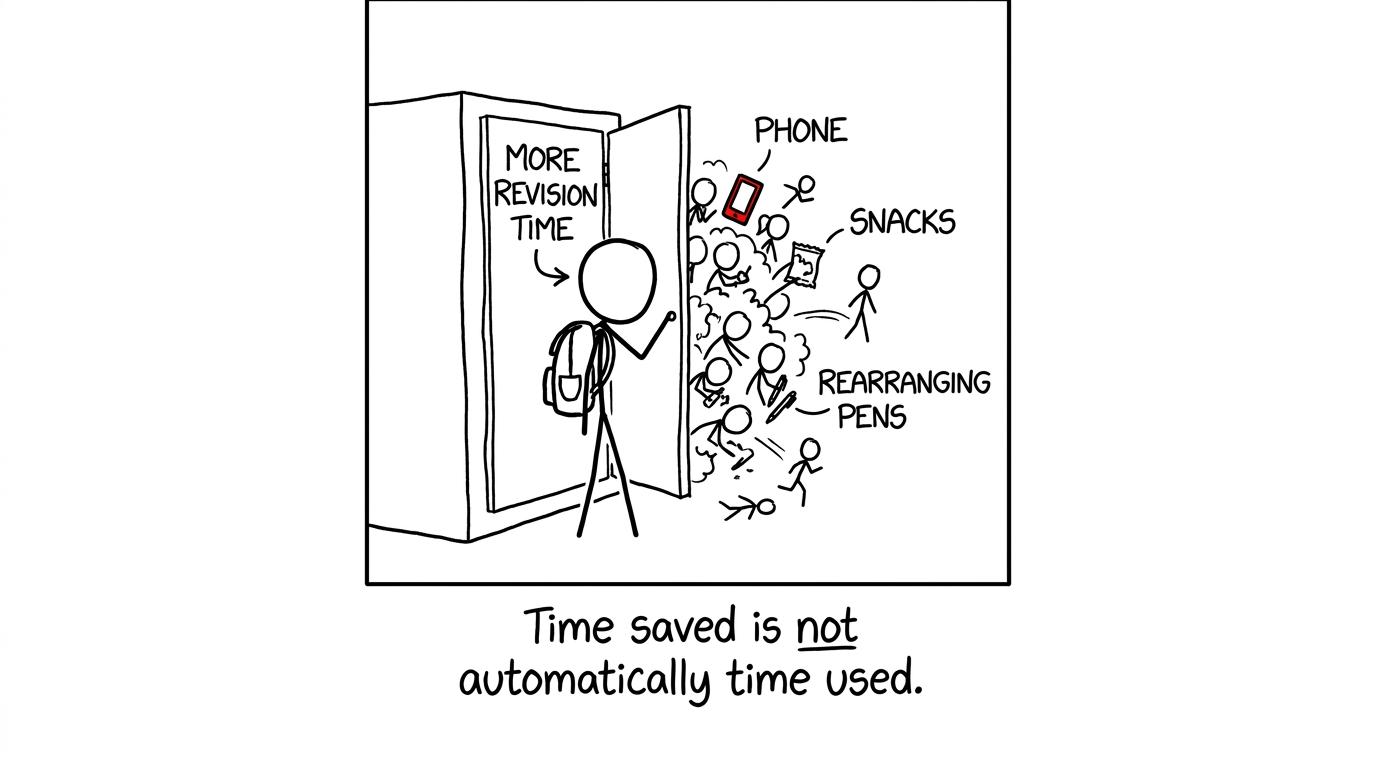 A cupboard of saved revision time releases distractions instead
Build a trial recovery plan before deciding
Unless there is an urgent wellbeing or safeguarding concern, ask for a short review period before making the final decision. Agree on:
- the essential Food Preparation and Nutrition tasks to complete;
- support sessions you will attend;
- a realistic weekly time limit;
- the date when progress will be reviewed;
- the evidence that would support staying or withdrawing.
Protect maths during this period. Use the best order for learning GCSE maths topics to choose one weak area at a time. Then complete questions, check the mark scheme and retest the skill later.
A trial works because it creates evidence. If you recover, you retain the qualification. If you do not, you and your school can make the decision knowing that targeted support was attempted.
Common mistakes when deciding whether to drop
Deciding after one poor result
A low assessment mark identifies a problem; it does not prove that the whole qualification is beyond reach. Ask which assessment objectives cost you marks and whether they can improve.
Ignoring the NEA position
Your decision should reflect what has been completed, what remains and which assessment windows are still available. Guessing from your exercise book is not enough; ask your teacher for an accurate position.
Assuming fewer subjects guarantee higher grades
Time can disappear into low-value activity. Before withdrawing, write a specific weekly plan for the hours you expect to recover.
Focusing only on maths
Protecting GCSE maths may be sensible, particularly when future courses require a particular grade. But review English, science and your wider qualification profile too. This is a whole-timetable decision.
Leaving before checking future requirements
A subject that is optional nationally may still matter within a particular sixth form programme, college course or career route. Check before acting.
Practising without marking
If additional time is going into maths, use it well. The guide to using GCSE past papers properly explains how to sit, mark, analyse and repair a paper rather than simply collecting scores.
Make the choice that improves the whole picture
The right decision is not always the one that preserves the largest number of subjects. Nor is it automatically the one that removes the hardest course. A good decision protects your wellbeing, respects the assessment rules and gives the rest of your timetable a clear purpose.
Speak to your teacher, head of year and exams officer. Confirm your NEA position. Check future entry requirements. Try a defined recovery period where appropriate. Then decide with evidence rather than exhaustion.
Whatever happens with Food Preparation and Nutrition, make your maths time count. Open the MathsGenie GCSE revision hub, choose the correct board and tier, and use free revision lessons, practice questions, mini tests, past papers, predicted papers, mark schemes and video solutions. One clear next step is more useful than an evening spent worrying about all of them.