Should You Drop GCSE English Language Mid-Year?
Drop GCSE English Language mid-year? Learn what schools allow, how to judge overload, and the effects on college, resits and your maths revision plan.
There is a particular kind of panic that appears halfway through Year 111111. Your English Language marks are not moving, maths needs more attention, and every week seems to bring another deadline. Dropping one subject can feel like the cleanest way to create breathing room.
But if you are considering whether to drop GCSE English Language, the short answer is that you usually cannot make that decision alone. In England, English is a compulsory core subject at Key Stage 444, and your school controls its curriculum and examination entries. More importantly, leaving the course can affect college entry, post-161616 English requirements and later applications.
That does not mean you should ignore genuine overload. It means the first step is diagnosis, not disappearance.
The quick decision checklist
Before asking to leave the course, find clear answers to these questions:
- Are you struggling with English Language itself, or with your total workload?
- Do several recent assessments show the same problem?
- Have you received precise feedback on the skills costing you marks?
- Are attendance, anxiety, health, special educational needs or difficult circumstances affecting your performance?
- Does your intended sixth form, college, apprenticeship or future course require GCSE English Language?
- Would dropping the examination actually remove lessons from your timetable?
- Has your head of year, English teacher, SENCO or examinations officer explained the alternatives?
One bad mock is evidence that something went badly. It is not, by itself, evidence that the subject is impossible.
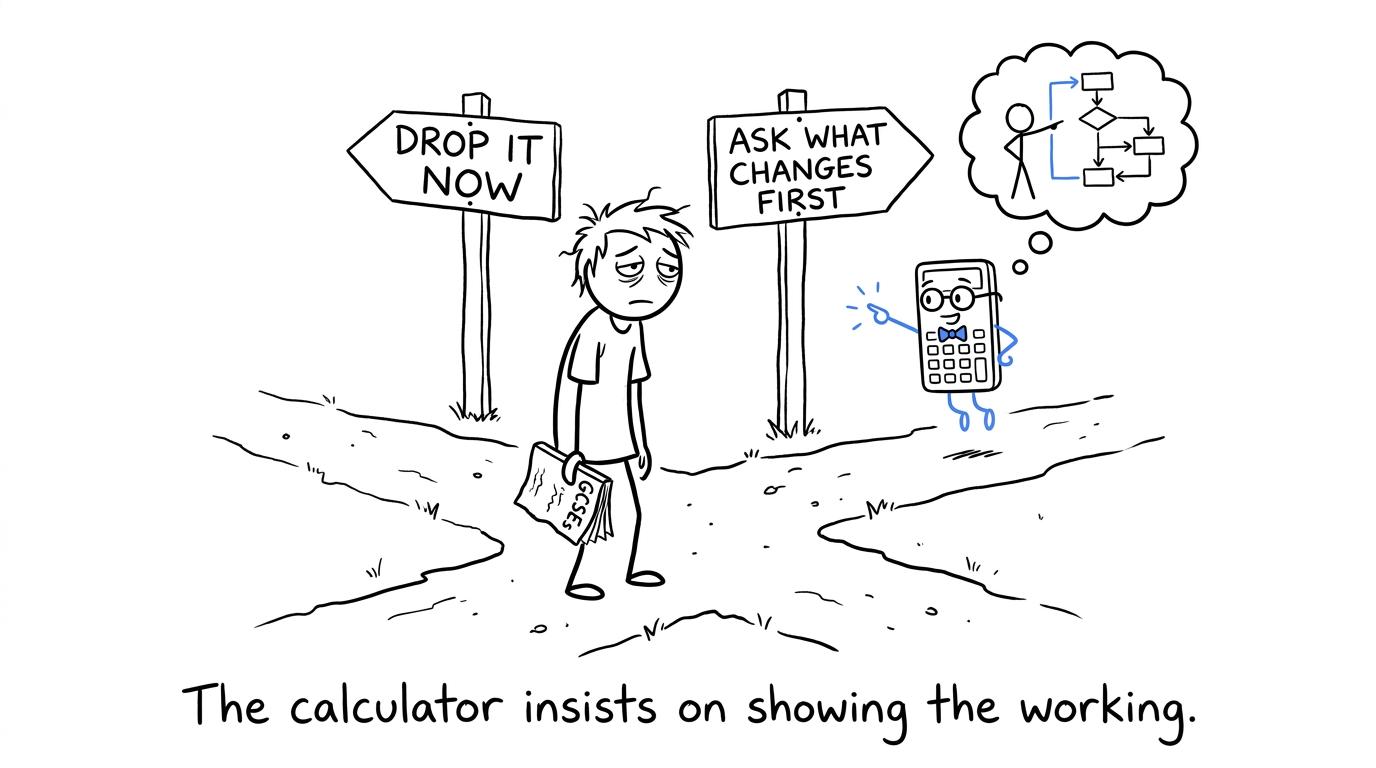 A student asks a calculator which path to take before dropping a GCSE
Can you actually drop GCSE English Language mid-year?
For most students in an English secondary school, not simply by requesting it. English and maths are statutory core subjects at Key Stage 444. Schools have responsibilities for the curriculum they provide, and they decide which students are entered for qualifications.
There is also an important distinction between three different changes:
- Leaving English lessons: no longer being taught the subject.
- Withdrawing an examination entry: not sitting the GCSE papers.
- Changing your support or timetable: remaining on the course with different intervention, access or workload arrangements.
These are not interchangeable. A school might withdraw an examination entry in exceptional circumstances while continuing to teach English. Equally, being withdrawn from one qualification does not automatically create free revision periods for maths.
Exam-entry changes are handled by the school or examination centre. Deadlines and possible fees vary by exam board and series, so Edexcel, AQA, OCR and Eduqas arrangements should be checked by the examinations officer rather than guessed from an online date.
The rules also differ across the UK. The statutory curriculum and post-161616 funding details discussed here mainly concern England. Students in Wales, Scotland or Northern Ireland should ask their school about the rules applying to their qualification and location.
How to tell if you are genuinely in over your head
Feeling behind is common. Being unable to access the course despite sustained, appropriate support is different. The distinction becomes clearer when you look for patterns over several weeks.
Your results are consistently below your target
Use several timed assessments, not one difficult paper. Look at question-level feedback and ask whether your marks are improving, stable or declining.
A total mark is less useful than knowing why it was lost. Your difficulty might be:
- understanding unfamiliar texts;
- selecting evidence;
- explaining a writer's methods;
- comparing viewpoints;
- organising extended writing;
- spelling, punctuation and sentence control;
- finishing within the time limit.
Each problem needs a different response. Calling all of them “bad at English” hides the information that could help you improve.
Support has not yet removed the barrier
Consider what has actually been tried. Have you attended intervention sessions, completed targeted practice, used teacher feedback and repeated the same question type later? If not, the course may be under-practised rather than beyond you.
If a special educational need, disability, illness or mental-health difficulty may be involved, speak to the SENCO or pastoral team. Appropriate support or access arrangements are based on evidence and formal rules; they are not automatically granted, but neither should a genuine barrier be treated as laziness.
The workload is damaging every subject
Overload can show up as persistent missed work, falling attendance, severe loss of sleep or an inability to begin tasks across the timetable. That deserves a wider conversation with school and home.
Yet the subject that feels most uncomfortable is not always the subject creating the overload. Removing English Language while keeping an unrealistic revision plan would change the label, not the problem.
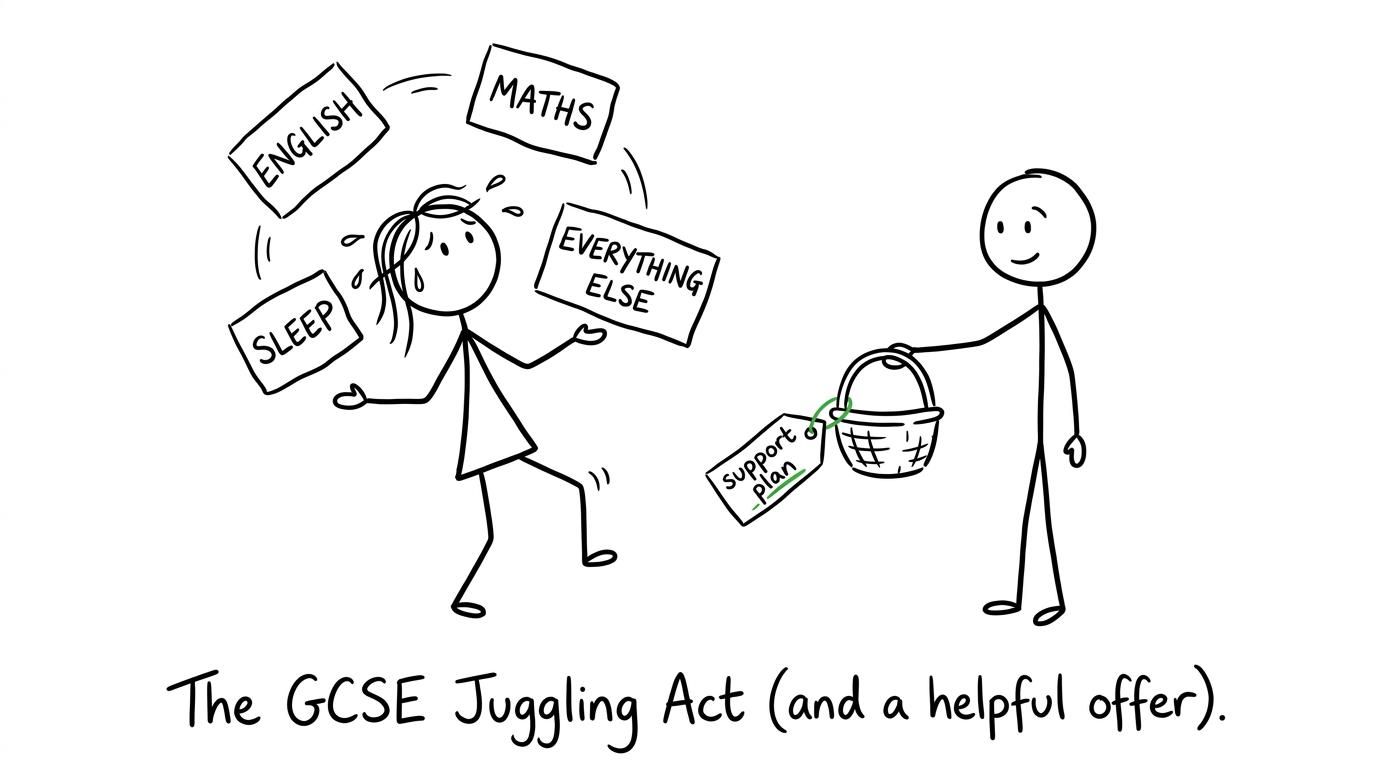 A GCSE student juggles English, maths, sleep and everything else
What dropping English Language could affect
Your sixth-form or college choices
Entry requirements are set by individual institutions and courses. Many ask for a particular grade in GCSE English Language, sometimes alongside GCSE maths. Some may accept specified equivalents, while others may insist on English Language itself or require a higher grade for a particular programme.
Do not rely on a general statement such as “English Literature counts”. Ask your intended provider, in writing if possible:
- Which English qualification is required?
- What minimum grade is needed?
- Are equivalent qualifications accepted?
- Could you enrol while continuing English after Year 111111?
A requirement can vary between two courses at the same institution.
Post-161616 English study in England
Under current English funding guidance, eligible students on relevant post-161616 study programmes who have not achieved the required Level 222 standard in English may need to continue studying an approved English qualification.
For the funding condition, a grade 444 or above in either GCSE English Language or GCSE English Literature at Key Stage 444 can meet the English prior-attainment requirement. However, this does not mean every college course accepts Literature instead of Language for admission.
The funding condition is also a study requirement rather than an automatic instruction to sit the next available examination. The appropriate qualification and timing depend on prior attainment, programme type and current guidance. Your future college should confirm what would apply to you.
In practical terms, dropping English now may postpone the work rather than remove it.
University, training and employment applications
Requirements vary. Some universities and employers specify GCSE English Language at grade 444 or above; others accept particular alternatives or set different thresholds. Competitive and professionally regulated courses may have stricter conditions.
You do not need to predict your entire career at 151515 or 161616. You do need to avoid closing a door without checking what is behind it.
Your final set of GCSE results
If your entry is withdrawn, you will not receive a GCSE English Language grade from that examination series. That is different from sitting the papers and receiving a low grade, and it may need explaining on applications that request the qualification.
Withdrawing from Language does not automatically withdraw you from English Literature. They are separate qualifications, although your school's teaching and entry arrangements may connect them.
What dropping English Language does not affect
It does not directly change your GCSE maths grade, tier or examination entry. Maths is assessed separately, whether you study foundation or higher tier.
It also does not:
- guarantee extra supervised maths revision;
- remove England's requirement to remain in education or training until 181818;
- guarantee admission to a college course;
- prevent a future English requirement or resit;
- automatically solve stress, poor sleep or an overloaded timetable;
- make your remaining GCSE papers easier.
You may gain some time if your school formally changes your timetable, but time only becomes useful when it has a job. An unplanned free lesson often dissolves. A scheduled practice session can produce evidence of progress.
If maths is the main concern, begin with the GCSE Maths revision hub and diagnose the exact topics losing marks. The guide to finding your weakest maths topics helps turn a vague fear into a short, workable list.
Better options to explore before dropping the subject
Ask for a review meeting
Include your English teacher, head of year or pastoral lead, and involve the SENCO when appropriate. Bring recent assessment results, attendance information and examples of feedback.
Ask for a written plan covering:
- the grade currently indicated by your evidence;
- the two or three weakest skills;
- support available before the examination;
- how progress will be checked;
- whether any timetable adjustment is realistic;
- the consequences of withdrawing the entry.
Reduce chaos rather than curriculum
A balanced timetable may be safer than removing a core qualification. MathsGenie's GCSE maths revision timetable shows how to combine short topic sessions, marking and timed practice without turning every evening into a marathon.
If the exams are close, use the one-month GCSE maths revision plan or the GCSE English Language exam-week checklist. A planned split between subjects is usually more productive than switching attention whenever panic becomes loudest.
Make maths revision evidence-led
Do not assume more maths hours automatically mean more maths marks. Use revision lessons to repair a method, complete practice questions, mark them and revisit the same skill later.
Past papers should begin while there is still time to respond to what they reveal. The guide on when to start GCSE past papers explains how to progress from short sections to full timed papers. Edexcel students can then add GCSE maths predicted papers after topic work and official past-paper practice.
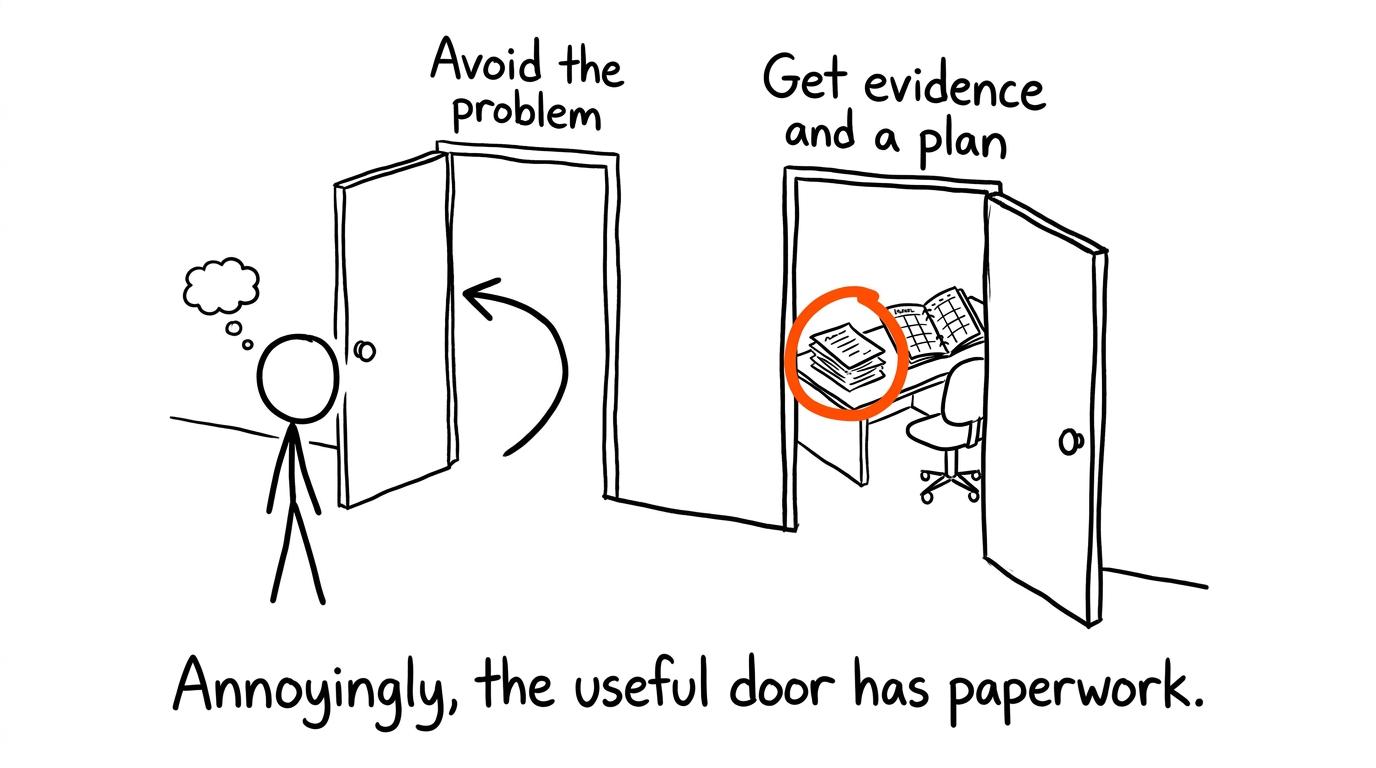 The useful decision door contains evidence, a timetable and paperwork
Common mistakes when making this decision
Deciding after one mock
Mocks are snapshots. Compare several assessments and identify recurring weaknesses before drawing a conclusion.
Assuming English Literature always replaces Language
It may satisfy a particular funding condition, but colleges, universities and employers can set their own entry requirements. Check the exact course.
Confusing withdrawal with support
A student may need intervention, pastoral help, access arrangements or a more realistic workload rather than removal from the examination.
Assuming the saved time will transform maths
Extra time has no automatic value. Give it a defined task using lessons, practice questions, mini tests and mark schemes. The GCSE maths night-before plan also shows why focused practice and rest beat last-minute volume.
Waiting until an entry deadline has passed
Talk to your school early. Only the examinations team can confirm whether an entry has been made, whether it can be withdrawn and what deadlines apply.
Make the next decision with evidence
Wanting to drop GCSE English Language is often a signal. Sometimes it signals a serious barrier that needs formal support. Sometimes it signals exhaustion, unclear feedback or a revision plan trying to do too much at once.
Either way, do not make the decision from the worst hour of your week. Ask what your school permits, check the requirements for your next step and agree on a short support plan with a review date.
Then make your maths revision calmer and measurable. Use MathsGenie's free revision lessons and practice questions to repair individual topics, mini tests to check recall, and past papers or predicted papers to build examination stamina. Mark everything with the mark schemes, use video solutions when a method remains unclear, and organise the work through a realistic revision planner.
The aim is not to keep every subject at any cost. It is to protect your options while giving each revision hour a clear purpose.