GCSE: How to Find Your Weakest Maths Topics Fast
GCSE maths revision: learn how to find your weakest topics fast using mini tests, past papers and mark schemes so you can improve grades 9-1.

GCSE revision has a weird emotional trap: you can work hard, feel busy, and still keep getting the same marks. Not because you are “bad at maths”, but because you are revising what feels familiar instead of what your exam will actually test. The fastest way to improve your GCSE grade is to find your weakest topics, name them clearly, and practise them with feedback until they stop being weaknesses.
That sounds simple. The hard part is being honest about where the gaps really are, especially when a topic feels “fine” until you meet it in a past paper.
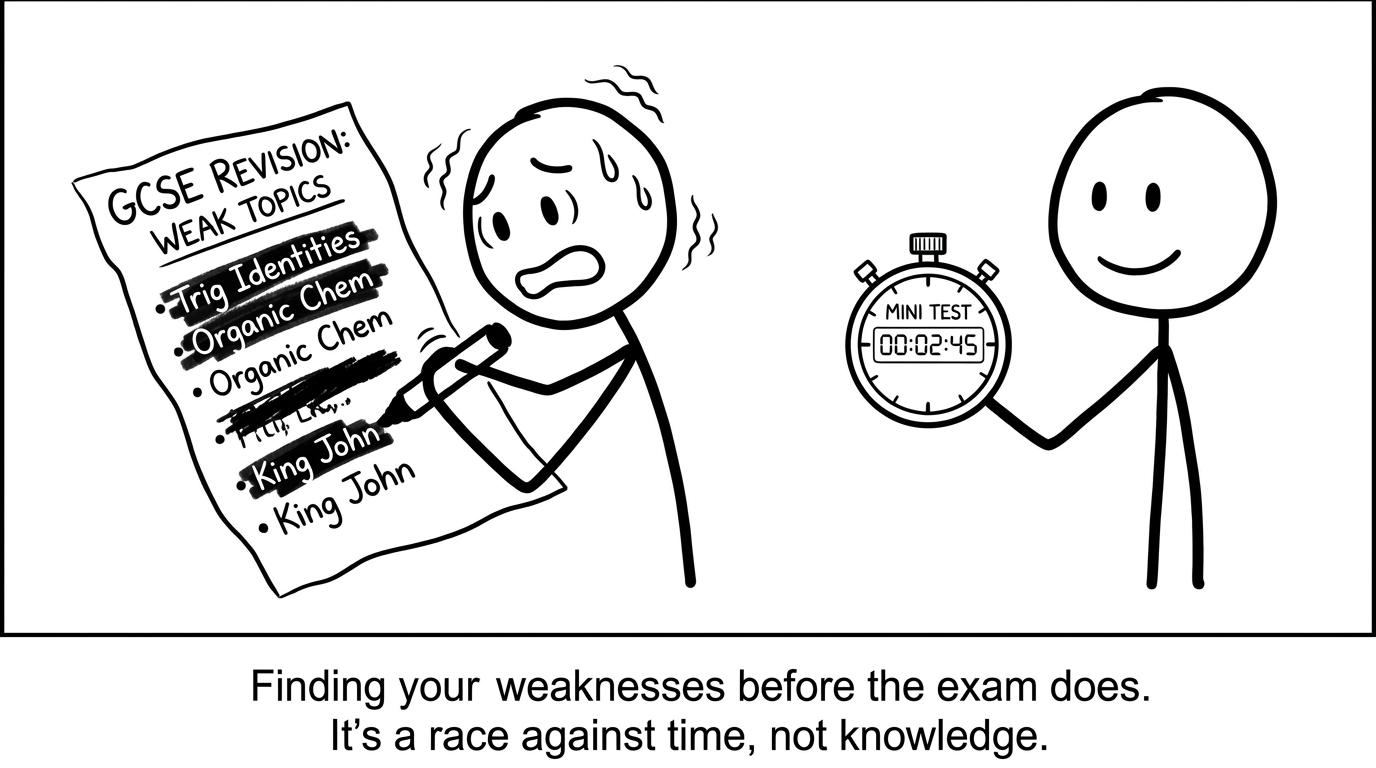 A student finding weak topics before the exam does
A quick checklist to find your weakest GCSE topics
Use this as your map. You will go faster by being systematic.
- Pick your exam board and tier (Edexcel, AQA, OCR, Eduqas; foundation or higher).
- Take one short diagnostic test (mini test or a half paper) under light time pressure.
- Mark it carefully using the mark scheme, not your memory.
- Turn every lost mark into a labelled topic (not “silly mistake”).
- Rank weak topics by (1) frequency in papers and (2) marks available.
- Fix one topic at a time using a tight loop: learn, practise, mark, repeat.
- Re-test the same topic a week later to prove it stuck.
YesGenie makes this loop simple because you can move from papers to mark schemes to topic practice in one place.
Start with the right GCSE baseline (board + tier)
Weakest topics only make sense when you’re measuring the right exam.
- Edexcel has three papers (one non-calculator, two calculator) and very recognisable topic patterns.
- AQA and OCR are similar in structure but differ in wording style and where the “problem-solving” marks sit.
- Foundation questions often test fewer techniques but demand accuracy.
- Higher questions combine topics (for example, algebra and geometry in the same question).
First, choose the right hub:
Then choose the most realistic test style for today’s energy:
- Full papers when you want endurance: Edexcel GCSE Maths Past Papers
- Short diagnostics when you want speed: Edexcel GCSE Maths Mini Tests
- Mixed exam practice across the site: GCSE Past papers
The “lost marks to topics” method (the most reliable way)
Most students track revision like this: “I revised algebra for two hours.” Exams don’t reward time. They reward marks.
So here is the method: every lost mark becomes a topic label.
Step 1: Sit a mini test or half paper
Pick something that’s short enough you will actually finish it. Use light timing so you feel pressure but not panic.
A good starting point is one of the Edexcel GCSE Maths Mini Tests or the 45 Minute GCSE Papers if you want something closer to a real paper.
Step 2: Mark like an examiner
Use the mark scheme and be strict. If your method is unclear, assume it would not earn method marks. If you only wrote an answer, check whether the question needed workings.
You are not trying to feel good. You are trying to get accurate data.
Step 3: Convert mistakes into topic labels
Write a table with these columns:
- Question
- Marks lost
- Why lost (concept, method, accuracy, exam technique)
- Topic label
- Next action
Example labels:
- Fractions (adding/subtracting)
- Solving linear equations
- Substitution into formulae
- Pythagoras
- Probability (two-way tables)
- Bounds
- Circle theorems
If you need a structured place to revisit topics, start from GCSE Maths Revision and drill down.
Worked example: turning a paper mistake into a clear weak topic
Imagine you lost marks on a “percentages” question, but you are not sure what specifically went wrong.
Question: A jacket costs £80. It is reduced by 15%15\%15%. What is the new price?
A common wrong approach is subtracting 151515 pounds. That mistake isn’t “percentages” in general; it’s finding a percentage of an amount.
Correct method:
15% of 80=0.15×80=12 15\% \text{ of } 80 = 0.15 \times 80 = 12 15% of 80=0.15×80=12New price:
80−12=68 80 - 12 = 68 80−12=68So the weak-topic label becomes: percentage of an amount (and possibly “converting percentages to decimals”).
Your next action is not “revise all percentages”. It is: practise 10 questions on percentage of an amount, mark them, and only then return to mixed questions.
Use mark schemes to separate “topic gaps” from “careless mistakes”
This matters more than people think.
A topic gap means you don’t have the method, or you can’t choose it under pressure.
A careless mistake is usually one of these:
- wrong sign (for example, −3+7-3 + 7−3+7 written as −10-10−10)
- misread the question (“estimate” vs “calculate”)
- rounding too early
- calculator error
- copying numbers incorrectly
Why does the difference matter? Because the fixes are different.
- Topic gap fix: lesson, guided examples, practice, re-test.
- Careless mistake fix: checking routine and slower writing.
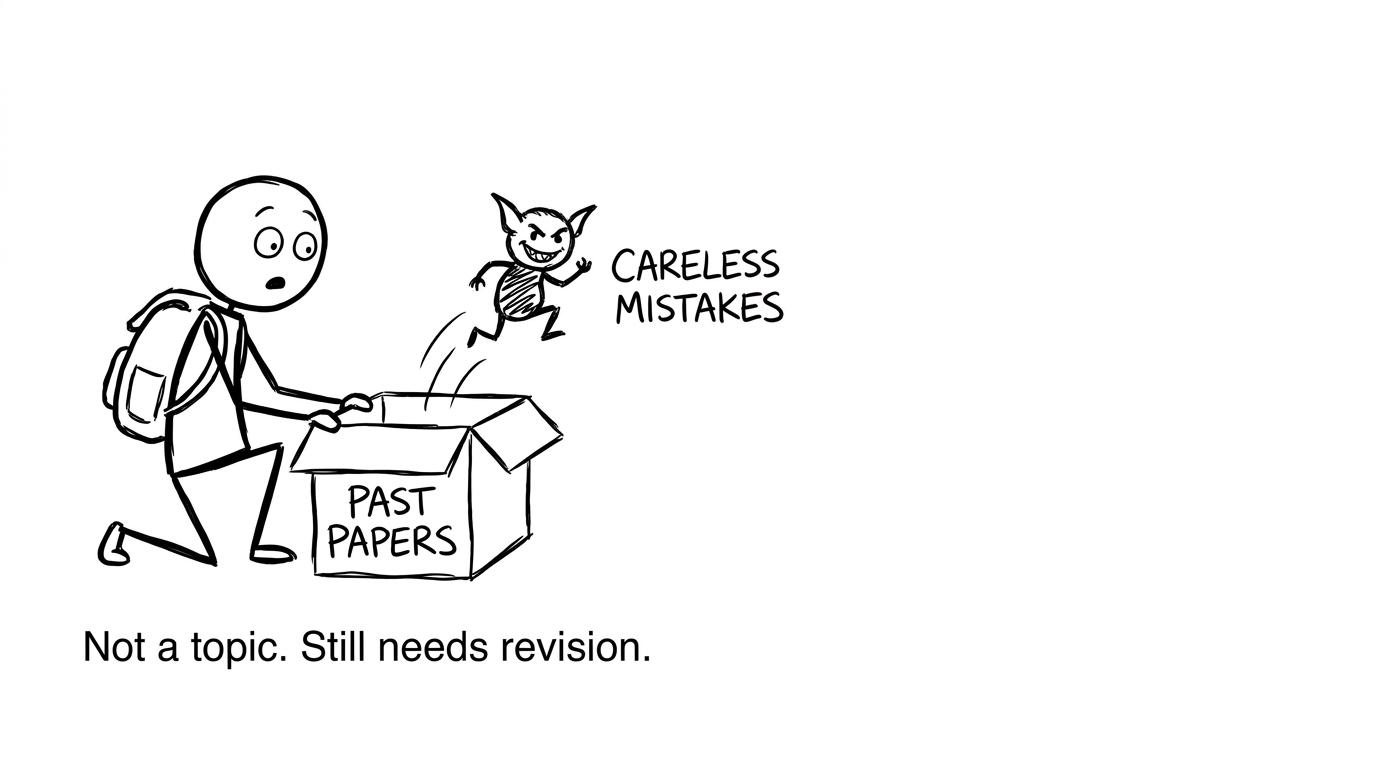 Past papers box with careless mistakes gremlin
How to rank weak GCSE topics so you revise the right thing first
If you have ten weak topics, you don’t revise them equally.
Rank each topic with two scores from 111 to 555:
- Frequency: how often it appears in GCSE papers.
- Marks: how many marks it tends to be worth.
Then calculate a simple priority score:
Priority=Frequency×Marks \text{Priority} = \text{Frequency} \times \text{Marks} Priority=Frequency×MarksA topic with score 5×4=205 \times 4 = 205×4=20 should usually come before a topic with 2×3=62 \times 3 = 62×3=6.
To see what topics appear often, nothing beats real exam practice: Edexcel GCSE Maths Past Papers and GCSE Past papers.
The tight revision loop that actually fixes weak topics
A lot of GCSE revision fails because students do “learn” and “practise” as two separate worlds. You need a loop.
Learn (short, focused)
Use a topic page or revision guide to remind yourself of the method and the examiner language. Keep it brief.
If one of your weak topics is a higher-grade skill, you can anchor it with a focused page such as Proof - GCSE Maths Revision (even if proof isn’t your weakness, it shows how YesGenie breaks down exam methods clearly).
Practise (topic-specific)
Do questions that only test that one skill. This is where confidence is built.
Mark (immediately)
Mark the same day, while the thinking is fresh. Write down what the mark scheme rewarded.
Repeat (until you can do it cold)
Re-do a few similar questions the next day without notes. Then revisit a week later.
This is also where predicted papers can help you pressure-test whether weaknesses are truly fixed: Edexcel GCSE Maths Predicted Papers.
Worked example: diagnosing algebra weakness (method vs accuracy)
Suppose your mini test had this question:
Question: Solve 3(2x−5)=273(2x - 5) = 273(2x−5)=27.
If you expand incorrectly, that’s a method gap (expanding brackets). If you expand correctly but make a slip later, that’s accuracy.
Correct method:
3(2x−5)=27 3(2x - 5) = 27 3(2x−5)=27 6x−15=27 6x - 15 = 27 6x−15=27 6x=42 6x = 42 6x=42 x=7 x = 7 x=7If you wrote 6x−5=276x - 5 = 276x−5=27, the weak-topic label is expanding brackets.
If you wrote 6x−15=27⇒6x=126x - 15 = 27 \Rightarrow 6x = 126x−15=27⇒6x=12, the label is solving linear equations (adding/subtracting negatives).
Notice how the same question can reveal different weakest topics depending on the exact line where you lost the mark.
Common mistakes when finding your weakest GCSE topics
- Only using topic lists, not marks. A list doesn’t tell you which topics cost you the most marks.
- Marking generously. It feels kind, but it hides the data you need.
- Writing “careless” for everything. If it keeps happening, it’s a system problem, not a personality flaw.
- Ignoring exam technique. Not showing workings can lose method marks even if your answer is right.
- Practising random questions too early. Mixed practice is brilliant, after you can do each technique reliably.
- Staying in your comfort zone. Weak topics feel slow at first. That slowness is information.
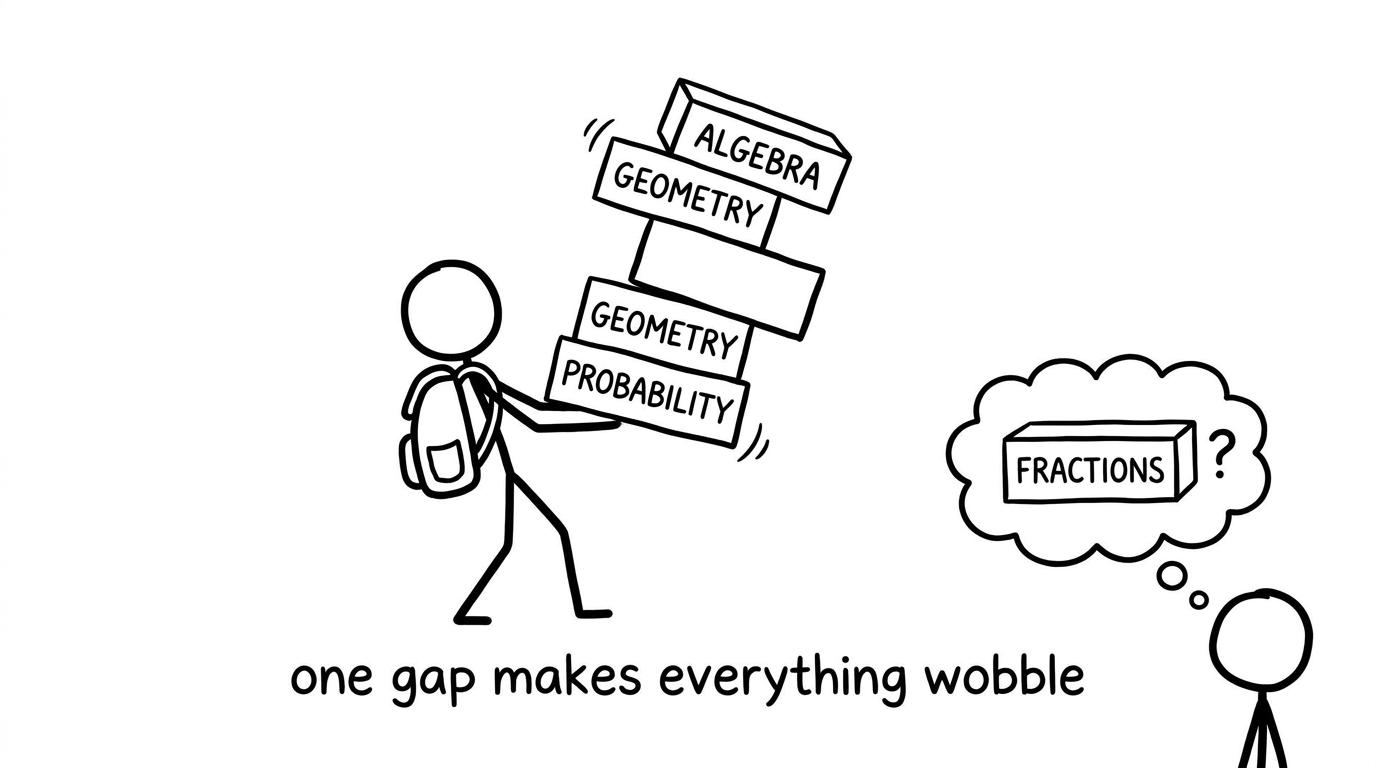 Revision wall missing fractions brick
Bringing it together: make your weakest GCSE topics your easiest marks
Your weakest topics are not a verdict. They are a to-do list written in pencil.
When you use GCSE mini tests and past papers to convert lost marks into specific topic labels, revision becomes calmer. You stop guessing. You stop “doing a bit of everything”. You start fixing exactly what the exam is punishing.
Build your loop on YesGenie: start from GCSE Maths Revision, diagnose with Edexcel GCSE Maths Mini Tests and GCSE Past papers, then pressure-test with Edexcel GCSE Maths Predicted Papers. Use the mark schemes, practise topic questions, and keep a simple error log.
If you do that consistently, your weakest GCSE topics stop being the reason your mark stalls but and start becoming the easiest marks you pick up on exam day.