Do GCSE Chemistry Class Sets Matter?
GCSE chemistry class sets matter less than tier choice, teaching and effective practice. Learn what affects your grade and how to take control of revision.
A set number can feel like a prediction. Move up and it seems that a high grade has come closer; move down and it can feel as though a door has quietly closed. But do GCSE Chemistry class sets matter in the way students often fear?
The short answer is: your set can influence your learning environment, but it does not directly decide your GCSE Chemistry grade. Your exam tier, the content you are taught, the quality of support you receive and what you do with feedback matter more. Consistent, well-directed effort can outweigh a set label, although students should not be expected to overcome limited teaching or restricted opportunities entirely by themselves.
The distinction that matters most is simple: your class set is not the same thing as your exam tier.
The quick answer: what actually affects your outcome?
Keep these points in mind:
- Your exam is marked without reference to your school set.
- Your foundation or higher tier entry affects the grades available.
- A set may indirectly influence pace, teaching content or tier recommendations.
- Research does not show that setting reliably improves attainment for all pupils.
- Focused practice, feedback and correction are more useful than worrying about a set number.
- If your class is not covering the content needed for your target grade, speak to your teacher early.
- Chemistry includes important mathematical skills, so stronger GCSE maths can protect valuable marks.
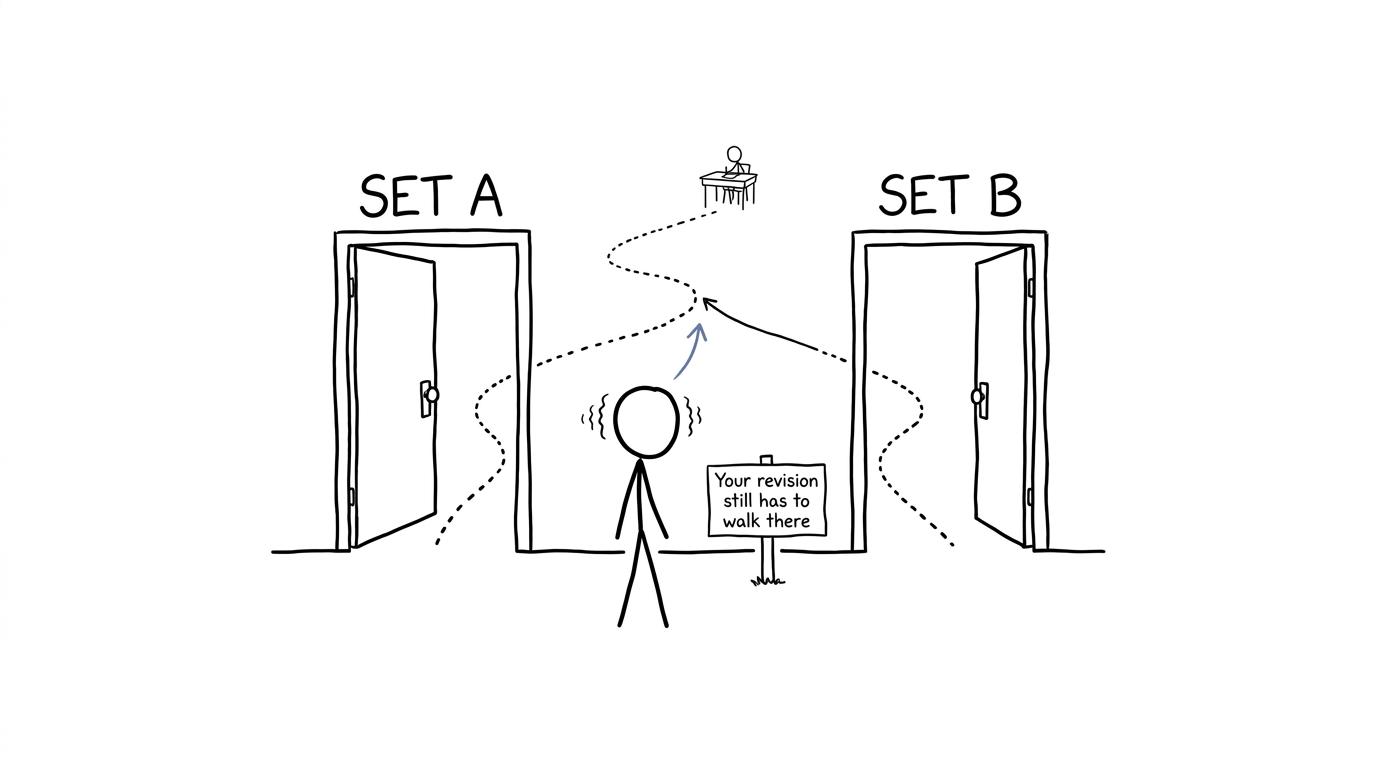 Two chemistry class-set doors leading to the same examination desk
Class set and exam tier are different decisions
A set is an internal school grouping. Schools may use previous assessments, teacher judgement, behaviour, timetable constraints or a mixture of evidence to organise classes. The meaning of “Set 2” can therefore differ considerably between schools.
A tier is an examination entry. GCSE Chemistry specifications from major boards including AQA, Edexcel and OCR offer foundation and higher papers. In separate GCSE Chemistry, foundation tier normally makes grades 111 to 555 available, while higher tier targets grades 444 to 999. A narrowly missed grade 444 on higher tier may result in an allowed grade 333, but a lower performance can be unclassified.
That makes tier entry a real decision with real consequences. Set placement, by itself, is not.
A student in a lower set who is entered for higher tier can still achieve a high grade. A student in a top set does not receive any automatic advantage from the set name when the paper is marked. The examiner sees the response, not the classroom door.
If you are uncertain about your entry, ask your teacher directly:
- Which Chemistry tier am I currently expected to sit?
- Is that decision final?
- What evidence would support a change?
- Am I being taught all the content required for that tier?
- What should I demonstrate in the next assessment?
These questions replace anxiety with information.
What does the evidence say about setting?
The Education Endowment Foundation describes setting as grouping pupils by current attainment in a particular subject. Its current evidence summary reports an average impact of approximately zero additional months of progress compared with mixed-attainment teaching. It also rates the supporting evidence as very limited.
The pattern is not perfectly even. Available research suggests a small positive effect for higher-attaining pupils and a small negative effect for lower-attaining pupils, but there is variation between studies. The evidence does not justify saying that every top-set student benefits or every lower-set student is held back.
It does justify a calmer conclusion: set placement is not destiny, and setting is not a proven method for raising every pupil’s attainment.
There are plausible ways a set can still affect an individual experience. Different classes may move at different speeds, encounter different levels of challenge or develop different expectations. Confidence can also be affected when a set label is treated as a judgement of fixed ability rather than a snapshot of current attainment.
Current attainment can change. That is what revision is for.
When your Chemistry set can matter indirectly
Access to higher-tier content
Higher-tier specifications include additional or more demanding material. If a class is being prepared only for foundation tier, it may not cover everything needed for grades above 555.
This is not a reason to assume that a lower set automatically means foundation entry. School policies vary. It is a reason to confirm your pathway rather than guessing from the number on your timetable.
Pace and level of challenge
A faster class may reach difficult material earlier and have more time for mixed examination practice. A slower class may spend longer securing fundamentals. Neither approach is automatically better for every student.
The important question is whether the pace helps you learn and whether your target remains realistically supported.
Teacher expectations and confidence
Labels can become powerful when students internalise them. “I am in a low set” can quietly turn into “I am bad at Chemistry”, even though those statements mean very different things.
Treat a set as an administrative description, not an identity. Your useful evidence is more specific: which questions can you answer, which concepts are insecure, and which errors keep returning?
MathsGenie’s guide to finding your weakest GCSE topics shows how to turn marks lost into a practical revision list.
Separate or combined science pathways
In some schools, grouping may be connected to whether pupils study separate sciences or Combined Science. These are different qualifications and should not be confused with foundation and higher tier.
If you are unsure which course you follow, ask for the exact qualification title, exam board and specification. “I do Chemistry” is not enough information when planning revision.
Does it simply come down to effort?
Effort matters enormously, but “just work harder” is incomplete advice.
Two students can spend the same hour revising and get very different returns. One rereads notes. The other answers questions, marks them, identifies a weak skill and attempts a similar question later. Both worked, but only one created a strong feedback loop.
A better formula for progress is:
useful effort=focused practice+feedback+correction+retesting\text{useful effort} = \text{focused practice} + \text{feedback} + \text{correction} + \text{retesting}useful effort=focused practice+feedback+correction+retestingThis is not a numerical equation. It is a reminder that effort needs direction.
Teaching quality, curriculum access, attendance, health and available support also affect outcomes. A student struggling in an unsuitable class should not interpret that struggle as a character flaw. Ask for help, explain the specific obstacle and request a measurable next step.
For a structured approach, use the MathsGenie guide to efficient GCSE maths revision. Its learn, practise, mark and fix cycle transfers well to Chemistry calculations.
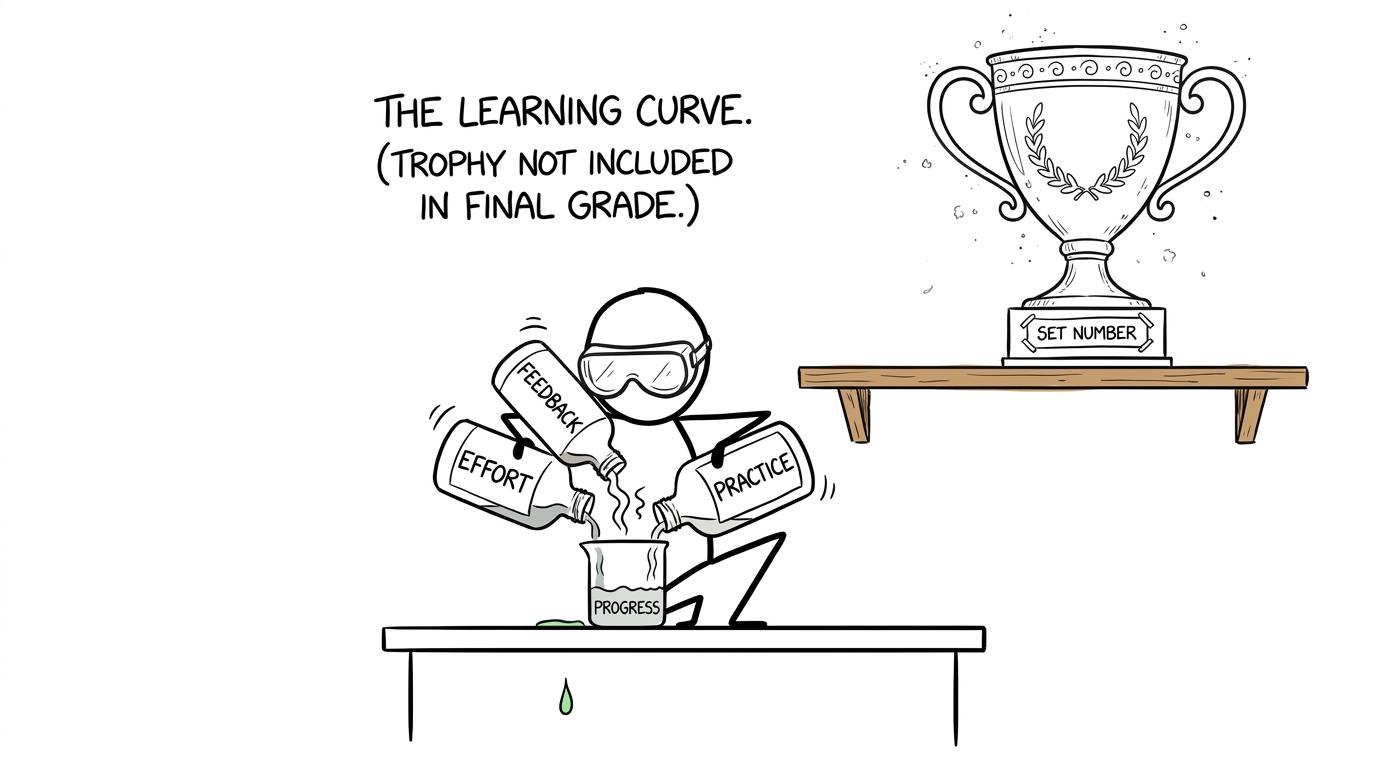 Revision effort and feedback poured into a progress beaker
Why maths can change your Chemistry result
GCSE Chemistry is not only factual recall. Official specifications include quantitative skills involving arithmetic, ratios, percentages, standard form, significant figures, algebra, graphs and unit conversions. OCR states that at least 20%20\%20% of the assessment in GCSE Chemistry involves mathematical skills at the appropriate tier; the national subject requirements apply substantial quantitative demand across exam boards.
Typical skills include:
- rearranging and substituting into equations;
- using ratios in chemical quantities;
- calculating percentage yield and atom economy;
- reading scales and interpreting graphs;
- finding gradients and using tangents;
- converting units correctly;
- writing very large or small values in standard form;
- choosing an appropriate number of significant figures.
These marks are especially valuable because the underlying maths can be practised independently of your Chemistry set. If powers of ten cause errors, use MathsGenie’s standard form revision resources. You can also use the GCSE maths topics by board and tier guide to identify relevant number, ratio, algebra and graph skills.
For students currently near a pass grade, the GCSE Chemistry revision guide for moving beyond a pass gives a focused system for knowledge, application, exam-writing and maths gaps.
What to do if you think you are in the wrong set
Do not begin with “I deserve to move up”. Begin with evidence.
Collect recent assessment results, corrected questions and examples of higher-tier work you can complete independently. Then ask your teacher what criteria the department uses for movement between sets. A useful conversation focuses on actions:
- the score or standard you need to demonstrate;
- the topics you must secure;
- whether higher-tier content is available to practise;
- when set and tier decisions are reviewed;
- what support is available if movement is impossible because of timetabling.
You may discover that moving set is possible. You may also discover that you can remain in the same class while being entered for the suitable tier or receiving extension work.
The goal is not the status of a different room. The goal is access to the teaching and assessment pathway needed for your target grade.
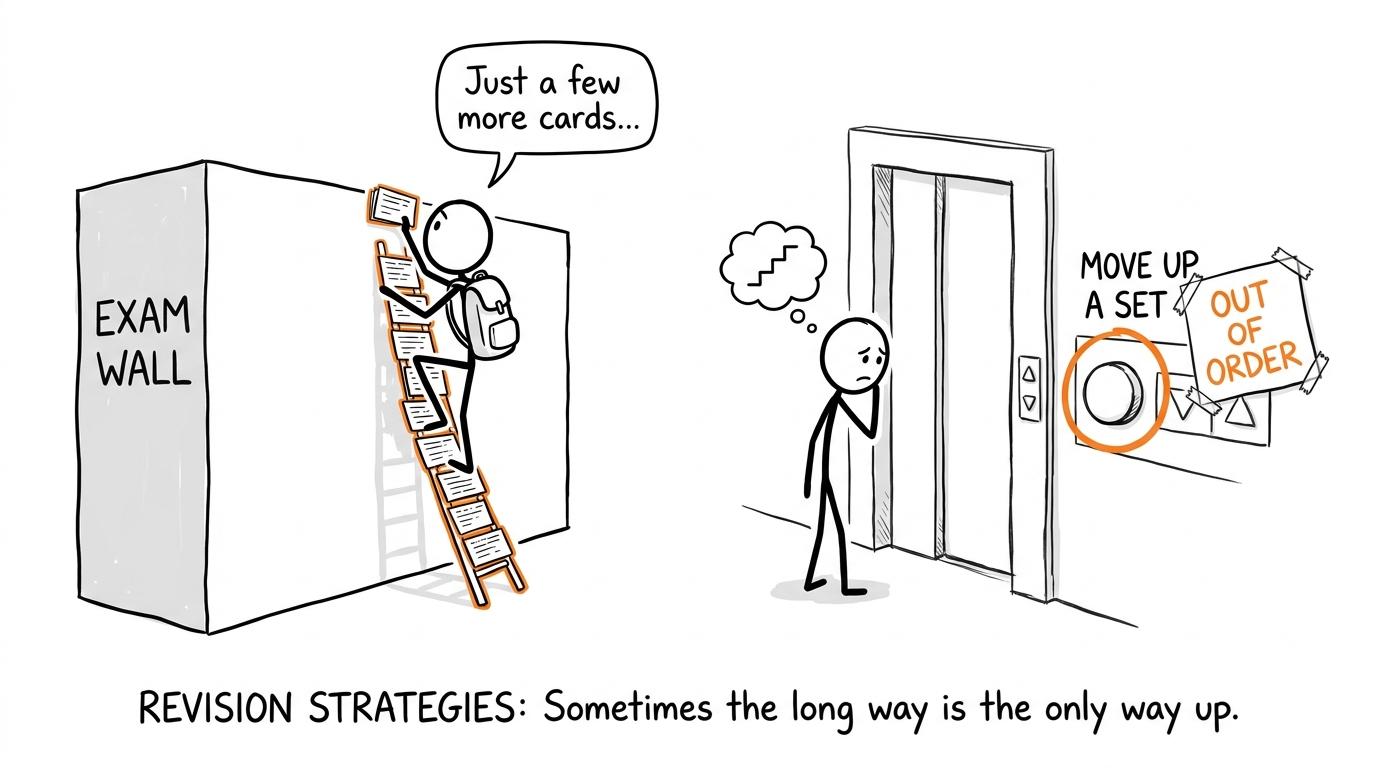 A revision-card ladder succeeding beside an out-of-order set-movement lift
A revision plan that works in any set
Use a simple weekly cycle:
Diagnose
Complete a short, timed set of questions. Record each lost mark as a knowledge, application, mathematical, practical or exam-language error.
Repair
Choose one narrow weakness. Review the relevant content, then answer questions without notes. For the mathematical side, MathsGenie’s overview of GCSE maths topics that regularly appear helps prioritise high-value foundations.
Mark and correct
Use the mark scheme carefully. Do not merely replace a wrong answer. Write down why the original response failed and what you will do differently next time.
Retest
Attempt a different question on the same skill after a short gap. Improvement must be demonstrated, not assumed.
Build examination stamina
Move gradually from topic questions to timed sections and complete papers. The guide to when to start GCSE past papers explains how mini tests, targeted practice and full papers can fit together. If time is short, adapt the MathsGenie one-week revision plan to organise short Chemistry and maths sessions.
Common mistakes when thinking about class sets
Confusing set with tier: A high set does not guarantee higher-tier entry, and a lower set does not always prevent it. Ask for confirmation.
Treating current attainment as fixed ability: Set decisions usually reflect evidence available at a particular time. They are not scientific measurements of your potential.
Chasing a set move instead of fixing weaknesses: A different classroom will not automatically repair insecure ratios, equations or chemical concepts.
Doing more work without checking it: Unmarked practice can reinforce mistakes. Feedback and correction make effort useful.
Ignoring mathematical errors: Dropped units, incorrect rearrangement and poor graph reading can cost marks even when your Chemistry knowledge is sound.
Revising only comfortable topics: Confidence grows fastest when you identify a precise weakness, repair it and prove the improvement through retesting.
Your set is context, not a verdict
A class set can shape pace, challenge and expectations. In some schools, it may influence tier recommendations or access to particular content. Those effects are real enough to question if they do not support your target.
But your set number is not printed on your examination script. It does not earn marks and it does not remove them. What matters on the day is the knowledge, reasoning, mathematical fluency and exam technique you can demonstrate.
Start by confirming your qualification and tier. Then build evidence through focused practice. MathsGenie is the free place to strengthen the maths beneath Chemistry using revision lessons, practice questions, mini tests, mark schemes and video solutions. When those skills are secure, use past papers and predicted papers to make them reliable under pressure.
Do not wait for a set label to give you permission to improve. Choose one weak skill, practise it today, mark it honestly and begin from there.