Do Documentaries Help GCSE Economics Revision?
Do documentaries help GCSE Economics? Learn when wider viewing improves context, where it falls short, and how to turn it into effective exam revision.
A documentary about inflation, global trade or the housing market can feel like revision. You recognise key terms. Complicated ideas begin to sound familiar. An hour passes without the resistance that often comes with opening a textbook.
But do documentaries help GCSE Economics enough to improve your grade? The short answer is yes, when they supply relevant context and make you think actively. They are useful for understanding how economics operates beyond a diagram. They are not a substitute for learning the specification, recalling definitions, interpreting data or answering exam questions.
That distinction matters. Enjoyable learning can support effective revision, but the two are not automatically the same.
The quick verdict
Use documentaries and wider reading to:
- see economic concepts operating in real situations;
- build examples for application and evaluation;
- encounter competing explanations of an issue;
- become more confident with economic language;
- practise questioning evidence, statistics and conclusions.
Do not rely on them to:
- cover every point in your specification;
- teach precise definitions consistently;
- provide exam-board-specific technique;
- develop calculations without written practice;
- replace past papers, mark schemes or retrieval practice.
A sensible rule is simple: documentaries create context; active revision turns that context into marks.
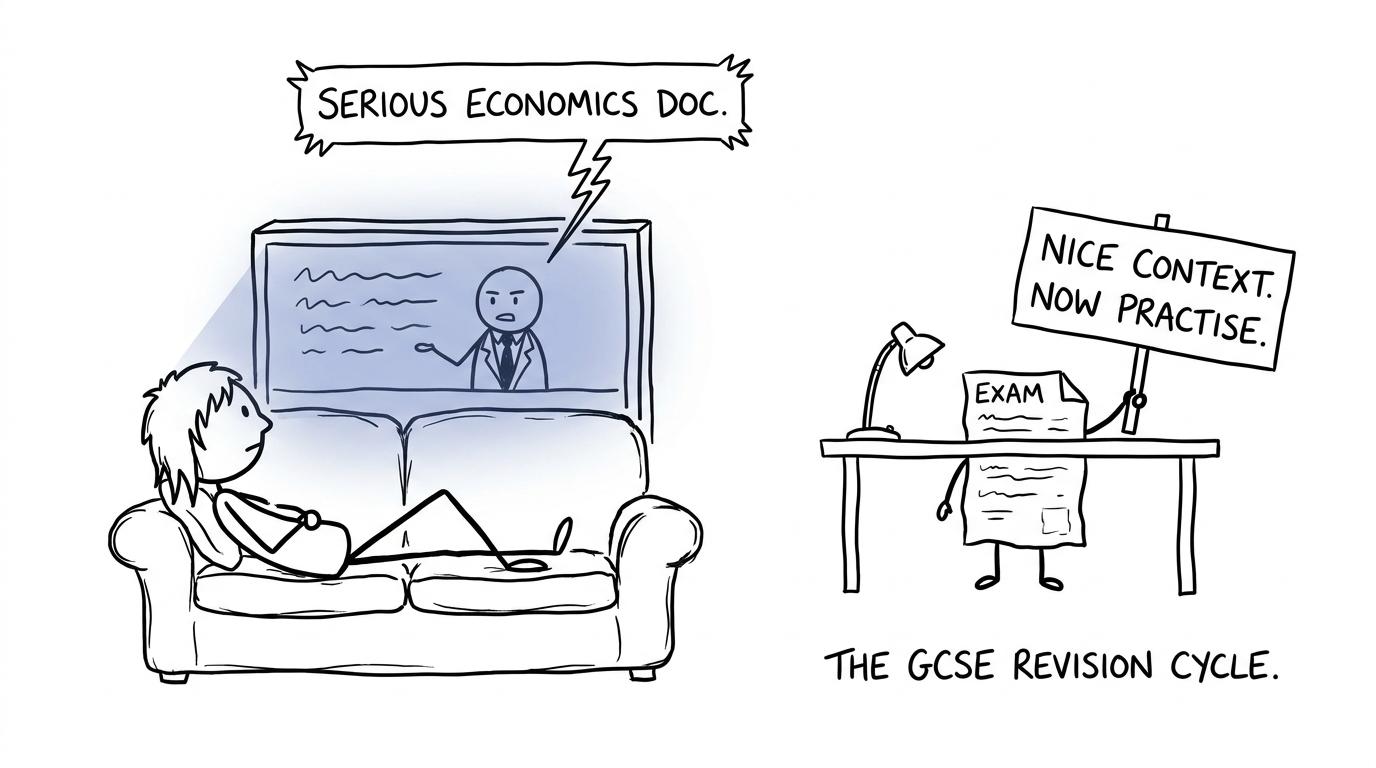 A documentary offers context while an exam paper asks for practice
Why documentaries can help GCSE Economics
Economics is full of ideas that are easy to define but harder to understand deeply. Scarcity, market failure, unemployment and globalisation can become lists of words unless you see the decisions and trade-offs behind them.
A well-chosen documentary can make those mechanisms visible. A programme about changing food prices might show producers facing higher costs, households altering spending and governments considering intervention. You begin to see that one change can affect several groups differently.
That is useful because GCSE Economics is not assessed through recall alone. Across current GCSE specifications, students are expected to demonstrate knowledge, apply it to contexts, and analyse or evaluate economic evidence and issues. For example, AQA and OCR both weight knowledge and understanding at 35%35\%35%, application at 35%35\%35%, and analysis and evaluation at 30%30\%30%.
Documentaries can contribute most naturally to the second and third of those areas.
They provide context for application
Application means using economic knowledge in the particular situation given, rather than writing a generic answer. Wider viewing can help you notice details such as affected stakeholders, time periods, incentives and unintended consequences.
However, a remembered documentary should not be forced into every response. The evidence in the exam question remains your starting point. Outside knowledge is valuable when it clarifies the context, not when it distracts from it.
They reveal disagreement and trade-offs
Good economics rarely ends with a consequence that is entirely positive or negative. A policy may help one group while imposing costs on another. It may work differently in the short run and long run. Its effect may depend on the size of the intervention or the state of the economy.
Documentaries often expose these disagreements. That can improve evaluation because you become used to asking:
- Who gains and who loses?
- How large is the effect likely to be?
- What assumptions does the argument make?
- Is the evidence current, representative and reliable?
- Might the result change over time?
These questions are far more useful than memorising an isolated example.
Why watching alone is not enough
The danger is familiarity. After hearing an explanation, it feels as though you know it. Yet recognition while the programme is playing is different from retrieving an idea independently in an exam.
Research on learning generally supports retrieval practice, bringing information to mind without looking, over repeatedly reviewing material. Research into educational video also suggests that watching is more useful when learners pause, summarise or answer questions. The exact effect varies with the material and the learner, so there is no honest formula guaranteeing a particular grade increase.
The practical lesson is less dramatic: make the viewing active.
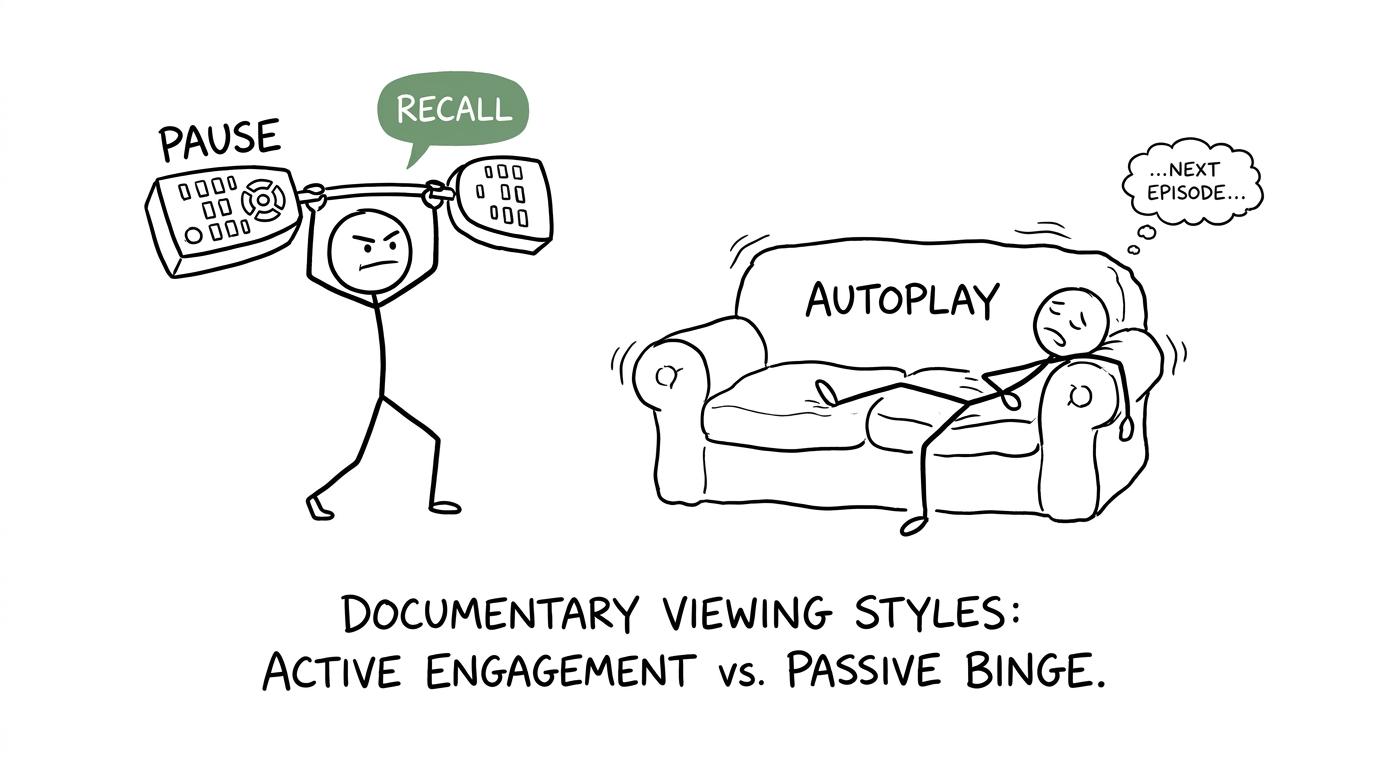 One student exercises the pause button while another disappears into autoplay
Use the pause, recall, connect method
After a meaningful section, pause the programme and close any notes. Then answer three prompts:
- Recall: What happened, in two or three sentences?
- Connect: Which specification concept explains it?
- Question: What evidence or alternative explanation might weaken the claim?
At the end, write no more than five useful notes. A short record forces selection. Transcribing everything merely turns watching into slow copying.
Then complete one exam-style task related to the topic. This final step matters most because it exposes whether you can convert understanding into a structured response.
The maths documentaries cannot practise for you
Economics contains a meaningful quantitative element. Ofqual's subject requirements state that at least 10%10\%10% of GCSE Economics marks must reward quantitative skills, assessed in an economic context. AQA and OCR specifications include percentages and percentage changes, averages, revenue, costs, profit, income, graphs, charts and the interpretation of economic data.
A documentary may display an inflation chart or unemployment figure, but seeing a graph is not the same as analysing one accurately under exam conditions.
You still need to be fluent with relationships such as:
percentage change=changeoriginal value×100\text{percentage change}=\frac{\text{change}}{\text{original value}}\times 100percentage change=original valuechange×100and
profit=total revenue−total costs.\text{profit}=\text{total revenue}-\text{total costs}.profit=total revenue−total costs.This is where GCSE maths revision supports Economics directly. Use MathsGenie's percentage change revision guide to strengthen comparisons over time, then practise identifying patterns with the scatter graphs topic resources.
Be especially careful with correlation. If two economic variables move together, that does not by itself prove that one caused the other. A documentary may present a persuasive story, but an exam answer should distinguish the pattern in the data from the explanation offered for it.
The wider GCSE Maths revision hub lets you choose your exam board and work through relevant lessons, worksheets and question banks. These skills are useful whether your maths paper is Edexcel, AQA, OCR or Eduqas, although you should always practise the format used by your own board.
Is reading around the subject better?
Reading and watching serve slightly different purposes.
Documentaries can make systems memorable. They show people, places, incentives and consequences unfolding over time. Reading is often faster for checking a definition, comparing arguments or locating a particular statistic. It also lets you stop and inspect a claim without the programme moving on.
Neither format is automatically superior. The decisive question is what you do afterwards.
A short article followed by self-testing is likely to be more useful than an entire evening of passive viewing. Equally, a carefully chosen documentary followed by specification mapping and an exam question can be valuable revision.
Judge wider material using four filters:
- Relevance: Does it connect to your current specification?
- Currency: Is the date important to the argument or data?
- Evidence: Are claims supported, and are limitations acknowledged?
- Usefulness: Can you explain one concept more clearly after engaging with it?
Remember that documentaries are constructed narratives. Editing, music, selected interviews and chosen statistics shape the viewer's interpretation. That does not make a programme untrustworthy, but it does mean you should treat it as a source to examine rather than an answer to memorise.
A balanced revision routine
Documentaries work best as a small part of a larger system. They should sit alongside the specification and question practice, not occupy the centre of your timetable.
A productive session might contain:
- a short documentary segment or piece of wider reading;
- a closed-book summary;
- links to two or three specification concepts;
- one challenge to the source's argument;
- a relevant exam-style question;
- marking and correction.
For your maths preparation, follow the same active principle. MathsGenie's guide to using GCSE past papers properly explains the paper, mark, fix and retest cycle. If revision time is fragmented, the 20-minute GCSE maths routine provides a manageable structure.
Your timetable should protect practice time. The GCSE maths revision timetable guide can help you balance topic learning, marking and timed work rather than letting comfortable activities expand indefinitely.
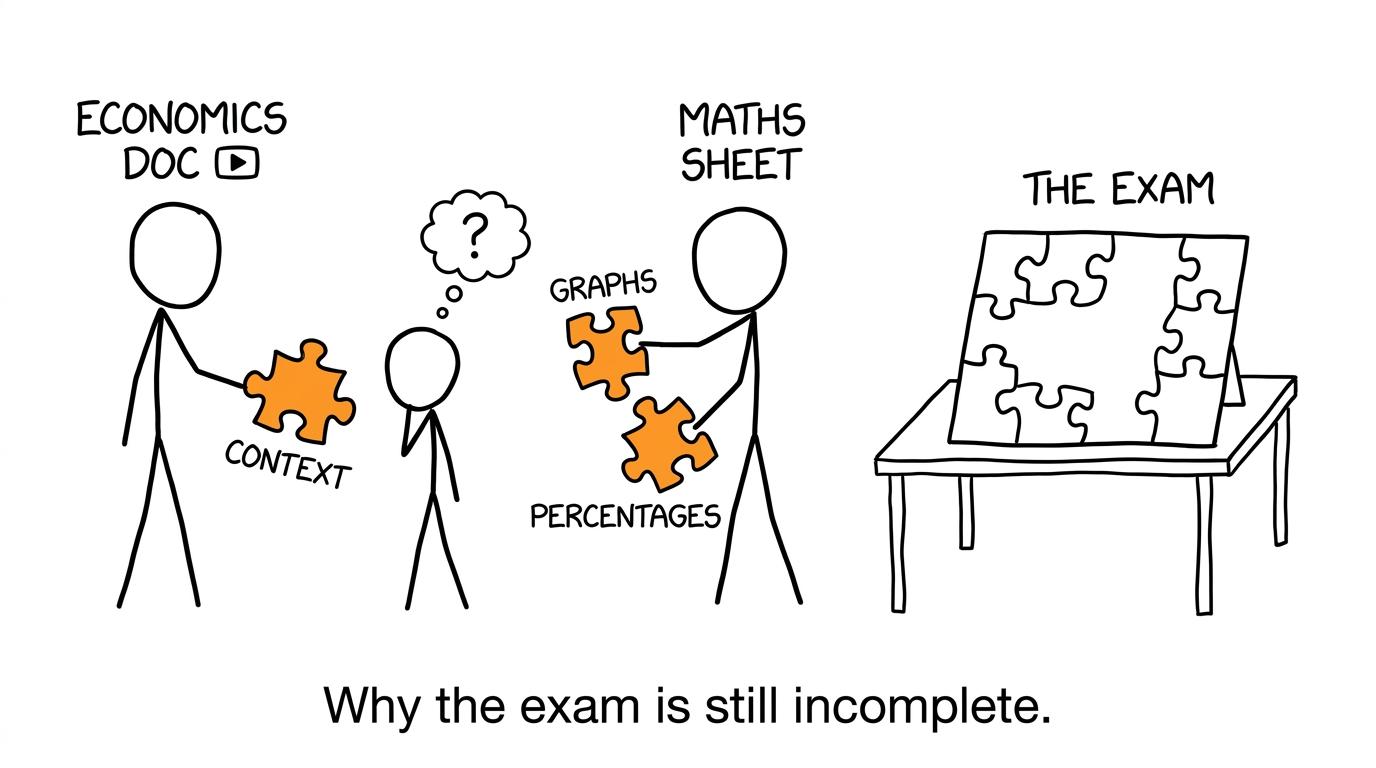 Context, graphs and percentages complete different parts of the exam puzzle
Common mistakes when using documentaries for revision
Counting viewing time as proof of progress
Time spent is an input, not a result. Test whether you can recall the concept, interpret fresh evidence and answer a question without support.
Choosing entertainment rather than specification relevance
An interesting programme about finance may have little connection to your course. Check your AQA or OCR specification before watching and identify the precise topic it supports.
Collecting examples without understanding mechanisms
A named company, country or policy earns little by itself. You need to explain the economic chain of reasoning and relate it to the question.
Treating one source as neutral or complete
Consider who produced the programme, when it was made, which evidence it selects and what alternative view is absent. Critical viewing is part of the benefit.
Neglecting quantitative practice
Watching someone discuss rising prices will not make percentage calculations automatic. Use focused practice, mark your working and revisit errors. MathsGenie's guide to finding your weakest GCSE topics offers a practical way to turn lost marks into your next revision priorities.
Enjoyable and useful are allowed to overlap
There is no prize for making every minute of revision unpleasant. Curiosity matters. A documentary that makes you want to understand why prices change or why governments make difficult choices has real educational value.
But interest opens the door; practice carries you through it.
Use documentaries to build context, wider reading to inspect arguments, and your specification to keep both relevant. Then retrieve the knowledge, interpret data and answer exam questions. For the quantitative side of Economics and your separate maths exams, make MathsGenie your next step: use free revision lessons and practice questions to repair individual skills, mini tests to check recall, and past papers or GCSE predicted papers with mark schemes and video solutions to test what you can genuinely do.