Cramming vs Learning GCSE French: Know the Difference
Cramming vs learning GCSE French: spot false confidence, test genuine recall and build revision that survives listening, speaking and writing tasks.
There is a dangerous moment in revision when everything looks familiar. You recognise the vocabulary list. Your model paragraph makes sense. The grammar notes seem obvious. Then you close the book and the words disappear.
That is the simplest way to understand cramming vs learning GCSE French: cramming creates short-lived familiarity, while learning gives you knowledge you can retrieve, adapt and use without support. Cramming may help you recognise material tomorrow. Genuine learning is more likely to hold up when an unfamiliar listening extract begins, a speaking question changes direction or a writing task asks for language you did not rehearse.
The difference is not how many hours you spend. It is what your brain has to do during those hours.
A quick cramming vs learning checklist
You are probably cramming if you:
- repeatedly read vocabulary rather than recalling it
- copy model answers without changing them
- complete several hours on one topic and never revisit it
- judge progress by how familiar your notes feel
- avoid listening, speaking or translation because they expose gaps
- check answers before making a serious attempt
You are more likely to be learning if you:
- retrieve vocabulary with the page closed
- revisit material across several days
- use familiar words in unfamiliar sentences
- practise listening, speaking, reading and writing
- mark mistakes and return to them later
- test yourself under increasingly realistic conditions
The honest question is not, “Have I revised this?” It is, “Can I still use it when the prompt, context and pressure change?”
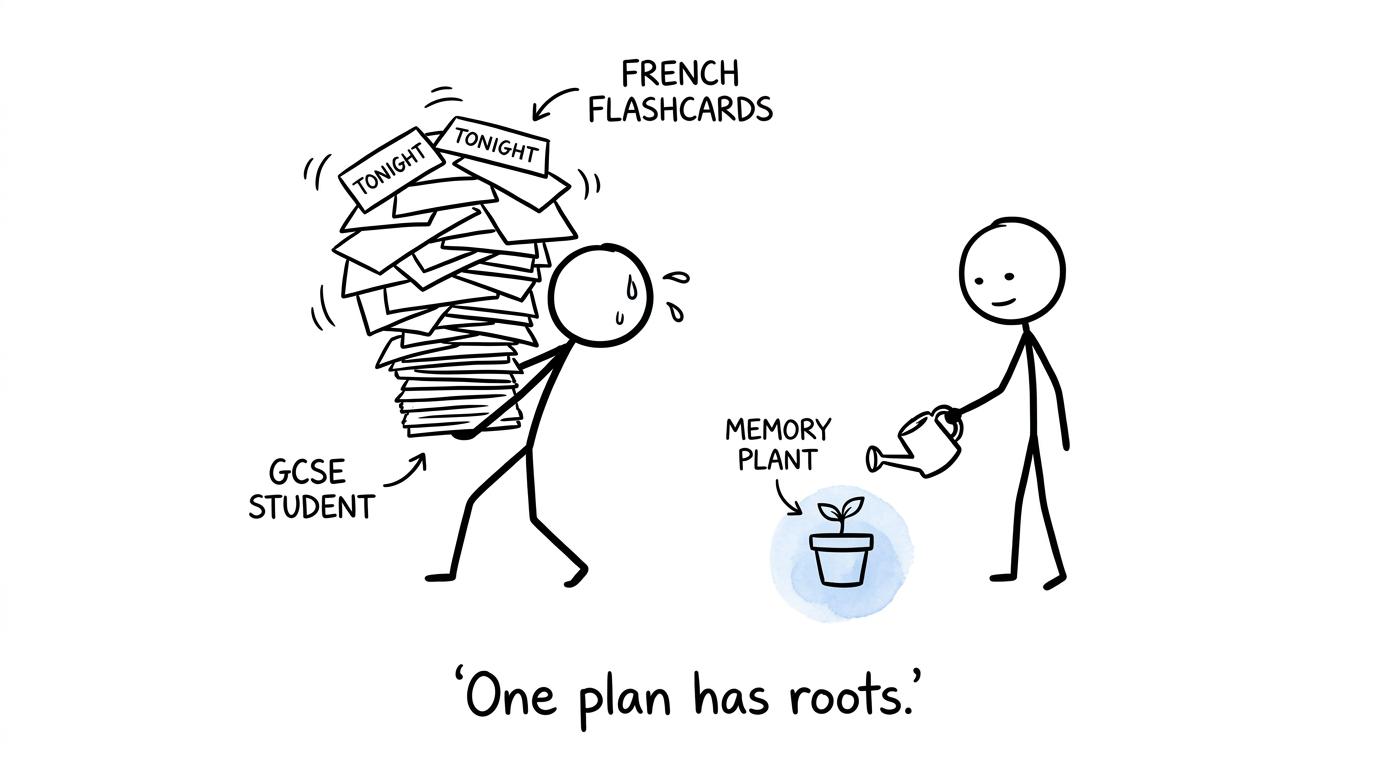 A student carries a tower of flashcards while another waters a memory plant
Why cramming feels more effective than it is
Cramming can feel productive because improvement inside one session is often rapid. After seeing the same vocabulary several times, recognition becomes easy. After reading a model paragraph repeatedly, its structure feels predictable.
But recognition is not the same as retrieval.
Recognition asks, “Does this look familiar?” Retrieval asks, “Can I produce or understand this without being shown the answer?” GCSE French examinations require the second skill. You must recover vocabulary from memory, process spoken or written language and apply grammar while attention is divided between the task, the clock and the meaning you want to communicate.
This is why closing the book matters. The attempt to remember is not merely a way to measure learning. Evidence reviews of retrieval practice suggest that the act of recalling material can itself strengthen later access to it. Feedback matters too, because an uncorrected error can become increasingly familiar.
Cramming also concentrates practice into one short period. Spaced practice distributes encounters across time. Educational research generally supports spacing and retrieval over repeated restudying, although the best schedule depends on the material and the learner. The practical principle is straightforward: return after some forgetting has begun, rather than waiting until everything feels completely new again.
Maths students may recognise the same trap. Watching a method is not proof that you can solve a fresh question. MathsGenie’s guide to stopping GCSE content from being forgotten explains the same learn, retrieve, space and test cycle. French needs that cycle too.
What genuine GCSE French learning looks like
GCSE French is not a memory contest with one enormous vocabulary list. It assesses whether vocabulary, grammar and pronunciation can be used across different language skills.
For the revised French GCSEs first assessed in England in summer 202620262026, official subject content includes listening, speaking, reading and writing, alongside translation, dictation and reading aloud. Foundation and higher tier students are entered at one tier across their assessments. Exact timings, task structures and vocabulary requirements vary by specification, so always check your current exam-board documents and teacher guidance.
Start from the MathsGenie GCSE French revision hub, where you can choose the relevant board, including AQA, Edexcel, Eduqas or WJEC. AQA students can go directly to the AQA GCSE French revision page.
You can retrieve vocabulary in both directions
Recognising a French word and recalling it from an English prompt are different demands. Listening adds pronunciation and speed. Writing adds spelling, gender, agreement and sentence construction.
Test vocabulary through several routes:
- French to English for meaning
- English to French for production
- audio to written meaning for listening
- spoken production for pronunciation
- short sentences for grammatical use
A word is becoming useful when it is available through more than one route. If you only recognise it on the original flashcard, the memory remains tied to that card.
You can adapt language instead of reciting it
A memorised paragraph can provide useful structures. The problem begins when it only works for one exact question.
To test learning, alter the time frame, subject, opinion or context. Can you change a sentence from present to past? Can you replace one activity with another while preserving agreement? Can you answer an unexpected follow-up without restarting the memorised script?
Adaptation reveals whether you understand the structure underneath the words. It is also closer to what happens in an examination, where prompts may be familiar in theme but unfamiliar in wording.
Your knowledge survives a delay
Immediate success is weak evidence. A better test is whether you can retrieve the same material tomorrow, several days later and again the following week.
You do not need a complicated algorithm. Use the free MathsGenie revision planner to schedule short returns. A manageable pattern might be:
- first session: learn, retrieve and correct
- next day: brief recall without notes
- several days later: mixed vocabulary and grammar
- the following week: exam-style listening, reading, speaking or writing
The gap may make recall feel harder. That difficulty is not automatically a sign of failure. It gives you honest information about what remains accessible.
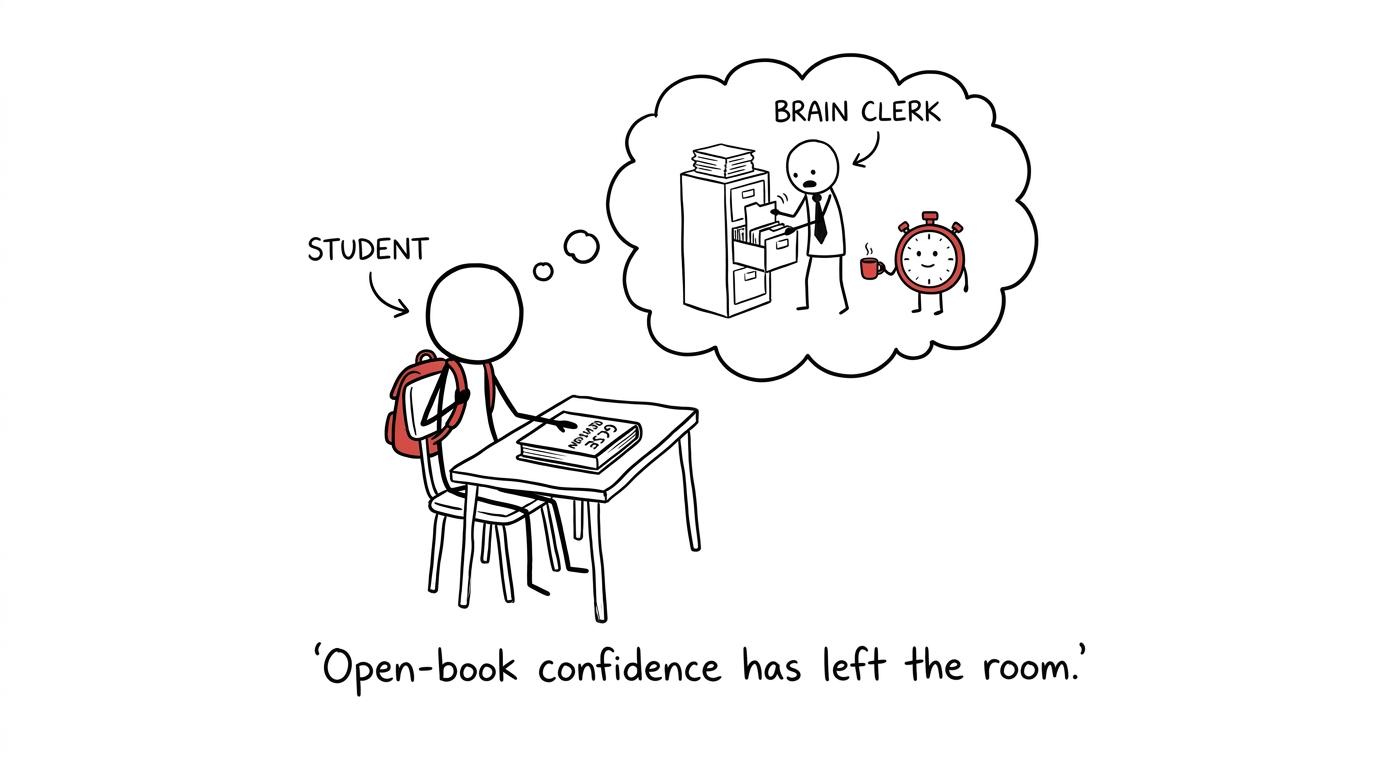 A brain searches a filing cabinet after the revision book closes
The closed-book test for real learning
You can diagnose cramming in about 202020 minutes. Choose a small area you revised recently and work without notes.
Recall
Write or say everything you can remember. Include vocabulary, structures and pronunciation patterns. Do not look immediately when you hesitate. Give retrieval a genuine chance.
Transfer
Use the material in a different context. Change the person, tense, opinion or topic. The aim is not to create a polished model answer but to discover whether your knowledge is flexible.
Switch skill
If you learnt the material through reading, use it in speaking or writing. If you learnt vocabulary from a list, listen for it in connected speech. Knowledge that only works in its original format is fragile.
Check and classify
Compare your attempt with reliable notes, teacher feedback or a mark scheme. Label each gap precisely:
- meaning not known
- word recognised but not produced
- spelling inaccurate
- pronunciation uncertain
- grammar not applied
- question misunderstood
This is more useful than writing “French is weak”. MathsGenie’s approach to finding your weakest GCSE topics follows the same principle: diagnose the exact loss, practise narrowly and retest.
Build revision that holds up on exam day
A strong session moves from support towards independence.
Begin with a short learning phase. Review one defined set of vocabulary, one grammar feature or one pronunciation pattern. Then remove the notes and retrieve it. Check the result, correct errors and use the material in another skill.
Keep sessions small enough to repeat. The MathsGenie 202020-minute revision routine is written for maths, but its structure transfers well: choose one precise target, practise actively, mark the attempt and use the error to choose the next target.
Across a week, balance the four skills:
- Listening: hear unfamiliar voices and identify detail without relying on a transcript
- Speaking: answer aloud without scripting every word first
- Reading: infer meaning from grammar and context rather than translating mechanically
- Writing: produce accurate language from a blank page and check it independently
Do not let your favourite skill consume the timetable. Your exam board’s precise assessment model matters, but GCSE French requires broad language control rather than one rehearsed performance.
As examinations approach, use papers to test readiness rather than create it. Older past papers can still provide useful language practice, but students taking a revised specification should compare tasks with their current course because pre-reform papers may not mirror every new requirement. The MathsGenie guide to using past papers properly explains the essential loop: attempt, mark, identify the gap, repair it and retest.
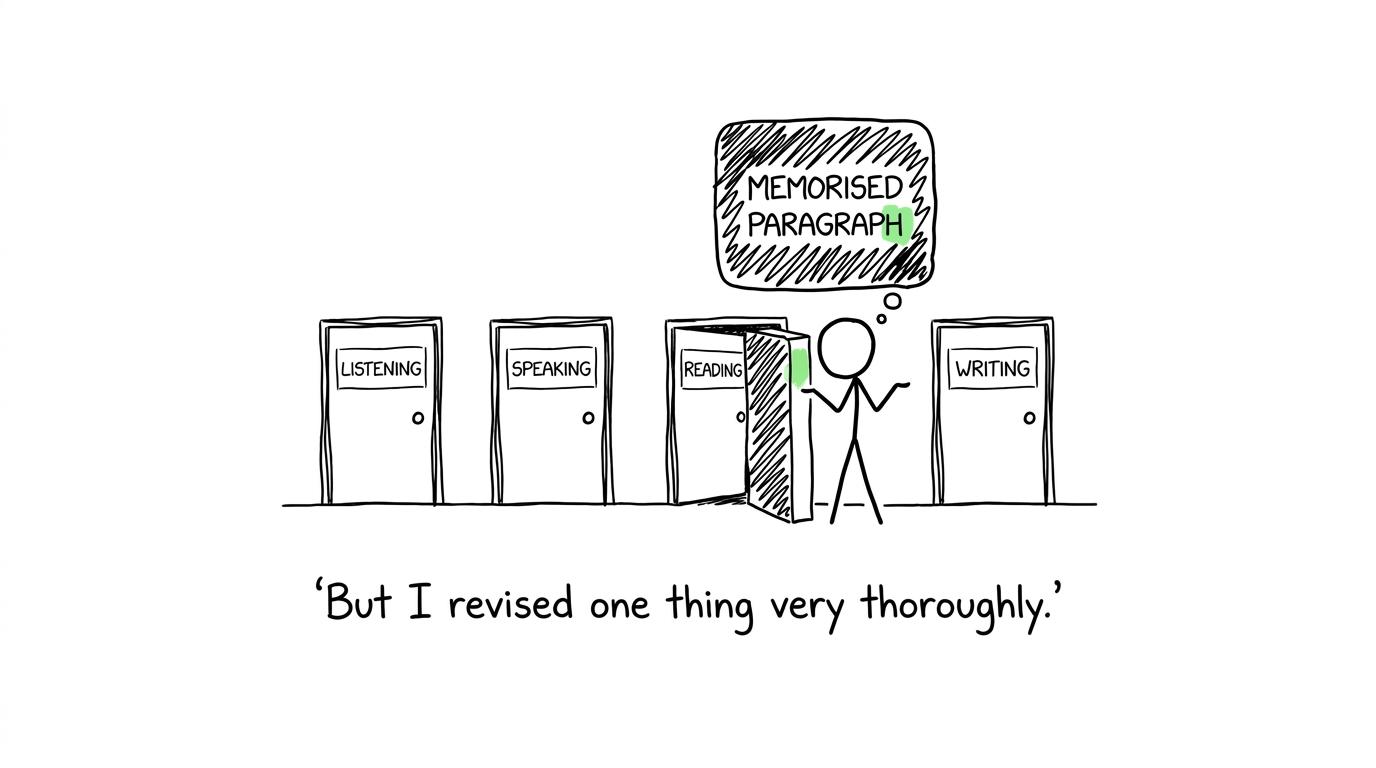 A memorised paragraph fails to fit through four GCSE French skill doors
Common mistakes when trying to stop cramming
Turning active recall into another reading exercise
Looking at a flashcard answer after one second is not meaningful retrieval. Pause, attempt the answer and then check. The effort must come before the feedback.
Revising vocabulary without sound
French is heard and spoken as well as read and written. A vocabulary list without pronunciation practice can create words that you recognise on paper but miss in listening or hesitate to say.
Memorising impressive paragraphs too early
Model language is useful, but long scripts can hide weak foundations. Secure high-frequency vocabulary, core grammar and flexible sentence patterns first. Then use model answers to improve range and organisation.
Repeating only successful material
Easy recall feels reassuring, so students often keep testing what they already know. Track errors and give more time to uncertain items while still revisiting secure ones occasionally.
Completing papers without repairing mistakes
A score tells you where you are. It does not move you forward by itself. Use the mark scheme, teacher feedback and your error log to decide what must happen next. This diagnostic mindset is also central to MathsGenie’s GCSE weak-topic process.
Leaving all four skills until the final week
Speaking confidence, listening discrimination and accurate writing develop through repeated contact. A late burst can refresh existing knowledge, but it is a poor substitute for producing and understanding French regularly.
From familiarity to dependable knowledge
Cramming is not defined by revising late one evening. Sometimes deadlines are real and a short emergency session is unavoidable. The problem is relying on familiarity, massed repetition and memorised scripts as your main system.
Learning is quieter. You retrieve before looking. You return after a delay. You expose errors rather than protecting confidence. Then you test whether your French survives a different question, skill and context.
Use the MathsGenie GCSE French resources to find board-specific revision materials and past papers, then organise your returns with the revision planner. If you are balancing French with maths, MathsGenie can also keep your wider revision in one place through free revision lessons, practice questions, mini tests, past papers, predicted papers, mark schemes and video solutions.
Close the notes. Try to retrieve what you know. Mark the gaps honestly. Then come back to them. That is the point where revision stops looking productive and starts becoming learning.