GCSE: How to Find Your Weakest Topics (Fast)
GCSE revision: learn how to find your weakest topics quickly using evidence from papers, mark schemes and targeted practice on YesGenie.

GCSE revision has a strange habit of drifting towards what feels comfortable. You rewrite neat notes. You watch a video you already understand. You do the same kind of question again because it gives you that quick hit of “I’m getting this”. Then you open a past paper and realise the marks didn’t go missing by accident; they leaked out of a handful of weak topics you never properly named.
This post shows you how to find your weakest topics in a way that is calm, measurable, and repeatable. The twist is that the title mentions GCSE Biology, but you’re a maths student: the same approach works brilliantly for GCSE Maths, and it’s even easier to track because maths leaves fingerprints in your working. Use the method below to build a personal “weak-topic map”, then fix it using YesGenie’s lessons, revision guides, practice questions, past papers, predicted papers, and mark schemes.
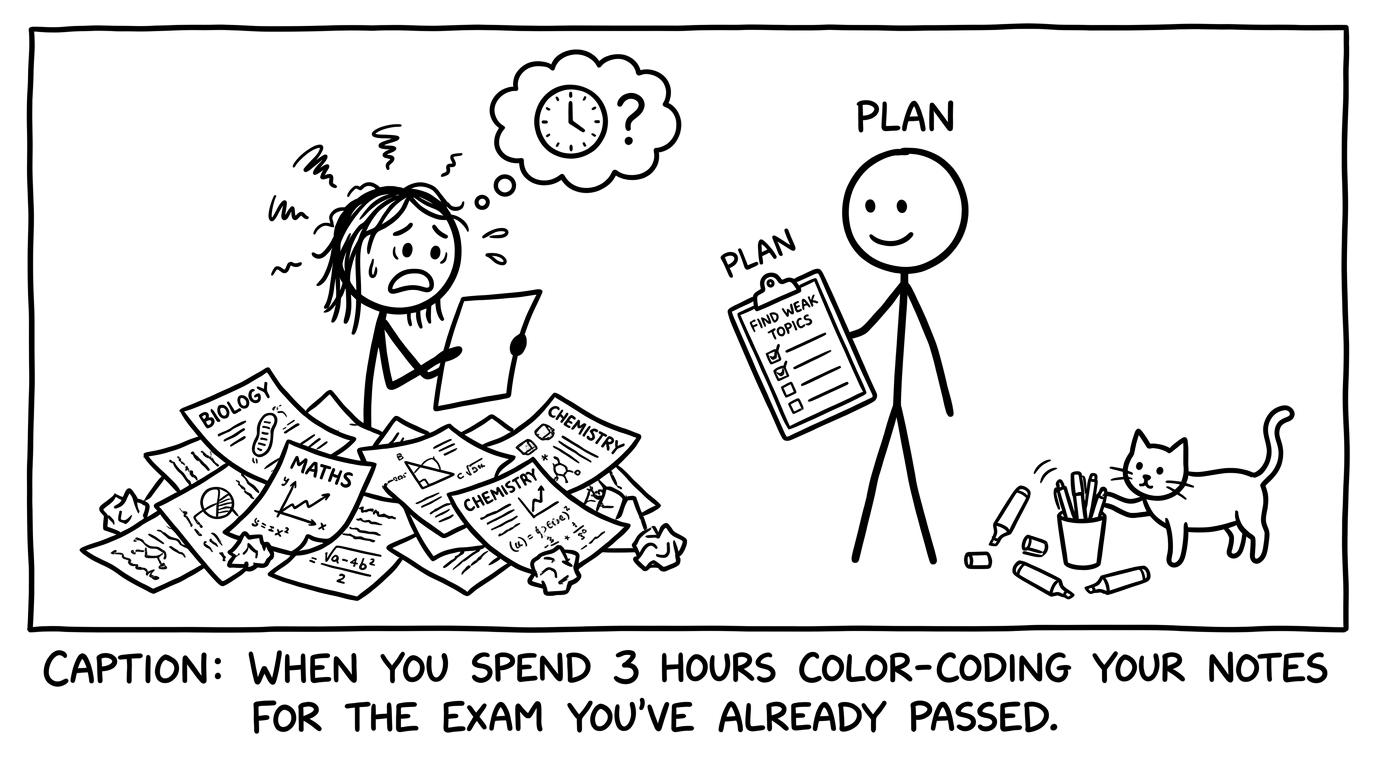 A student revises the wrong subject again
The one-sentence goal
Your goal is to turn “I’m bad at maths” into “I lose marks on these exact GCSE topics, for these exact reasons, and I know what to do next.”
That’s the whole game.
Quick checklist: how to find weak topics in any GCSE subject
Use this as your process every time you do a paper, mini test, or set of mixed questions.
- Collect evidence (past papers, predicted papers, mini tests).
- Mark properly (with the mark scheme, not your memory).
- Tag every dropped mark with a topic label.
- Diagnose the reason (knowledge gap, method gap, exam technique, or accuracy).
- Practise narrowly (topic questions and worked examples).
- Re-test (same topic, new questions).
If you want ready-made exam practice for maths, start here: GCSE Past Papers and Resources (Predicted Papers, Mini Tests, Mock Builder).
Why “weakest topics” beats “revise everything”
When a student says they’re revising GCSE Maths, they often mean they’re spending time near maths. But time near revision isn’t the same as marks earned.
Weak topics are expensive. They’re where you lose chains of marks: one shaky skill quietly ruins four questions that look different but share the same root method. In GCSE Biology, that might be required practicals or maths-in-science questions. In GCSE Maths, it might be algebraic manipulation or graphs.
So the method has to be forensic: follow the marks.
Build a “weak-topic tracker” (and keep it boring)
You don’t need a fancy app. A simple table in a notebook or spreadsheet is enough.
Use these columns:
- Paper/Test name (e.g. “Edexcel Paper 1H June 2019”)
- Question number
- Topic (e.g. “probability tree”, “bounds”, “rearranging formulae”)
- What went wrong (choose one: knowledge, method, exam technique, accuracy)
- Fix (a specific YesGenie page or task)
- Re-test date
For topics to label correctly, it helps to have a topic list open. If you’re on Edexcel maths, the lessons list is a great reference point: Edexcel GCSE Maths Lessons.
The four “what went wrong” buckets
- Knowledge: you didn’t know a fact or definition (e.g. what bounds mean).
- Method: you knew what the topic was, but couldn’t execute the steps.
- Exam technique: you misread, didn’t show working, or ignored command words.
- Accuracy: arithmetic slips, sign errors, rounding mistakes.
This matters because each bucket needs a different fix. More time isn’t the answer. The right type of time is.
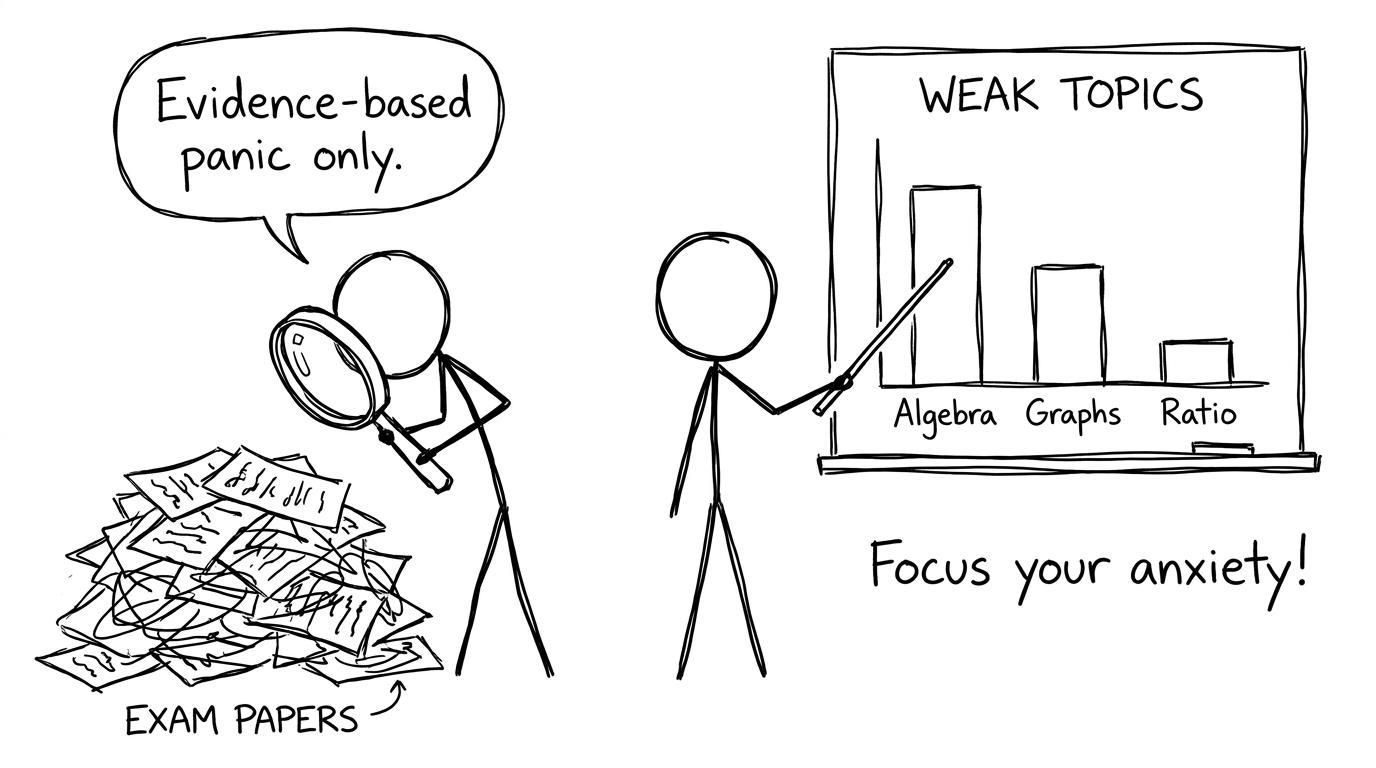 Evidence-based panic only
Use papers to find weak topics (the highest-signal method)
If you only do one thing, do this: complete a paper, mark it honestly, and tag every lost mark.
On YesGenie, you can practise with real papers and mark schemes: GCSE Past Papers. For maths, you can also use full topic coverage by exam board, such as GCSE Maths (OCR).
How to tag marks without overthinking
After marking, go through only the questions you dropped marks on and ask:
- What topic is this really testing?
- Which step failed?
- Is the error repeating elsewhere?
The trick is to label topics narrowly. “Algebra” is too broad. “Changing the subject” is better. “Changing the subject when the variable appears twice” is best.
Worked example: turning one messy question into a topic label
Suppose you lose marks on this GCSE-style algebra rearrangement:
Rearrange A=3x+2yA = 3x + 2yA=3x+2y to make yyy the subject.
Correct method:
A=3x+2y A = 3x + 2y A=3x+2y A−3x=2y A - 3x = 2y A−3x=2y y=A−3x2 y = \frac{A - 3x}{2} y=2A−3xIf your mistake was writing y=A−3x2yy = \frac{A - 3x}{2y}y=2yA−3x, that’s not “bad algebra”. That’s specifically changing the subject: isolating a term correctly (a method gap), and possibly also accuracy with inverse operations.
Your fix becomes targeted: practise rearranging formulae until the “do the same to both sides” habit is automatic.
Use topic practice to confirm a weak topic (and fix it faster)
A weak topic isn’t “confirmed” because you disliked it. It’s confirmed because it fails repeatedly.
Once your tracker shows a topic twice (or once, if it’s a big mark-loss), switch to topic practice:
- Use revision notes and worked examples.
- Do short bursts of exam questions.
- Mark and redo.
On YesGenie, revision guides are ideal for quick re-learning, then you can move straight into questions. For example:
Worked example: diagnosing a probability weakness with numbers
Say your tracker shows “probability” keeps appearing. Try a short diagnostic question and mark it strictly.
A bag contains 3 red and 2 blue counters. One counter is picked at random.
- P(red)=35P(\text{red}) = \frac{3}{5}P(red)=53
- P(blue)=25P(\text{blue}) = \frac{2}{5}P(blue)=52
Now suppose a student writes P(red)=32P(\text{red}) = \frac{3}{2}P(red)=23. That’s not a small mistake. It reveals a broken foundation: probability is a number between 000 and 111, and it must be “favourable outcomes over total outcomes”.
So the weak topic label becomes probability basics: forming correct fractions, not “trees” or “Venn diagrams” yet. Your fix starts earlier, which is why it works.
The GCSE Biology connection (and why maths students should care)
GCSE Biology weak topics often hide in places students don’t expect: required practicals, command words, and calculations (rates, magnification, percentages). If you’re revising maths, this is good news: your maths improvement supports science marks too.
Use the same tracker method across subjects:
- In Biology, tag errors like “required practical: osmosis” or “graph interpretation”.
- In Maths, tag errors like “bounds”, “ratio”, “graphs”, “algebraic fractions”.
The habit you’re building is bigger than one paper. It’s a way of thinking: evidence first, feelings second.
Common mistakes when finding your weakest topics
- You only record the score, not the cause. A mark is a symptom. You need the diagnosis.
- You label topics too broadly. “Geometry” won’t tell you what to practise tomorrow.
- You don’t use the mark scheme properly. GCSE mark schemes reward method marks; if you skip working, you skip marks.
- You never redo questions. If you don’t return to the exact error, you keep paying for it.
- You confuse speed with competence. Rushing a weak topic just makes the same mistake faster.
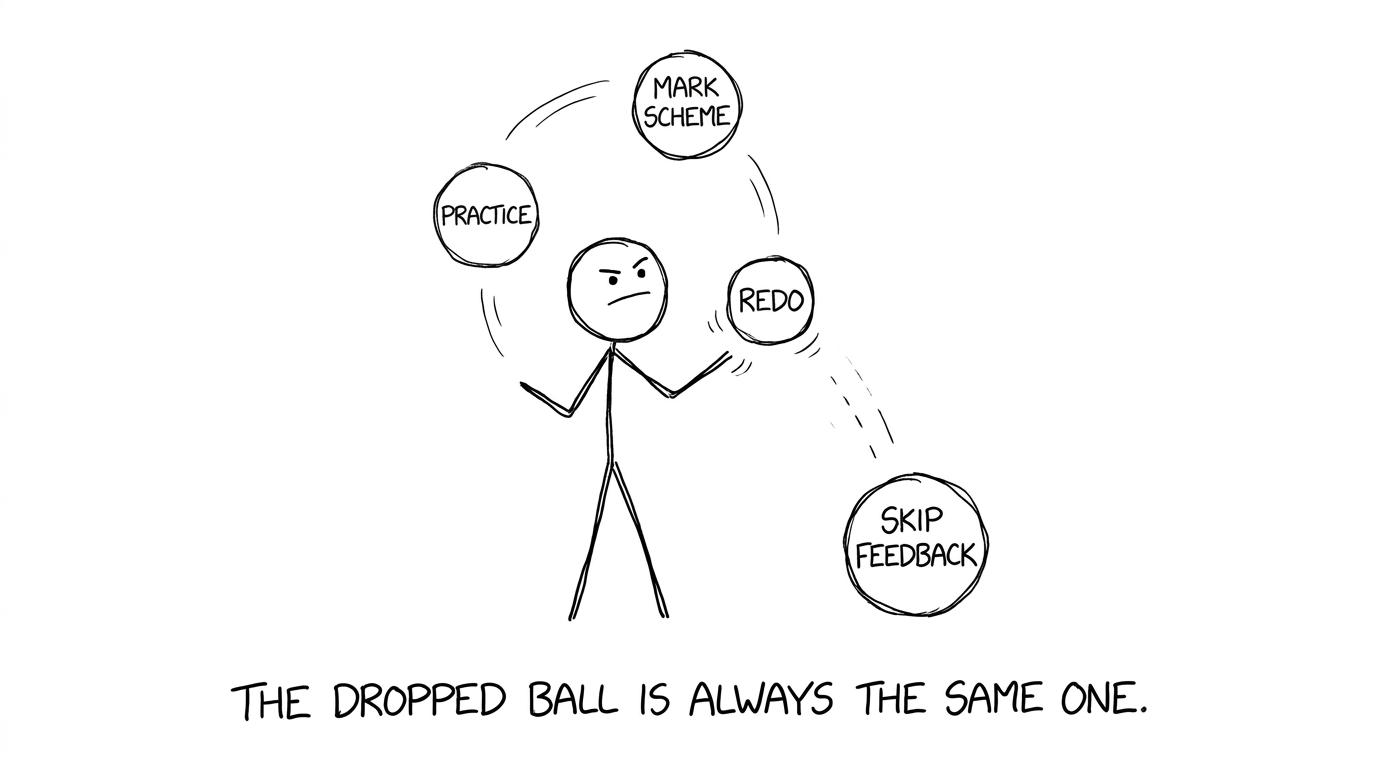 The ball you always drop
How to turn weak topics into a weekly revision plan
A useful rhythm for GCSE Maths looks like this:
- Two days: fix weak topics (revision guide + focused questions).
- One day: mixed practice to stop topics isolating themselves.
- One day: paper practice and marking.
If your exam board is OCR, you can keep everything in one place using GCSE Maths (OCR), then pull full papers from GCSE Past Papers.
A simple “marks-weighted” rule
Spend time in proportion to marks lost.
If you lost 181818 marks on algebra and 666 marks on geometry, that’s a 3:13:13:1 split.
So if you have 808080 minutes, allocate:
Algebra time=80×1818+6=80×1824=60 \text{Algebra time} = 80 \times \frac{18}{18+6} = 80 \times \frac{18}{24} = 60 Algebra time=80×18+618=80×2418=60 Geometry time=80×624=20 \text{Geometry time} = 80 \times \frac{6}{24} = 20 Geometry time=80×246=20It’s not glamorous, but it’s exactly how you stop “revision” becoming guesswork.
Closing: make GCSE revision measurable
GCSE success is rarely about a sudden surge of motivation. It’s about finally being honest about where the marks are going, and then being patient enough to win them back.
Find your weakest topics by using evidence: do a paper, mark it carefully, tag every dropped mark, and write down the reason. Then practise narrowly, redo the exact mistakes, and re-test until the topic stops appearing on your tracker.
When you’re ready to run this properly, use YesGenie as your home base: start with GCSE Past Papers, build targeted practice from Resources (Predicted Papers, Mini Tests, Mock Builder), and tighten weak areas using structured topic pages like GCSE Maths (OCR) plus clear topic lists from Edexcel GCSE Maths Lessons. Your weakest topics don’t need more panic. They need a plan, and a few good repetitions done properly.