Cramming vs Learning GCSE Arabic: Know the Difference
Cramming vs learning GCSE Arabic: spot false confidence, test real recall and build a calm revision routine that holds up across all four papers on exam day.
The evening before an exam can make weak knowledge feel strangely strong. You reread a vocabulary list, recognise almost every word and begin to relax. Then the paper arrives, the wording changes, and familiar material becomes difficult to retrieve.
That is the practical difference between cramming vs learning GCSE Arabic. Cramming creates short-term familiarity. Learning means you can recall, understand and use Arabic after time has passed, without relying on the page that taught it to you. The simplest test is this: close your notes, wait, and try to produce the language in an unfamiliar task. If you can, learning is taking hold.
This distinction matters to GCSE maths students too. In both subjects, recognition can imitate competence. A method looks obvious while a video is playing; a phrase looks familiar while the vocabulary sheet is open. The exam, however, asks what you can do independently.
The quick cramming or learning checklist
You are probably cramming if you:
- repeatedly read or highlight the same material;
- recognise vocabulary but cannot produce it unaided;
- practise one theme for a long, uninterrupted session;
- remember a prepared paragraph but struggle when the question changes;
- check answers before making a serious attempt;
- feel confident immediately after revision but forget much of it later.
You are more likely to be learning if you:
- retrieve vocabulary and structures with your notes closed;
- revisit material across several days;
- correct errors using reliable feedback;
- use familiar language in new listening, speaking, reading and writing tasks;
- mix older content with recently learned content;
- can explain precisely what you still find difficult.
The key difference is not effort. Cramming can feel exhausting. The difference is whether your revision produces durable, flexible knowledge.
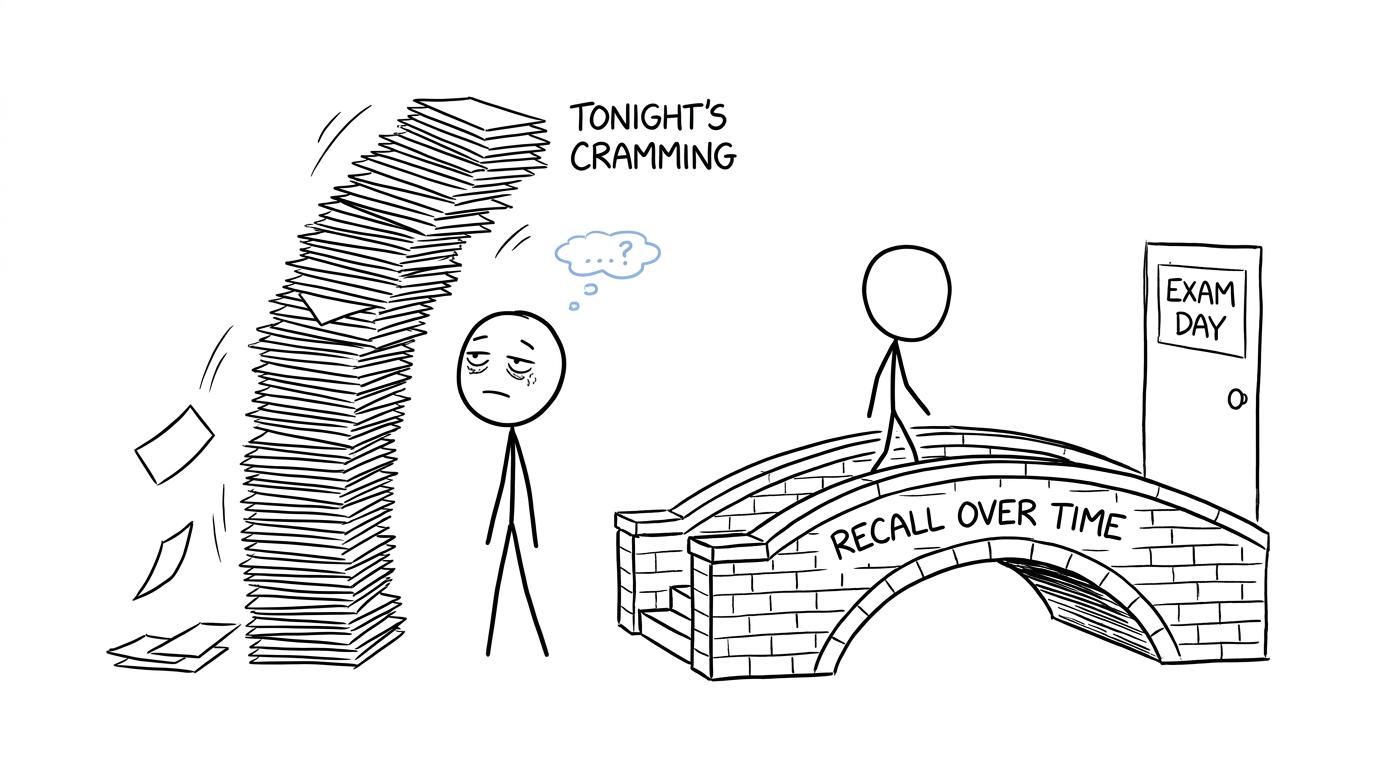 A student compares a cramming tower with a bridge built from recall over time
Why cramming feels more effective than it is
Rereading gives you prompts. The page supplies the first letter, the surrounding topic and the order in which ideas appeared. That support creates fluency: everything seems to move smoothly, so it is tempting to conclude that you know it.
An exam removes much of that support. You may hear an unfamiliar speaker, encounter vocabulary inside a longer text or need to adapt language to a different purpose. What felt available during revision may only have been recognisable.
This is why productive revision sometimes feels less comfortable. Trying to retrieve a word before checking it creates uncertainty. Attempting a translation exposes gaps. Speaking without a script feels slower than reading one aloud. Yet those difficulties provide useful evidence about what your memory can actually supply.
Recent evidence reviews from the Education Endowment Foundation distinguish massed practice from learning distributed over time. They find promising evidence for retrieval practice and spaced learning, while also cautioning that classroom implementation depends on subject, age and context. The sensible conclusion is not that one fashionable technique solves everything. It is that repeated, effortful recall with feedback is generally more useful than repeatedly looking at the same information.
Maths revision follows the same principle. The MathsGenie guide to efficient GCSE maths revision uses a learn, practise, mark, fix and retest cycle. Arabic requires different subject knowledge, but the learning logic transfers remarkably well.
What genuine GCSE Arabic learning must survive
For the current Pearson Edexcel GCSE Arabic qualification, students are assessed in listening, speaking, reading and writing. Each skill contributes 25%25\%25% of the qualification, and students enter foundation or higher tier across the papers. Dictionaries are not permitted in the assessments, including speaking preparation time.
That structure makes breadth important. A student cannot compensate for passive vocabulary revision by hoping every task will resemble a memorised list. Genuine learning must function through four different forms of performance.
Listening must survive normal uncertainty
Knowing a word on a flashcard is not the same as recognising it in connected speech. Listening practice should train you to identify the overall message, key details, opinions, time references and negatives without expecting to understand every sound.
A useful learning test is whether you can listen once, record what you understood, listen again and then identify exactly what changed. Simply replaying the audio until it feels familiar can become another form of cramming.
Speaking must work beyond a script
Prepared material is useful because it gives you accurate structures to draw upon. It becomes fragile when you can only reproduce it in one order.
Test whether you can answer follow-up questions, change a detail, move between past, present and future events, or recover after forgetting a word. Pearson’s current speaking format includes a role play, a picture-based task and a conversation. Flexible communication therefore matters more than delivering one polished speech in isolation.
Reading must go beyond word spotting
Cramming often produces islands of recognition: several familiar words appear, and the student guesses the meaning between them. Learning means following the relationships within the text. Who holds an opinion? Is the statement positive or negative? When did the event occur? Does a connective reverse the writer’s argument?
Do not measure reading revision by pages completed. Measure whether you can justify answers from the text and translate meaning accurately rather than assembling a sentence from isolated vocabulary.
Writing must be adaptable
A memorised paragraph may earn credit when it happens to fit. It may also answer the wrong question or include details that do not suit the prompt.
Build reusable language instead: accurate sentence patterns, common verbs, opinions with reasons, connectives and structures for different time frames. Then practise selecting and adapting them. The goal is not to memorise every possible answer. It is to own enough language to construct one.
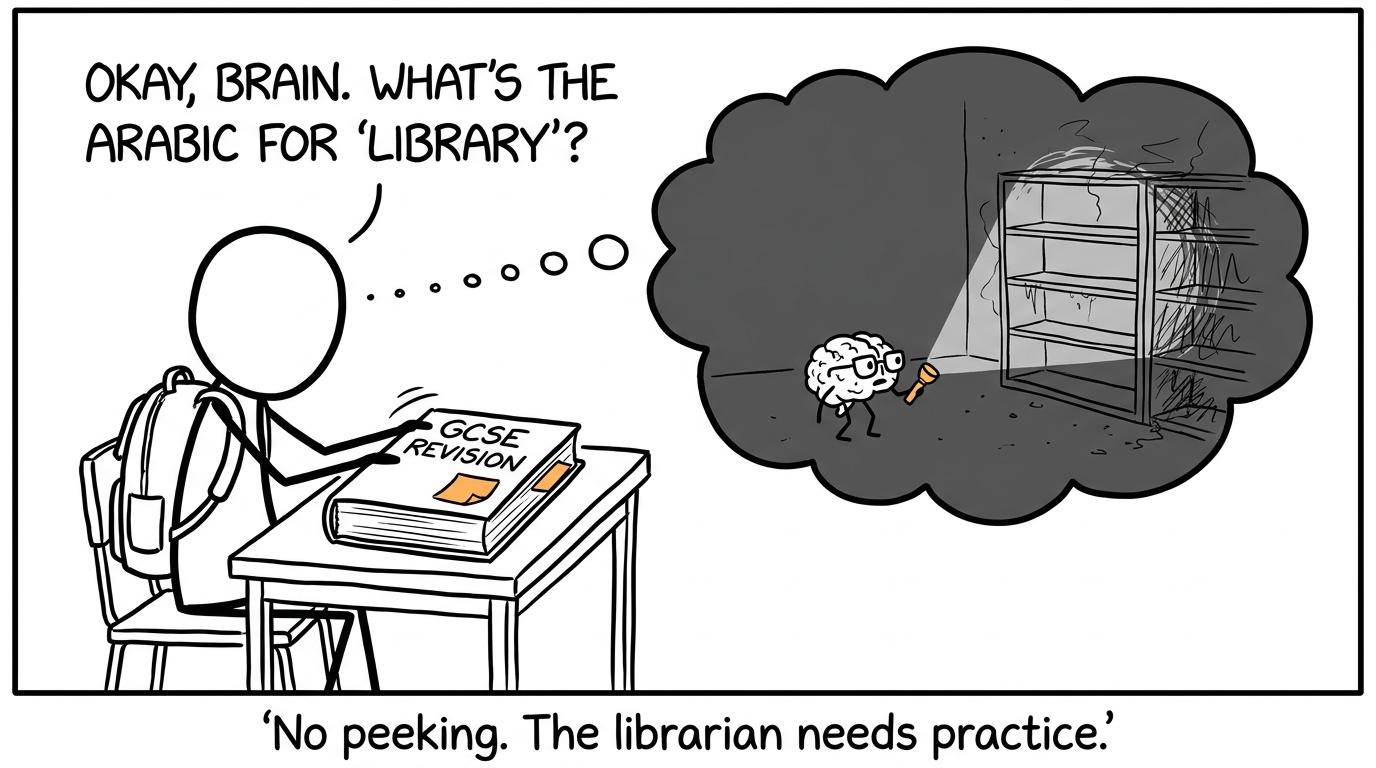 A tiny brain librarian searches for a word while a student practises without peeking
A revision routine that turns exposure into learning
A strong routine is short enough to repeat and demanding enough to reveal the truth.
Retrieve before reviewing
Begin with a blank page, an audio response, flashcards or spoken questions. Recall vocabulary, structures and ideas before opening your notes. The attempt matters even when recall is incomplete.
Then check your answer. Feedback prevents mistakes from becoming rehearsed habits. Record only the gaps that require another attempt rather than copying the entire page again.
MathsGenie’s GCSE mini tests demonstrate the same diagnostic idea for maths: a short test can reveal more than a long period of passive reading. Use that model to create small Arabic checks covering vocabulary, grammar and comprehension.
Space the next attempt
Return to the material after a delay. A practical pattern might revisit it the following day, several days later and again the next week. These intervals are not magical deadlines; they simply stop every successful attempt from happening while the answer is still sitting in short-term memory.
If something is repeatedly forgotten, shorten the gap and improve the cue. If it is consistently secure, increase the interval. A short daily revision routine can be easier to sustain than occasional marathon sessions.
Mix skills and themes
The examination does not announce which exact vocabulary item or structure you will need next. Mix themes and task types so that you must choose the language rather than follow a predictable sequence.
For example, one session might combine listening, short spoken responses and a brief reading task. Another might include translation, vocabulary retrieval and planning a writing response. This is not about creating chaos. It is about making practice slightly more like the decisions required in the assessment.
Use papers as evidence, not theatre
A completed paper is useful only if it changes what you do next. Mark it, identify why each error occurred and return to the underlying weakness. Was vocabulary missing? Did you overlook a negative? Was the grammar inaccurate? Did you misunderstand the instruction?
Maths students can see this process clearly in MathsGenie’s guide to using past papers properly. Use official Arabic papers and mark schemes from your own qualification, then apply the same paper, mark, fix and retest cycle. Confirm your exact specification first, particularly if your centre offers an international qualification rather than Pearson Edexcel GCSE Arabic.
How to prove that learning is holding up
Do not ask, “Have I revised this?” Ask for evidence.
A topic is becoming secure when you can:
- retrieve key language after a delay;
- recognise it in speech from more than one speaker;
- understand it inside an unfamiliar text;
- use it accurately in a new spoken or written response;
- spot and correct your own recurring errors;
- perform without seeing the answer first.
Use fresh questions where possible. Repeating an old task can still be valuable, but a correct answer may come from remembering the page rather than understanding the language. Leave a gap, repair the weakness and then test it through a different task.
This is also why finding your weakest topics quickly is so useful in maths revision. Accurate diagnosis protects time. The same principle helps you distinguish “Arabic grammar” as a vague worry from a specific problem such as inaccurate verb forms or difficulty identifying time references in listening.
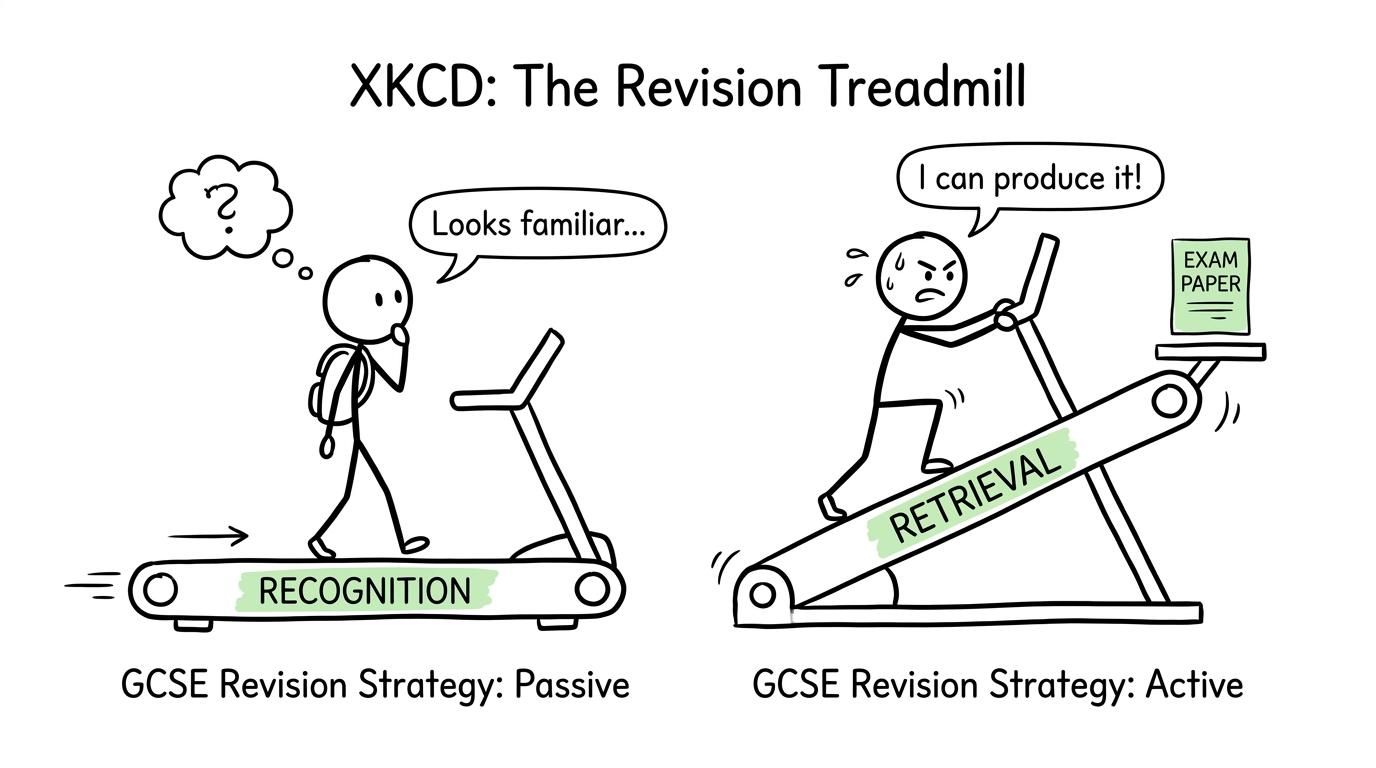 Recognition and retrieval compete on two revision treadmills
Common mistakes when escaping the cramming cycle
Turning flashcards into another reading task
Looking at both sides and thinking “yes, I knew that” is recognition. Commit to an answer before turning the card. Say or write it, then compare it carefully.
Memorising answers without understanding their parts
Prepared responses can support fluency, but you should know what each sentence means and how to alter it. Break material into reusable structures and recombine them for different prompts.
Revising only the comfortable skill
Students naturally return to what feels successful. GCSE Arabic assesses all four skills, so your timetable should not become several weeks of vocabulary reading followed by a late panic about speaking or listening.
Counting time instead of successful recall
Two hours at a desk is not automatically better than a focused half-hour. Track what you retrieved, what you corrected and what you will retest.
Using the wrong paper or specification
Do not assume that Arabic follows the format used by AQA, OCR or Eduqas language courses, or that an International GCSE paper matches the Pearson Edexcel GCSE. Check the qualification title, tier and current specification with your teacher before practising.
Treating the final night as a rescue mission
The final evening is better used for light retrieval, reviewing recurring errors and preparing calmly. MathsGenie’s GCSE night-before plan offers a useful model: choose a small amount of high-value practice, correct it and protect your sleep rather than trying to rebuild an entire course overnight.
Build knowledge that is still there tomorrow
Cramming asks, “Can I recognise this now?” Learning asks a harder and more useful question: “Can I retrieve and use this later, when the prompt is unfamiliar?”
For GCSE Arabic, close the notes, attempt the language, check carefully and return after a delay. Mix listening, speaking, reading and writing. Let mistakes shape the next session. The process may feel less fluent than rereading, but it produces much better evidence.
For GCSE and A Level maths, put the same principle into action through the free MathsGenie GCSE maths revision hub or A Level maths revision hub. Use revision lessons to rebuild understanding, practice questions and mini tests to retrieve methods, then past papers, mark schemes and video solutions to expose remaining gaps. Nearer the examination, add GCSE predicted papers as fresh practice rather than as a substitute for learning.
The aim is not to feel ready while the answer is visible. It is to become ready when it is not.