Comparing GCSE Russian Progress With Friends
Comparing GCSE Russian progress friends can distort revision. Learn why personal evidence, clear targets and calm routines are better measures of improvement.
It can happen in seconds. A friend answers a Russian speaking question fluently, remembers a difficult case ending or scores higher in a vocabulary test. Suddenly, your own progress feels smaller.
If you are comparing GCSE Russian progress friends have made with your own, the short answer is this: comparison is not automatically bad, but it usually becomes unhelpful when somebody else's performance replaces evidence from your own work. Your classmate can offer ideas, encouragement and useful feedback. They cannot provide a fair measurement of how much you have improved.
The better question is not, “Am I ahead of them?” It is, “What can I do now that I could not do reliably a month ago?” That shift matters in Russian, and it matters just as much when you return to GCSE maths revision.
A quick checklist for healthier comparison
Before comparing yourself with a classmate, ask:
- Are we working towards the same tier, paper and target grade?
- Am I comparing a genuine exam result or an impression from one lesson?
- Does the comparison reveal a specific action I can take?
- Am I recognising my stronger skills as well as my weaker ones?
- Will this thought help my next revision session?
If the answer to the final question is no, the comparison is probably noise rather than feedback.
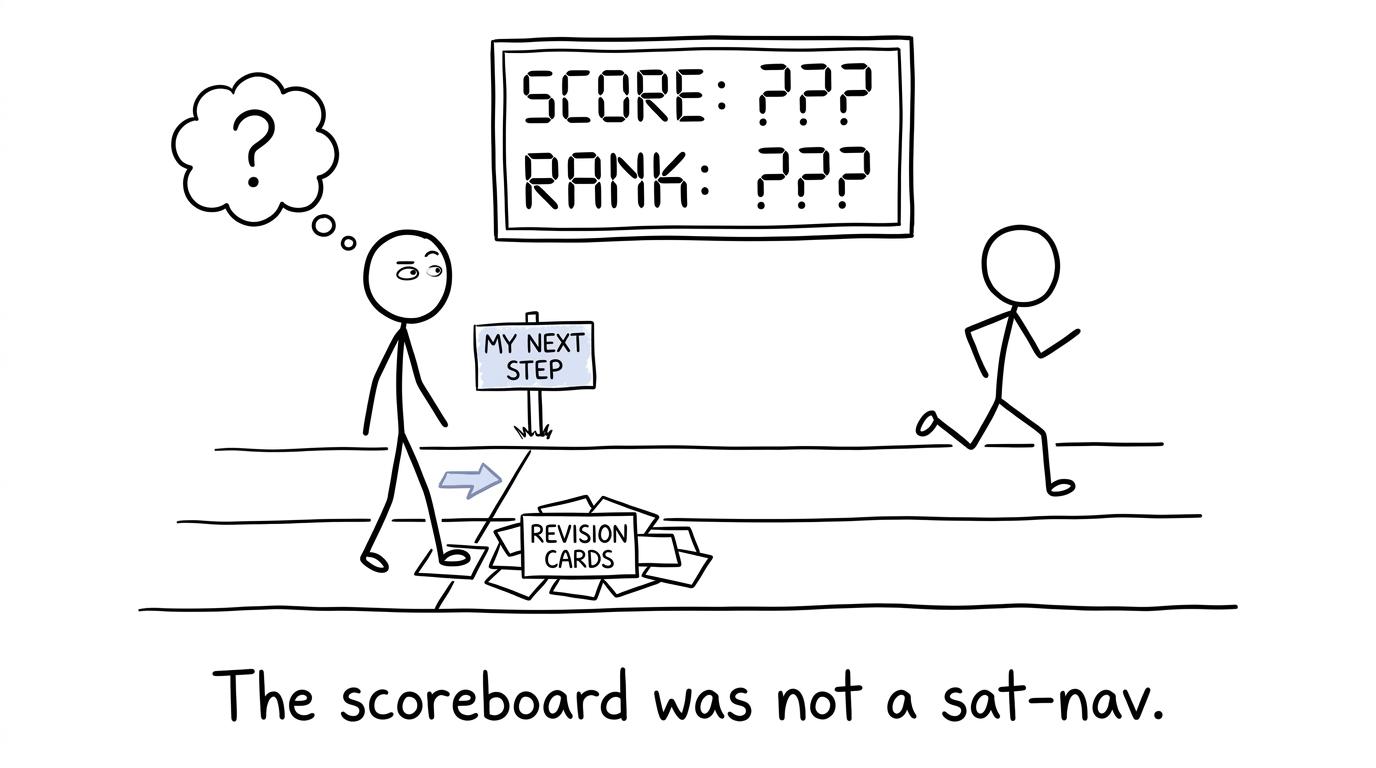 A student discovers that a scoreboard is not a sat-nav for revision
Why comparing GCSE Russian progress with friends is misleading
Progress looks simple from a distance. One student appears “good at Russian”, while another appears behind. Up close, the picture is more complicated.
The current Pearson Edexcel GCSE Russian qualification assesses listening, speaking, reading and writing separately. Each skill contributes 25%25\%25% of the qualification. A student who sounds confident in conversation may still find listening extracts or translation difficult. Somebody who pauses when speaking may produce accurate, well-developed writing.
You rarely see the complete set of evidence behind another student's performance. You may not know:
- whether Russian is spoken in their family or wider community;
- how long they have been learning the language;
- which skills they practise outside lessons;
- whether they revised that precise topic recently;
- how they perform under timed examination conditions;
- which mistakes are hidden behind their confident answers.
This creates an unfair comparison: your complete experience, including every hesitation and error, is being measured against the small part of somebody else's learning that happens to be visible.
Different starting points produce different-looking journeys
Imagine two runners beginning from different places on the same track. Looking only at their current positions tells you who is further ahead, but not who has travelled further.
Revision works in a similar way. One student may begin with strong vocabulary but weak grammar. Another may read Cyrillic confidently but struggle to respond spontaneously. Their current marks reflect different starting points, opportunities and skill profiles.
A fairer measure is movement from your own baseline. If your listening score rises, your written answers become more accurate or you can sustain a longer conversation, that is genuine progress even when a friend remains ahead.
When comparison can actually help
Not every comparison is harmful. Used carefully, classmates can provide useful information and support.
Healthy comparison is specific and action-focused. You might notice that a friend organises vocabulary by topic, rehearses unpredictable speaking questions or corrects mistakes immediately. The useful conclusion is not, “They are naturally better than me.” It is, “That revision behaviour may be worth trying.”
Comparison becomes constructive when you:
- borrow a revision method rather than judge your ability;
- practise speaking together without turning it into a contest;
- exchange precise, respectful feedback;
- celebrate each other's improvement;
- ask a teacher why your marks differ.
This distinction is important. A friend can be a source of strategy. They should not become your personal grade boundary.
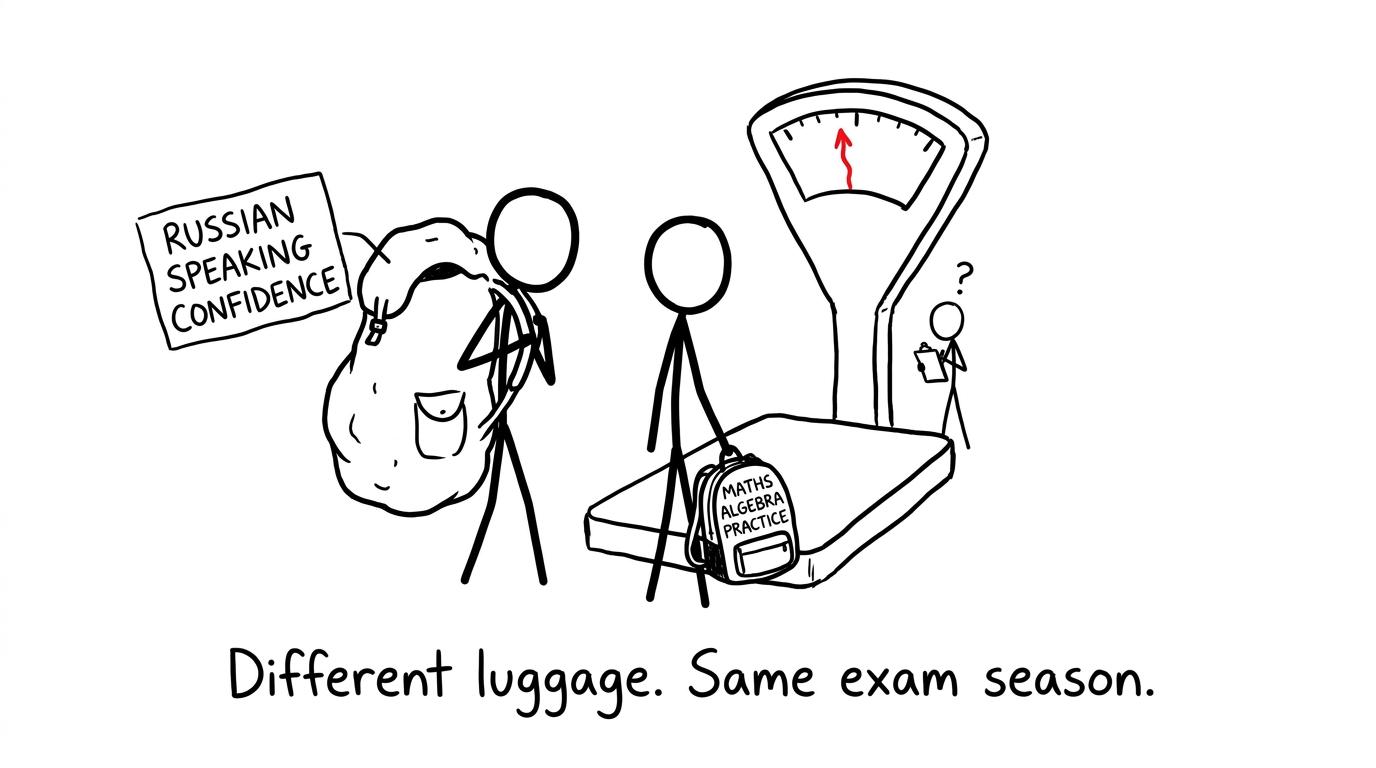 Students attempt to weigh two completely different revision backpacks
Build a personal progress scoreboard instead
A useful scoreboard measures things you can influence. It should tell you what is improving, what remains uncertain and what to do next.
Track evidence across all four Russian skills
Once a week, record one small piece of evidence for listening, speaking, reading and writing. This might include:
- marks from an exam-style task;
- vocabulary recalled without prompts;
- recurring grammar errors;
- questions completed within the available time;
- teacher feedback that you have acted upon;
- a speaking response recorded and reviewed.
Keep the conditions reasonably consistent. Comparing an untimed task completed with notes against a closed-book timed task will not reveal much about progress.
You can calculate a simple accuracy rate when tasks have different totals:
Accuracy rate=marks achievedmarks available×100%\text{Accuracy rate}=\frac{\text{marks achieved}}{\text{marks available}}\times 100\%Accuracy rate=marks availablemarks achieved×100%The percentage is useful, but the explanation matters more. Add one sentence identifying why marks were lost and one next action. “Revise vocabulary” is too broad. “Practise recognising past-tense verbs in listening extracts” is specific enough to guide a session.
Use the plan, monitor and review cycle
Evidence on metacognition and self-regulated learning supports teaching students to plan, monitor and evaluate their learning. In practical terms, your revision cycle can be simple:
- Plan: choose one precise skill and a realistic task.
- Monitor: complete the task without hiding mistakes.
- Review: mark it, classify the errors and decide what changes next.
This process turns revision into a sequence of decisions rather than a vague test of intelligence. MathsGenie's guide to finding your weakest GCSE topics uses the same evidence-led principle.
Compare attempts, not identities
Instead of saying, “I am bad at Russian listening,” compare two attempts under similar conditions. Did you identify more details? Did fewer unfamiliar words derail the whole answer? Did you distinguish opinions from facts more reliably?
An attempt can be improved. An identity label merely feels permanent.
Carry the same approach into GCSE maths
Russian may trigger the comparison, but the same habit often follows students into maths. One friend finishes algebra quickly. Another is already attempting Higher tier questions. Somebody announces a mock grade before you have even opened your paper.
Yet maths progress also has several dimensions: knowledge, method selection, accuracy, reasoning, timing and presentation. A single mark cannot explain all of them.
Start with the GCSE Maths revision hub and choose resources for your own exam board, whether that is Edexcel, AQA, OCR or Eduqas. Your tier matters too. Foundation and Higher tier students are not working through identical papers, so direct mark comparisons may be particularly misleading.
If you take Edexcel, the Edexcel GCSE Maths revision area brings together lessons, questions and paper practice. Use it to answer three personal questions:
- Which methods can I now recall independently?
- Where am I still losing marks?
- Can I perform the skill when it appears in an unfamiliar question?
That is much more useful than knowing whether your friend completed the worksheet first.
Turn mistakes into your next action
Feedback is valuable when it is connected to a learning goal and gives specific information about improvement. After marking maths practice, classify each lost mark:
- knowledge gap;
- incorrect method;
- calculation slip;
- misread instruction;
- incomplete working;
- time pressure.
Then use a revision lesson or practice questions to address the category. The MathsGenie guide to using Edexcel past papers properly explains how to mark honestly, diagnose mistakes and revisit difficult questions.
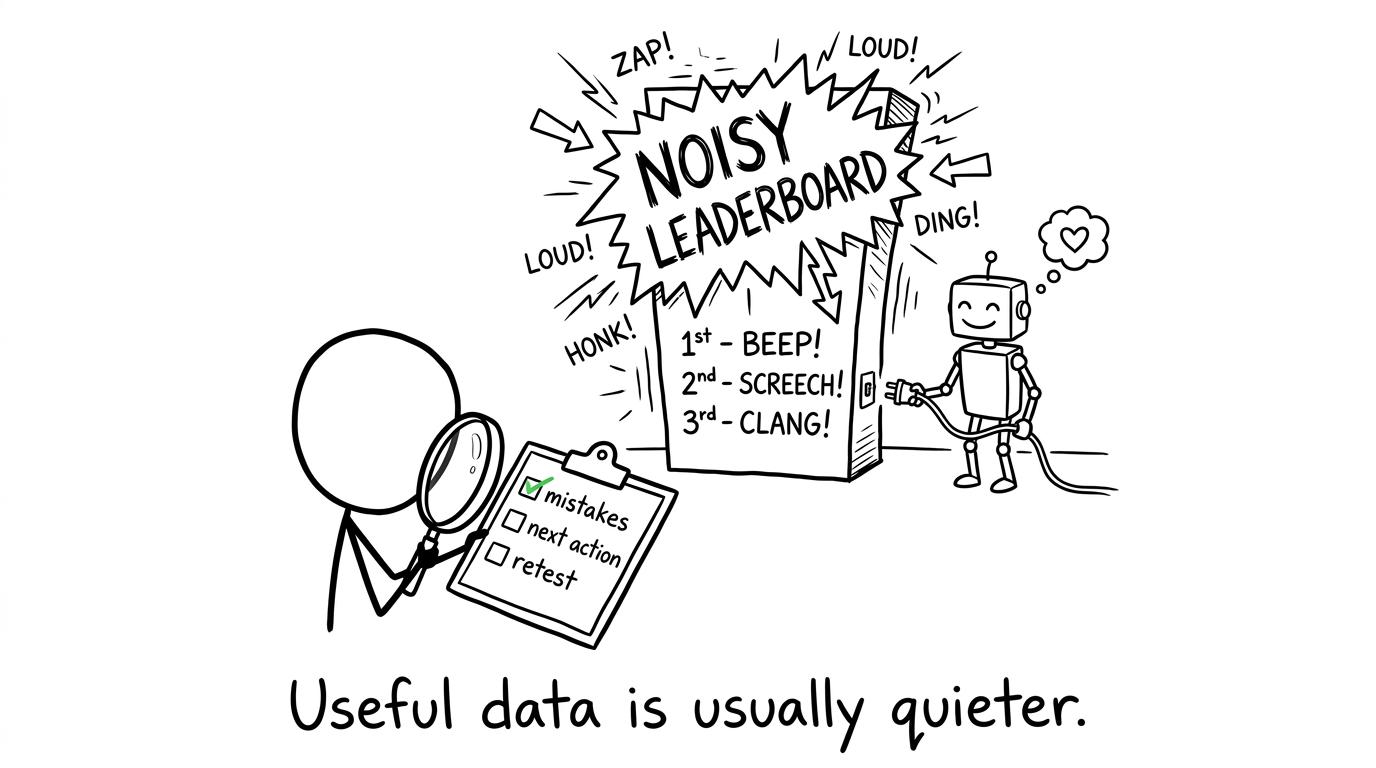 A quiet checklist defeats a large and noisy revision leaderboard
Create a revision routine that survives comparison
A strong routine reduces the number of moments when you need to ask how everybody else is doing. You already know your next step.
For a short weekday session, follow this pattern:
- retrieve prior knowledge with notes closed;
- complete one focused set of questions;
- mark the work carefully;
- record one recurring error;
- choose the next task from that evidence.
The 20-minute GCSE maths revision routine provides a manageable structure for busy school days. For longer-term organisation, use the GCSE maths revision timetable guide or adapt the one-month GCSE revision plan.
The principle is the same in Russian and maths: retrieve, attempt, mark, correct and retest. Confidence tends to become more stable when it rests on repeated evidence rather than classroom rank.
Common mistakes when judging your progress
Treating one test as a permanent verdict
One result is information, not an identity. It may reveal a topic gap, weak timing or an ineffective revision method. Use several comparable tasks before drawing a broad conclusion.
Comparing total revision time
Hours alone do not show the quality of revision. One focused session with closed-book retrieval and careful marking may reveal more than a long evening of rereading. Compare completed actions and corrected errors, not reported hours.
Looking only at strengths your friend displays publicly
Students tend to reveal successful answers more readily than confused ones. Classroom visibility is not a complete performance record.
Ignoring differences between subjects, tiers and papers
Russian tests four distinct language skills. GCSE maths varies by board and by Foundation or Higher tier. Compare like with like, under similar conditions.
Using predicted papers as predictions of your worth
Predicted papers are practice resources, not guarantees about an examination or your final grade. Use GCSE predicted topics and revision resources to uncover gaps, then return to lessons and targeted questions.
Letting comparison disrupt sleep or concentration
If class chats or social media leave you repeatedly checking other people's revision, create boundaries around them. If comparison is causing persistent anxiety, affecting sleep or making school feel unmanageable, speak to a parent, carer, teacher, tutor or another trusted adult.
Your progress needs evidence, not a leaderboard
You do not need to pretend that other students do not exist. Friends can make revision less lonely, share useful methods and provide thoughtful feedback. The problem begins when their visible strengths become the ruler you use against your entire learning journey.
Measure Russian through your own listening, speaking, reading and writing evidence. Measure maths through methods remembered, marks recovered and mistakes that no longer repeat.
Then make the next step easy. Open MathsGenie's free GCSE Maths revision hub, choose your board and tier, and use revision lessons and practice questions to repair individual gaps. Follow with mini tests, past papers, predicted papers, mark schemes and video solutions. Your friend's progress can remain encouraging. Your own evidence should decide what happens next.