

How to Catch Up GCSE Dance After Absence
Catch up GCSE Dance after absence with a realistic recovery plan for practical work, choreography, theory and maths revision without burning out.
Missing several weeks of school can make GCSE Dance feel unusually difficult to recover. Notes can be copied. A group performance cannot. If you need to catch up GCSE Dance after absence, begin by asking your teacher what was taught, what was assessed and what has the nearest deadline. Then rebuild in this order: safe physical readiness, essential group material, choreography evidence and written knowledge.
The goal is not to recreate every missed lesson. It is to recover the work that protects the most marks while keeping enough time and energy for GCSE maths and your other subjects.
Your catch-up checklist
Use this list before making a detailed timetable:
- Tell your Dance teacher how long you were absent and whether you have any continuing health restrictions.
- Confirm your exam board, specification and assessment dates.
- Separate missed work into performance, choreography and dance appreciation.
- Ask which practical material requires supervised teaching or group rehearsal.
- Obtain authorised class notes, resources and feedback.
- Agree three priorities for the next school week.
- Add short theory sessions at home, but do not attempt unsafe practical work alone.
- Protect existing revision commitments, especially approaching maths exams.
- Speak to the school’s exams officer promptly if illness affected a formal assessment.
This first conversation matters because Dance is not a course you can reconstruct entirely from somebody else’s folder. Your teacher knows which movement material, practical evidence and deadlines apply to your centre.
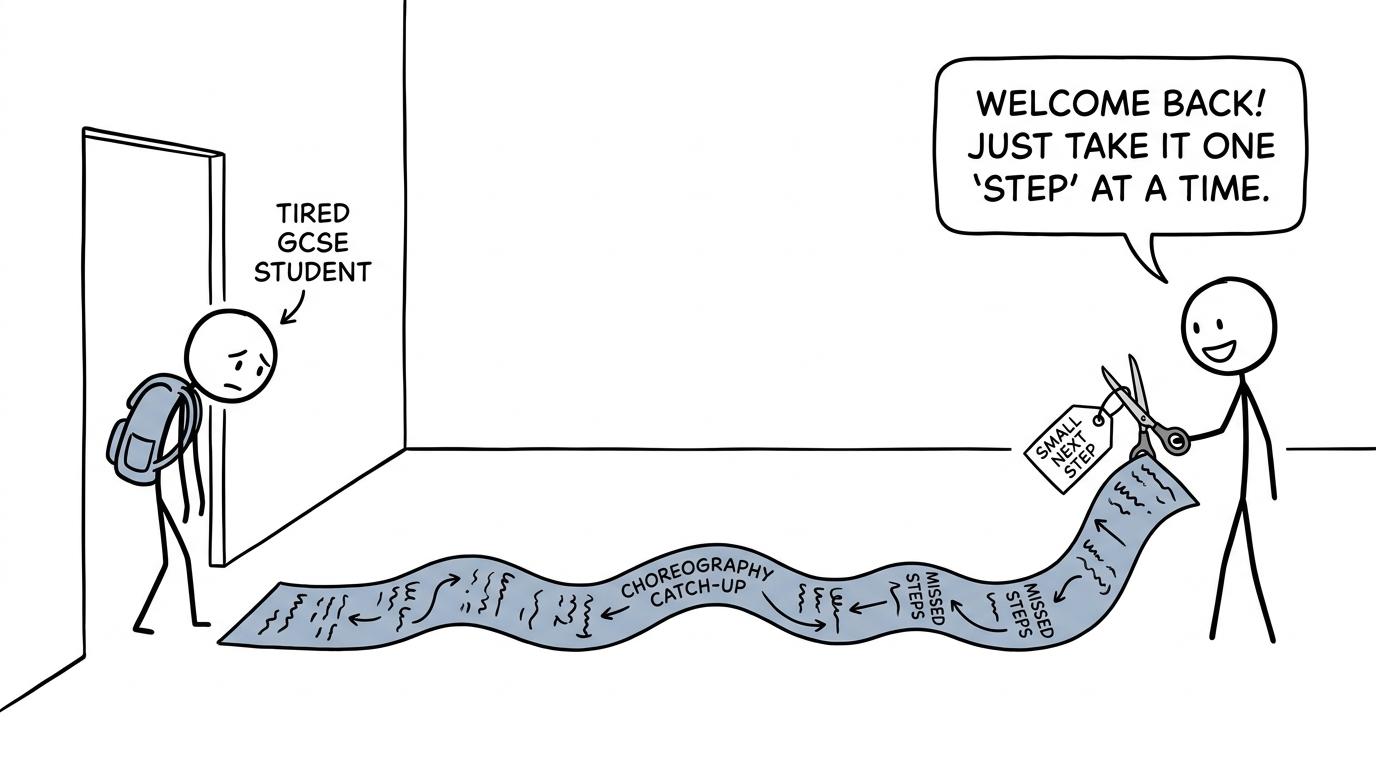 A returning GCSE student faces a long roll of missed choreography while a teacher offers one small next step
Find the real size of the gap
Absence often feels like one enormous problem. In practice, it is several smaller problems with different solutions.
Create a catch-up audit with four columns:
| Area | What might be missing | Best person or resource | Urgency |
|---|---|---|---|
| Performance | Set phrases, duet or trio material, spacing and feedback | Teacher and group members | Usually high |
| Choreography | Research, motif development, structure, rehearsal and refinement | Teacher and your own authorised records | Depends on deadline |
| Appreciation | Professional works, terminology and analytical writing | Class materials and specification | Can often be spread out |
| Administration | Assessment dates, recording arrangements or missed supervised work | Teacher and exams officer | Immediate if relevant |
Do not write “all of Dance” in the first column. Name the exact gap. “I missed changes to the final section of our trio” can be solved. “I am behind” cannot.
For AQA GCSE Dance, performance and choreography form the non-exam assessment, worth 60%60\%60% overall, while Dance appreciation is a written examination worth 40%40\%40%. Within the qualification, performance and choreography are each worth 30%30\%30%. That balance explains why practical work cannot simply be postponed until every set of theory notes is complete.
Your own board and centre arrangements must guide your plan, so check the specification and ask your teacher rather than relying on a classmate’s memory.
Speak to your teacher before practising alone
A useful meeting can be short. Take four questions:
- What material did I miss?
- What must be learned with you or my group?
- Which deadline matters first?
- What is a realistic target by our next lesson?
Also ask what evidence you are permitted to use. Your school may have authorised recordings, rehearsal notes or teaching resources, but assessment and authentication rules still apply. Do not assume that filming, replacing or completing assessed work independently is acceptable.
AQA’s published administration guidance says that occasional absence should normally be addressed by giving students an opportunity to make up missed work, potentially through an alternative supervised session. The arrangement must come from the school. It is not something a student can declare for themselves.
If you missed a formal assessment because of illness, tell your teacher and exams officer immediately. JCQ distinguishes ordinary lost teaching time from illness or another adverse event affecting an assessment. Special consideration is not an automatic allowance for weeks of missed learning; eligibility depends on the circumstances, the assessment and whether the candidate had been fully prepared. Your centre must make any application.
Use a three-phase GCSE Dance recovery plan
A recovery plan should become more demanding gradually. After illness, an ambitious first day can create a second interruption.
Phase one: reconnect and organise
For the first few days back:
- collect the missed material;
- observe or mark through group sections where appropriate;
- update choreography records using authorised information;
- review key terminology in brief sessions;
- ask for one piece of teacher feedback;
- follow medical and school guidance about returning to physical activity.
Observation is not wasted time. Watching pathways, formations, timing and transitions can help you understand the structure before your body is ready for full-out performance.
Phase two: rebuild practical accuracy
Once you are safe to participate, divide movement into manageable sections. Work slowly enough to recover action, timing, dynamics and spatial detail. Then connect the sections.
For group work, prioritise material that depends on other dancers: formations, contact, canon, unison, entrances and exits. These are difficult to repair at home because your spacing and timing are relational.
Ask for specific feedback. “What is the first detail I should correct?” is more useful than “Was that all right?” Record the answer in a catch-up log and revisit it during the next supervised rehearsal.
Phase three: return to assessment readiness
When the material is secure, shift attention towards performance quality, stamina, expressive skills and choreographic intention. For written work, begin answering questions from memory rather than repeatedly reading notes.
A simple weekly cycle is:
- retrieve one area of knowledge;
- practise or plan one defined section;
- receive feedback;
- correct the weakest detail;
- revisit it later in the week.
This is the same principle behind an effective GCSE revision timetable: improvement comes from a repeatable cycle, not a heroic weekend.
Catch up on Dance without losing maths marks
The quiet danger is allowing one missed subject to consume every evening. GCSE maths still needs regular contact, whether you take Edexcel, AQA, OCR or Eduqas and whether you sit foundation or higher tier.
Use a fixed minimum for maths. On a busy Dance day, that might be a short topic session rather than a complete paper. The MathsGenie GCSE maths revision hub brings together free lessons, exam questions, worksheets and board-specific resources, so you can begin without spending half the session searching.
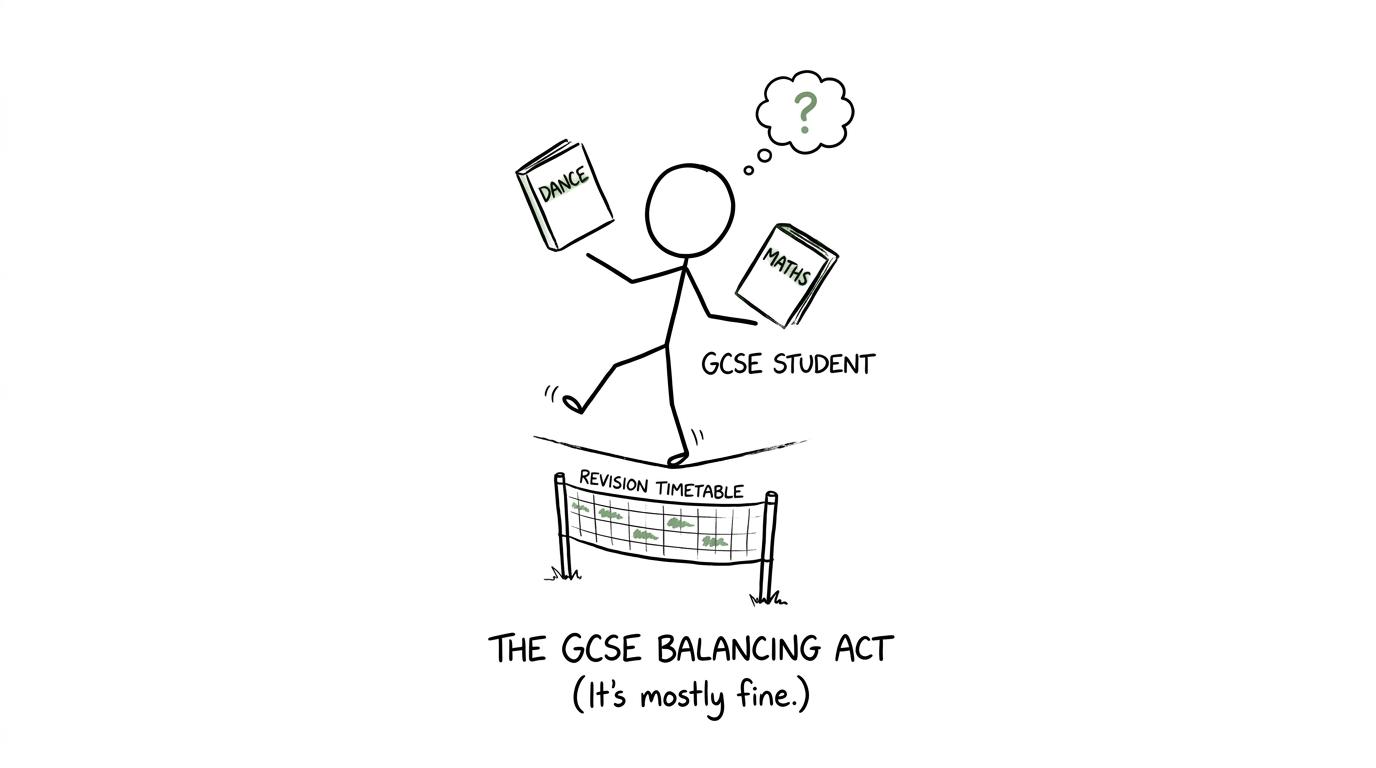 A student balances Dance and Maths books above a tiny revision timetable safety net
A realistic school-week pattern could look like this:
| Day | Dance catch-up | Maths protection |
|---|---|---|
| Monday | Confirm priorities and review theory | Short practice on one weak topic |
| Tuesday | Supervised practical rehearsal | Rest or brief retrieval |
| Wednesday | Choreography notes and refinement | Focused exam questions |
| Thursday | Group rehearsal or teacher feedback | Mark and correct Wednesday’s work |
| Friday | Light Dance recall | Rest |
| Weekend | One longer Dance block | Mini test or timed paper section |
Adjust the length to your health, deadlines and school workload. The important feature is the boundary: Dance has allocated time, but it does not absorb every available hour.
If maths feels equally disrupted, use the one-month GCSE maths revision plan or follow the diagnostic approach in finding your weakest GCSE topics. Diagnose first, then practise the exact skill that is costing marks.
Short assessments can keep maths moving during a practical catch-up period. The Edexcel GCSE maths mini tests, for example, provide focused timed practice with marking support. Use resources matching your own board and tier.
Recover Dance appreciation efficiently
Theory catch-up is more manageable when you organise it around questions rather than pages of copied notes.
For each professional work required by your specification, identify the areas your class has covered. These may include choreographic intention, movement content, performance environment, aural setting, costume, lighting, set or relationships between production features and meaning.
Then create prompts that require recall:
- What was the choreographic intention?
- Which feature supports that intention?
- What specific evidence could I describe?
- What effect or interpretation follows from that evidence?
- How could I compare it with another work?
For your own performance and choreography, recover the reasoning behind decisions, not merely a timeline of rehearsals. You need to understand how skills, processes and choices communicate intention.
Keep answers precise. Description identifies what happens. Analysis explains how a feature creates meaning or effect. Evaluation reaches a supported judgement. If your teacher provides a mark scheme or response guidance, use it to check the quality of your explanation.
Common mistakes when catching up after absence
Trying to complete everything chronologically
The earliest missed lesson is not necessarily the most urgent. Start with assessment deadlines, group-dependent material and knowledge needed for current lessons.
Learning group choreography from an unofficial clip
A clip may hide spacing, timing or recent changes. Use resources approved by your teacher and confirm the material during supervised rehearsal.
Returning at full intensity immediately
After illness or injury, physical readiness matters. Follow professional medical advice and your school’s safe-practice procedures. Tell your teacher about restrictions instead of attempting to conceal them.
Copying theory without testing recall
A complete notebook can create false confidence. Close it and answer a focused question from memory. Checking what you can retrieve reveals the genuine gap.
Sacrificing every other GCSE
Catch-up should restore balance, not create another crisis. Maintain small, regular maths sessions and build towards paper practice. MathsGenie’s guide to using GCSE past papers properly explains the productive cycle: complete, mark, diagnose, repair and retest.
Assuming special consideration will solve missed preparation
Special consideration concerns adverse circumstances affecting assessment and is governed by formal rules. It does not replace teaching or automatically compensate for incomplete course preparation. Speak to your school’s exams officer early and provide any evidence requested.
Build forward from the next manageable action
Extended absence can make you measure progress against an imaginary version of yourself who attended every lesson. That comparison is not useful. Measure progress against yesterday’s position instead: one clarified deadline, one recovered section, one stronger written response.
Ask your Dance teacher for a prioritised plan, rebuild practical work safely and use short retrieval sessions for appreciation. Protect maths with a non-negotiable weekly minimum. As exams approach, move from topic work into GCSE predicted paper practice and use the GCSE maths exam-week checklist to keep the final stage calm.
MathsGenie can carry the maths side of that plan for free. Choose your exam board and tier, then work through revision lessons, practice questions and mini tests before progressing to past papers, predicted papers, mark schemes and video solutions. You do not need to recover every lost week tonight. You need a clear next step, and then another one tomorrow.











