

How to Catch Up GCSE Biology After Absence
Catch up GCSE Biology after absence with a realistic recovery plan covering missed lessons, practical work, exam questions and manageable revision.
Missing several weeks of school can make GCSE Biology feel as though the class has moved on without you. New vocabulary appears on the board, practical results are discussed as if everyone remembers them, and your folder contains a quiet but intimidating gap.
The best way to catch up GCSE Biology after absence is not to copy every missed page. First identify exactly what was taught, then prioritise essential concepts and practical work, use active recall, answer exam questions and ask your teacher to check the gaps. Work in short, repeatable sessions that respect your recovery.
This article gives you a realistic route back into Biology while helping you protect the maths revision that still matters across your other GCSE exams.
Your catch-up checklist
Before building a complicated timetable, complete these steps:
- Confirm your exam board and whether you take separate Biology or Combined Science.
- Ask your teacher for the precise topics, practical activities and assessments you missed.
- Compare that list with your exam board specification.
- Sort each item into learn, practise, ask about or already secure.
- Schedule short sessions across several weeks rather than one exhausting weekend.
- Revisit each topic using retrieval questions and exam-style practice.
- Keep maths moving with a small weekly minimum.
- Review the plan with your teacher if your health or workload changes.
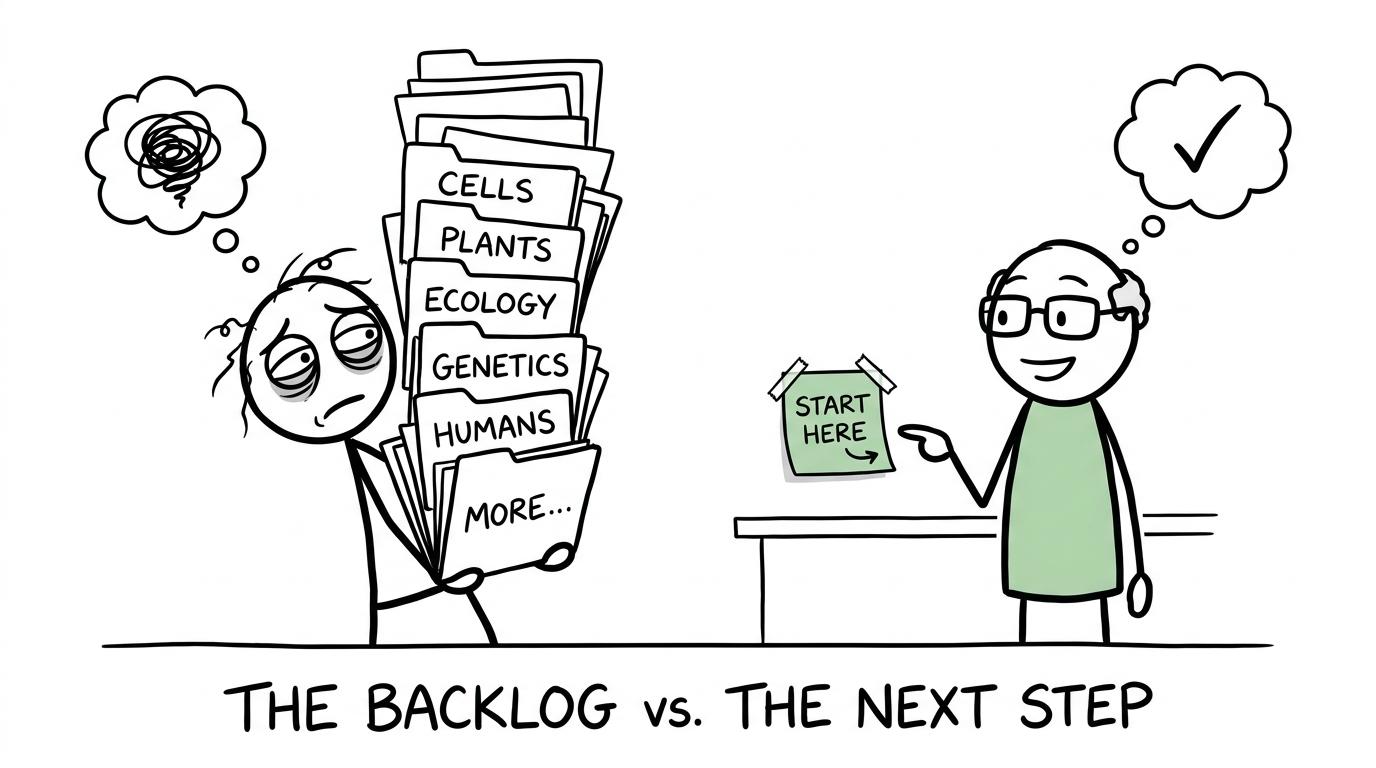 A returning student turns a mountain of Biology folders into one manageable starting point
Begin with the actual gap, not the whole course
After an absence, students often restart from the beginning of the textbook. It feels responsible, but it can waste the limited energy available. You do not need to relearn everything. You need an accurate map of what is missing.
Ask your Biology teacher for:
- lesson titles and specification references;
- slides, worksheets or textbook sections used;
- homework and assessment materials;
- practical activities completed by the class;
- topics that will be assumed in upcoming lessons;
- the next test date and its content.
Do not rely solely on a friend's folder. Their notes can help you see the lesson sequence, but they may omit explanations, corrections or practical details.
Your exam board matters too. AQA, Edexcel, OCR and Eduqas organise content and practical requirements differently. Paper divisions are not interchangeable, and separate Biology contains material beyond the biology component of Combined Science. Check the qualification, specification and tier with your teacher rather than revising from a generic online list.
A simple traffic-light audit is enough:
- Red: not taught to you or not understood;
- Amber: partly understood but cannot answer questions independently;
- Green: can recall and apply the idea without notes.
Red does not mean failure. It means the next decision has become clearer.
Build a realistic recovery timetable
A catch-up plan should fit around current lessons. If all your time goes into old work, this week's teaching becomes next month's backlog.
For most students, a useful starting structure is three Biology sessions each week:
- one learning session of 252525 to 353535 minutes;
- one retrieval and question session of 202020 to 303030 minutes;
- one review session of 151515 to 202020 minutes.
These timings are a framework, not a medical target. If you are still recovering, agree a manageable workload with your family, school or healthcare team. A smaller plan completed consistently is more useful than an ambitious timetable abandoned after two days.
The GCSE one-month revision plan shows how diagnosis, short topic blocks and regular review can structure revision. Its subject is maths, but the underlying rhythm, identify, learn, practise, mark and revisit, transfers well to Biology.
A sensible four-week sequence
Week one: map and stabilise. Collect materials, identify missed topics and keep up with current classroom work. Learn only the concepts needed to understand what your class is doing now.
Week two: rebuild core knowledge. Work through the highest-priority red topics. After each short lesson, close your notes and write or say what you remember.
Week three: apply and correct. Answer board-specific questions, mark them and classify errors. Return to any idea you can describe but cannot apply.
Week four: mix and retest. Combine missed material with older topics. Complete a short timed set and ask your teacher to review anything that remains uncertain.
For a more compressed structure near an assessment, adapt the GCSE one-week revision plan, but avoid forcing several weeks of Biology into seven intense days.
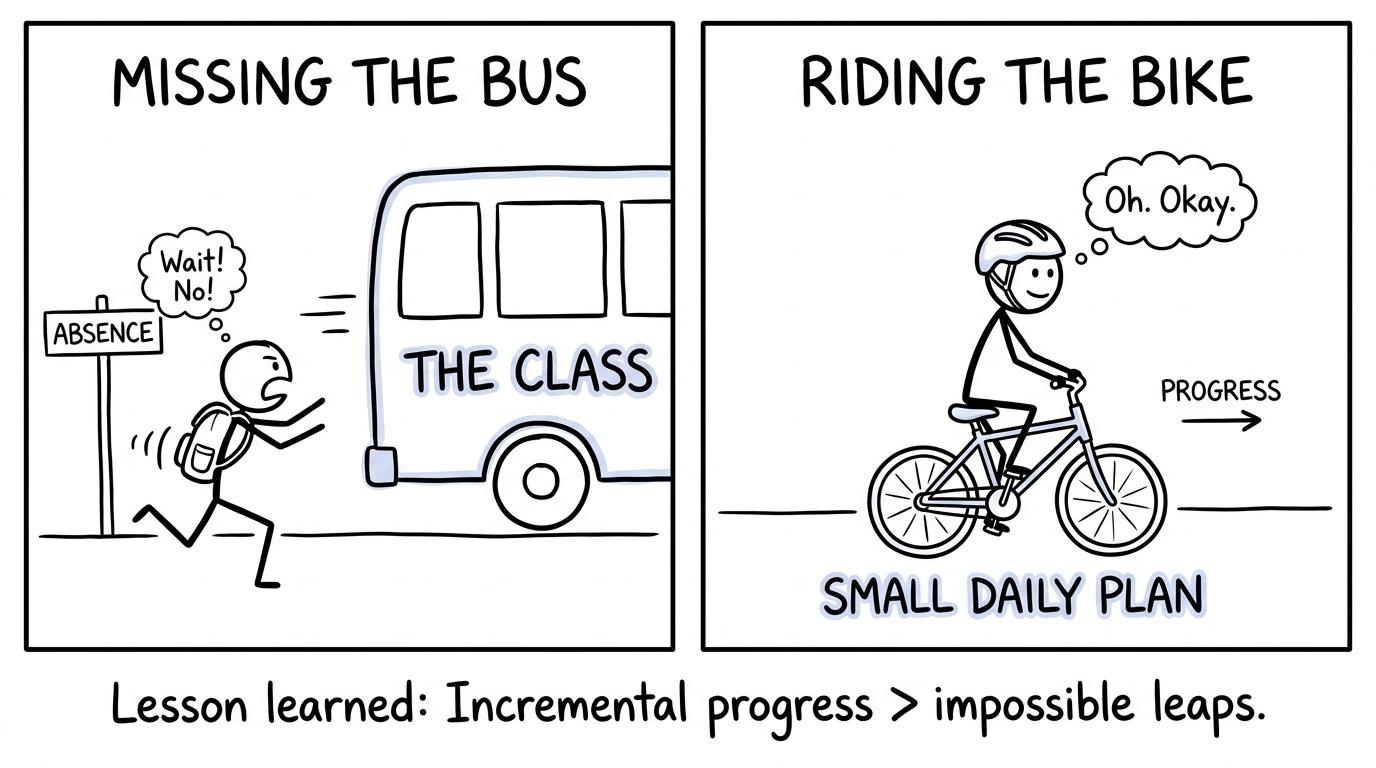 A student chooses a small daily revision bicycle instead of chasing the runaway class bus
Learn Biology actively rather than copying notes
Copying can make a folder look complete while leaving understanding unchanged. Catch-up revision needs to reveal what you can retrieve without support.
Use this cycle for each missed topic:
- Read or watch one concise explanation.
- Reduce the idea to a small set of key terms and relationships.
- Close the resource and recall it from memory.
- Draw and label any relevant biological process or structure.
- Answer specification-matched questions.
- Check the mark scheme and improve weak responses.
- Retest the topic after a short interval.
Biology questions often require more than definitions. You may need to apply knowledge to unfamiliar organisms, interpret data, evaluate a method or explain a process as a logical chain. For an explanation question, each sentence should move the mechanism forward rather than repeat the same fact in different words.
Keep an error log with four categories:
- missing biological knowledge;
- misunderstood command word;
- weak data or mathematical skill;
- incomplete practical reasoning.
This is the same principle behind the GCSE maths revision timetable: organise revision around weaknesses that cost marks, not simply the chapters you enjoy revisiting.
Recover missed practical work properly
Practical work is the part of an absence that notes cannot fully reproduce. GCSE Biology specifications include prescribed practical activities, and practical knowledge is assessed through written examination questions.
Ask your teacher which practicals you missed and whether the school can arrange a suitable opportunity to complete or observe them. Requirements vary by qualification. For example, AQA GCSE Biology specifies required practical activities, while Edexcel identifies mandatory core practicals. Your teacher should confirm what applies to your course.
For every missed practical, make sure you understand:
- the purpose and hypothesis;
- the independent, dependent and control variables;
- the equipment and method;
- relevant risks and safety controls;
- how results are recorded and displayed;
- sources of uncertainty or error;
- ways to improve validity, accuracy and reliability;
- the biological explanation for the expected pattern.
Watching a demonstration or reading a method may support your understanding, but do not assume it replaces any practical experience your school needs you to complete. Speak to your teacher early, particularly if your absence may continue or recur.
In England, schools have responsibilities to support pupils with medical conditions. Where illness is likely to prevent attendance for more than 151515 school days, whether consecutive or cumulative, schools and local authorities may need to consider additional educational support. A parent or carer should discuss prolonged or recurring absence with the school's pastoral, attendance or medical-support team.
Do not neglect the maths inside Biology
Biology is not a maths-free subject. Current GCSE Biology requirements include numerical work, handling data, algebra, graphs and selected geometrical skills. At least 10%10\%10% of marks in GCSE Biology assessments test mathematical skills, although the exact questions and contexts vary.
Skills worth checking include:
- fractions, ratios and percentages;
- percentage change;
- means and sampling;
- standard form and orders of magnitude;
- significant figures;
- rates and simple equations;
- interpreting tables and graphs;
- gradients and correlations;
- area, volume and surface-area-to-volume ratio;
- unit conversion and magnification.
Useful relationships may include:
magnification=image sizeactual size\text{magnification} = \frac{\text{image size}}{\text{actual size}}magnification=actual sizeimage sizeand
percentage change=new value−original valueoriginal value×100\text{percentage change} = \frac{\text{new value} - \text{original value}}{\text{original value}} \times 100percentage change=original valuenew value−original value×100Use the MathsGenie GCSE Maths revision hub to strengthen the underlying maths through free revision lessons, worksheets, exam questions and video solutions. Choose your board and tier so that your wider maths practice matches your actual GCSE entry.
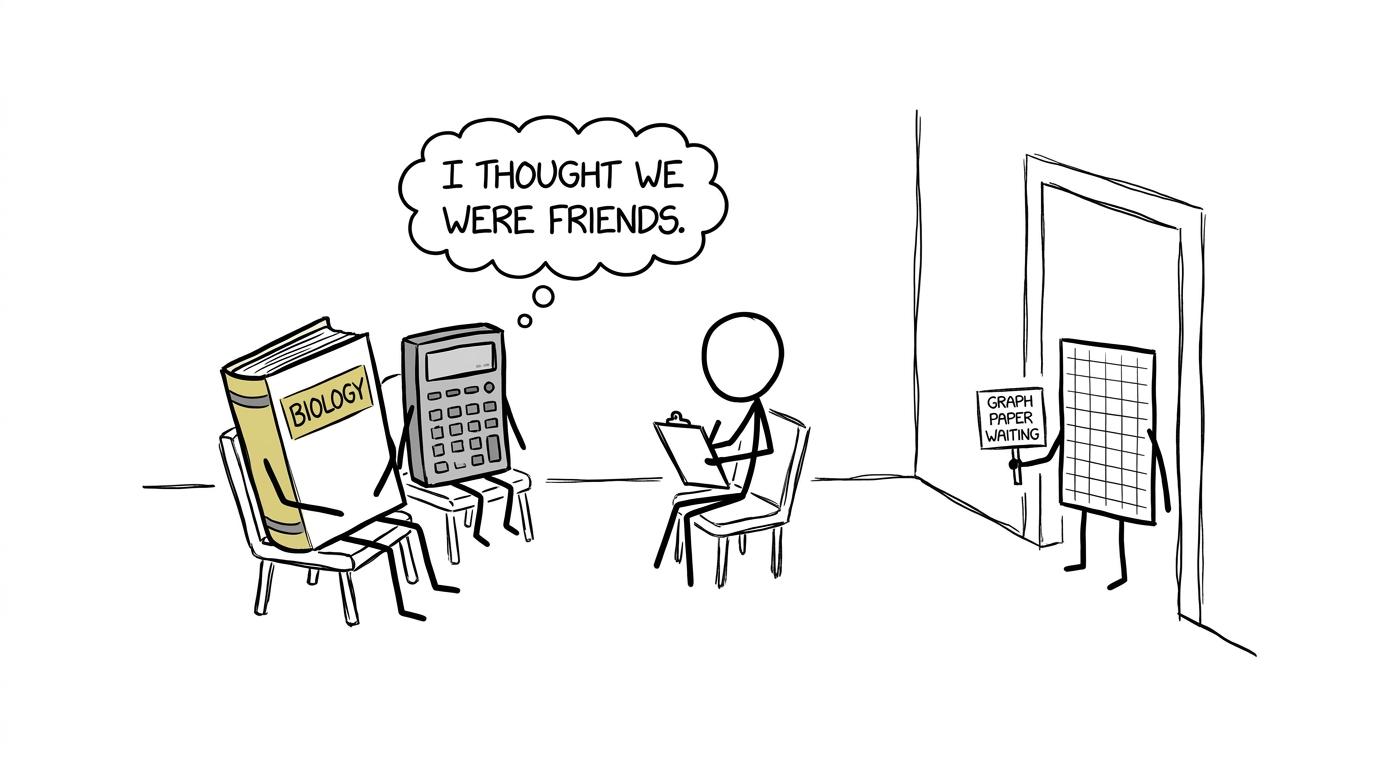 A Biology book and calculator repair their friendship before meeting graph paper
Balance Biology catch-up with maths exam preparation
The danger of catching up in one subject is quietly falling behind in another. Protect a minimum maths routine even during a Biology-heavy week.
Two or three short maths sessions can maintain fluency. Use one session for a weak topic, one for mixed questions and one for a mini test or timed paper section. The MathsGenie home page provides a direct route into free GCSE and A Level maths revision resources.
When exams are close, use predicted GCSE topics sensibly. Predictions can guide practice, but they should never replace full specification coverage or past-paper work. For both Biology and maths, revise what your board can assess, not only what someone expects to appear.
If a test is imminent, the calm priorities in the GCSE night-before plan are valuable: use a short exam-style set, correct a few recurring mistakes and stop at a sensible time.
Common mistakes when catching up after illness
Trying to complete everything immediately
A backlog looks like one large task, but it is really a sequence of smaller decisions. Prioritise lessons needed for current understanding, assessed practical content and foundational ideas.
Making beautiful notes without testing recall
Neat notes are a resource, not proof of learning. Close the page and retrieve the process, terminology or method without prompts.
Ignoring missed practical activities
Practical questions can assess variables, methods, data and evaluation. Tell your teacher exactly which activities you missed and ask what catch-up arrangement is appropriate.
Using resources for the wrong course
Separate Biology and Combined Science are not identical. Nor are AQA, Edexcel, OCR and Eduqas specifications. Confirm your board, qualification and tier before choosing questions.
Completing questions without marking them
The mark scheme shows whether your answer was scientifically precise enough. Record the missing term or reasoning step, then answer a similar question later.
Sacrificing sleep or recovery
Illness is not a motivation problem. If revision worsens symptoms or feels unmanageable, reduce the workload and speak to an adult at home and school. Catching up should support recovery, not compete with it.
Move forward one secure topic at a time
An absence creates missing lessons, not a fixed limit on your grade. The way back is quieter than panic suggests: establish the exact gap, protect current learning, recover practical content, practise active recall and use questions to expose what still needs attention.
Keep your maths foundations moving at the same time. Start with the free MathsGenie GCSE revision hub, choose your exam board and combine revision lessons with practice questions, mini tests, past papers, predicted papers, mark schemes and video solutions. One carefully corrected session today is a stronger beginning than another evening spent worrying about the whole backlog.










