

Best GCSE Subjects to Pair with Further Maths
GCSE subjects to pair with Further Maths explained: compare science, computing, economics and balanced options without creating an unmanageable workload.
Choosing GCSE options can feel like trying to predict your future before you have finished understanding the present. If Further Maths is on your list, it is tempting to surround it with every subject that sounds difficult or impressive.
That is rarely the best strategy. The most useful GCSE subjects to pair with Further Maths are separate sciences, Computer Science, Design and Technology, Economics and Geography. But the right combination depends on your interests, possible A Level choices and total workload. An essay-based, practical or creative subject may produce a healthier timetable than another heavily technical option.
Further Maths should stretch your mathematical thinking. It should not turn every school evening into a contest against exhaustion.
The short GCSE subject checklist
Before choosing an option, ask:
- Does it support an A Level or career route I may genuinely consider?
- Do I enjoy the subject enough to practise when it becomes difficult?
- How is it assessed: examinations, practical work, programming or an extended portfolio?
- Will major deadlines collide with Further Maths and other subjects?
- Am I choosing it for a clear reason, rather than because it sounds impressive?
- What grades or subjects does my intended sixth form require?
School option blocks, entry rules and available qualifications differ. Check your school's current booklet and speak to the relevant teachers before finalising anything.
First, understand what GCSE Further Maths is
At GCSE age, “Further Maths” normally means an additional qualification studied alongside GCSE Mathematics. The exact title and awarding organisation vary between schools.
For example, the AQA Level 222 Certificate in Further Mathematics is an untiered qualification intended for students expected to achieve grades 777 to 999 in GCSE Mathematics. It develops higher-order skills, particularly algebraic reasoning, and helps prepare students for Level 333 study. It is not a replacement for GCSE Mathematics.
This matters because your first priority remains strong GCSE Maths. Algebra, graphs, geometry and problem-solving form the platform on which Further Maths stands. You can check the full landscape through the GCSE Maths revision hub and compare content using the GCSE topics by exam board and tier.
Do not assume that taking GCSE Further Maths automatically guarantees entry to A Level Further Mathematics. Sixth forms set their own requirements, commonly based on a high GCSE Maths grade as well as overall attainment. Always check the current admissions policy of the institution you may attend.
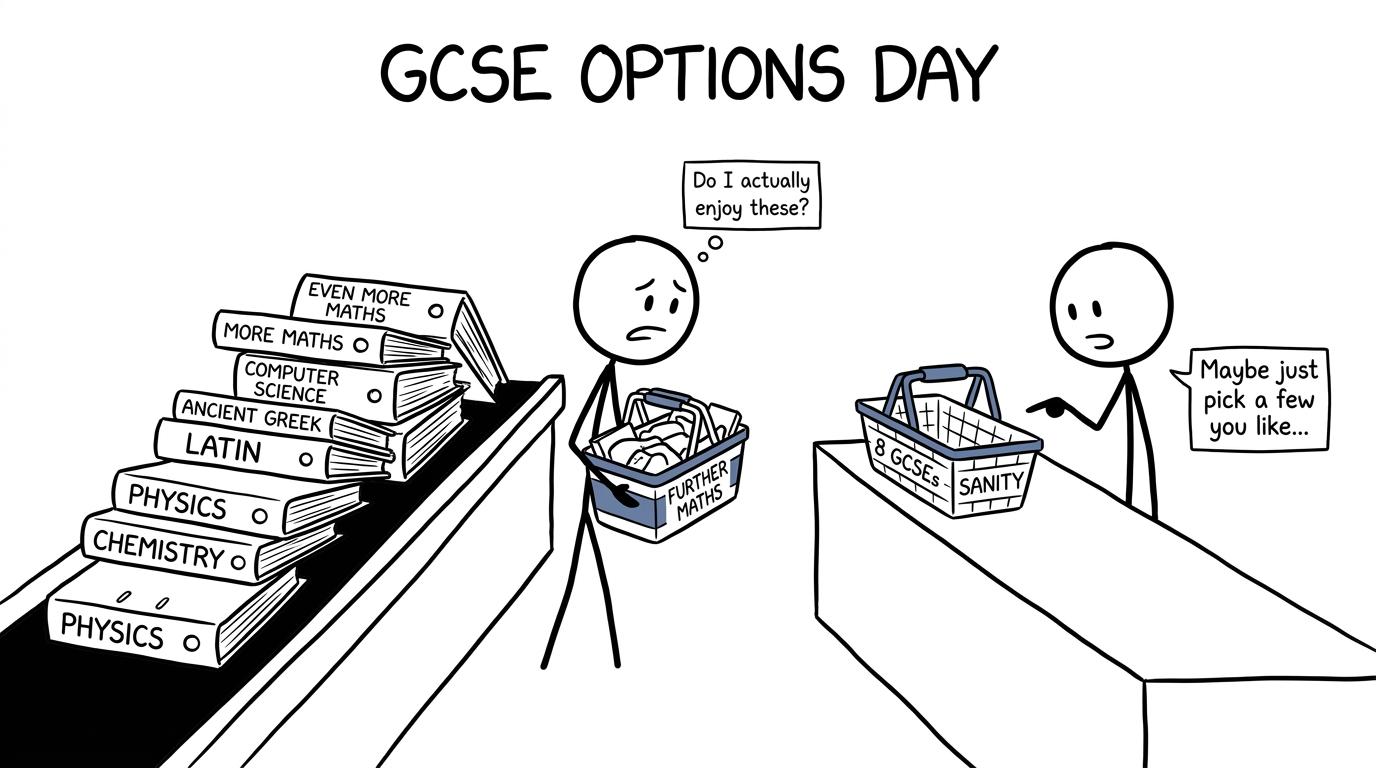 A student choosing a sensible basket of GCSE subjects rather than buying every option
The strongest STEM subjects to take alongside Further Maths
Separate sciences, especially Physics
If your school offers separate sciences as an option, Physics has the clearest conceptual connection with mathematics. Students meet equations, proportional relationships, graphs, units and multi-stage problem-solving. These habits complement Further Maths even when the specifications do not directly overlap.
Separate sciences can also preserve flexibility if you later consider A Levels in Physics, Chemistry or Biology. However, Combined Science does not close the door automatically. Sixth-form entry policies vary, so compare the actual requirements rather than relying on playground mythology.
Triple Science carries substantial content. It makes sense for students who enjoy science and may pursue STEM subjects, but it should not be selected merely to create the most “academic-looking” timetable.
Computer Science
Computer Science pairs naturally with Further Maths because both reward logic, decomposition and precise thinking. Programming also teaches a useful lesson: an answer can be nearly right and still fail because one instruction is misplaced.
The overlap is mainly in ways of thinking, not identical syllabus content. GCSE Computer Science includes programming, algorithms, data representation, computer systems and networks. It will not simply feel like another maths lesson.
Choose it if you are interested in computing and willing to debug code patiently. Do not choose it solely because you have heard that it is necessary for a Computer Science degree. Mathematics is particularly important for many highly quantitative university Computer Science courses, while requirements vary between institutions.
Design and Technology
Design and Technology can be an excellent applied partner. Measurement, scale, modelling and accuracy give mathematical ideas a physical purpose. It also develops design judgement and iterative problem-solving.
The caution is workload shape. Practical development and portfolio deadlines can consume time in concentrated bursts. Ask when these deadlines occur and how much independent work is typical at your school.
Economics, Geography and data-focused options
Economics
Where GCSE Economics is offered, it can suit students curious about markets, incentives, policy and decision-making. Percentages, rates, graphs and interpreting evidence make mathematical confidence useful.
Yet Economics is not Further Maths with money attached. Written explanation and evaluation matter. It is also not normally required before A Level Economics, although individual sixth forms may have their own entry rules.
Economics is therefore a sensible choice when you enjoy both numerical evidence and structured argument. Taking it only because you associate Further Maths with finance is a weaker reason.
Geography
Geography is one of the most balanced partners. It uses statistics, graphs, scale, fieldwork evidence and interpretation while also developing extended writing and evaluation. That mixture can be valuable when much of your timetable is already calculation-heavy.
In England, Geography or History forms the humanities element of the English Baccalaureate, alongside English, maths, science and a language. The EBacc is a subject combination rather than a separate qualification. Curriculum arrangements differ across Wales and Northern Ireland, so follow the guidance for your school.
Geography is especially worth considering if you like data but also want to understand how evidence relates to people, places and environmental systems.
When a contrasting subject is the smarter choice
A good subject combination does not need every component to resemble Further Maths. In fact, contrast can protect both motivation and flexibility.
History develops evidence-based argument. A modern language builds communication and disciplined recall. Art, Music and Drama offer different forms of creative thinking. Religious Studies and English Literature strengthen analysis and extended writing.
None of these subjects weakens an otherwise strong mathematical profile. If you enjoy one and can perform well in it, the contrast may be an advantage. It gives your week a different rhythm and prevents your entire academic identity from being tied to one skill set.
The key is to investigate assessment demands. Art may offer a refreshing escape from equations but can involve a significant portfolio. History provides variety but requires regular factual recall and timed writing. Languages need frequent short practice rather than occasional revision marathons.
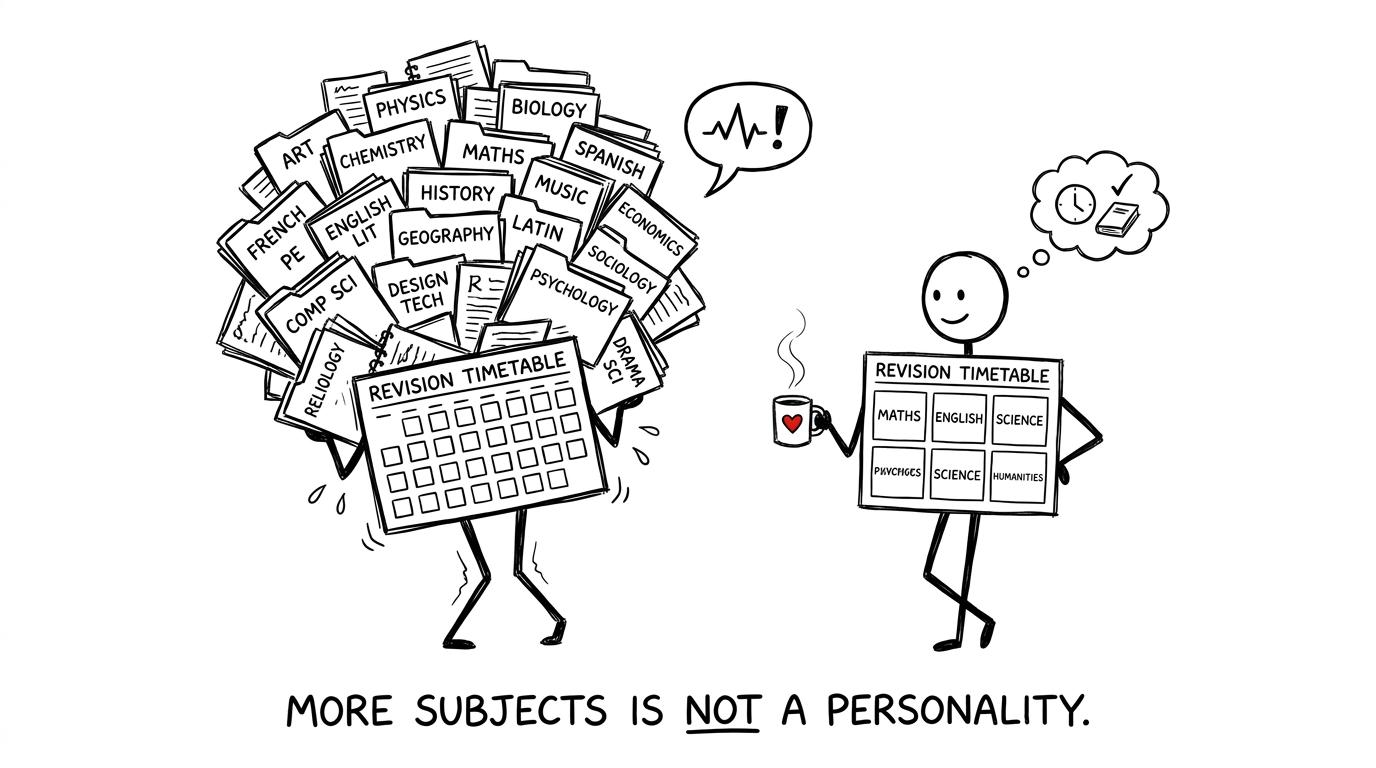 A balanced revision timetable calmly drinking tea beside an overloaded timetable
Which combinations can create unnecessary stress?
No subject combination is universally “too hard”. Stress usually comes from the interaction between workload, interests and assessment deadlines.
Too many content-heavy STEM subjects
Further Maths, separate sciences, Computer Science and Design and Technology can form a coherent package. They can also create a dense timetable containing difficult examinations, programming tasks, practical work and project deadlines.
This combination is reasonable for a student who enjoys every component and works consistently. It is unnecessary if several subjects are being selected only to prove academic ability.
Too many portfolio subjects
Art, Design and Technology, Drama and Music may involve substantial practical or portfolio commitments, depending on the specification. Combining several can produce deadline clusters even if you enjoy the lessons.
Do not judge workload only by the number of final written papers. Ask about controlled assessment, practical preparation and work completed outside lessons.
Choosing both Economics and Business without checking the content
Economics and Business are distinct subjects, but some students find that taking both provides less breadth than combining one with Geography, History, Computer Science or a creative option. That does not make the pairing wrong. It simply means there should be a positive reason for choosing both.
Treating every option as preparation for university
GCSE choices matter, but they do not need to reproduce your future degree timetable. Many later courses care more about the appropriate A Levels and strong grades than whether every related subject appeared at GCSE.
If you are already thinking ahead, read A Level choices after GCSE Maths and preview the free A Level Further Maths revision resources. Previewing real material is more informative than choosing from a subject name alone.
How to choose a balanced combination
Use three tests: enjoyment, usefulness and manageability.
Enjoyment matters because difficult subjects require sustained effort. Interest does not remove hard work, but it makes that work easier to return to.
Usefulness means the subject supports a realistic future route or develops skills you value. It does not mean every choice must be vocational.
Manageability considers your whole timetable. Include homework, revision, practical deadlines, travel, responsibilities and activities outside school.
You might classify each possible option as:
- a clear future requirement;
- a useful supporting subject;
- a subject chosen mainly because you enjoy it.
A strong combination often contains all three. If every option sits in the first category, you may be treating uncertain future plans as fixed obligations.
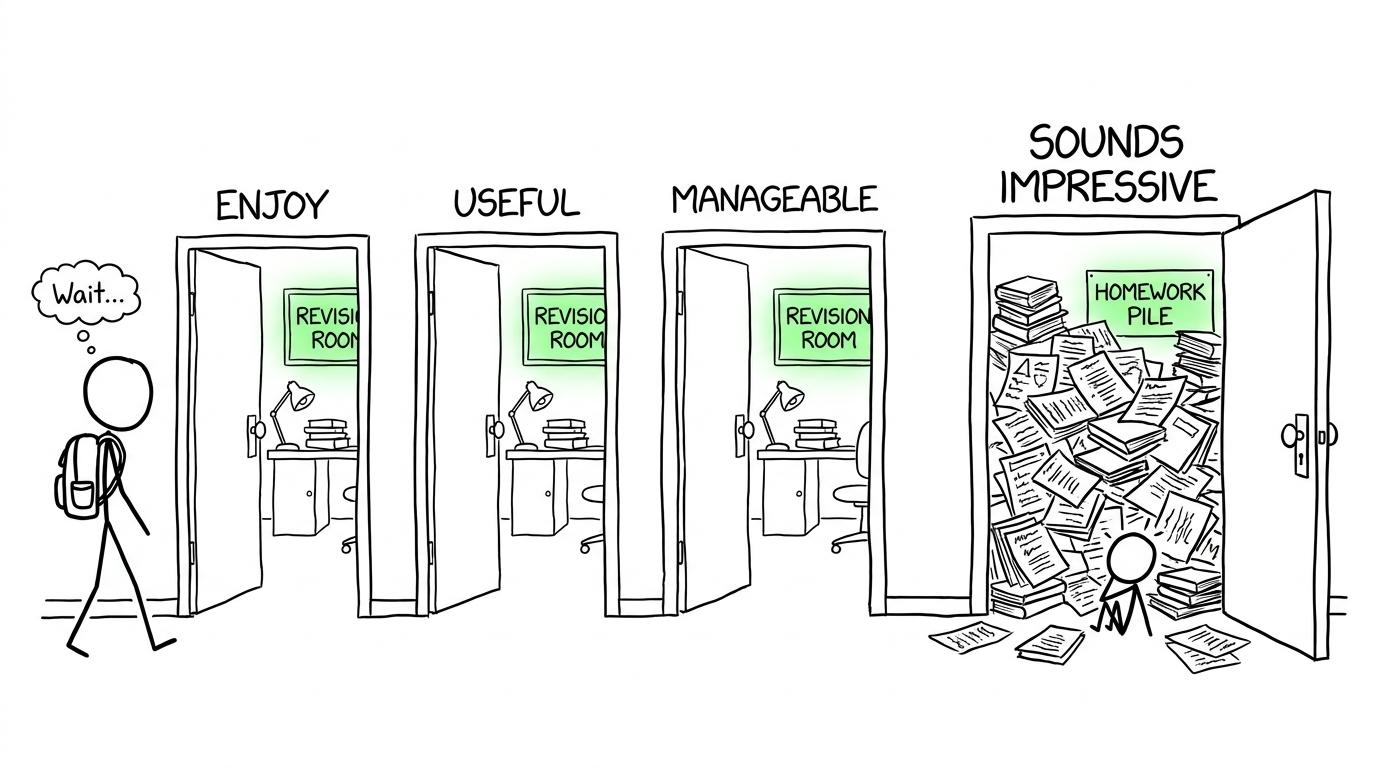 Three useful subject-choice doors and one door leading to a mountain of homework
Common mistakes when choosing GCSE subjects
Assuming the hardest-looking combination is automatically best
Universities and sixth forms value attainment and appropriate preparation. A crowded list of demanding subjects is not useful if it lowers your grades or damages your wellbeing.
Ignoring your school's actual specification
AQA, Edexcel, OCR and Eduqas organise and assess courses differently. For additional mathematics qualifications, the title and board may differ again. Read the specification used by your centre rather than relying on a friend's experience elsewhere.
Neglecting ordinary GCSE Maths
Further Maths rests on secure core skills. If algebraic manipulation, fractions or graphs remain unreliable, repair those foundations first. The best order for learning GCSE Maths topics provides a structured route through them.
Choosing around a career you do not yet understand
It is sensible to keep doors open. It is less sensible to build your entire timetable around a career title you have only encountered briefly. Investigate the work, relevant A Levels and current entry requirements before allowing it to determine every option.
Underestimating assessment congestion
Write down mock periods, portfolio deadlines and practical assessments for each proposed subject. A combination can look balanced on paper while becoming difficult during one crowded half-term.
Build the maths foundation behind your choices
The best combination is not the one that earns the loudest reaction. It is the one you can study with curiosity, consistency and enough space to recover when something goes wrong.
Once your options are settled, turn attention back to the qualification that links them. Use MathsGenie's free revision lessons and practice questions to strengthen individual topics, then test your understanding with mini tests. When you are ready, the AQA GCSE Further Maths past papers provide papers, mark schemes and worked solutions where available.
Build towards full papers gradually. The guide to when to start GCSE past papers explains how to move from topic practice to timed work, while redoing past papers effectively shows how to convert mistakes into better methods.
Start with one honest decision: choose subjects you have a reason to take. Then let MathsGenie's revision lessons, practice questions, video solutions, past papers, predicted papers and mark schemes help you make the most of that choice.











