AI Quiz GCSE French: A Safe, Productive Guide
AI quiz GCSE French guidance for productive self-testing, better prompts, reliable checking and a balanced revision routine for busy GCSE students.
Revision can become strangely inefficient when two subjects demand completely different things. Maths asks you to show a method. French asks you to retrieve a word, recognise a sound or build a sentence before it disappears from memory.
An AI quiz GCSE French tool can help with the second problem. You can ask one to test vocabulary, grammar, translation, reading and speaking questions, then adapt the difficulty to your answers. But it should be treated as an unverified practice partner, not a teacher, specification or mark scheme. AI can produce convincing mistakes, use vocabulary outside your course and judge open responses inconsistently.
The productive approach is simple: give the tool precise instructions, answer from memory, check important feedback against trusted course materials, and keep your French practice short enough that it does not consume the time reserved for maths.
The quick checklist
Before beginning an AI French quiz:
- confirm your exam board, tier and current specification
- choose one skill and one topic
- provide an approved vocabulary list or teacher-checked material where possible
- ask for one question at a time
- answer before requesting any hint
- make the AI explain corrections briefly
- verify doubtful grammar, vocabulary and exam claims
- save errors, not entire conversations
- retest mistakes on another day
- never enter personal or sensitive information
This turns a chatbot from an answer machine into a retrieval tool. That distinction matters. Reading an answer can feel fluent; producing it without help is what reveals whether you know it.
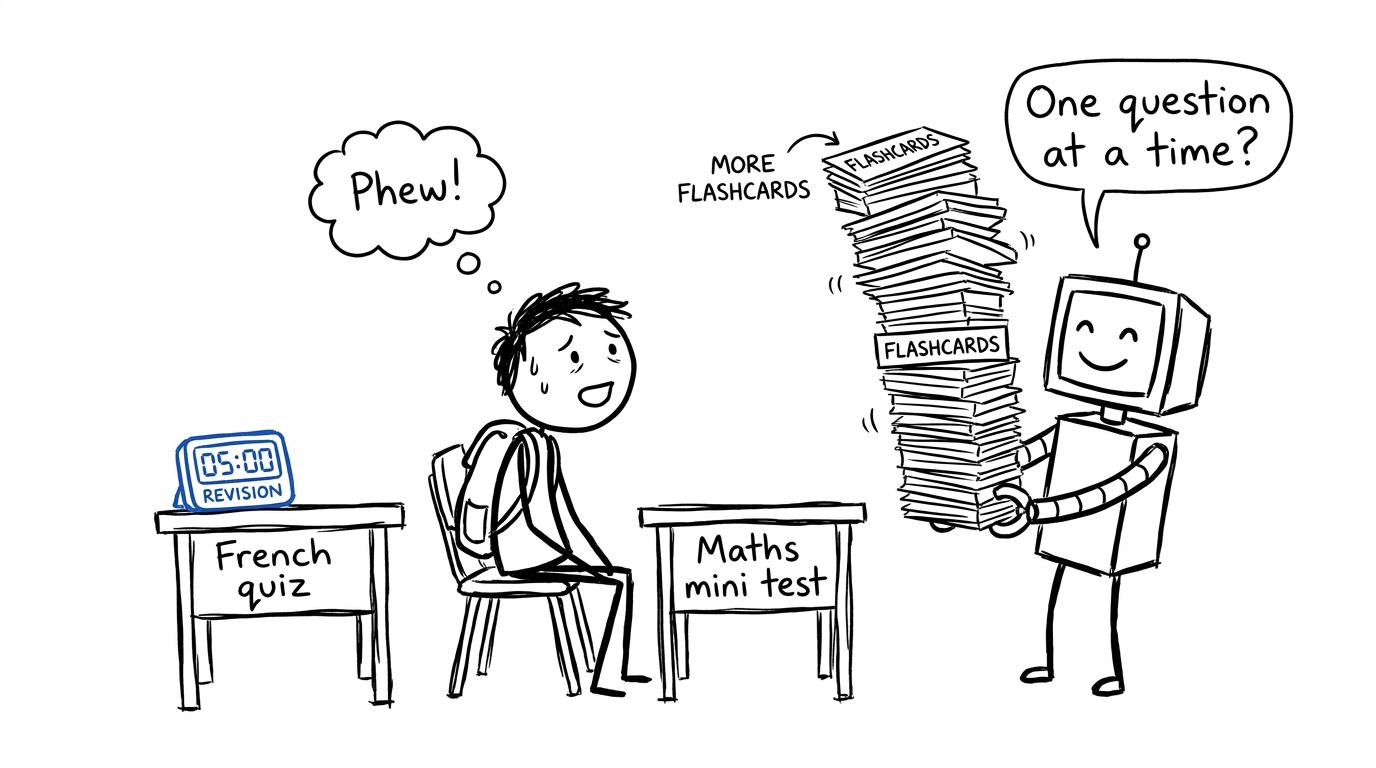 A student balancing a French quiz and maths revision while a robot offers one flashcard at a time
What can an AI French quiz test?
GCSE French assesses listening, speaking, reading and writing. For the reformed qualifications first assessed from summer 2026, official specifications also include tasks involving dictation and reading aloud. Precise formats differ between AQA, Pearson Edexcel and Eduqas, so your own specification must control the quiz rather than the AI's general knowledge.
Vocabulary retrieval
AI is useful for short recall questions. It can give an English word for you to translate, ask you to select the correct French meaning, or retest words you missed.
Ask it to stay within a vocabulary list that you paste into the conversation. Without that boundary, it may introduce obscure synonyms or phrases that are valid French but unhelpful for your course.
Good retrieval practice is slightly uncomfortable. If the tool reveals the answer after one second, the quiz becomes reading. Ask it to wait for your attempt, record errors and repeat missed words later in a different order.
Grammar and translation
A chatbot can test verb forms, adjective agreement, negatives, pronouns and short translations. It can also identify a likely error and ask you to repair it.
This is useful, but grammar feedback needs checking. French sometimes permits more than one natural translation, while an AI tool may insist that its preferred wording is the only correct answer. Ask it to separate:
- genuine grammatical errors
- spelling or accent errors
- answers that are correct but phrased differently
- stylistic improvements that are optional
That prevents a useful alternative from being marked wrong merely because it differs from the model's original response.
Reading and speaking preparation
AI can generate a short passage and ask comprehension questions. It can also act as an interviewer, asking follow-up questions on school, free time, relationships, travel, technology or the environment.
For speaking, the value is in formulating an answer under pressure. A text chatbot cannot reliably judge pronunciation, and voice systems vary in how accurately they recognise learners' speech. Use teacher feedback and approved audio resources for sound accuracy. Treat automated pronunciation scores as clues, not marks.
How to prompt an AI quiz GCSE French tool
A vague request such as “quiz me on French” leaves too many decisions to the model. A productive prompt defines the course, level, content, format and feedback rules.
You could adapt this template:
I am preparing for GCSE French with [exam board] at [foundation/higher] tier. Quiz me only on [topic or supplied vocabulary]. Ask one question at a time and do not reveal the answer before I respond. After each answer, say whether it is correct, give one short correction, and record the words or grammar points I miss. After ten questions, retest my errors in a new order. If you are uncertain, say so rather than guessing.
For a more focused session, change the task:
- “Use English-to-French retrieval only.”
- “Test present, perfect and near-future verb forms.”
- “Ask short reading questions, but do not translate the passage for me.”
- “Run a brief speaking-style conversation and ask one follow-up at a time.”
- “Use only the vocabulary pasted below.”
Do not ask the tool to predict your grade from a casual chat. A real grade depends on performance across the assessed papers and official grade boundaries, not a chatbot's impression.
Use a closed-source quiz when accuracy matters
“Closed-source” here does not refer to the software licence. It means restricting the quiz to material you provide: a vocabulary list, class notes, teacher-approved sentences or a section of your specification.
Tell the AI:
Build every question and correction only from the material below. If the material does not contain enough information, tell me instead of adding facts.
This does not guarantee accuracy, but it reduces the space in which the model can improvise. It is particularly helpful when older and reformed GCSE specifications are both visible online. An AI tool may otherwise blend legacy tasks with the format used for exams from summer 2026 onwards.
Always tell it your exam board. AQA, Pearson Edexcel and Eduqas share national subject requirements, but their paper structures and task details are not interchangeable.
Turn each quiz into a feedback loop
A quiz is only as useful as the action it changes. The best loop has four stages:
- Retrieve: answer without notes or translation software.
- Check: compare the response with approved material.
- Record: write down the smallest specific error.
- Retest: return to that error after a gap.
Keep an error log with categories such as vocabulary, verb form, agreement, word order, accent and misunderstood question. “French was bad today” gives you nothing to practise. “Used the infinitive after the subject instead of conjugating the verb” gives you a next step.
The same discipline improves maths revision. MathsGenie's guide to finding your weakest GCSE topics explains how to diagnose a gap, practise it and retest it rather than repeatedly revising comfortable material.
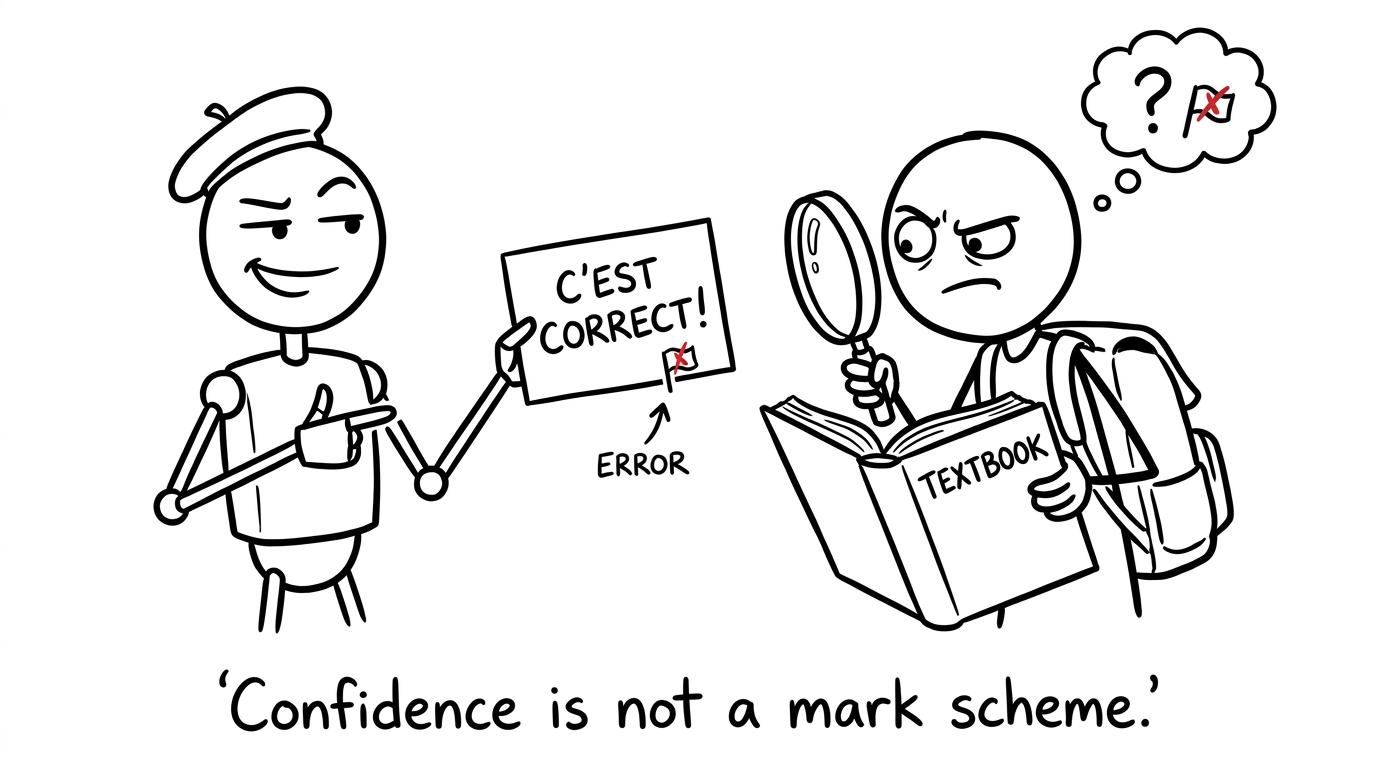 A confident robot gives French advice while a student checks it against a trusted book
Where AI tends to give bad information
The Department for Education warns that generative AI output can be inaccurate, biased, out of date, taken out of context or simply false while sounding plausible. That risk appears in several predictable ways during French revision.
Invented exam rules
An AI may confuse old and new specifications, mix GCSE with International GCSE, or describe one board's paper as if it applies to every student. Check paper formats, timings, vocabulary requirements and assessment rules through your school and official exam-board materials.
Overconfident language corrections
A model may “correct” acceptable French, miss an agreement error or offer an unnatural translation. Be especially cautious when it claims there is only one possible answer. Ask for the grammatical rule, then verify that rule using your notes or teacher-approved resources.
Unreliable marks and grades
A chatbot does not possess the authority of an examiner. It may apply a writing mark scheme loosely or award marks for features that are not relevant to your board. Use its comments to notice possible weaknesses, but use official sample materials, mark schemes and teacher feedback to understand assessment.
This is the same reason maths students should mark against proper schemes. On MathsGenie, Edexcel GCSE Maths past papers place papers and official mark schemes together, with worked solutions where available.
Fabricated quotations or sources
AI can invent a source, textbook reference or specification detail. Never assume a citation exists merely because it looks formal. For revision, the safer hierarchy is your current specification, official assessment materials, your teacher and checked course resources.
Privacy and unsuitable tools
Do not submit your full name, school, login details, assessment records or personal conversations. Follow the tool's age requirements and your school's AI policy. If an assignment has rules about AI assistance, follow them; self-quizzing does not make every other use acceptable.
Balance French quizzing with maths revision
AI's greatest temptation is endless variation. There is always another quiz, another correction and another regenerated question. The session feels active while the evening quietly disappears.
Set a finish condition before starting: one topic, ten questions, one error list. Then move to the next subject.
For maths, open the GCSE Maths revision hub and choose resources matching your board and tier. If time is limited, the GCSE twenty-minute revision routine provides a repeatable structure based on recall, exam questions and immediate marking.
A balanced evening might contain a short French retrieval quiz followed by a focused maths topic session. When exams approach, add timed work through the approach in the GCSE one-month maths revision plan. The important idea is not the exact timetable. It is that each session has a defined purpose and an honest check at the end.
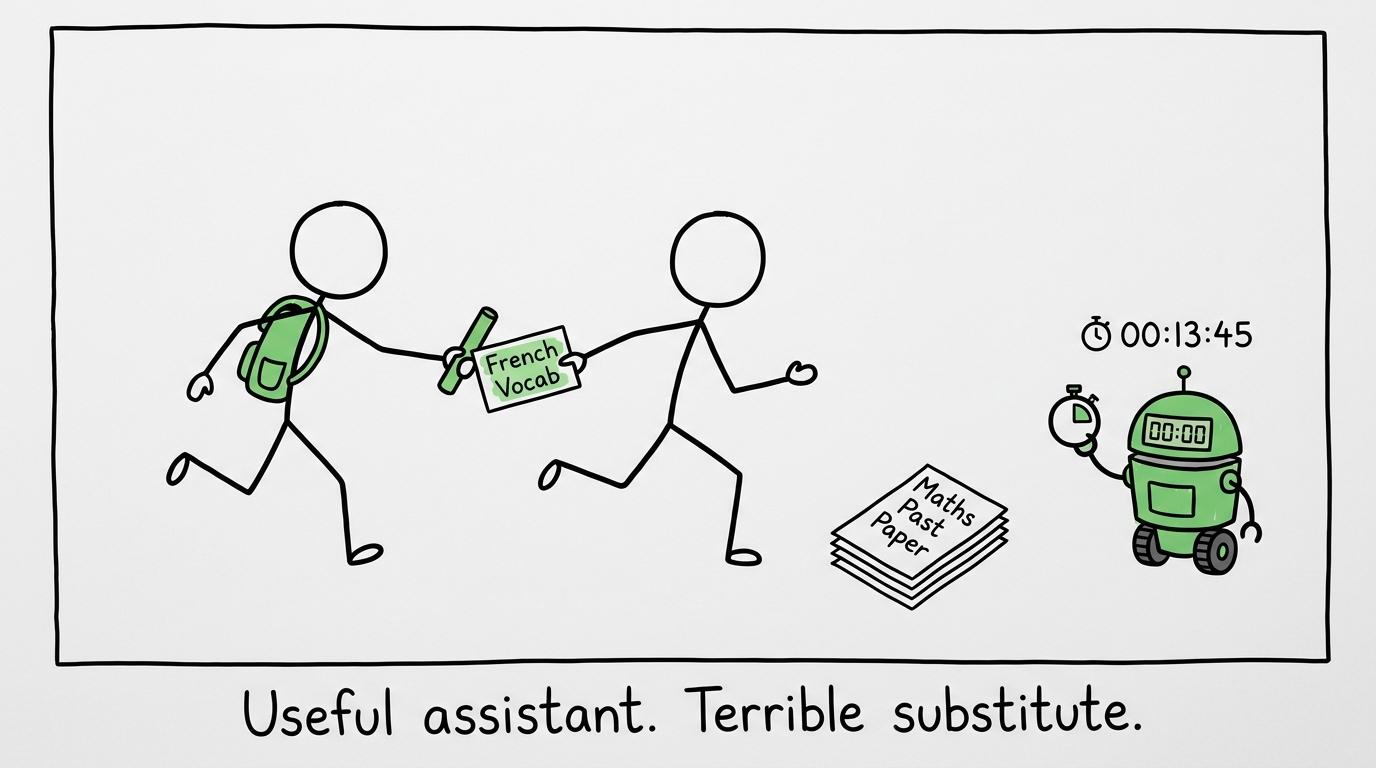 A student runs a revision relay while a robot acts as the stopwatch rather than running the race
Common mistakes when using AI for French revision
Letting the AI answer first
If you ask for a question and explanation together, you remove retrieval. Insist that the model waits for your attempt.
Quizzing an entire subject at once
“Test all GCSE French” produces shallow, unpredictable coverage. Choose one theme, grammar point or vocabulary set.
Trusting confident feedback
Fluent wording is not proof. Check corrections that conflict with your notes, and ask a teacher when the distinction affects exam technique.
Copying polished answers
An impressive model answer can hide what you can produce independently. Improve your own response in small steps rather than replacing it with the AI's version.
Saving scores instead of errors
A score tells you what happened. An error log tells you what to do next. The principle also sits at the centre of efficient GCSE maths revision.
Replacing real papers with generated questions
AI-generated questions are supplementary. They do not reproduce an exam board's quality control or exact assessment style. In maths, learn when to start GCSE past papers, then combine official papers with targeted topic work and predicted papers.
Make AI the assistant, not the authority
Yes, you can use AI to quiz yourself on GCSE French. It is best at creating rapid retrieval practice, adapting follow-up questions and helping you organise mistakes. It is weakest when asked to act as an examiner, provide definitive specification advice or replace checked teaching materials.
Keep the relationship clear: you choose the source, the topic and the stopping point. The AI supplies questions. Trusted materials verify the answers.
Then apply the same disciplined loop to maths. Use MathsGenie's free revision lessons and practice questions to repair weak skills, mini tests to check recall, and past papers to build exam timing. Nearer the exams, add predicted papers, mark schemes and video solutions so every mistake leads to a specific correction.
Start at the MathsGenie GCSE Maths revision hub, choose your exam board and tier, and make your next session small enough to begin today.