Question 2
FThe diagram shows a fractionating column. Fractions are collected at outlets P, Q, R, S and T.
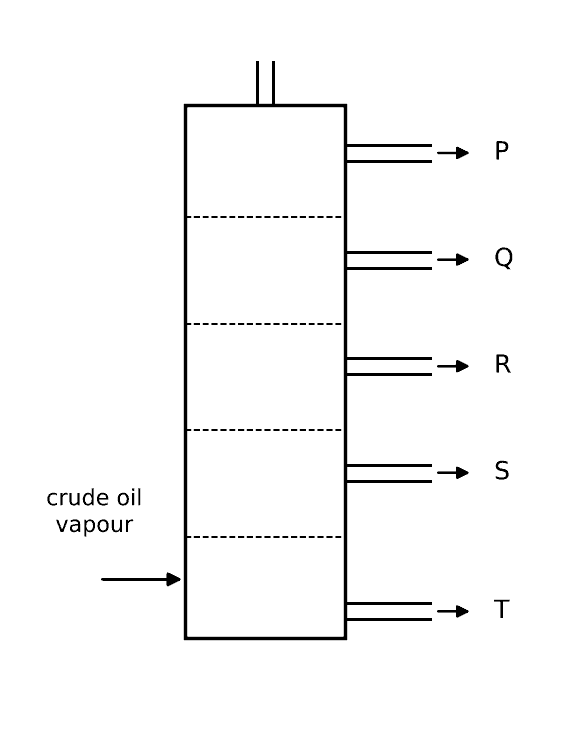
Statement 1: The molecules in the fraction collected at P have weaker intermolecular forces than the molecules in the fraction collected at S.
Statement 2: The fraction collected at T contains the hydrocarbons with the lowest boiling points.
Statement 3: The molecules in fraction R are larger than those in fraction Q, so more covalent bonds must be broken when fraction R boils.
Statement 4: The temperature at outlet Q is lower than the temperature at outlet S.
Which statements are correct?
1, 3 and 4 only
2 and 3 only
1 and 4 only
1, 2 and 4 only
6.2 Organic chemistry Questions
63 exam-style questions on OCR GCSE Chemistry 6.2 Organic chemistry, covering 6.2.1 Crude oil and fractional distillation, 6.2.2 Cracking and dependence on hydrocarbons, 6.2.3 Functional groups and homologous series, 6.2.4 Reactions of alkanes, alkenes and alcohols, 6.2.5 Addition polymerisation and repeat units, 6.2.6 Naturally occurring polymers, 6.2.7 Chemical cells and fuel cells, and 6.2.8 Condensation polymerisation and how to make one. Each one has a worked solution and a mark scheme showing where the marks go.