Question 10
HThis question is about alcohols.
The table shows the molecular formulae of the first four alcohols.
| Alcohol | Molecular formula |
|---|---|
| methanol | CH3OH\mathrm{CH_{3}OH}CH3OH |
| ethanol | C2H5OH\mathrm{C_{2}H_{5}OH}C2H5OH |
| propanol | C3H7OH\mathrm{C_{3}H_{7}OH}C3H7OH |
| butanol | C4H9OH\mathrm{C_{4}H_{9}OH}C4H9OH |
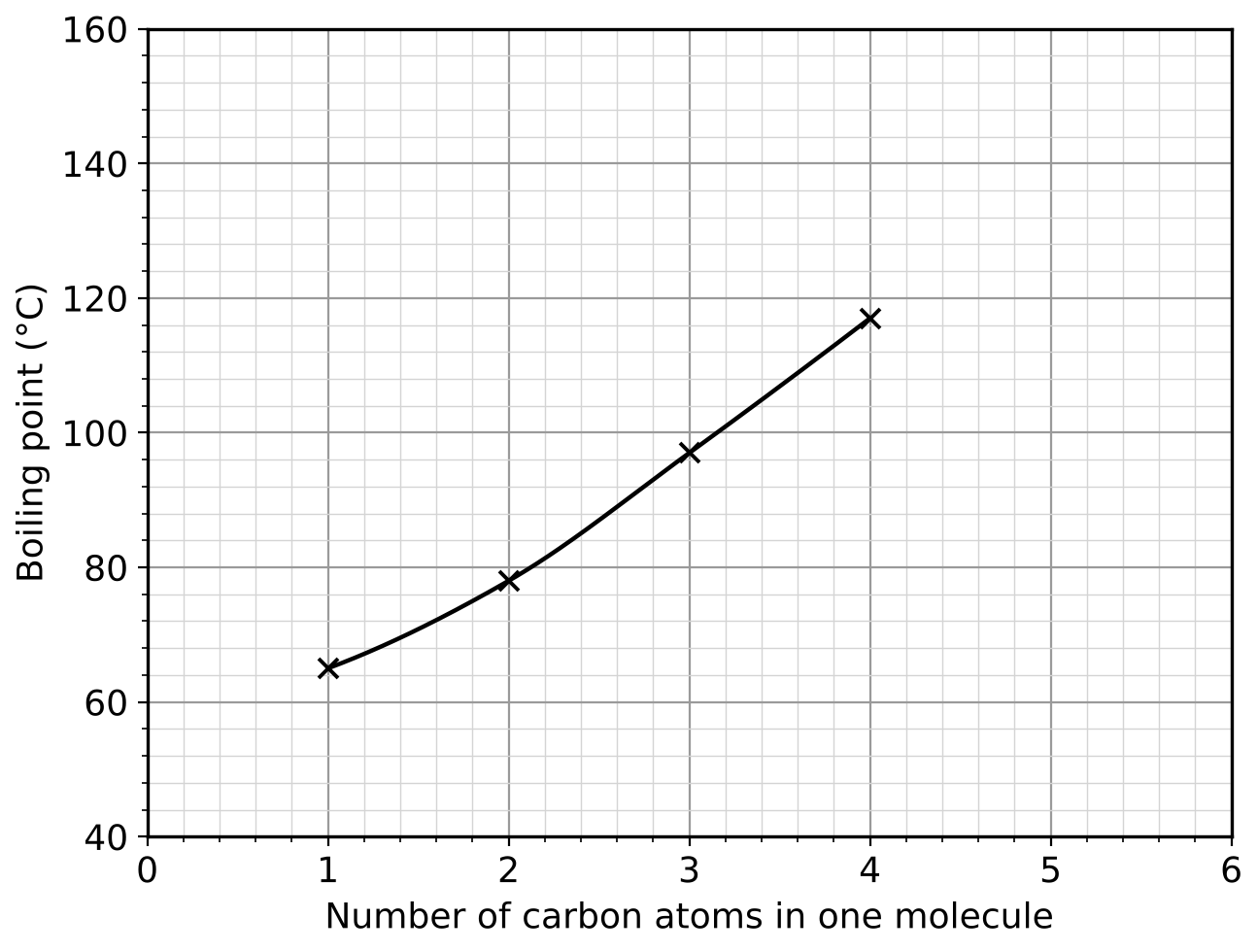
The graph shows the boiling points of the first four alcohols.
a.[1]
Name the functional group present in all alcohols.
b.[1]
Write the structural formula of butanol. The −OH\mathrm{-OH}−OH group is at the end of the carbon chain.
c.[2]
Explain how the information in the table and the graph shows that the alcohols form a homologous series.
d.[2]
The fifth alcohol in the series is pentanol.
Predict the molecular formula and the boiling point of pentanol. Use the table and the graph.
e.i.[1]
Butanol can be oxidised to a carboxylic acid.
Name the carboxylic acid made.
e.ii.[1]
Write the formula of this carboxylic acid.
f.[2]
Propanol burns completely in oxygen.
Write the balanced symbol equation for this reaction.
6.2 Organic chemistry Questions
63 exam-style questions on OCR GCSE Chemistry 6.2 Organic chemistry, covering 6.2.1 Crude oil and fractional distillation, 6.2.2 Cracking and dependence on hydrocarbons, 6.2.3 Functional groups and homologous series, 6.2.4 Reactions of alkanes, alkenes and alcohols, 6.2.5 Addition polymerisation and repeat units, 6.2.6 Naturally occurring polymers, 6.2.7 Chemical cells and fuel cells, and 6.2.8 Condensation polymerisation and how to make one. Each one has a worked solution and a mark scheme showing where the marks go.