Question 6
FA student makes a simple chemical cell.
The student puts a strip of copper and a small piece of zinc foil into dilute sulfuric acid and connects them to a voltmeter.
The student records the potential difference every 20 minutes.
The graph shows the results.
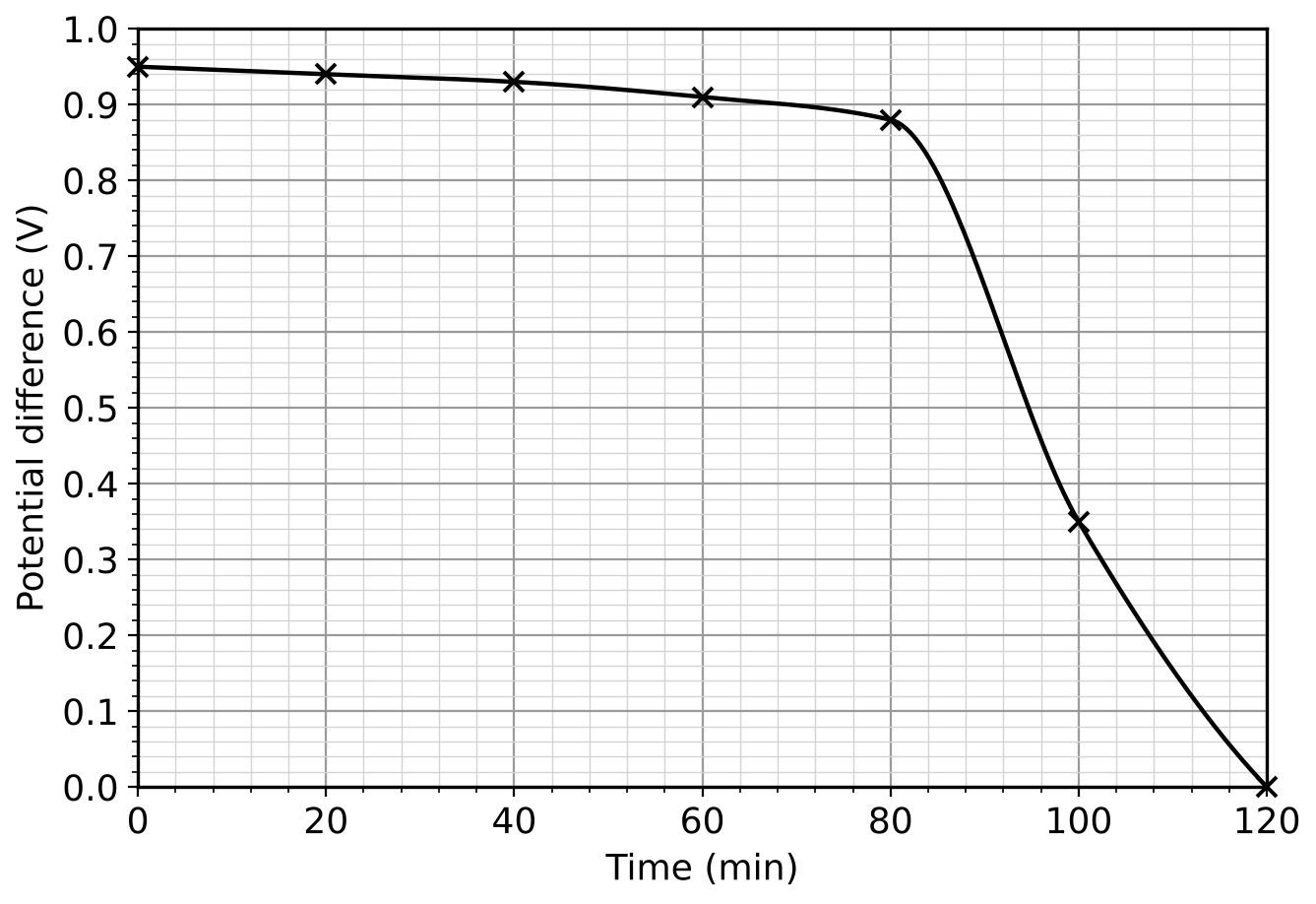
At 120 minutes, there is no zinc left in the acid.
a.[1]
Explain why the potential difference falls to 0.00 V.
b.[1]
Suggest one change the student could make so that the cell produces a potential difference for longer.
c.[1]
A hydrogen–oxygen fuel cell produces a potential difference for as long as hydrogen and oxygen are supplied.
Complete the word equation for the reaction in a hydrogen–oxygen fuel cell.
hydrogen + oxygen →\rightarrow→ ......
d.i.
[1]
A city council is choosing new buses.
The table shows information about three types of bus.
| Type of bus | Range on a full tank or full charge (km) | Time to refuel or recharge (min) | Cost to buy (£) | Substances released by the bus |
|---|---|---|---|---|
| diesel | 600 | 10 | 250 000 | carbon dioxide, water, oxides of nitrogen, particulates |
| battery electric | 250 | 240 | 450 000 | none |
| hydrogen fuel cell | 450 | 10 | 600 000 | water |
Calculate how many times more expensive the hydrogen fuel cell bus is than the diesel bus.
d.ii.[1]
Each bus travels 400 km every day.
Which types of bus can travel 400 km without refuelling or recharging?
d.iii.[4]
The council says:
"Hydrogen fuel cell buses are the best choice because they cause no pollution at all."
Evaluate the council's statement.
Use the table and your own knowledge.
e.[1]
Give one advantage of the battery electric bus compared with the hydrogen fuel cell bus.
Use the table.
6.2 Organic chemistry Questions
63 exam-style questions on OCR GCSE Chemistry 6.2 Organic chemistry, covering 6.2.1 Crude oil and fractional distillation, 6.2.2 Cracking and dependence on hydrocarbons, 6.2.3 Functional groups and homologous series, 6.2.4 Reactions of alkanes, alkenes and alcohols, 6.2.5 Addition polymerisation and repeat units, 6.2.6 Naturally occurring polymers, 6.2.7 Chemical cells and fuel cells, and 6.2.8 Condensation polymerisation and how to make one. Each one has a worked solution and a mark scheme showing where the marks go.