Question 27
HThe diagram shows a section of a condensation polymer. The boxes X and Y represent groups of atoms.
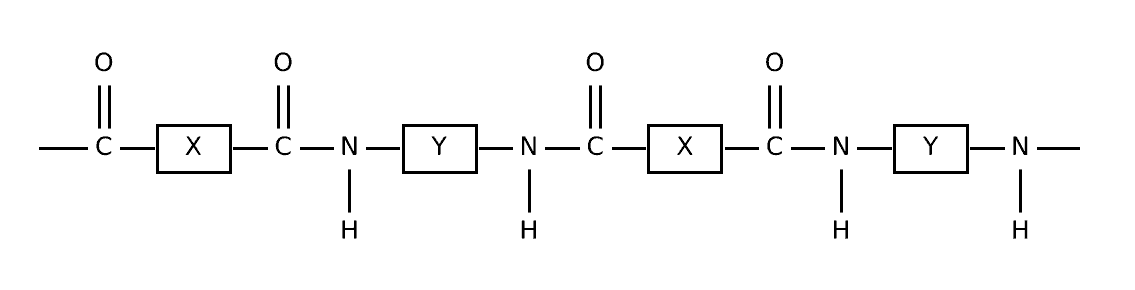
Which row shows the monomers used to make this polymer and the small molecule lost at each link?
HOOC−X−COOH\mathrm{HOOC{-}X{-}COOH}HOOC−X−COOH and H2N−Y−NH2\mathrm{H_{2}N{-}Y{-}NH_{2}}H2N−Y−NH2; water
H2N−X−NH2\mathrm{H_{2}N{-}X{-}NH_{2}}H2N−X−NH2 and HOOC−Y−COOH\mathrm{HOOC{-}Y{-}COOH}HOOC−Y−COOH; water
HOOC−X−COOH\mathrm{HOOC{-}X{-}COOH}HOOC−X−COOH and H2N−Y−NH2\mathrm{H_{2}N{-}Y{-}NH_{2}}H2N−Y−NH2; hydrogen
HO−X−OH\mathrm{HO{-}X{-}OH}HO−X−OH and HOOC−Y−COOH\mathrm{HOOC{-}Y{-}COOH}HOOC−Y−COOH; water
6.2 Organic chemistry Questions
63 exam-style questions on OCR GCSE Chemistry 6.2 Organic chemistry, covering 6.2.1 Crude oil and fractional distillation, 6.2.2 Cracking and dependence on hydrocarbons, 6.2.3 Functional groups and homologous series, 6.2.4 Reactions of alkanes, alkenes and alcohols, 6.2.5 Addition polymerisation and repeat units, 6.2.6 Naturally occurring polymers, 6.2.7 Chemical cells and fuel cells, and 6.2.8 Condensation polymerisation and how to make one. Each one has a worked solution and a mark scheme showing where the marks go.