Question 6
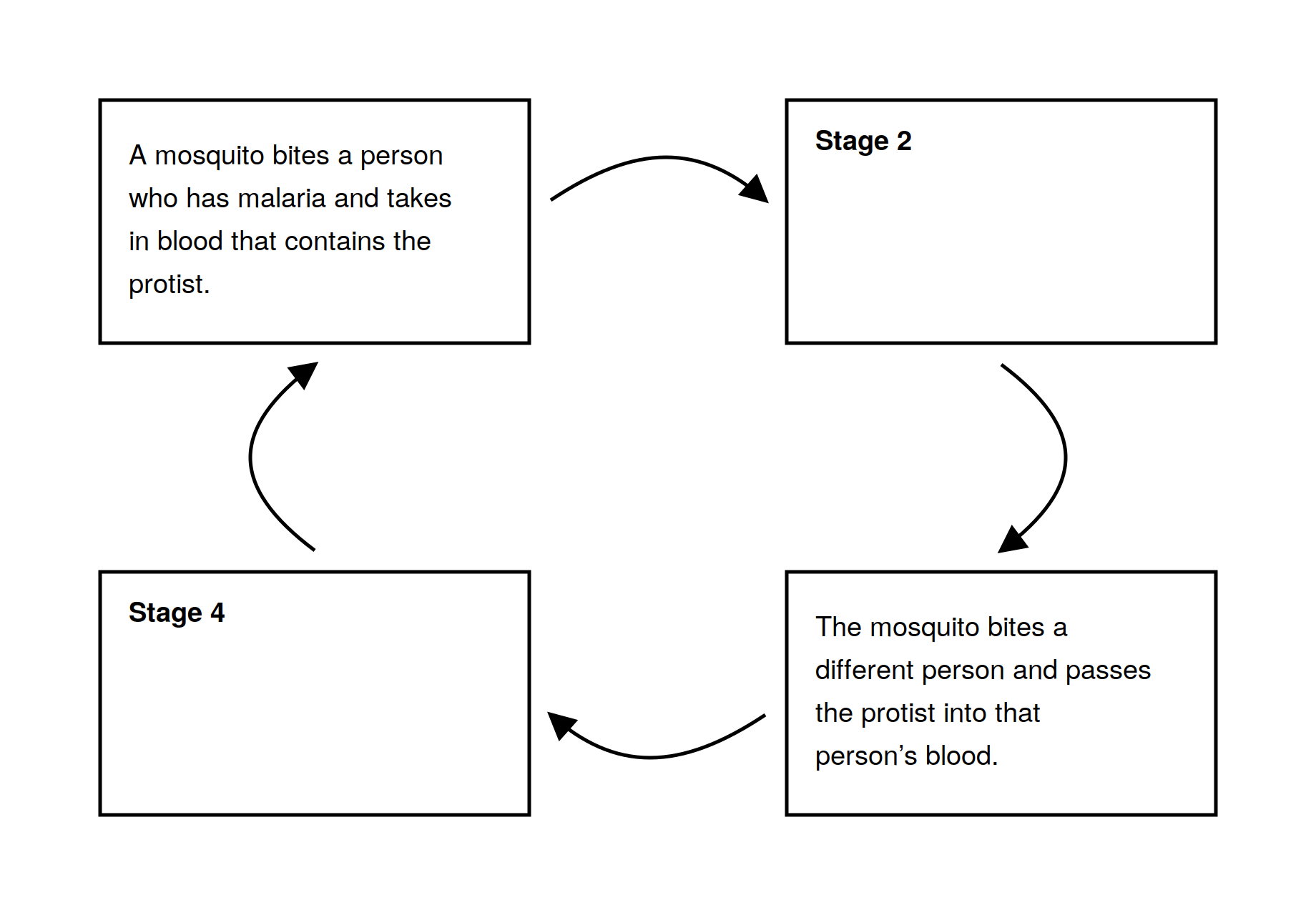
FThe life cycle of the malarial protist includes time in a person and time in a mosquito. The figure shows this life cycle. Two of the stages have been left blank.
Figure: The stages by which the malarial protist is passed between a person and a mosquito
a.[2]
Describe what happens at stage 2 and at stage 4.
b.[2]
A mosquito has never bitten a person who has malaria. Explain why this mosquito cannot give a person malaria.
c.[2]
In one region, every person who has malaria is treated with a drug that kills the protist in their blood. No mosquitoes are killed. Explain why the number of new cases of malaria in the region still falls.
3.1 Communicable diseases Questions
176 exam-style questions on AQA GCSE Biology 3.1 Communicable diseases, covering 3.1.1 Communicable (infectious) diseases, 3.1.2 Viral diseases, 3.1.3 Bacterial diseases, 3.1.4 Fungal diseases, 3.1.5 Protist diseases, 3.1.6 Human defence systems, 3.1.7 Vaccination, 3.1.8 Antibiotics and painkillers, and 3.1.9 Discovery and development of drugs. Each one has a worked solution and a mark scheme showing where the marks go.