Question 4
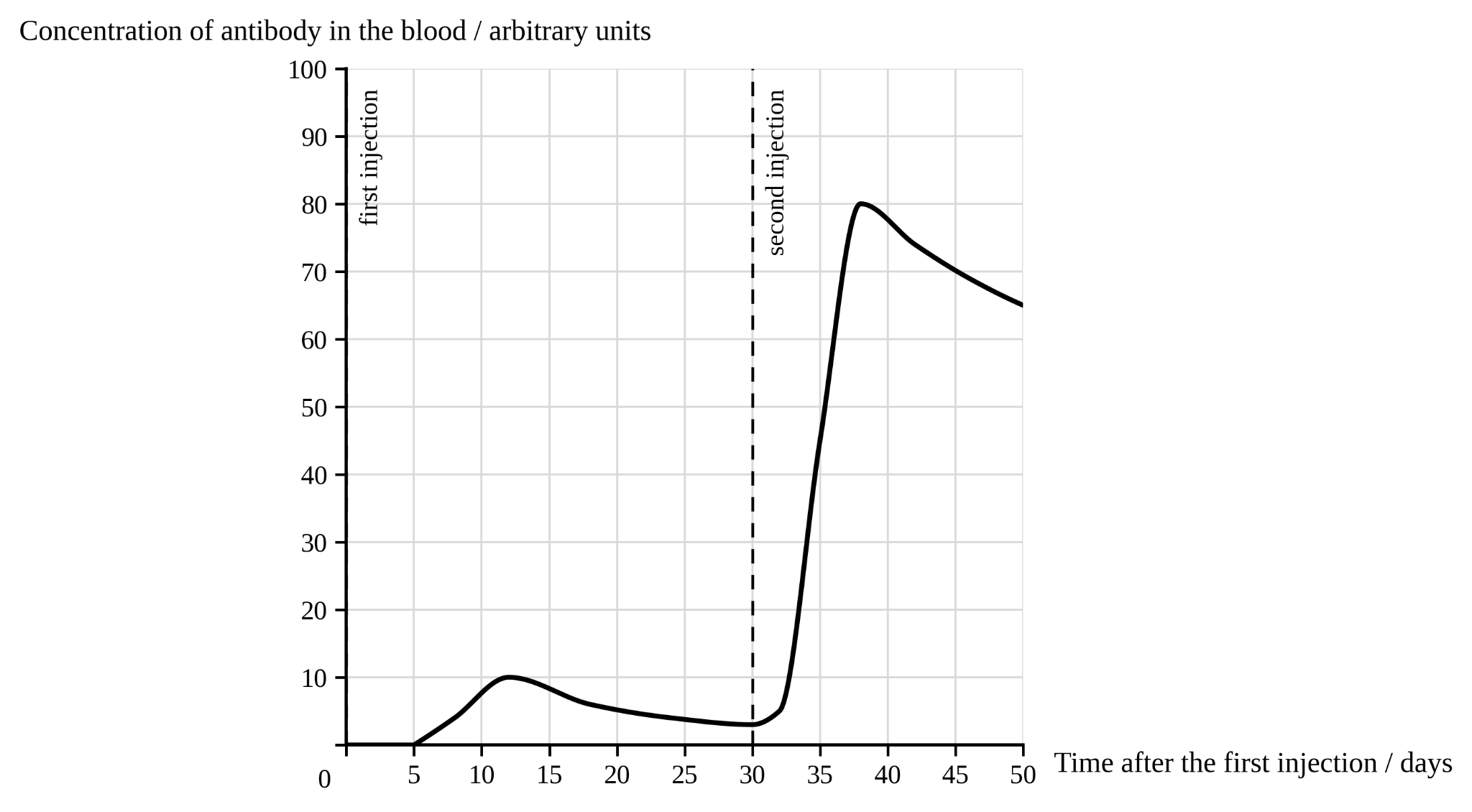
FA person was given a vaccine on day 0. They were given a second injection of the same vaccine on day 30. Figure 1 shows the concentration of one antibody in their blood.
Figure: The concentration of one antibody in a person's blood for 50 days after a vaccine was injected on day 0 and again on day 30
a.[1]
Use Figure 1 to give the highest concentration of antibody reached after the first injection.
b.[2]
Describe two differences between the response to the first injection and the response to the second injection. Use data from Figure 1 in your answer.
c.[2]
Explain why the response to the second injection is faster than the response to the first injection.
3.1 Communicable diseases Questions
176 exam-style questions on AQA GCSE Biology 3.1 Communicable diseases, covering 3.1.1 Communicable (infectious) diseases, 3.1.2 Viral diseases, 3.1.3 Bacterial diseases, 3.1.4 Fungal diseases, 3.1.5 Protist diseases, 3.1.6 Human defence systems, 3.1.7 Vaccination, 3.1.8 Antibiotics and painkillers, and 3.1.9 Discovery and development of drugs. Each one has a worked solution and a mark scheme showing where the marks go.