Question 2
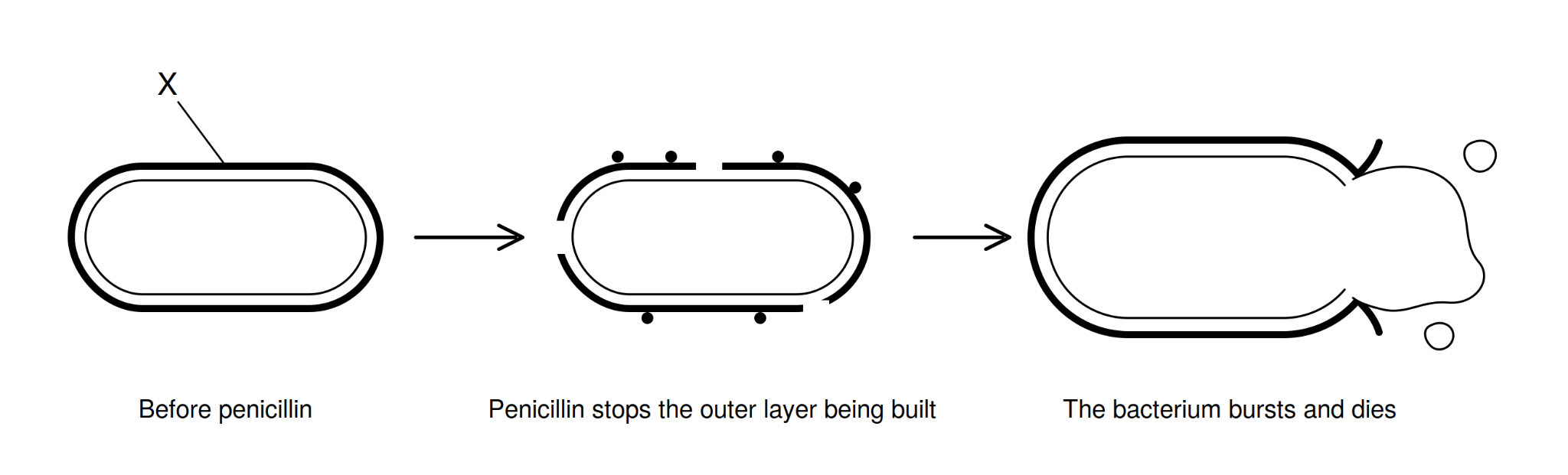
F46%Penicillin is an antibiotic. The figure shows the effect of penicillin on a bacterium.
Figure: The effect of penicillin on a bacterium, shown in three stages
a.[1]
Name structure X.
b.[2]
Use the figure to describe how penicillin kills the bacterium.
c.[2]
Explain why penicillin damages bacterial cells but does not damage the patient's own cells.
d.[1]
A doctor prescribes penicillin for one patient but a different antibiotic for another patient. Suggest why.
3.1 Communicable diseases Questions
176 exam-style questions on AQA GCSE Biology 3.1 Communicable diseases, covering 3.1.1 Communicable (infectious) diseases, 3.1.2 Viral diseases, 3.1.3 Bacterial diseases, 3.1.4 Fungal diseases, 3.1.5 Protist diseases, 3.1.6 Human defence systems, 3.1.7 Vaccination, 3.1.8 Antibiotics and painkillers, and 3.1.9 Discovery and development of drugs. Each one has a worked solution and a mark scheme showing where the marks go.