

YouTube Channels GCSE Panjabi: Are They Enough?
YouTube channels GCSE Panjabi guide: learn what videos can teach, what they miss, and how to combine them with past papers and active practice.
A revision video can create a reassuring feeling: the teacher explains something, it makes sense, and the next video begins automatically. Yet recognition is not the same as recall, and watching is not the same as performing under exam conditions.
So, are YouTube channels GCSE Panjabi students use enough to secure a pass on their own? Usually, no. Videos can explain vocabulary, grammar, pronunciation and exam technique, but GCSE Panjabi assesses listening, speaking, reading and writing. To prepare properly, you must actively practise all four skills, complete timed past-paper tasks and use mark schemes to identify what needs improving.
YouTube can be an excellent teacher. It should not be your entire revision system.
The short answer: what else do you need?
A complete GCSE Panjabi revision plan should include:
- carefully chosen videos for explanations and model language;
- regular vocabulary and grammar retrieval;
- listening practice without subtitles;
- speaking practice with another person or a recording device;
- reading in Gurmukhi under time pressure;
- handwritten responses and translation practice;
- official-style questions, past papers and mark schemes;
- feedback from a teacher, tutor or fluent reader where possible.
Start by checking the resources on the AQA GCSE Panjabi revision hub. It brings the qualification and available revision materials into one place, reducing the temptation to build your plan around whichever video appears next.
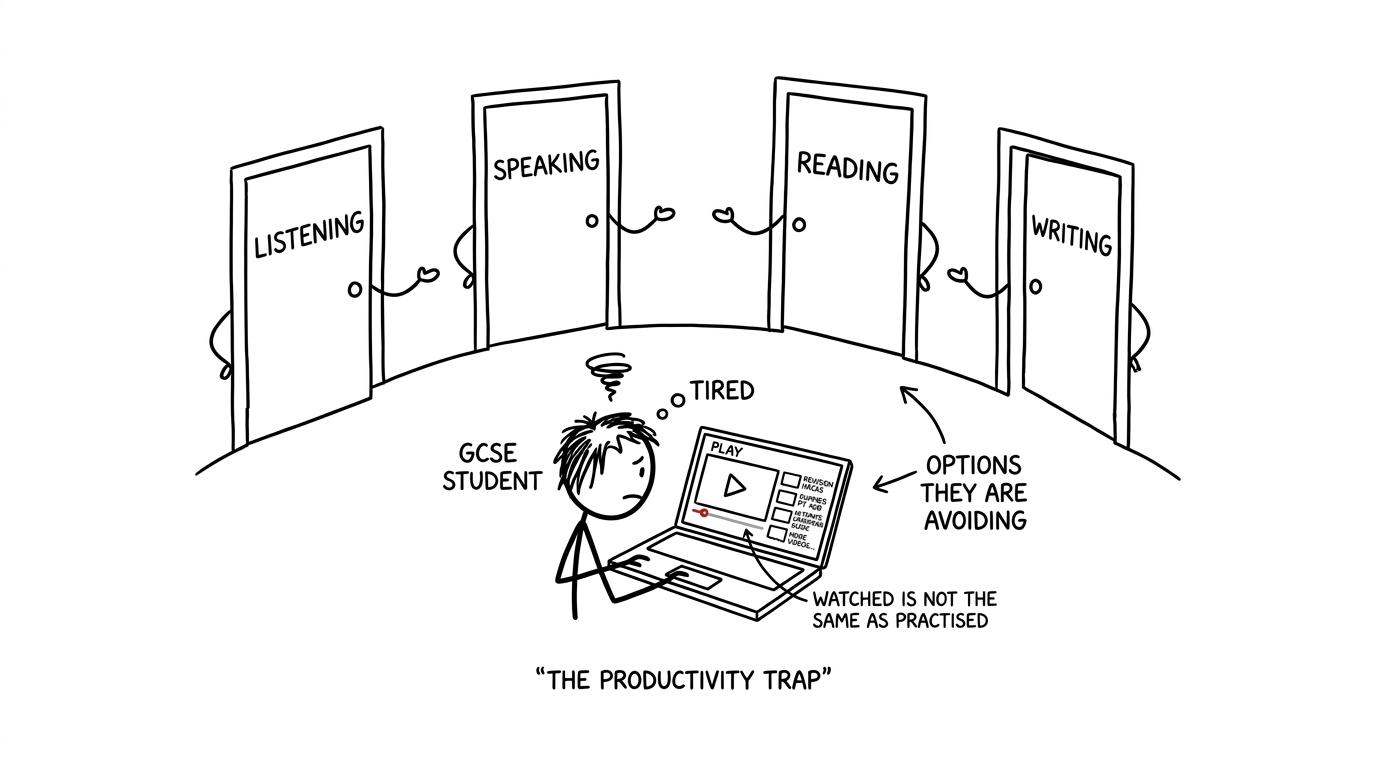 A student watching an endless playlist while four language skills wait behind them
What GCSE Panjabi actually assesses
The current AQA GCSE Panjabi specification is linear, meaning the assessments are completed at the end of the course in the same exam series. Students enter either foundation tier, covering grades 1-5, or higher tier, covering grades 4-9. All components must be taken at the same tier.
The qualification has four equally weighted areas:
- Listening: understanding and responding to spoken Panjabi;
- Speaking: a role-play, photo card and general conversation;
- Reading: understanding different written texts and translating into English;
- Writing: producing accurate responses and translating from English into Panjabi.
Each area contributes 25%25\%25% of the qualification. That matters because a playlist focused mainly on vocabulary explanations or reading cannot fully prepare you for the remaining assessment.
The specification also covers three broad themes: identity and culture; local, national, international and global areas of interest; and current and future study and employment. A useful channel should therefore match both the required skills and the specification topics rather than offering general conversational Panjabi alone.
Before choosing resources, confirm your qualification and tier with your school. Do not assume that advice for another language, an older course or an informal language test matches your paper.
Where YouTube channels help GCSE Panjabi students
YouTube works particularly well when you need to hear language rather than simply read about it. A clear video can model pronunciation, expose you to different speaking speeds and make a grammar pattern feel less abstract.
It can be useful for:
- hearing vocabulary spoken naturally;
- pausing and replaying difficult listening extracts;
- seeing how sentences are constructed;
- learning topic-specific phrases;
- reviewing role-play or photo-card strategies;
- observing how a strong answer is developed;
- filling a particular gap when your notes are unclear.
Videos are also convenient. If maths, English and science are competing for your revision time, a focused ten-minute explanation is easier to fit into an evening than an unfocused hour of rereading. The principle behind MathsGenie's 20-minute GCSE revision routine transfers well: choose one small skill, retrieve what you know, practise it and check the result.
The important word is practise. A video becomes useful when it leads to something you produce yourself.
Why YouTube alone is usually not enough
Watching can hide gaps in recall
When the answer remains on screen, everything feels familiar. Close the video and the situation changes. Can you recall the phrase, spell it correctly in Gurmukhi and adapt it to a different question?
After every short video, close it and write or say what you remember. Then check. This turns passive recognition into retrieval and reveals gaps while there is still time to repair them.
Speaking requires interaction
Repeating after a presenter can improve pronunciation, but the speaking assessment also requires you to respond, extend ideas and cope with an unfamiliar prompt. A recording cannot wait for your answer, notice hesitation or ask a follow-up question based on what you have said.
Practise role-plays and conversations with a teacher, tutor, classmate or fluent family member. When that is not possible, record yourself answering unseen prompts under a time limit. Listen back for clarity, accuracy, pace and whether you actually answered the question.
Writing needs correction
It is easy to watch someone construct an excellent answer. It is harder to produce your own accurate response from a blank page.
You need handwriting practice, translation practice and timed extended writing. Compare your work with the relevant criteria and mark scheme, then ask a knowledgeable person to check spelling and grammar where possible. Feedback matters because repeatedly writing an incorrect form can make the mistake more familiar rather than less.
Videos do not reproduce the whole paper
An edited explanation removes silence, uncertainty and time pressure. The examination does not. You must become comfortable moving between questions, interpreting instructions and continuing after a difficult section.
Use AQA GCSE Panjabi past papers to experience the actual structure. Complete individual sections early in your revision, then progress to timed papers. The advice in when to start GCSE past papers explains why papers work best while you still have time to act on the weaknesses they expose.
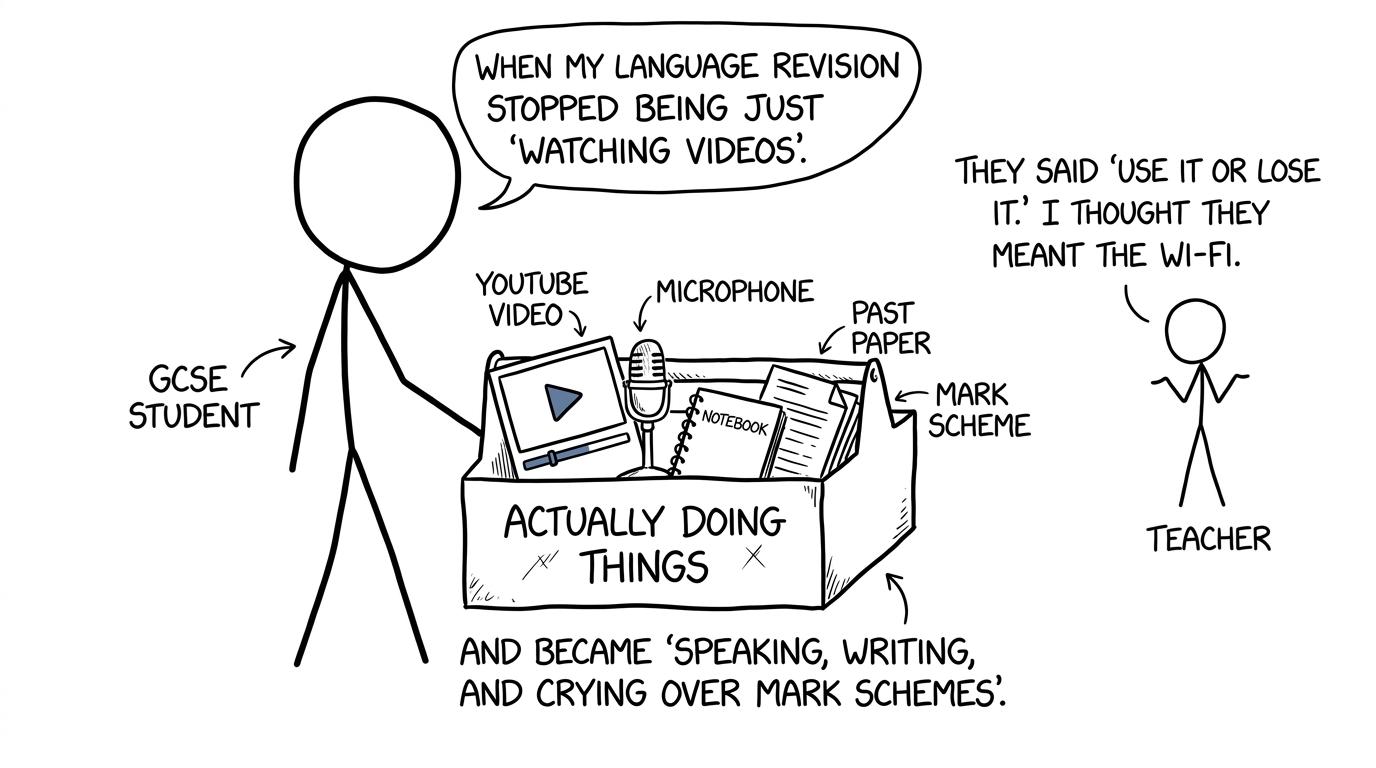 A video placed in a revision toolbox beside a microphone, notebook and past paper
A better way to combine videos and active practice
Treat each video as the first step in a short learning cycle, not the final task.
Choose one precise objective
Avoid goals such as “revise Panjabi”. Choose something observable: recognising vocabulary about employment, responding to a photo-card question, translating a short passage or using more than one time frame accurately.
Watch with a purpose
Select a video that matches your specification and objective. Check who created it, when it was published and whether it refers to the current AQA course. Pause to predict answers and note only the rules or phrases you will use later.
Do not allow recommendations to decide the rest of your session. Autoplay rewards continued watching, not examination readiness.
Produce something without support
Immediately after watching, remove the transcript and notes. Depending on the skill, you could:
- summarise the main ideas aloud;
- write several original sentences;
- answer an unseen speaking prompt;
- complete a short listening task without captions;
- translate a new passage;
- retrieve vocabulary in both directions.
This is the point where learning becomes visible.
Check and diagnose
Use an available mark scheme, model response or informed feedback. Record the reason for each weakness: missing vocabulary, inaccurate spelling, misunderstood instructions, weak grammar, slow reading or incomplete development.
Maths students already meet this idea when reviewing a paper. MathsGenie's guide to turning mark-scheme feedback into marks shows why checking is part of revision rather than an optional task after it.
Return to the weakness
Practise the same skill again with new material within the next few days. The goal is not to remember the video. It is to perform independently when the wording and context change.
If you struggle to identify priorities across several GCSEs, use the process in finding your weakest GCSE topics: diagnose with evidence, group mistakes and tackle the most costly patterns first.
What if you already speak Panjabi at home?
Home fluency is valuable, especially for listening and spontaneous conversation, but it does not automatically cover every examination demand. Informal speech may differ from the vocabulary, register and structured responses expected in an assessment. You may also speak confidently while finding Gurmukhi reading, spelling or translation more difficult.
Do not dismiss what you already know. Test it against the specification. Complete a reading task, write by hand and attempt a formal speaking prompt. Evidence is more useful than either confidence or worry.
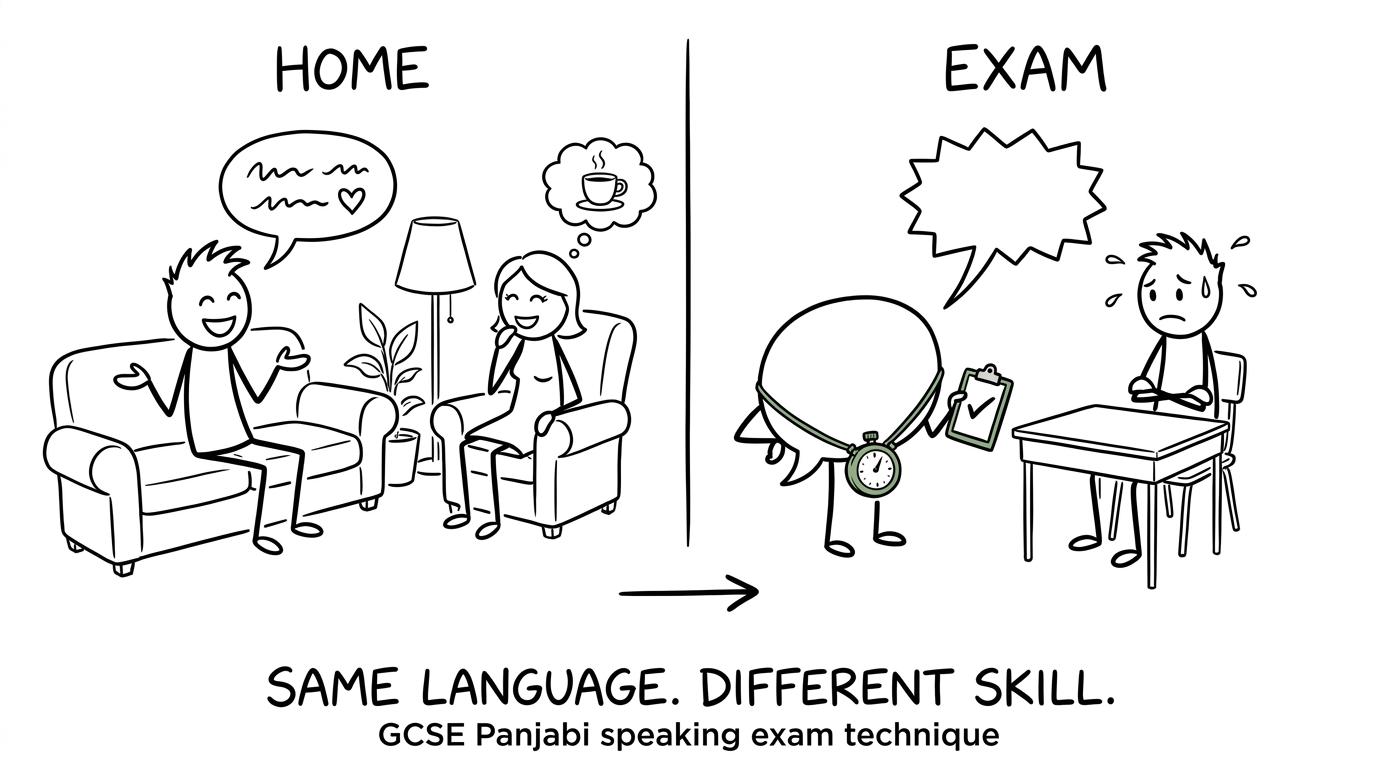 A confident home conversation meets a stopwatch-carrying speaking assessment
Common mistakes when revising GCSE Panjabi online
Following one popular channel without checking the specification. Clear teaching can still be incomplete or aimed at another course. Use the AQA requirements as your checklist.
Watching with English subtitles throughout. Subtitles may support early learning, but they can prevent you from testing genuine listening comprehension. Gradually remove them.
Revising only comfortable skills. Confident speakers may avoid writing; strong readers may avoid spontaneous speaking. Because the four areas are equally weighted, neglected skills matter.
Using views and subscribers as quality measures. Popularity does not prove that a video is accurate, current or matched to your tier. Look for clear specification links, accurate language and realistic tasks.
Completing papers without reviewing them. A score describes one attempt. Improvement comes from finding the cause of lost marks and repeating the weak skill.
Treating grade boundaries as permanent targets. Boundaries can change between exam series. The AQA GCSE Panjabi grade boundaries page can provide historical context, but your revision should focus on improving performance across the whole course rather than aiming at one fixed raw mark.
Build a revision system, not a longer playlist
YouTube channels can make GCSE Panjabi explanations accessible, flexible and engaging. They are most powerful when they lead directly to speaking, listening, reading or writing that you complete yourself.
The reliable pattern is simple: learn, retrieve, practise, check and repeat. Begin with the AQA GCSE Panjabi revision resources, then use past papers and mark schemes to test whether the learning survives without the video beside you.
For the rest of your timetable, MathsGenie's GCSE maths revision hub brings together free revision lessons, practice questions, mini tests, past papers, predicted papers, mark schemes and video solutions. Use the same active cycle across your subjects. Watch less automatically. Practise more deliberately.











