YouTube Channels GCSE German: Enough to Pass?
YouTube channels GCSE German can help, but are they enough alone? Learn the listening, speaking, reading and writing practice needed to pass your exam.
There is a comforting kind of revision where someone else does all the difficult thinking. A teacher explains German word order, the examples make sense and the next video begins automatically. For half an hour, progress feels almost effortless.
But are YouTube channels GCSE German students watch actually enough to secure a pass on their own?
The short answer is usually no. Videos can teach pronunciation, vocabulary, grammar and exam technique extremely well. What they cannot do by themselves is make you retrieve language, speak without a script, write under time pressure or learn from marked exam practice. To pass GCSE German confidently, you need to turn what you watch into something you can produce.
That distinction matters for students balancing German with GCSE maths and several other subjects. Your revision time is limited. The aim is not to abandon YouTube, but to give every video a job.
The quick answer: what you actually need
A complete GCSE German revision plan should include:
- current videos matched to your exam board and tier
- vocabulary retrieval without prompts
- regular listening to unfamiliar German
- speaking practice with no script in front of you
- independent writing that receives useful feedback
- reading and translation practice
- grammar correction and sentence-building
- timed specimen or past-paper questions
- review of mistakes followed by another attempt
YouTube can support almost every item on that list. It does not automatically complete them.
This is similar to maths revision. Watching an explanation can reveal a method, but marks come from applying it independently. MathsGenie's GCSE maths revision hub is organised around that movement from explanation to questions, papers and feedback. German requires the same shift from recognition to production.
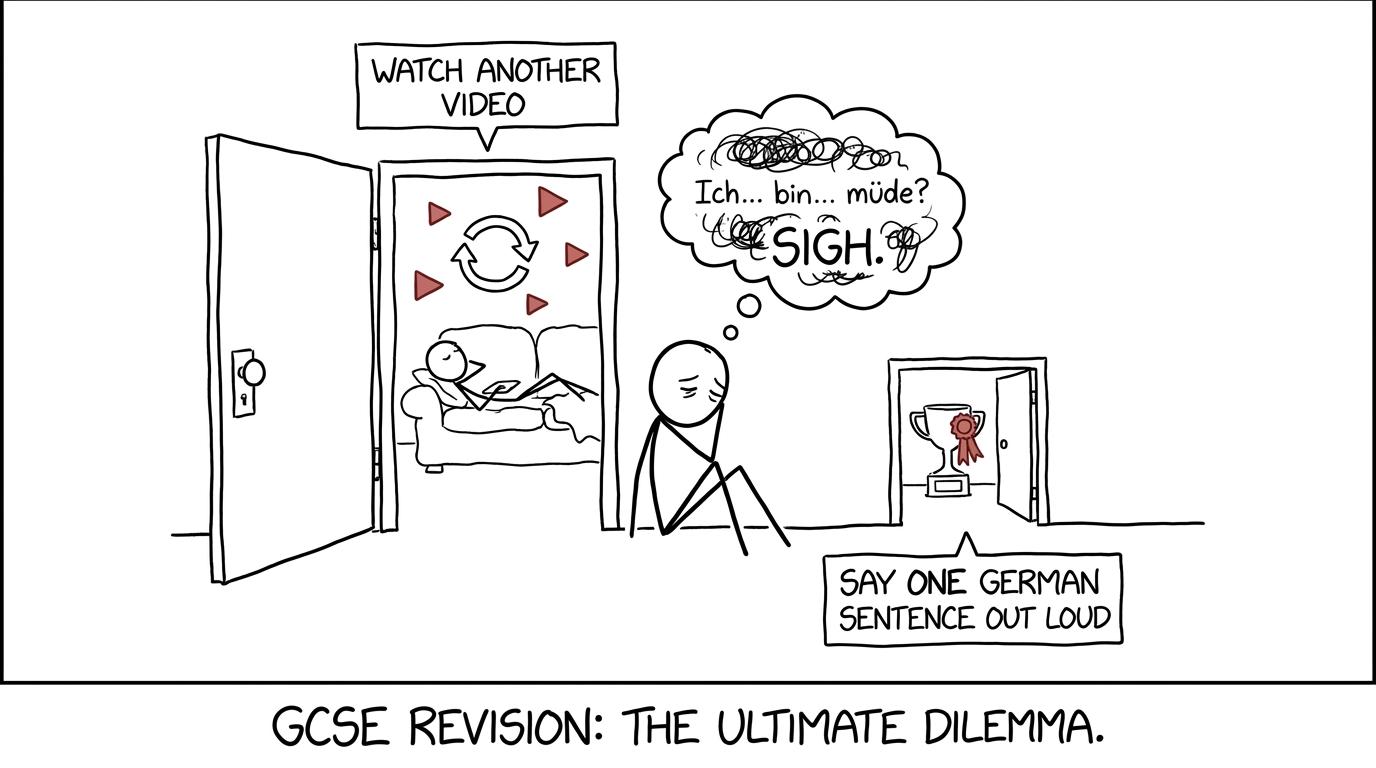 A GCSE student choosing between another video and speaking German aloud
Why GCSE German needs more than passive watching
A video can make German feel familiar. Familiarity is useful, but it is not the same as recall.
When a presenter says a phrase and immediately supplies the meaning, you may recognise it. In an exam, however, you must identify that phrase inside an unfamiliar listening passage, retrieve it for a writing task or pronounce it during your speaking assessment. The support has disappeared.
That is the central weakness of video-only revision: it often trains recognition while the examination demands independent performance.
For revised GCSE French, German and Spanish qualifications first assessed from summer 2026, specifications place explicit emphasis on prescribed vocabulary, grammar and sound-spelling relationships. Tasks may include dictation and reading aloud alongside listening, speaking, reading, translation and writing. The precise format depends on your awarding organisation, so check the current specification supplied by your school rather than assuming an older revision video still matches.
For example, AQA's current GCSE German specification has four equally weighted components: Listening, Speaking, Reading and Writing, each worth 25%25\%25% of the qualification. It offers Foundation tier for grades 1-5 and Higher tier for grades 4-9, with all components taken at the same tier. Other specifications may organise individual tasks differently.
A playlist that covers only vocabulary and grammar is therefore teaching ingredients, not the whole performance.
What good GCSE German YouTube channels can do
YouTube is particularly strong when you need a clear explanation repeated at your own pace. A useful channel or playlist can help you:
- hear accurate German pronunciation
- connect spelling patterns with sounds
- understand cases, adjective endings and word order
- organise vocabulary by theme or frequency
- see how speaking and writing answers are structured
- pause, replay and slow down difficult listening
- observe an examiner-style task before attempting it
These advantages are real. Free access also means you can compare explanations until one makes sense.
The danger is not the video itself. The danger is confusing consumption with competence. A twenty-minute explanation followed by ten minutes of independent practice is revision. Three explanations watched consecutively may be little more than reassurance.
Maths students encounter the same trap with solution videos. The better routine is attempt, check, correct and retest. The article on using GCSE past papers properly explains that feedback loop for maths, but its central principle transfers neatly to languages: the useful learning often happens after you discover what you cannot yet do.
How to tell whether a channel matches your course
Before relying on any creator, check the resource against your actual specification.
Look for the correct exam cycle
Material made for an older specification can still explain timeless grammar accurately. However, its claims about assessment tasks, vocabulary expectations or speaking formats may be out of date.
For examinations from summer 2026 onwards, look for explicit coverage of the revised qualification. If a video does not identify the specification it supports, verify its advice using your exam board's current documents or ask your teacher.
Check the board and tier
Do not assume that an AQA walkthrough precisely matches an Edexcel paper. Likewise, Foundation and Higher tier require different levels of vocabulary, grammatical control and task demand.
Write your exam board, specification and tier at the top of your revision plan. This small act prevents weeks of vague revision. MathsGenie's GCSE maths revision timetable guide uses the same principle: identify the course and your weaker areas before deciding what to practise.
Look for all four language skills
A complete resource should direct attention towards listening, speaking, reading and writing. It should also cover relevant grammar, vocabulary, pronunciation, translation and current task types.
Be cautious if every upload promises vocabulary shortcuts while speaking and writing receive little attention. The hardest skills to practise are often the easiest ones for a playlist to neglect.
Turn every video into active German revision
The solution is not necessarily more resources. It is a better routine around the resources you already use.
Before watching
Choose one narrow objective. It might be recognising past-tense verbs in a listening task, improving pronunciation or reviewing word order after a subordinating conjunction.
Then test yourself briefly before pressing play. Say what you remember, write several relevant sentences or attempt a question. This creates a reason to pay attention.
While watching
Pause before the presenter gives an answer. Predict the missing word, translate the sentence or say the phrase aloud. If the video contains a model response, do not simply copy it. Notice why it works and identify language you could adapt.
Keep notes short. A page of copied subtitles is unlikely to improve recall. A few corrections and reusable patterns are more valuable.
After watching
Close the video and produce something without support:
- summarise the explanation from memory
- record a spoken response
- complete a short dictation
- write several original sentences
- translate a brief passage
- answer an exam-style question under time pressure
Then check the result. For speaking, a teacher or partner can notice pronunciation and communication problems that self-marking misses. For writing, ask for feedback on accuracy, range and whether your answer addresses the task.
Finally, return to the same skill on another day. One successful attempt immediately after an explanation may reflect short-term memory rather than secure knowledge.
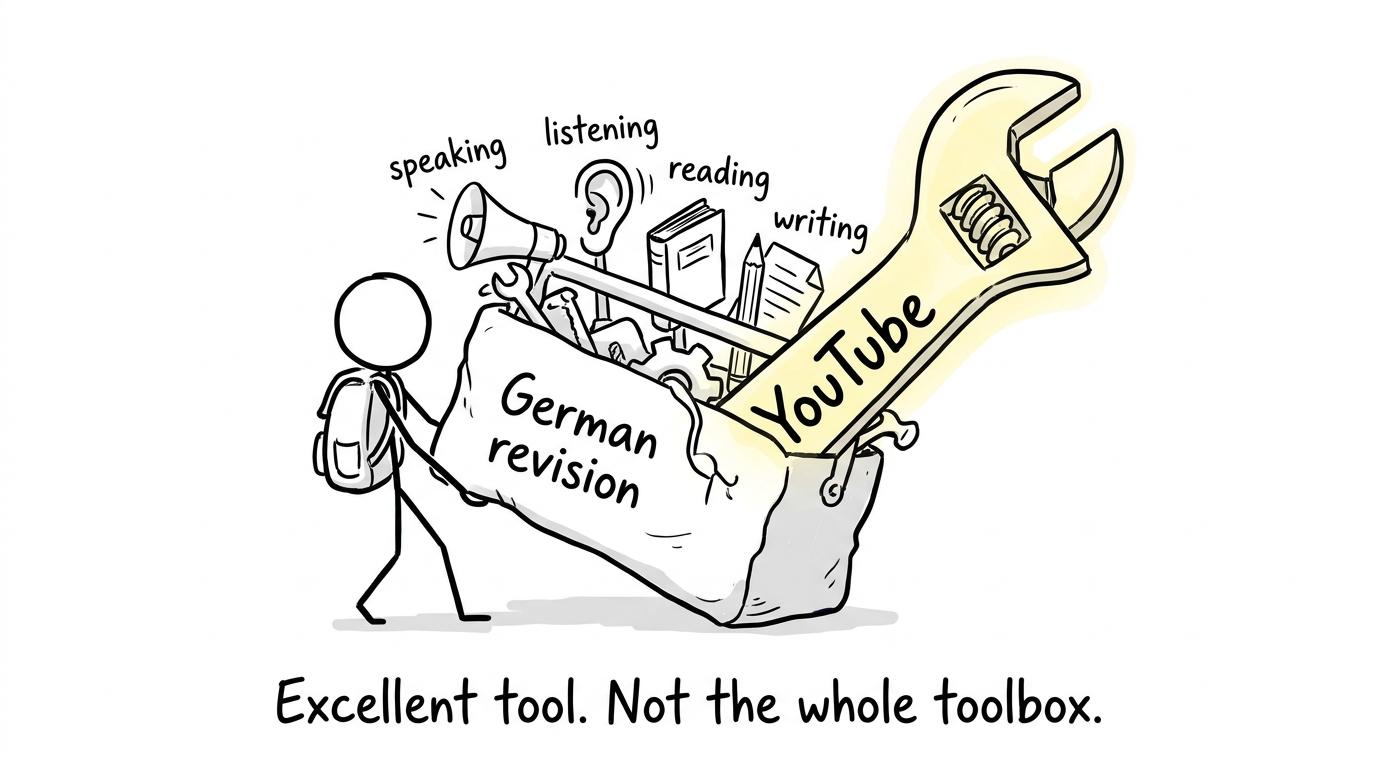 YouTube shown as one useful tool within a complete German revision toolbox
The revision resources YouTube cannot replace
A specification and vocabulary list
Your specification defines what may be assessed and how. It should control your revision choices, not the platform's recommendation system.
Use the prescribed vocabulary and grammar information for your exam board. A popular video can be helpful without being complete.
Genuine speaking practice
Speaking improves through speaking. Reading a transcript silently does not train interaction, pronunciation or recovery when you forget a word.
Practise with your teacher, a classmate or another suitable partner. Record yourself when working alone, but remember that recordings do not provide expert feedback automatically. Build confidence by answering from bullet points rather than memorising an entire script.
Marked writing
Writing needs correction. Without feedback, it is possible to repeat the same errors in verb endings, cases or word order until they feel normal.
Complete short tasks regularly and use teacher feedback to create an error list. Rewrite corrected sentences, then use the same structure in a fresh context.
Timed assessment practice
Videos often show polished answers with generous thinking time. Exams do not.
Use current specimen materials and available papers that match your specification. Complete tasks without pausing, subtitles or online dictionaries unless the assessment permits a particular resource.
This mirrors effective maths preparation. MathsGenie's past-paper library places papers beside mark schemes and selected solutions because performance and feedback belong together. For shorter maths sessions, GCSE maths mini tests help students move from isolated learning towards timed recall.
A balanced weekly plan for German and maths
A sensible week does not need to be dramatic. It needs to be repeatable.
For German, rotate the four skills rather than allowing videos to occupy every session. One session might combine a short explanation with listening and dictation. Another could focus on speaking. A third could involve timed reading or writing followed by correction.
For maths, continue the same active pattern: lesson, practice questions, marking and retesting. If exams are close, the GCSE one-month maths revision plan can help you protect time for both subjects without letting one urgent task consume the week.
Keep a simple record of:
- the skill practised
- what you attempted independently
- the mistake you found
- when you will revisit it
The record matters because online revision has weak stopping rules. There is always another video. A plan tells you when watching has done its job and practice must begin.
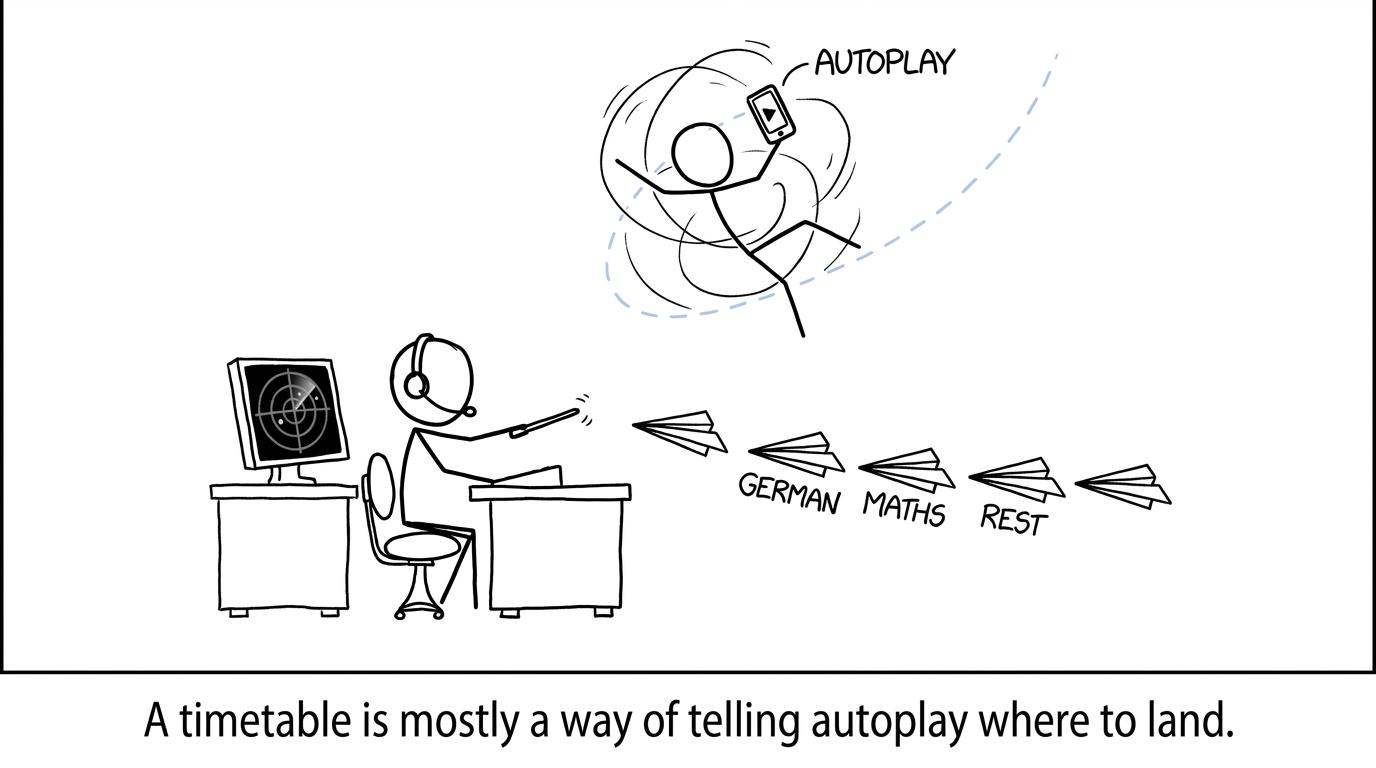 A revision planner directing German, maths and rest while autoplay circles overhead
Common mistakes when revising GCSE German on YouTube
Watching without producing German
If you finish a session without speaking, writing, translating or answering questions, you have little evidence that the learning is available independently.
Choosing entertainment over specification coverage
The clearest or funniest creator is not automatically the most relevant. Check dates, board, tier and task format.
Using subtitles for every listening task
Subtitles are useful scaffolding, but permanent scaffolding becomes dependence. Listen once without them, use them to diagnose the difficulty, then listen again without support.
Memorising model answers word for word
A memorised response can collapse when the task changes. Learn flexible structures and practise adapting them to new prompts.
Avoiding speaking because it feels uncomfortable
Speaking often exposes gaps immediately. That discomfort is information. Start with brief recordings, then progress towards unscripted responses and interaction.
Never checking mistakes
Unmarked practice can preserve errors. Use feedback to identify one specific correction and retest it later. MathsGenie's guide to using mark schemes to improve reinforces the wider lesson: marking is not merely a score; it tells you what to change.
So, can free YouTube content be enough?
In theory, a carefully chosen collection of free videos could teach much of the knowledge needed for GCSE German. But if “YouTube alone” means only watching, the answer is no.
Passing requires performance across several skills. You must understand unfamiliar language, retrieve vocabulary, apply grammar, communicate aloud, write independently and work within assessment conditions. Those abilities grow through deliberate attempts and correction.
Use YouTube as the teacher in the room, not as the student doing the work for you.
For the maths part of your GCSE revision, let MathsGenie provide the complete practice loop. Begin with the free GCSE maths revision resources, then move from revision lessons into practice questions, mini tests, past papers and predicted papers. Mark your work carefully, use video solutions when a method breaks down and revisit the questions that cost you marks.
The principle is the same in German and maths: explanations open the door. Independent practice is what gets you through it.