

YouTube Channels GCSE Biblical Hebrew: Enough?
YouTube channels GCSE Biblical Hebrew can explain grammar, but videos alone rarely prepare you to translate texts and perform under timed exam conditions.
A video can make a difficult grammar point feel obvious. The teacher explains it, the examples make sense, and you finish the lesson feeling more confident. Then you open an unseen passage without the video beside you and the confidence disappears.
That is the central problem with relying on YouTube channels GCSE Biblical Hebrew students can access for free. The short answer is that videos can be an excellent teaching resource, but they are unlikely to be enough on their own. To prepare properly, you also need specification coverage, vocabulary recall, independent translation, set-text knowledge, timed papers and feedback from mark schemes or a teacher.
If you also take GCSE maths, the principle will feel familiar: watching somebody solve a problem is not the same as solving it yourself.
The short checklist: what you actually need
A complete GCSE Biblical Hebrew revision system should include:
- videos or lessons that explain vocabulary, morphology and syntax
- the current Pearson Edexcel specification and prescribed vocabulary
- accurate coverage of the set texts for your examination year
- regular closed-book vocabulary retrieval
- unseen comprehension and translation practice
- independent literature responses
- timed work using the correct paper format
- official mark schemes and examiner feedback
- correction and retesting after mistakes
- support from a qualified teacher where possible
YouTube may help with the first item and parts of the second and third. It does not automatically provide the rest.
MathsGenie's free Edexcel GCSE Biblical Hebrew revision hub gives you a more structured starting point, including lessons, revision tools and exam-focused practice.
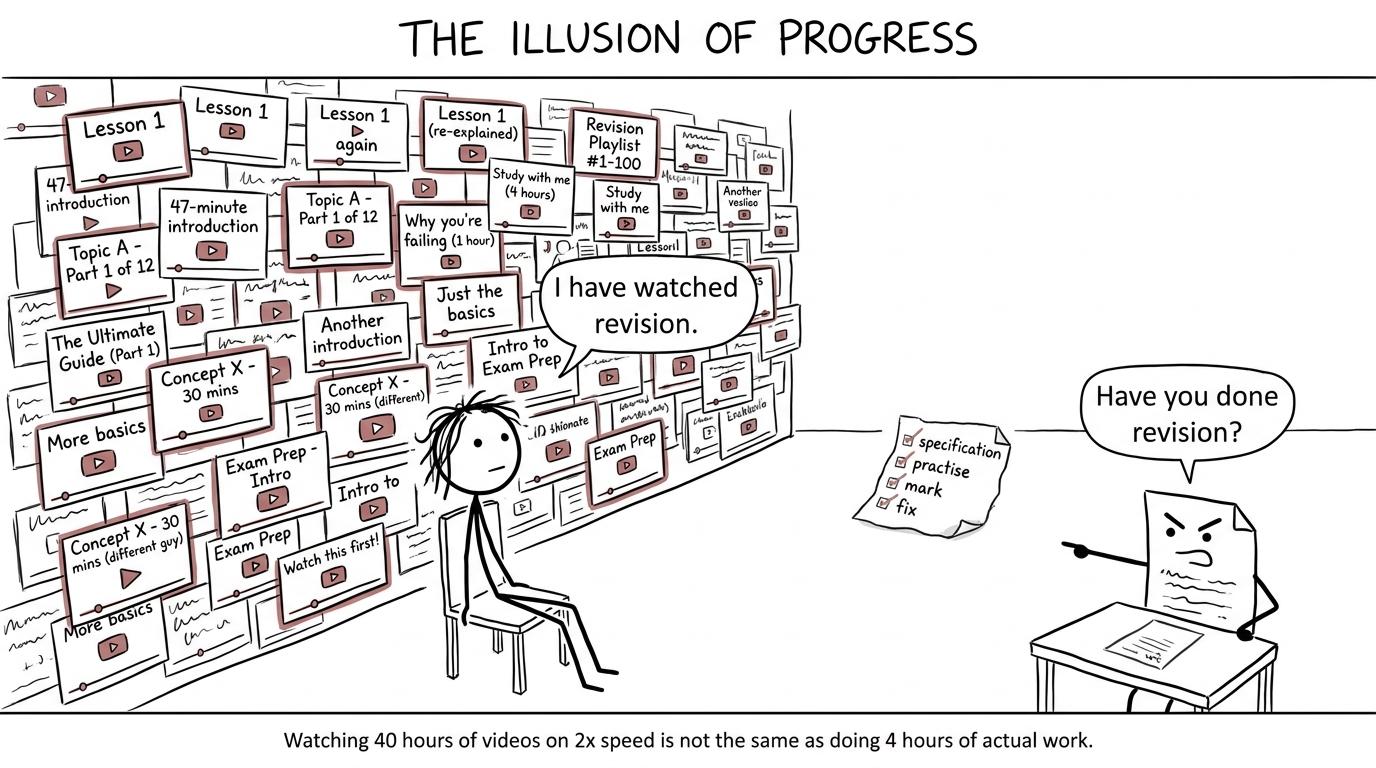 A student discovers that watching revision and doing revision are not quite the same
What does the GCSE Biblical Hebrew exam require?
The current Pearson Edexcel GCSE Biblical Hebrew qualification has two externally examined components. Each paper lasts 222 hours, carries 100100100 marks and contributes 50%50\%50% of the qualification.
Component 111, Language, assesses your ability to read and understand unseen Biblical Hebrew, answer comprehension questions and translate into English. It also includes an option involving grammatical understanding or translation of simple English sentences into pointed Biblical Hebrew.
Component 222, Literature, tests knowledge and understanding of prescribed texts as well as your ability to analyse and respond to them. Across the qualification, the official assessment-objective weighting is:
- AO111: language knowledge and understanding, worth 50%50\%50%
- AO222: literature knowledge and understanding, worth 25%25\%25%
- AO333: analysis, evaluation and response, worth 25%25\%25%
For examinations from 202620262026 to 202820282028, Pearson prescribes Genesis chapters 414141-434343, covering Joseph's rise to power, and II Kings chapters 444-777, covering the miracles of Elisha. Students should confirm the applicable set texts with their school and the latest specification rather than assuming an older playlist remains current.
That last point matters. A beautifully taught video can still be the wrong revision resource if it follows an expired set-text cycle or an older qualification.
What YouTube channels do well
YouTube is particularly useful when a textbook explanation feels too compressed. A clear teacher can slow down the recognition of forms, model how a sentence is divided and explain why a translation works.
Making grammar visible
Biblical Hebrew contains features that are easier to notice when somebody talks through them. Videos can help you recognise roots, prefixes, suffixes, verb stems, aspects, word order and attached pronouns. The ability to pause and replay a difficult explanation is genuinely valuable.
Supporting pronunciation and reading fluency
Audio can help you become more comfortable reading pointed text. Although the written examination is not a speaking or listening test, greater fluency can reduce the mental effort needed to process a passage.
Providing a low-pressure introduction
A video is often a sensible first step when a topic feels intimidating. It can give you enough orientation to begin independent work rather than staring at a page without knowing where to start.
The limitation is subtle: familiarity can feel like mastery. You recognise the explanation while it is being presented, but the examination requires you to retrieve and apply that knowledge without prompts.
Why videos alone usually are not enough
The exam does not ask whether a teacher's explanation looked sensible. It asks whether you can produce an accurate response independently and within a time limit.
Watching does not test retrieval
Vocabulary knowledge must be available when you meet a word in context. If the translation is displayed immediately, you are practising recognition rather than recall.
After a video, close it and write down what you remember. Test vocabulary in both directions. Identify forms without replaying the explanation. If you cannot retrieve the information, the lesson is not yet secure.
This is the same distinction explored in MathsGenie's guide to self-studying GCSE maths: independent revision works when lessons lead directly to practice, marking and retesting.
General courses may not match Edexcel
Many free Biblical Hebrew channels are designed for university students, religious study or general language learning. They may be thoughtful and accurate while still omitting the precise vocabulary, question types, literature demands and set texts required for Pearson Edexcel GCSE.
Before committing to a playlist, ask:
- Does it explicitly follow Pearson Edexcel specification 1BH01\text{BH}01BH0?
- Does it cover the current set texts?
- Does it distinguish language work from literature analysis?
- Does it include independent exam-style tasks?
- Can its advice be checked against official materials?
If the answer to several questions is no, use the channel as supporting tuition rather than your complete course.
You need feedback, not only explanation
Translation errors are often precise. You may have missed a suffix, confused a verb form, ignored a conjunction or produced English that does not convey the whole phrase. Without marking, the same error can quietly become a habit.
Feedback may come from a teacher, a reliable mark scheme or a carefully checked model response. The important part is turning it into an action: record the exact error, practise that feature again and retest it later.
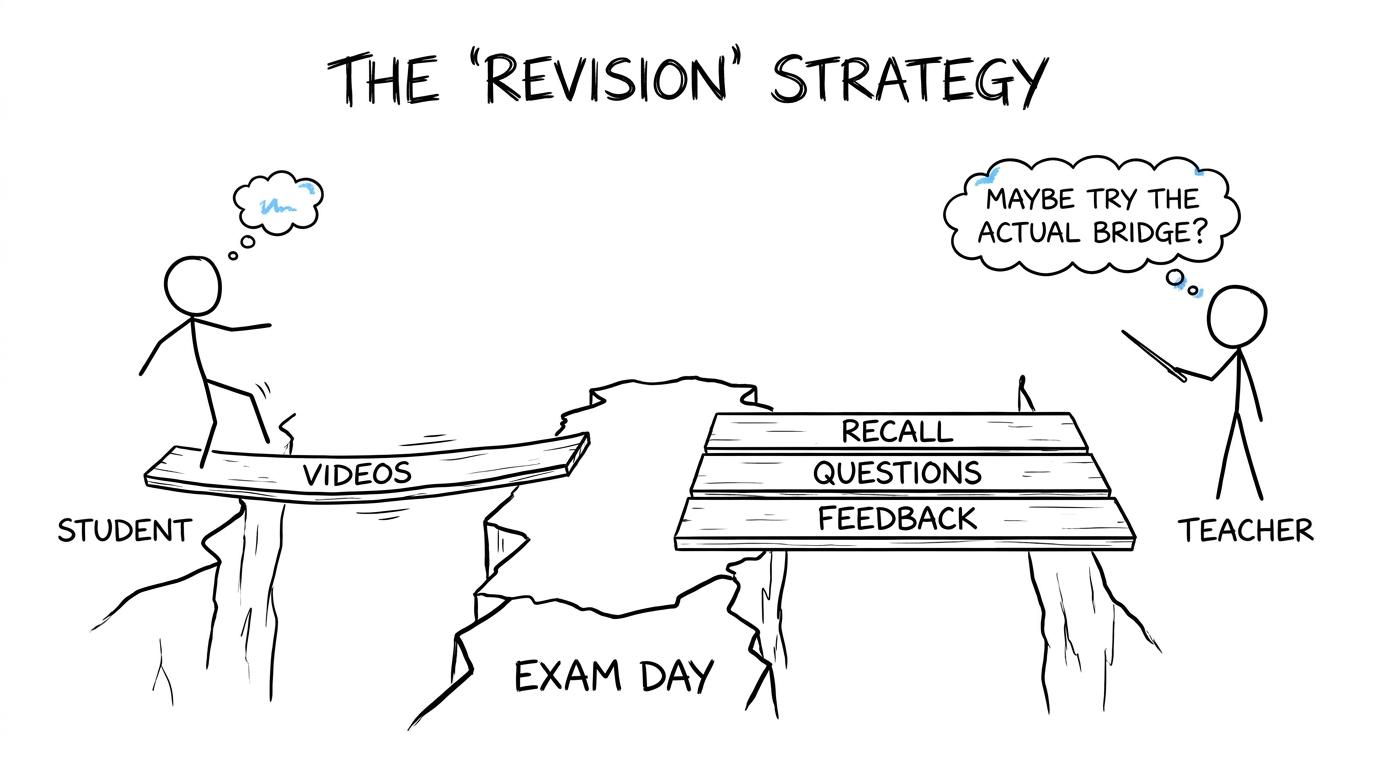 A student attempts to reach exam day using videos as the only bridge
A better way to use YouTube for GCSE Biblical Hebrew
The answer is not to stop watching videos. It is to give each video a job inside a wider revision cycle.
Preview, practise, check and retest
Use this sequence:
- Preview: choose one tightly defined objective, such as recognising a particular grammatical feature.
- Learn: watch a short, relevant explanation and take minimal notes.
- Retrieve: close the video and reproduce the key ideas from memory.
- Practise: complete unseen or set-text questions without assistance.
- Check: mark the work and identify exactly why marks were lost.
- Retest: return to the same skill on another day using different material.
This turns YouTube from entertainment into instruction. MathsGenie's advice on finding your weakest GCSE topics explains how an error log can focus later sessions on evidence rather than guesswork.
Make past papers part of the course
Past papers reveal whether your knowledge survives unfamiliar wording and a running clock. Begin with individual sections if you have not finished the course, then move towards complete papers under the published conditions.
Use the Edexcel GCSE Biblical Hebrew past papers to practise by year and exam series, checking official mark schemes and solutions where available. MathsGenie's broader guide to when GCSE students should start past papers is also useful when planning across several subjects.
Do not reduce a paper to one total mark. Sort lost marks into categories such as vocabulary, morphology, syntax, incomplete translation, set-text knowledge, literary analysis and timing. Your next revision session should address the largest repeated weakness.
Build a routine that works across GCSE subjects
Students taking Biblical Hebrew alongside maths and other GCSEs have a limited revision budget. A complicated plan usually collapses under the weight of school, homework and ordinary life.
A repeatable weekly structure is more useful:
- one session for vocabulary and grammatical retrieval
- one session for unseen language work
- one session for set-text translation and close analysis
- one timed section or paper
- one correction session based on the week's errors
The exact length of each session depends on your timetable and current level. What matters is that every week includes active production and feedback, not only explanation.
MathsGenie's GCSE revision timetable guide can help you organise several subjects without giving every evening to the subject that currently feels most urgent. The Other Resources collection also includes self-assessment materials that can inspire a simple red, amber and green tracking system.
Common mistakes when revising with YouTube
Choosing by popularity rather than specification
A large audience does not prove that a course matches your exam. Check the board, qualification code, set-text cycle and paper demands before investing hours in a playlist.
Copying notes throughout the video
Transcription feels productive because it fills pages. It may leave you with no evidence that you can recall or apply anything. Keep notes short, then spend more time answering questions without support.
Avoiding unseen passages
Set texts can become reassuringly familiar. Paper 111 also requires you to process unseen language, so unfamiliar passages must be part of revision rather than something saved for the final weeks.
Marking translations too generously
It is easy to award yourself credit because you understood the general story. Examination marks depend on what your English translation actually communicates. Compare every unit carefully and ask a teacher about doubtful judgements.
Using outdated set-text videos
Older lessons may remain useful for general grammar, but literature preparation must match the texts prescribed for your examination series.
Watching another explanation instead of correcting errors
When practice exposes a weakness, the comfortable reaction is to return to passive viewing. Correction is less pleasant but more valuable: identify the error, repair it and prove the repair with another question.
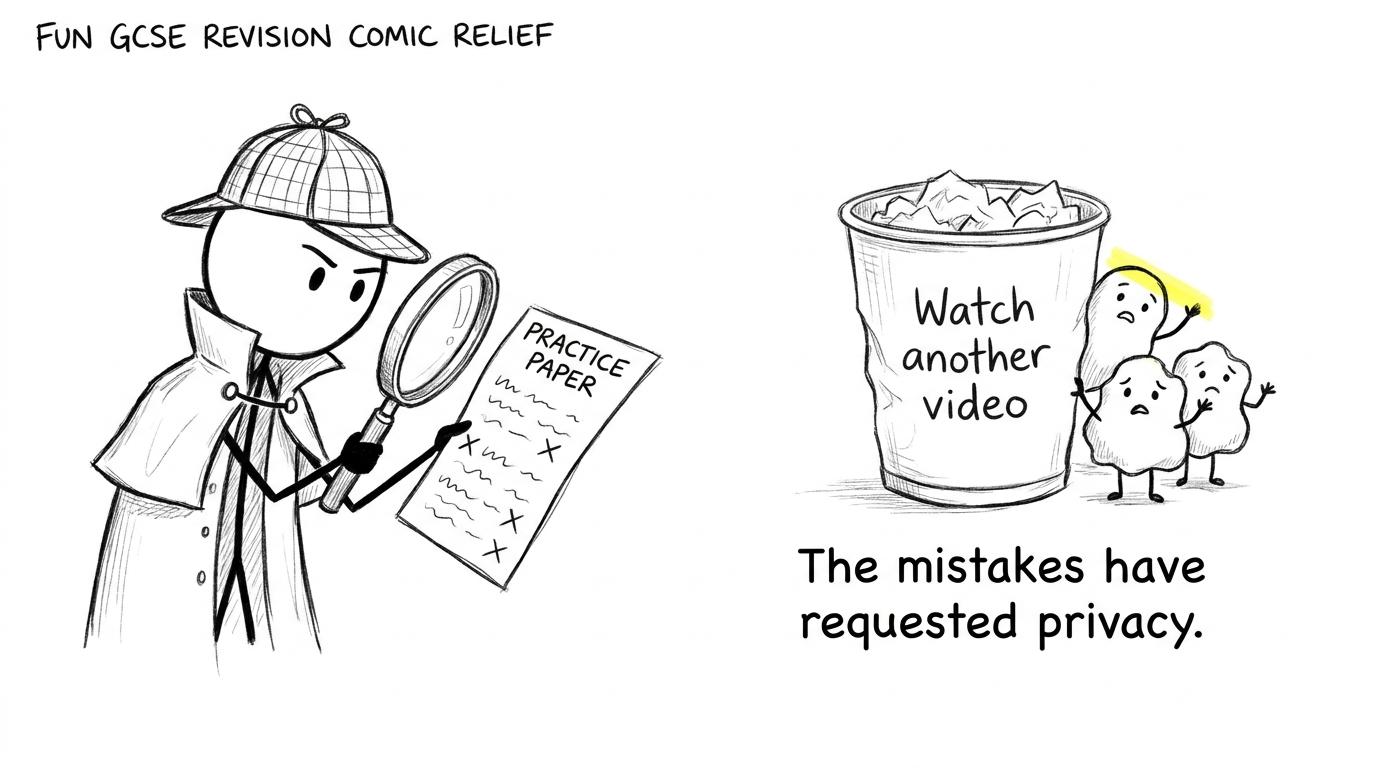 A revision detective investigates the mistakes trying to hide from correction
The verdict: can free videos get you a pass?
Possibly, but not safely as a stand-alone method. A student who already has strong foundations, chooses a fully specification-aligned course and independently adds vocabulary testing, written practice, current set texts, timed papers and accurate marking may succeed. At that stage, however, the student is no longer using YouTube alone.
No channel can guarantee a pass or a particular grade. Grade boundaries vary by examination series, while performance depends on both papers. The more useful question is whether your revision produces evidence: accurate translations, stronger literature responses, fewer repeated errors and improved performance under time pressure.
Use videos to learn. Use questions to discover what you can do. Use mark schemes to discover what the examiner can reward.
Start with MathsGenie's free GCSE Biblical Hebrew revision resources, then build towards timed past papers and careful correction. For your mathematics preparation, the GCSE maths revision hub brings together revision lessons, practice questions, mini tests, past papers, mark schemes and video solutions, while GCSE predicted papers provide further exam-style maths practice near the examination.
The medium matters less than the cycle. Learn, retrieve, practise, mark, fix and return. That is how a useful video becomes a result you can reproduce when the screen is gone and the examination paper is in front of you.










