YouTube Channels GCSE Arabic: Are They Enough?
YouTube channels GCSE Arabic can build vocabulary and grammar, but passing also needs speaking, writing, recall and timed exam practice for every paper.
There is a comfortable kind of revision that looks productive from the outside. A video is playing. Notes are open. New phrases make sense. Yet when the screen closes and a blank page appears, nothing arrives.
That is the central problem with relying on YouTube channels GCSE Arabic students find online. Videos can explain vocabulary, grammar, pronunciation and exam tasks extremely well, but for most students they are not enough on their own. Passing requires you to retrieve Arabic without prompts, understand unfamiliar material, speak under pressure and produce answers that meet the mark scheme.
YouTube can be a valuable teacher. It cannot sit the assessment for you.
The short answer: what else do you need?
A complete GCSE Arabic revision plan should include:
- videos chosen for the correct specification and tier;
- active vocabulary retrieval rather than repeated viewing;
- regular listening without subtitles;
- live or recorded speaking practice;
- independent reading and writing;
- exam-style questions under timed conditions;
- mark schemes, corrections and feedback;
- deliberate practice of weak topics and skills.
If a channel helps you do those things, it is useful. If it keeps you watching without testing what you can produce, it is entertainment wearing revision clothes.
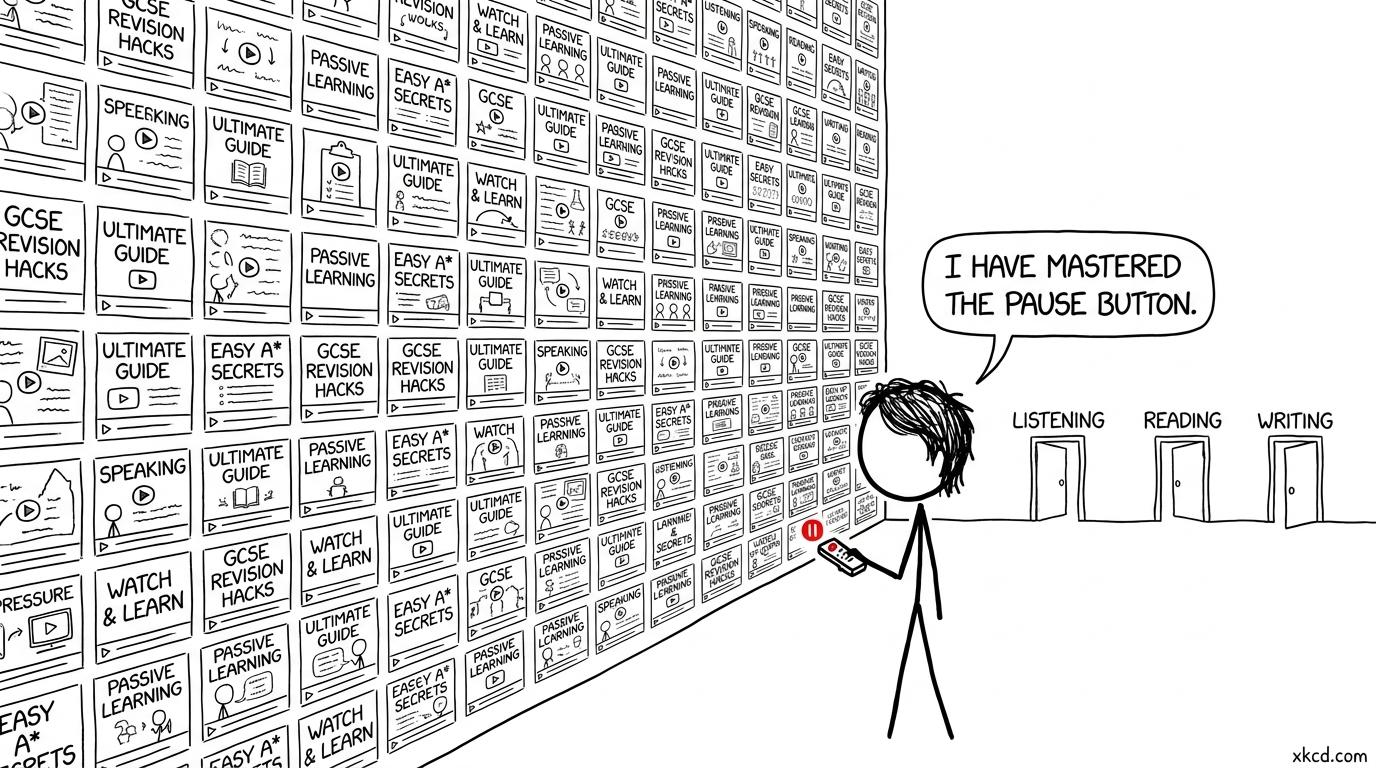 A student faces video thumbnails while four GCSE language skills wait behind them
What GCSE Arabic actually assesses
Before deciding whether a resource is enough, you need to know the job it must perform.
The current Pearson Edexcel GCSE Arabic qualification, code 1AA01AA01AA0, assesses four separate skills: listening, speaking, reading and writing. Each contributes 25%25\%25% of the qualification. All four papers are compulsory, and students enter either Foundation or Higher tier across the whole qualification rather than mixing tiers.
This matters because a channel may be excellent at explaining grammar while doing little for spontaneous speaking. Another may offer clear listening clips but never ask you to write an extended response. A resource can be genuinely good and still cover only one quarter of your problem.
The speaking assessment includes a role play, questions based on a picture stimulus and a conversation. Reading includes a translation into English, while writing includes translation into Arabic alongside open-response tasks. Dictionaries are not permitted in the assessments, including the preparation time for speaking.
In other words, recognition is only part of the course. You must also produce language independently.
Check that the content matches your course
Unlike GCSE Maths, where students commonly encounter Edexcel, AQA, OCR and Eduqas specifications, GCSE Arabic students should confirm the exact qualification used by their school or examination centre. Do not assume that a video labelled simply “GCSE Arabic” matches your paper.
Check whether it teaches:
- the themes and vocabulary on your specification;
- Foundation or Higher expectations;
- Modern Standard Arabic where the assessment requires it;
- the correct speaking task format;
- translation in both required directions;
- suitable lengths and styles for written responses.
Arabic videos focused mainly on a regional dialect may improve cultural understanding or everyday conversation, but they are not automatically preparation for an examination assessing standard Arabic. The distinction is not about one form being better. It is about practising the form the paper rewards.
Where YouTube channels are genuinely useful
YouTube is particularly effective when seeing or hearing an explanation removes confusion quickly.
A well-designed video can help you notice pronunciation, hear sentence patterns, understand how verbs change and see how a strong response is organised. You can slow down audio, replay difficult sections and compare speakers. That flexibility is valuable, especially when classroom time has moved on before a topic feels secure.
Videos are also useful for starting a session. Ten focused minutes can supply the model you need before completing a harder task independently.
The important word is “before”. Watching should lead somewhere.
A reliable sequence is:
- watch a short section with a specific question in mind;
- close the video and recall its key language;
- say or write something without copying;
- check your accuracy;
- correct the precise error;
- return to the same skill later without the video.
This resembles the feedback loop used in effective maths revision: learn, attempt, mark, repair and retest. MathsGenie explains the same principle in its guide to using GCSE mark schemes as a revision coach.
Why watching alone usually falls short
The mind often mistakes familiarity for knowledge. A phrase feels obvious while the teacher on screen is saying it. Five minutes later, without the opening word or subtitle, it may be inaccessible.
An examination does not measure how familiar the teacher’s answer feels. It measures what you can understand or produce when the support disappears.
Speaking needs another voice
You can repeat sentences after a presenter, and that is useful for pronunciation. However, speaking assessment also demands interaction: understanding a question, deciding what it means and constructing an appropriate response under time pressure.
Practise with a teacher, tutor, classmate or suitable family member where possible. If nobody is available, record yourself answering unseen prompts. Listen back for hesitation, incomplete answers and repeated grammatical errors. Recording is not a perfect substitute for interaction, but it is more revealing than silently imagining that you could answer.
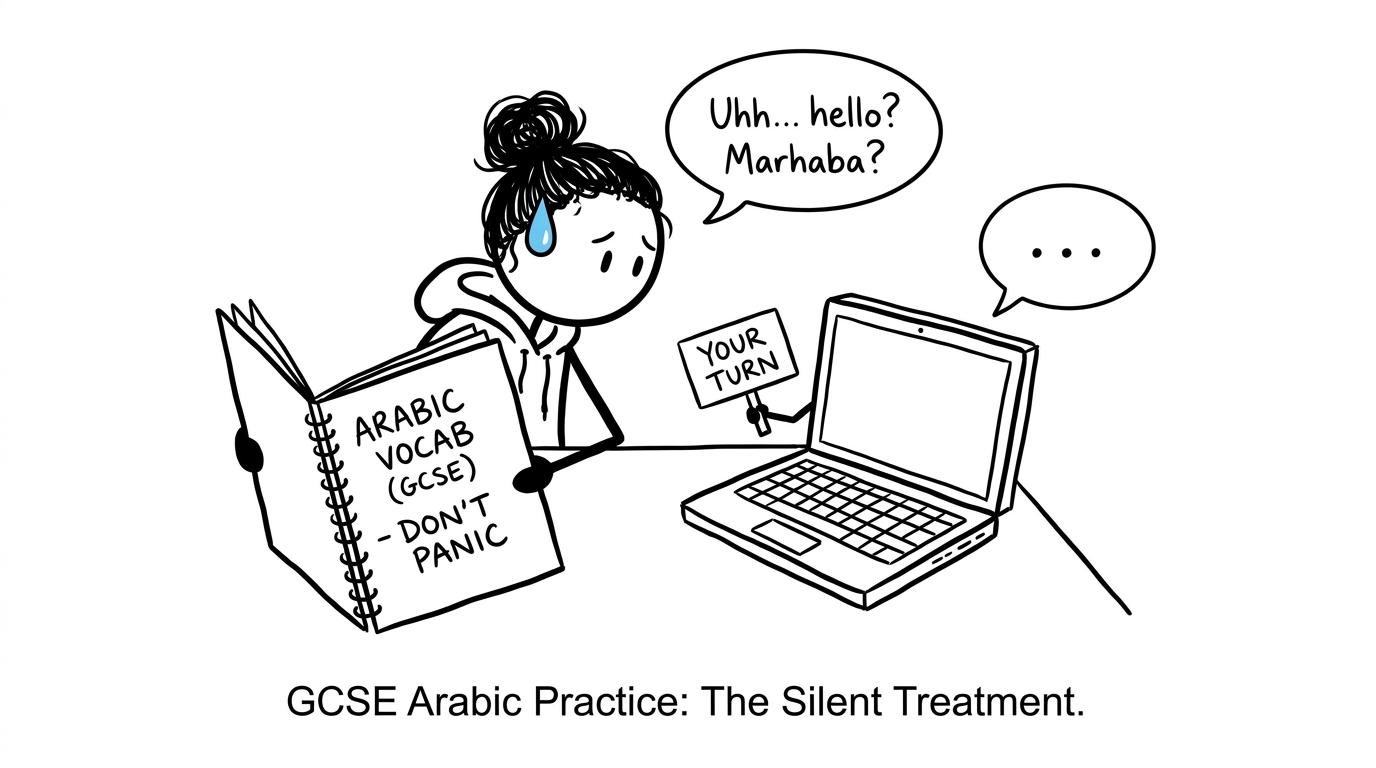 A nervous student attempts speaking practice with a silent laptop
Writing needs correction
A video can show you an excellent paragraph. It cannot automatically identify the patterns in your own writing: inaccurate verb forms, agreement errors, missing detail or a memorised sentence that does not answer the question.
Write regularly without pausing to copy model answers. Then obtain feedback from your teacher or compare your work carefully with official materials and mark schemes. Keep a correction log containing the error, the corrected form and a prompt that makes you retrieve it again.
Listening must become less comfortable
Subtitles make difficult audio accessible, but permanently leaving them on can hide a listening weakness. Use them in stages: listen first without support, listen again with a transcript or subtitles, identify what blocked understanding, then replay without support.
You also need unfamiliar voices and exam-style recordings. Becoming accustomed to one presenter’s pace can produce confidence that disappears when the speaker changes.
Timed papers test the whole system
Topic videos isolate ideas. Real papers combine themes, instructions, unfamiliar vocabulary and time pressure. That combination is a separate skill.
Use official sample or past assessment materials for your specification. Complete sections without pausing, mark them honestly and turn each lost mark into a precise action. “Revise writing” is too broad. “Practise giving a justified opinion in more than one time frame” gives you something useful to do.
The same diagnostic approach works across subjects. The MathsGenie guide to catching up on GCSE revision shows how to turn a paper into a targeted list rather than a judgement about your ability.
A balanced GCSE Arabic revision routine
A sensible week gives all four skills repeated attention. It does not need to give each skill an identical session, but none should disappear for weeks.
Try this structure:
- Learn: use a focused video, lesson or specification-based resource.
- Recall: retrieve vocabulary and structures with no notes visible.
- Apply: complete a listening, speaking, reading or writing task.
- Check: use feedback or a mark scheme to identify exact weaknesses.
- Retest: attempt a related prompt after a gap.
- Mix: complete timed material that combines themes and skills.
Keep sessions narrow enough to finish. “Revise Arabic” encourages drift; “record answers to five unseen speaking questions and correct them” creates evidence.
If you are balancing Arabic with maths and other GCSEs, plan tasks rather than vague blocks of time. Maths students can use the GCSE Maths revision hub for lessons, exam questions, past papers and short tests, leaving their Arabic sessions free for language-specific practice. The advice in the best order to learn GCSE Maths topics also demonstrates a useful planning principle: secure foundations first, then add more demanding work.
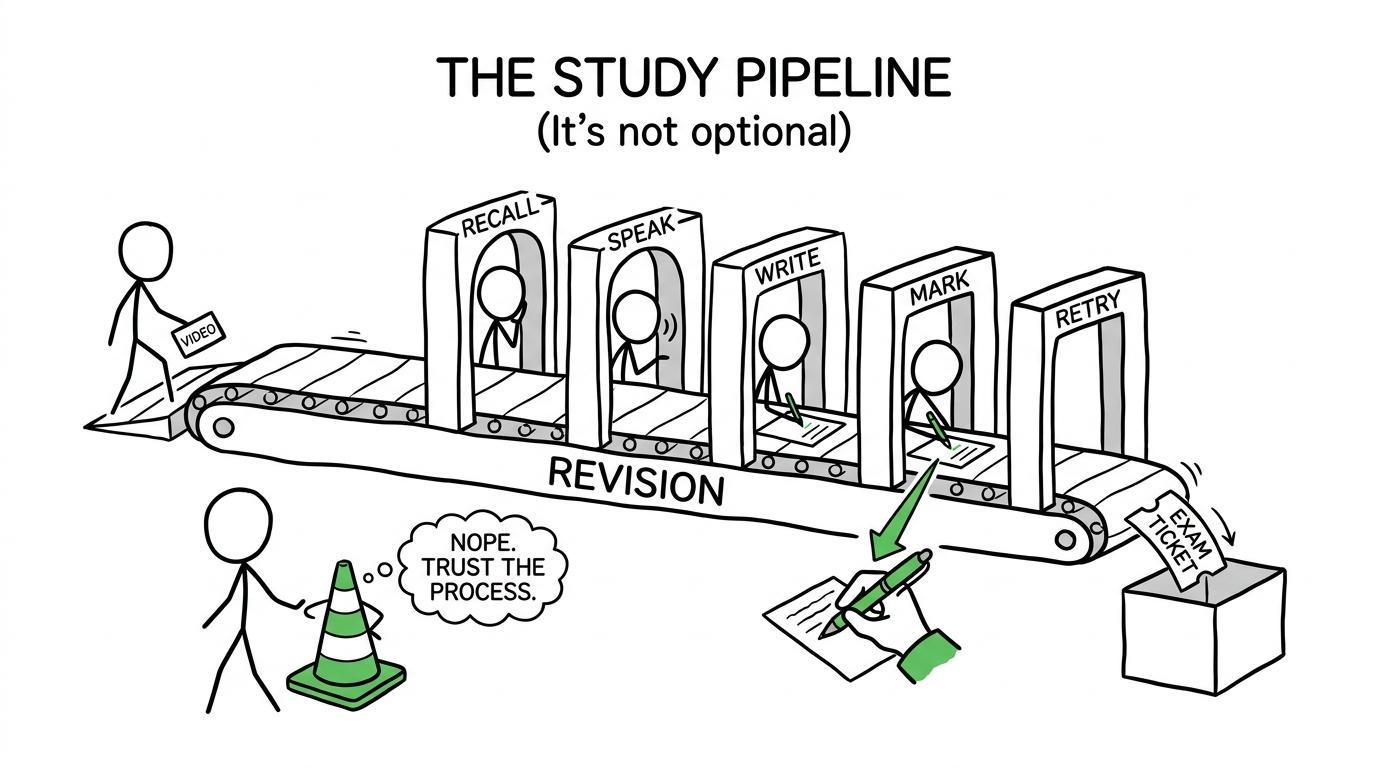 A revision conveyor belt turns watching into recall, speaking, writing, marking and retrying
How to judge YouTube channels for GCSE Arabic
Subscriber counts and polished thumbnails do not tell you whether a channel fits your examination. Use a practical checklist instead.
A strong channel should:
- identify the qualification or specification it supports;
- distinguish standard Arabic from dialect where relevant;
- cover more than isolated vocabulary lists;
- explain why language is correct rather than only presenting answers;
- encourage speaking and writing away from the screen;
- include questions, pauses or retrieval tasks;
- avoid promising a particular grade from watching alone;
- be checked against current official specification documents.
You do not need one perfect channel. A small collection may serve different purposes: pronunciation, grammar, listening and exam technique. The danger is collecting resources instead of using them. Three carefully chosen videos followed by independent practice are worth more than a playlist of fifty unwatched or half-watched lessons.
Common mistakes when revising GCSE Arabic online
Treating hours watched as progress
Time is an input, not proof of learning. Track what you can now recall, understand, say or write.
Copying notes word for word
Transcription keeps your hand busy while allowing your memory to remain passive. Pause, hide the explanation and reconstruct the key idea yourself.
Avoiding speaking because it feels awkward
The discomfort is information. It shows that retrieval is not yet automatic. Begin with short recorded responses, then move towards unpredictable questions and live interaction.
Using material that does not match the specification
A general Arabic lesson may be educational without preparing you for the wording, themes or task types in your GCSE. Keep the official specification and assessment structure as your map.
Completing papers without learning from them
A score tells you where you are. Corrections change where you are going. The method described in MathsGenie's past-paper revision guide transfers well: attempt, mark, create a precise fix list, repair and retest.
Letting one subject consume the timetable
Students sometimes spend an entire evening on the subject that feels safest. A structured plan protects less comfortable work. If maths is becoming urgent, MathsGenie's focused three-day revision framework offers a useful model for diagnosis, targeted practice and timed checking without pretending that a few days replace long-term preparation.
YouTube is a tool, not the whole revision plan
Free YouTube content can take you a long way. For a student who already speaks and reads Arabic confidently, it may fill specific grammar or exam-technique gaps. For a beginner or a student with uneven skills, relying on it alone leaves too much untested. No platform can guarantee a pass because the result depends on your starting point, tier, performance across four papers and quality of independent practice.
Use videos to learn. Then remove the support and see what remains.
For your maths preparation, make MathsGenie's GCSE Maths resources your free revision base. Move from revision lessons to practice questions, then test yourself with past papers, predicted papers and mini tests. Use mark schemes and video solutions to correct each weakness. The subject may change, but the dependable revision loop does not: learn, practise, check and return stronger.