Wrong Tier GCSE Polish: What Happens Next?
Wrong tier GCSE Polish entry? Learn what each tier allows, whether your school can change it before the exam, and exactly who you should contact now.
A tier can look like one small letter on an exam entry: F or H. Yet that letter controls the papers you receive and the grades available. If you are worried about a wrong tier GCSE Polish entry, the immediate answer is reassuring: it can usually be corrected before the exam, but you should tell your Polish teacher and your school or college exams officer straight away.
Do not wait for the first written paper. Your exams officer, rather than the student, must amend the official entry with AQA. Changes made after the published amendment deadline may involve a fee, but that is an administrative matter for the centre and not a reason to stay silent.
What to do if your GCSE Polish tier looks wrong
Use this checklist:
- Check whether your entry says Foundation or Higher.
- Compare it with the tier agreed with your Polish teacher.
- Tell your teacher and exams officer immediately if it is incorrect.
- Ask them to confirm the corrected tier in writing.
- Check that the same tier applies to listening, speaking, reading and writing.
- Continue revising while the centre deals with the amendment.
- If you have already completed a speaking assessment, raise the issue urgently because special rules may apply.
You should not try to contact the exam board to amend the entry yourself. The school, college or centre that entered you must handle that process.
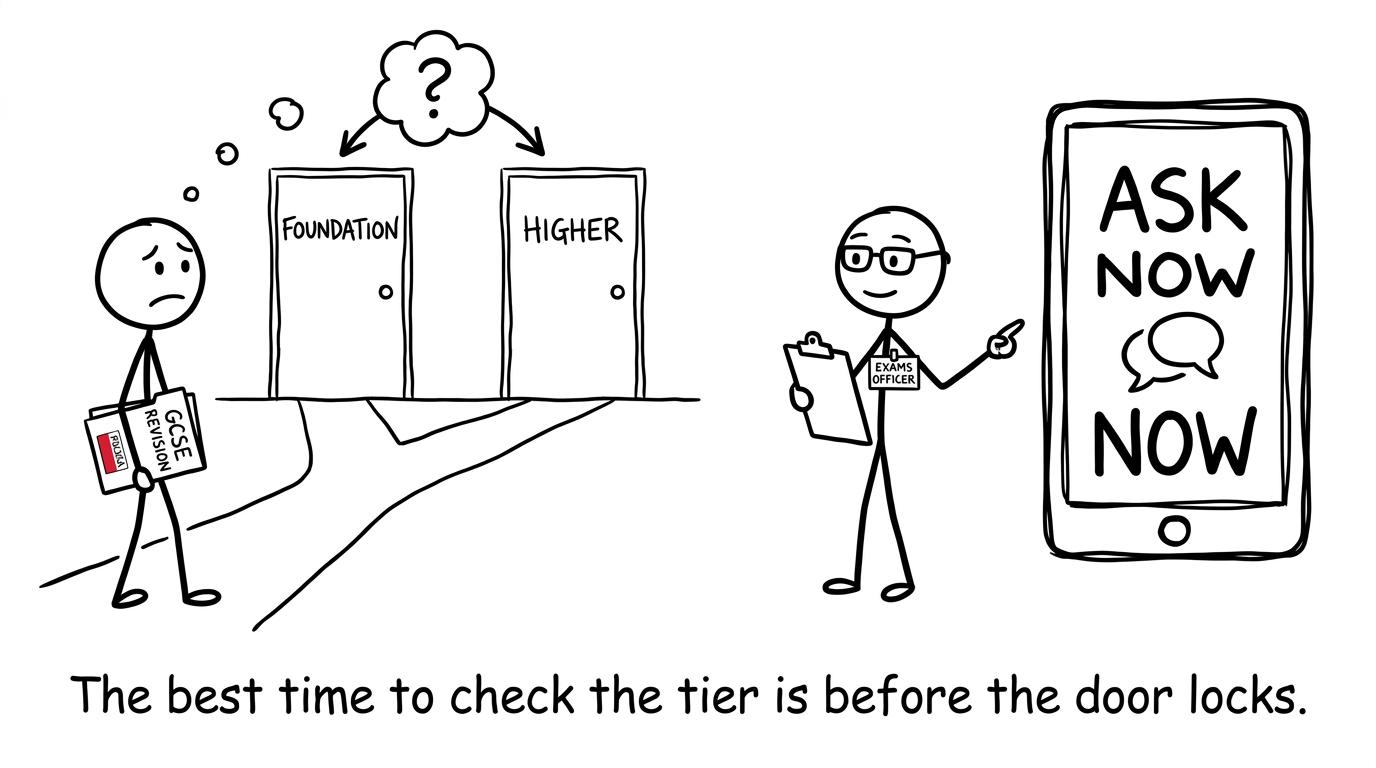 A student choosing between Foundation and Higher while an exams officer recommends checking now
How GCSE Polish tiers work
The current AQA GCSE Polish qualification, specification code 8688, has two tiers. AQA is the relevant exam board for this qualification, so references to Edexcel, OCR or Eduqas procedures for other subjects should not be treated as Polish entry instructions.
| Tier | Normal grade range | Entry code |
|---|---|---|
| Foundation | Grades 111 to 555 | 8688/F |
| Higher | Grades 444 to 999 | 8688/H |
At Higher tier, a narrowly missed grade 444 may result in an allowed grade 333. A performance below the minimum standard for that safety-net grade receives a U, meaning unclassified. At Foundation tier, the highest available grade is 555.
GCSE Polish assesses four skills:
- listening;
- speaking;
- reading;
- writing.
Each contributes 25%25\%25% of the qualification. Crucially, a student must take all four assessments at the same tier and in the same exam series. You cannot, for example, take Foundation listening and Higher writing as a deliberate entry strategy.
That rule explains why checking early matters. This is not simply about swapping one paper on one morning. The tier applies across the complete qualification.
What happens if Foundation was entered instead of Higher?
If you were meant to take Higher but have been entered for Foundation, your potential grade is capped at 555. Even an exceptional Foundation performance cannot produce a grade 666, 777, 888 or 999 because those grades are outside that tier's range.
That does not automatically mean Foundation is the wrong choice. A grade 444 or 555 achieved at Foundation is worth the same as the corresponding grade achieved at Higher, and the tier does not appear on the certificate. The right decision depends on the evidence from your teacher, mock assessments and performance across all four skills.
However, if Higher was agreed and the entry displays Foundation, ask for it to be investigated. A clerical entry should not quietly determine your ceiling.
What happens if Higher was entered instead of Foundation?
Higher tier offers access to grades 444 to 999, but its tasks and language demands are more challenging. There is also a greater risk at the lower end: except for the narrow allowed grade 333, a student who does not reach the required standard receives a U.
Foundation may therefore be the more appropriate tier when the evidence suggests that it gives the student the best opportunity to secure grades 111 to 555. Higher is not automatically better merely because its maximum grade is higher.
Tier decisions should be based on consistent evidence rather than one unusually good or difficult mock. Listening, speaking, reading and writing all matter. Confidence in conversation alone does not necessarily show that Higher reading and writing are secure.
Can the wrong tier be fixed before the exam?
Yes, in most cases. AQA allows centres to amend a student's tier. The exams officer normally withdraws the incorrect tier entry and submits the correct one through the same entry system used originally.
AQA states that tier changes can be made without an amendment charge before the relevant amendment deadline. After that deadline, a fee may apply. Deadlines vary by exam series, so the safest advice is simple: report the problem now rather than trying to calculate how long you can leave it.
Even when a deadline has passed, you should still speak to the exams officer. A late fee does not necessarily mean that a correction is impossible. It means the centre must follow the exam board's current late-amendment process.
Who is responsible for changing it?
The exams officer makes the formal amendment. Your Polish teacher or head of languages may need to confirm the intended tier, while a parent or carer can help you follow up if confirmation is slow.
A useful message is:
My GCSE Polish entry appears to show Foundation/Higher, but I understood that I would take Higher/Foundation. Please could you check the official AQA entry and confirm my tier for all four assessments?
Keep the wording factual. You are asking for a check, not accusing anyone of making a mistake.
How should you confirm the correction?
Ask for written confirmation from your school or centre. A timetable can help reveal a problem, but it may not display every detail clearly. The exams officer can check the centre's official entry record and the relevant AQA option code.
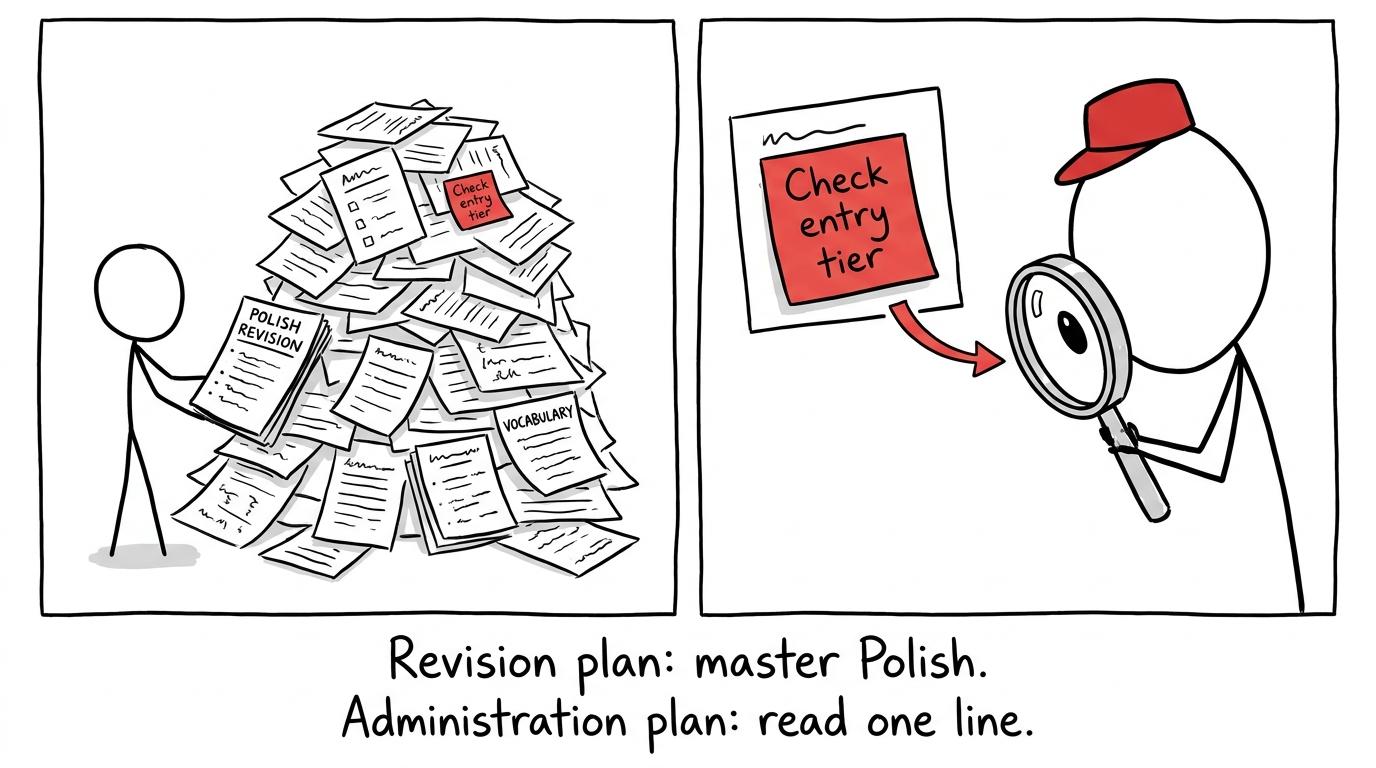 A huge revision pile beside one important sticky note reminding a student to check the entry tier
What if you discover the error during the exam period?
Tell an invigilator or exams officer immediately. Do not simply take a different paper because it looks more suitable, and do not assume that the entry will correct itself when the script is returned.
If the wrong written paper has only just been issued and the problem is noticed while the examination is still in progress, the centre should follow AQA's current exam-day instructions. Staff, not the student, must decide how to secure the incorrect paper, supply the proper paper and record what happened.
The speaking assessment requires particular urgency because it normally takes place within a confidential testing window. AQA's conduct instructions allow a speaking test accidentally completed at the wrong tier to be redone at the correct tier within that window, using different materials, with the original test discarded. The centre must manage this process exactly as instructed.
If an assessment has already finished, the exams officer should contact AQA for case-specific guidance. The outcome depends on what was taken, when the mistake was identified and whether the remaining components can be administered correctly. Do not rely on advice about another exam board or another subject.
How to decide whether the tier itself is appropriate
An incorrect entry and a disagreement about the best tier are different problems.
If the code is not what the school intended, it is an administrative correction. If the code is accurate but you believe the decision is unsuitable, ask your teacher to explain the evidence behind it. Useful questions include:
- Which tier have I been entered for officially?
- What do my listening, speaking, reading and writing results suggest?
- What grade range is realistic across the whole qualification?
- Is there enough current evidence to reconsider the decision?
- When must the final request reach the exams officer?
A calm discussion is more useful than treating Higher as a badge of ability or Foundation as a judgement. The purpose of a tier is to give you an appropriate assessment route.
Maths students face a similar decision at GCSE. If Polish administration has disrupted your wider revision, return to a simple structure with the GCSE one-month maths revision plan or build a longer routine using the GCSE maths revision timetable.
Keep the problem from consuming your revision
Administrative uncertainty has a habit of occupying more attention than it deserves. Once you have reported the issue and asked for confirmation, keep preparing for your other examinations.
For maths, use resources matching your own exam board and tier. The MathsGenie free GCSE and A Level maths revision hub brings revision lessons, exam questions and solutions together. If you take Edexcel, the guide to revising Edexcel GCSE Maths efficiently provides a focused revision loop.
Past papers are most valuable when they are marked and reviewed rather than merely completed. The guide to when to start GCSE past papers helps you plan the timing, while how many GCSE past papers to complete explains why careful review matters more than an impressive total.
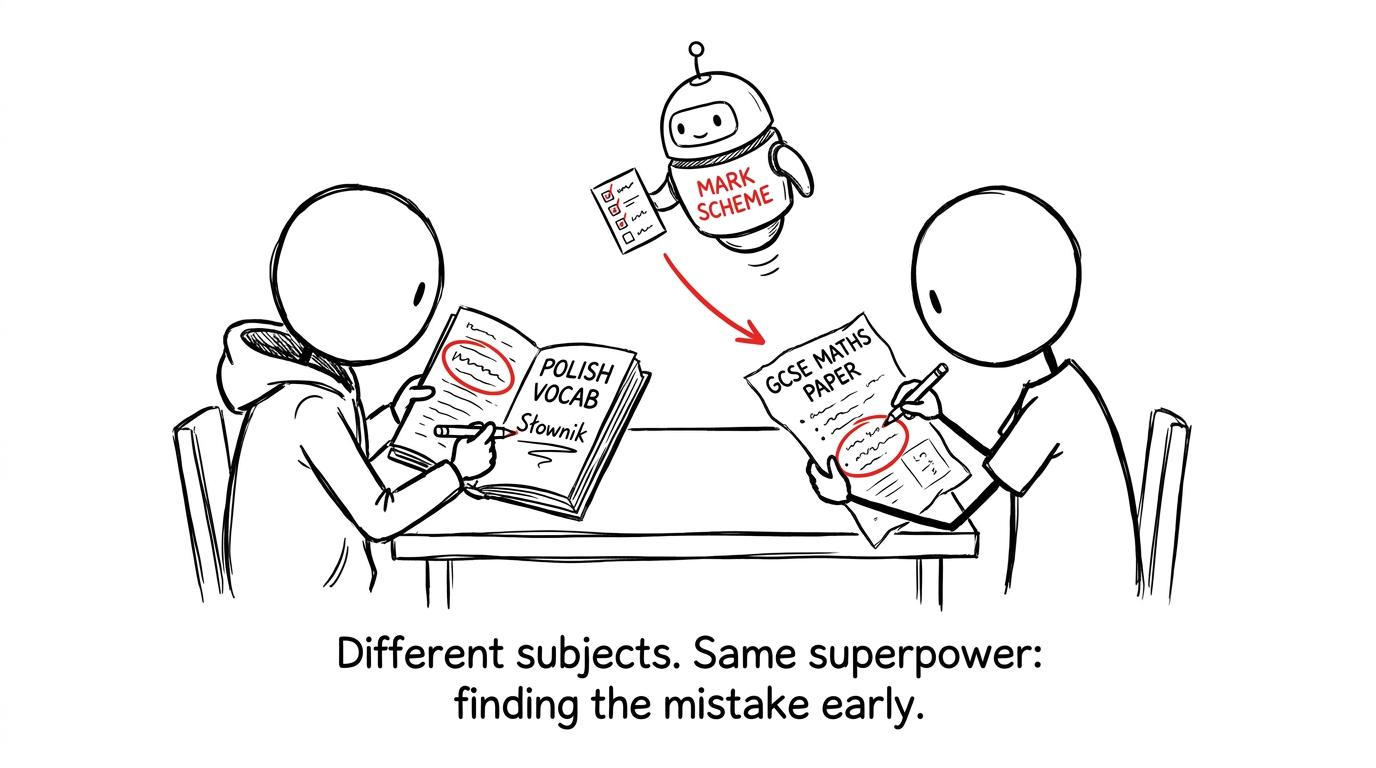 Polish and maths students using a mark scheme to find mistakes early
Common mistakes when dealing with a wrong entry
Waiting because the exam is still weeks away
Entry amendments become more complicated after deadlines. Reporting the concern early gives the exams officer more time to verify and correct it.
Assuming the teacher has already changed it
A conversation about changing tier is not the same as an amended official entry. Ask for confirmation from the exams officer.
Thinking different skills can use different tiers
All four GCSE Polish assessments must be taken at the same tier. Mixed-tier entry is not a valid planned route.
Choosing Higher only because it reaches grade 999
Higher creates access to the top grades, but it also contains more demanding tasks and carries a U risk below the safety-net standard. The decision should reflect evidence across every skill.
Ignoring a speaking test already taken at the wrong tier
This is time-sensitive because any permitted retest must follow the confidential-window rules. Tell the centre immediately.
Letting the issue stop all other revision
Raise it, document it and follow up. Then continue preparing. For final maths practice, Edexcel GCSE Maths predicted papers can be used alongside past papers, while the guide to predicted GCSE maths topics explains why predictions should never replace specification-wide revision.
Act early, then return to the work you control
A wrong GCSE Polish tier can affect the papers you sit and the grades available, but an entry spotted before the examinations can usually be amended by your centre. Tell your teacher and exams officer now, ask them to check the official AQA code, and obtain written confirmation covering all four skills.
Then bring your attention back to preparation. MathsGenie gives you free revision lessons, practice questions, mini tests, past papers, predicted papers, mark schemes and video solutions so that an administrative worry does not derail the marks still within your control. Resolve the tier question early, choose the correct MathsGenie resources for your maths board and tier, and make the next revision session count.