Why Did I Fail My GCSE Resit? Your Grade 4 Fix
Why did I fail my GCSE resit? Diagnose gaps, timing, technique and tier choice, then follow a focused plan to reach grade 4 with confidence.

Opening a November result and seeing a grade 333 can feel strangely final. It is not. If you are asking, “why did I fail my GCSE resit?”, the most useful answer is rarely that you are simply bad at the subject. More often, your result came from a combination of topic gaps, weak timing, exam technique and, in GCSE Maths, possibly the wrong tier choice.
Your next step is not to repeat the same revision for longer. It is to diagnose where the marks disappeared, then build a resit improvement plan around that evidence. For Maths, this means analysing individual questions and topics. For English Language, it means looking closely at reading responses, writing choices, timing and assessment objectives.
A missed grade 4 is information. Used carefully, it can become a map.
Your grade 4 diagnosis checklist
Before beginning another revision cycle:
- Record your mark for every paper or component.
- Compare your total with the published grade boundary for your exact exam board and series.
- Ask your school, college or exam centre whether you can access your marked scripts.
- Separate knowledge gaps from timing and exam technique problems.
- Review whether your GCSE Maths tier was suitable.
- Choose a small number of priorities for the next four weeks.
- Complete timed papers and measure whether the same errors return.
Do not rely on the grade alone. Two students can receive the same grade 333 for completely different reasons, so they should not follow identical revision plans.
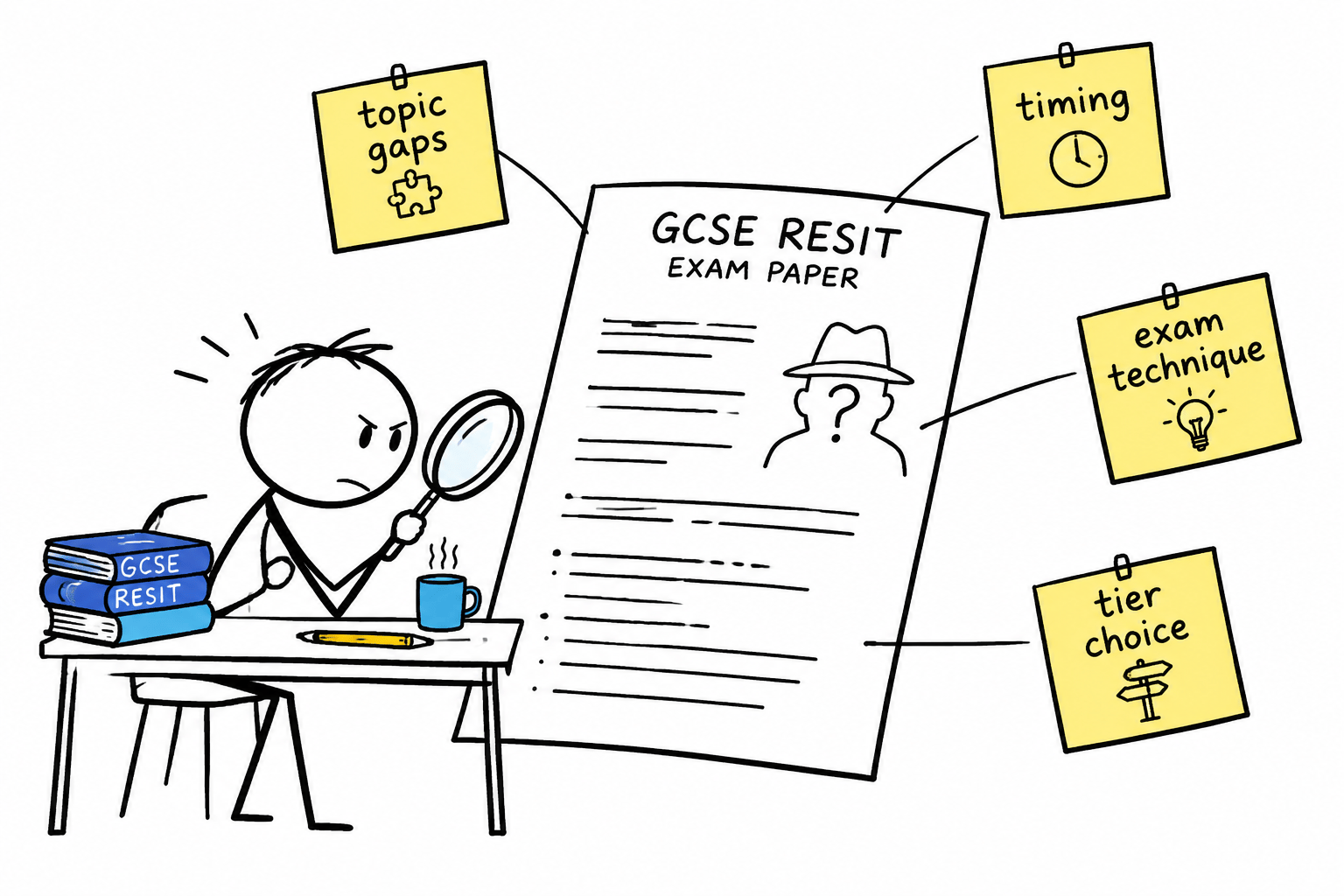 A GCSE resit student investigating topic gaps, timing, exam technique and tier choice
Start by analysing your GCSE results
The distance from grade 4 matters. Find the official grade boundary for your exam board, qualification, tier and exam series, then calculate:
mark gap=grade 4 boundary−your total mark\text{mark gap} = \text{grade 4 boundary} - \text{your total mark}mark gap=grade 4 boundary−your total markGrade boundaries can change between exam series, so do not assume that an old boundary will apply next time. Use it to understand your November performance, not to predict an exact future target.
If you missed grade 4 narrowly, your quickest gains may come from timing, checking and collecting method marks. A larger gap usually suggests that several core skills need rebuilding. Neither situation calls for panic. They simply require different plans.
For GCSE Maths, start with the free GCSE Maths revision hub, where you can select your exam board and find relevant revision materials, past papers, mark schemes and grade boundaries.
For English Language, break the result down by paper and section. Ask whether reading, transactional or persuasive writing, creative writing, technical accuracy, or unfinished answers caused the greatest loss. Use the terminology and assessment objectives from your own specification because AQA, Edexcel, OCR and Eduqas do not structure every task identically.
Request your marked scripts when they will help
A result sheet tells you how many marks you earned. A marked script can show how you earned them.
Ask your school, college or exam centre about access to scripts as soon as possible. Under the JCQ process, centres request scripts through the awarding body, and each exam board publishes its own arrangements and deadlines. If you entered privately, contact the centre through which you sat the examination.
A script is especially useful when you need to know whether you:
- left later questions unfinished;
- misunderstood command words;
- used correct methods but lost accuracy marks;
- wrote too little or too much in English Language;
- failed to show sufficient mathematical working;
- repeatedly changed correct answers;
- received unexpectedly low marks on a particular section.
Review the script with a teacher where possible. They can compare your answers with the mark scheme and distinguish a marking concern from an answer that did not meet the required criteria. Accessing a script is not the same as requesting a review of marking, so ask your exams officer about the available post-results services before making a decision.
Diagnose the four main causes
Knowledge and skill gaps
A knowledge gap means you could not confidently begin the question, even without time pressure.
In Maths, grade 4 depends on a broad foundation rather than one spectacular topic. Weaknesses in fractions, percentages, ratio, algebra, graphs, probability or geometry can reappear across several papers. Use topic questions and Edexcel GCSE Maths mini tests if you follow Edexcel, or choose the relevant resources for your board.
Do not write “algebra” on your weakness list. That is too broad to guide revision. Write the exact skill, such as solving linear equations, expanding brackets or finding a gradient. The process in finding your weakest GCSE Maths topics can help you turn a disappointing paper into a precise revision list.
For English Language, identify the exact reading or writing demand. “I am weak at English” is not actionable. “I do not select evidence efficiently” or “my paragraphs describe techniques without explaining effects” gives you something to practise.
Timing problems
Timing is the cause when you can answer questions afterwards but could not complete them during the examination.
Look at where your script becomes rushed or blank. In Maths, you might have spent too long fighting one difficult problem while accessible marks remained later in the paper. In English Language, an overlong reading answer may have reduced the time available for a high-mark writing task.
Practise sections under realistic time limits before attempting complete papers. When you move to full papers, allow only the official examination time. The aim is not to feel hurried. It is to make moving on a rehearsed decision rather than a stressful one.
Exam technique
Exam technique sits between knowing and scoring. You understand the topic, but your answer does not communicate enough to receive the marks.
In Maths, this can include missing working, premature rounding, ignoring units, misreading scales or failing to check whether an answer is reasonable. Learning how to use GCSE mark schemes will show you where method marks are available and what a complete response requires.
In English Language, technique includes addressing the precise task, selecting concise evidence, developing analysis and controlling paragraphs. In writing, marks are not awarded merely for length. Organisation, vocabulary, sentence control, punctuation and accuracy all matter according to the relevant mark scheme.
Tier choice in GCSE Maths
GCSE English Language is untiered, but GCSE Maths has foundation and higher tiers. Foundation offers grades 111 to 555, while higher is designed principally for grades 444 to 999.
Higher is not automatically the better choice. If too much of the paper is inaccessible, foundation may offer a more reliable route to grade 4. Equally, a student already performing securely on higher content may be better served by remaining there.
Discuss tier choice with your teacher or exam centre. Consider your paper performance, target grade and confidence across the specification. Do not choose a tier because it sounds more impressive. Choose the paper on which you can collect the marks you need.
Build a resit improvement plan
A useful plan has three repeating stages: learn, practise and test.
Weeks one and two: repair
Choose your three weakest areas rather than revising everything at once. For Maths, use revision lessons and video solutions, then complete focused practice questions. For English Language, practise one reading or writing skill at a time and ask for feedback against the assessment objectives.
Keep an error log with four headings: topic or task, what went wrong, the corrected approach, and when you will retest it.
Week three: connect skills
Move from isolated exercises to mixed questions and timed sections. Use mini tests in Maths and complete short English Language sections without notes. Return to any error that appears twice. Repeated mistakes deserve more attention than unfamiliar questions you encountered once.
Week four: test under exam conditions
Complete full papers in the correct time and mark them honestly. MathsGenie explains how many GCSE past papers to complete, but quality matters more than collecting paper totals. Every paper should produce corrections and a new priority list.
You can also use the MathsGenie paper marker for detailed feedback on completed Maths papers. If your exam is approaching, adapt the structure in this one-month GCSE Maths revision plan.
Common mistakes after missing grade 4
The first mistake is restarting the entire course from page one. This feels responsible, but it gives equal time to secure and insecure topics.
The second is completing untimed questions only. Familiar practice builds confidence, but it does not expose pacing problems.
The third is reading mark schemes without correcting answers. A mark scheme becomes useful when you rewrite the response, identify the missing step and retest the skill later.
The fourth is treating every lost mark as a knowledge gap. Some marks disappear through poor time allocation, unclear working or not answering the exact question.
Finally, do not measure progress through revision hours alone. Measure it through completed answers, fewer repeated errors and improving timed-paper marks.
Turn the result into your next decision
Missing grade 4 in November can feel like evidence that nothing changed. Often, it means the revision was not yet specific enough. The answer is not vague determination. It is a better feedback loop.
Request your scripts where useful. Identify whether gaps, timing, exam technique or tier choice held you back. Then use MathsGenie’s free revision lessons, practice questions, mini tests, past papers, mark schemes and video solutions to work on the precise Maths skills costing you marks.
Start with one paper and one honest diagnosis. A result tells you where you were on one examination day. Your next plan determines where you go from there.