Why Choose GCSE Sociology? What Students Enjoy
Why choose GCSE Sociology? Discover what students enjoy, the skills it develops, what the course covers and whether it could suit you at options time.
Choosing GCSE options can feel strangely permanent. You are asked to make a decision about a subject you may never have studied, while also thinking about exams that still feel a long way away. If you are wondering why choose GCSE Sociology, the short answer is that it offers a structured way to investigate questions about families, education, crime, inequality and society. Students who enjoy it often value the debates, the connection to everyday life and the chance to develop arguments rather than memorise isolated facts.
It is not automatically easy, and it will not suit everyone. Sociology involves substantial reading, precise terminology, evidence and extended writing. But for a curious student who likes asking why people behave differently in different social settings, that challenge can be exactly what makes the subject worthwhile.
GCSE Sociology at a glance
Before choosing the subject, check whether these statements sound like you:
- You are interested in how families, schools and communities work.
- You enjoy discussing more than one explanation for an issue.
- You are willing to learn sociological concepts and research evidence.
- You can support an opinion rather than simply state it.
- You want to improve your analytical and extended-writing skills.
- You are comfortable interpreting tables, graphs and statistical claims.
- You will practise timed answers and learn from mark schemes.
The reasons discussed below reflect features that students commonly find rewarding. They are not a promise that everyone will enjoy the course. Your school's specification, teaching approach and option arrangements matter, so read its course information and speak to the sociology teacher before deciding.
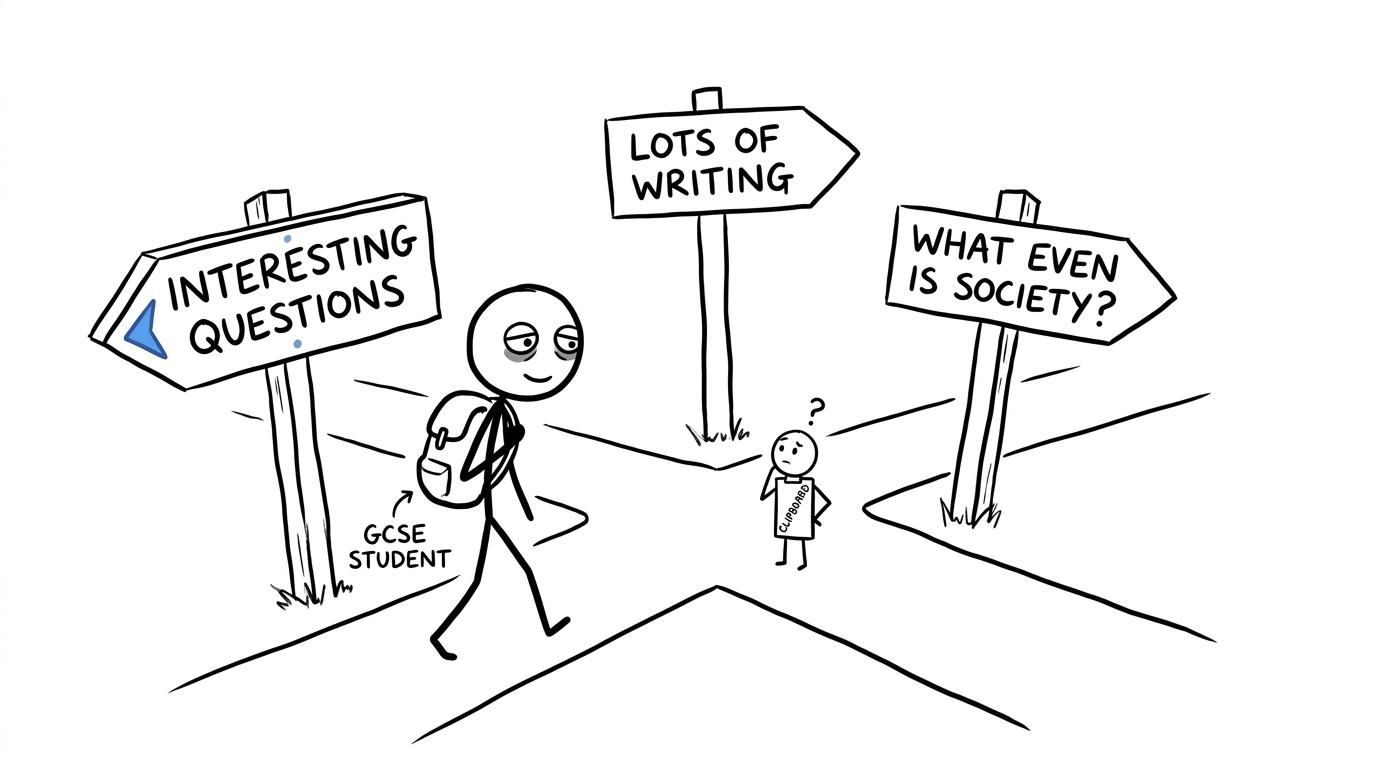 A student choosing the path towards interesting questions at a GCSE options crossroads
The subject makes familiar life look less obvious
One reason students can be glad they picked Sociology is that it changes how they see ordinary situations.
A school is no longer only a building where lessons happen. It can also be examined as an institution that transmits norms and values, sorts pupils into groups and influences future opportunities. A family is not treated as one fixed arrangement. Sociologists ask how family structures differ, how roles change and how wider economic or cultural forces affect private life.
This gives the course an unusual quality: lessons often begin with something recognisable, then reveal that it has several competing explanations. Students are not merely asked what happens. They consider why it happens, who benefits, how it could be investigated and whether the available evidence is convincing.
That can make revision more meaningful. A concept is easier to remember when you can recognise the question behind it.
Sociology rewards curiosity, but disciplines it
Sociology welcomes discussion, although it is not a subject in which every unsupported opinion earns marks. Strong responses use relevant concepts, evidence and reasoning.
That distinction is important. You might begin with a personal view about educational achievement or crime, but an examination answer must move beyond personal experience. It should identify an explanation, apply sociological knowledge, consider evidence and reach a justified judgement where required.
Students who enjoy debate often appreciate this structure. They can examine functionalist, Marxist, feminist and interactionist perspectives without being told that every social question has one simple answer. At the same time, the specification gives those discussions boundaries. You still need accurate terminology and carefully selected material.
This combination of openness and discipline is one of the strongest answers to why choose GCSE Sociology: it teaches you to be interested without becoming vague.
The course covers issues that genuinely matter
Exact content depends on your school and exam board, so never assume that every Sociology course is arranged identically. On the current AQA GCSE Sociology specification, students study families, education, crime and deviance, social stratification, social theory and research methods.
AQA assesses the qualification through two written papers. Each paper lasts one hour and forty-five minutes, carries one hundred marks and contributes half of the GCSE. Questions include multiple-choice, short-response and extended-response tasks. These details can change when specifications are updated, so confirm the course used by your school before choosing or revising.
The topics matter because they concern institutions and patterns students already encounter. Sociology creates room to ask questions such as:
- How do social class, gender and ethnicity relate to educational experiences?
- Why do sociologists disagree about the purposes of education?
- How are crime and deviance defined?
- How can inequality be measured and explained?
- What makes a piece of social research credible or ethical?
The value lies less in being handed final answers and more in learning how responsible explanations are built.
Research methods connect sociology with maths
For students preparing for GCSE maths, research methods provide a useful bridge between subjects. Sociologists use quantitative and qualitative evidence, and they must think carefully about sampling, questionnaires, interviews, observations, reliability, validity and ethics.
The current AQA specification also expects students to interpret information presented through graphs, diagrams, charts and tables. That does not turn Sociology into another maths lesson. It does mean that confidence with data can help you question what a statistic actually shows.
For example, you may need to notice a trend, compare groups or decide whether a conclusion is justified. Your maths knowledge supports the numerical interpretation; sociology adds questions about who collected the data, how the sample was selected and what may have been left out.
MathsGenie's free GCSE Statistics revision hub is useful if data interpretation feels uncertain. You can also strengthen specific foundations through percentages revision, two-way tables practice and probability revision.
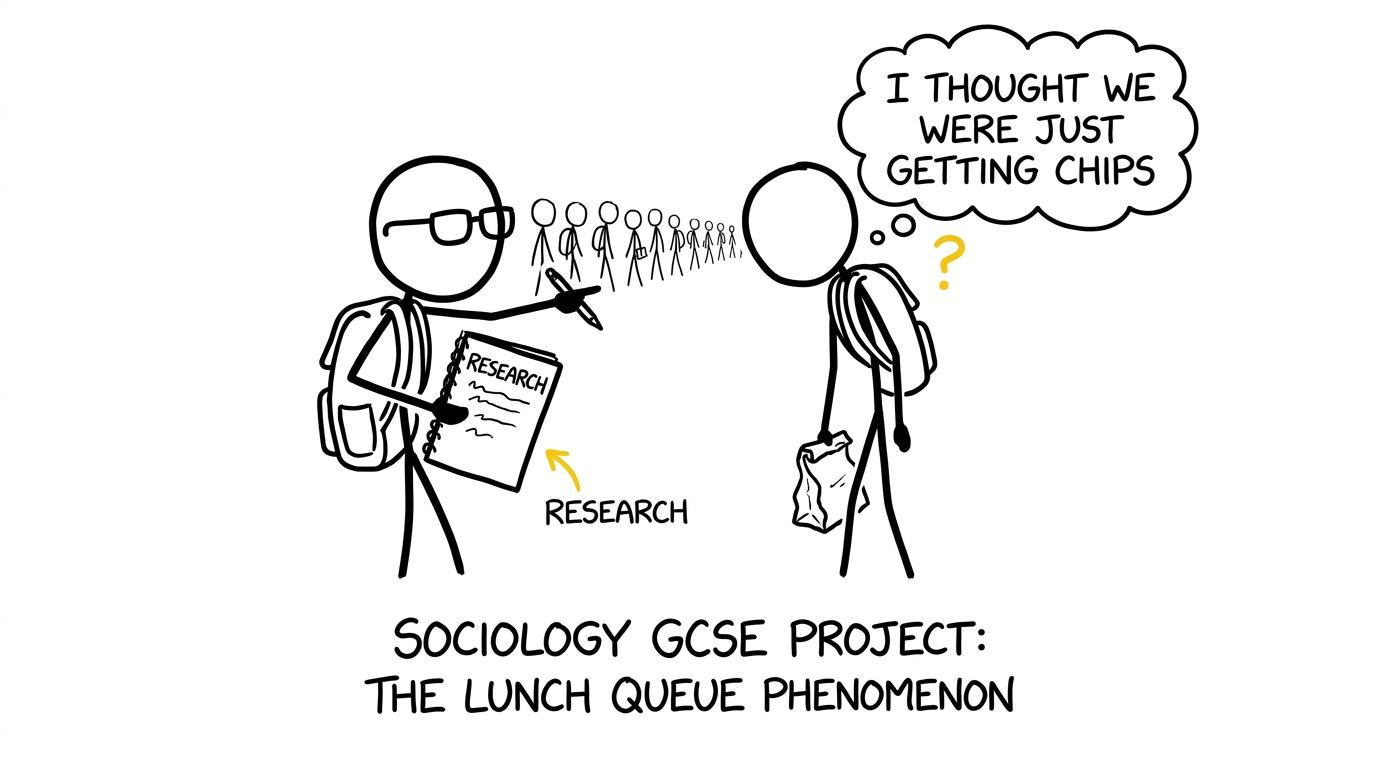 Two students accidentally turning the lunch queue into a sociology research project
The skills travel beyond one GCSE
Students may initially choose Sociology because the topics sound interesting, then become glad they selected it because of the skills it develops.
Building an evidence-based argument
Extended responses require selection. You cannot include every fact you remember, so you must decide which concepts and evidence directly address the question. This develops a useful habit: making a claim, supporting it and explaining its significance.
That skill matters in essay-based subjects and later study. It also helps with longer GCSE maths questions, where a conclusion must follow from the work shown rather than appear as an unexplained statement.
Comparing explanations fairly
Sociological perspectives often interpret the same issue differently. A thoughtful answer must represent those views accurately before evaluating them. This encourages intellectual patience: understanding an argument is not the same as agreeing with it.
Reading claims critically
A dramatic headline may use a large percentage while hiding a small sample. A graph may show correlation without proving causation. Sociology encourages students to ask what the evidence permits them to conclude.
If this side of the subject particularly interests you, the Edexcel GCSE Statistics revision centre offers questions, worksheets and paper practice focused on statistical reasoning.
Who is likely to enjoy GCSE Sociology?
Sociology may suit you if you enjoy English, history, geography, religious studies or other subjects involving interpretation and explanation. You do not need to fit one academic type, however. A student who enjoys maths may value the logical structure of arguments, the evaluation of evidence and the treatment of data.
You are more likely to enjoy the course if you:
- regularly ask why social patterns exist;
- prefer questions with competing explanations;
- are prepared to write developed answers;
- can learn specialist vocabulary precisely;
- accept that revision requires retrieval and exam practice, not just discussion.
It may be less suitable if you strongly dislike extended writing or expect every question to have one short, definite answer. That is not a judgement on your ability. A good option choice depends on how you like to think and work.
Questions to ask before choosing it
A subject title never tells you the whole experience. Ask your school:
- Which exam board and specification will I follow?
- What topics will be taught?
- How much extended writing is expected?
- Are there any entry recommendations?
- What does a typical lesson involve?
- Can I see a specimen paper or anonymised model response?
- How will Sociology fit beside my other GCSE subjects?
Do not select it solely because a friend is taking it. Friends can change classes; the specification remains on your desk.
Balancing Sociology with GCSE maths revision
Sociology and maths demand different kinds of practice. Sociology needs retrieval of concepts, planning and timed writing. Maths needs repeated problem-solving, correction and increasingly realistic paper practice. A good timetable gives each subject the type of attention it requires.
Avoid letting an interesting Sociology discussion consume the time reserved for a difficult maths topic. Equally, do not postpone essay practice because marking a maths question feels quicker. Both subjects improve when practice produces feedback.
MathsGenie's GCSE maths revision timetable guide can help you divide the week into manageable sessions. If examinations are close, use the one-week maths revision plan. For a longer runway, the one-month GCSE revision plan gives you more time to diagnose and repair weaknesses.
 Sociology cards and maths practice sheets negotiating a peaceful revision timetable
Common mistakes when deciding on GCSE Sociology
Assuming it is simply common sense
Everyday experience may help you engage with a topic, but examination marks depend on sociological knowledge, evidence and application. Familiarity is not the same as mastery.
Choosing it because it looks easy
The content may feel relatable, yet high-quality extended responses require accurate recall, organisation, evaluation and time control. Look at the actual assessment materials before deciding.
Treating lessons as debates without revising evidence
Discussion can make a topic memorable, but examination answers need relevant concepts and research. Build concise revision notes and practise recalling them without prompts.
Ignoring research methods
Students can focus on the headline topics and neglect sampling, data types, ethics, reliability and validity. Research methods are part of understanding how sociological claims are produced.
Neglecting other subjects
An option should fit within a balanced workload. Keep maths moving through short, regular practice rather than waiting for a large empty afternoon that may never arrive. MathsGenie's guide to effective GCSE revision for reluctant students offers a simple learn, practise, mark and correct cycle.
Is GCSE Sociology worth choosing?
For the right student, yes. Students who enjoy the subject often value its relevant questions, competing perspectives, evidence-based discussions and transferable analytical skills. It can make familiar institutions look more complicated, while giving you a disciplined framework for understanding that complexity.
The best decision is informed rather than fashionable. Check your school's specification, inspect the assessment style and be honest about whether you are willing to read, remember evidence and write extended answers. Choose Sociology because its questions interest you and its way of thinking suits you, not because somebody promised an effortless grade.
Then protect the rest of your GCSE programme. Use MathsGenie's free revision lessons and practice questions to strengthen weak maths topics, mini tests to check recall, and past papers or predicted papers to build examination confidence. Mark your work with the available mark schemes and video solutions, add the next task to your revision planner, and turn a crowded set of options into a clear plan.