Why Choose GCSE Economics? What Students Value
Why choose GCSE Economics? Explore its real-world ideas, useful maths, exam skills and honest trade-offs before deciding whether it suits you today.
Choosing GCSE options can feel strangely permanent. You are asked to predict what your future self will enjoy, often before you have experienced the subject properly. So, why choose GCSE Economics? The clearest answer is that it helps you understand how everyday decisions connect to much bigger forces: prices, wages, business costs, taxation, unemployment, trade and government policy.
Students who enjoy the course often value that connection to real life. Economics combines numerical evidence with structured arguments, so it can suit students who like maths but also want to discuss why the numbers matter. It is not an effortless option, and it is not simply about money. But for the right student, it makes the world feel more understandable.
GCSE Economics at a glance
Before choosing the subject, ask yourself whether these features sound appealing:
- Learning why prices, wages and markets change
- Interpreting graphs, charts and economic data
- Calculating percentages, averages, revenue, costs and profit
- Explaining how consumers, producers and governments respond to decisions
- Comparing the advantages and disadvantages of economic policies
- Writing reasoned conclusions rather than searching for one perfect answer
- Connecting lessons to national and global events
Availability varies between schools, so check which specification your school teaches. AQA and OCR currently offer GCSE Economics qualifications in England, but your own school determines whether the subject is available and which exam board you follow.
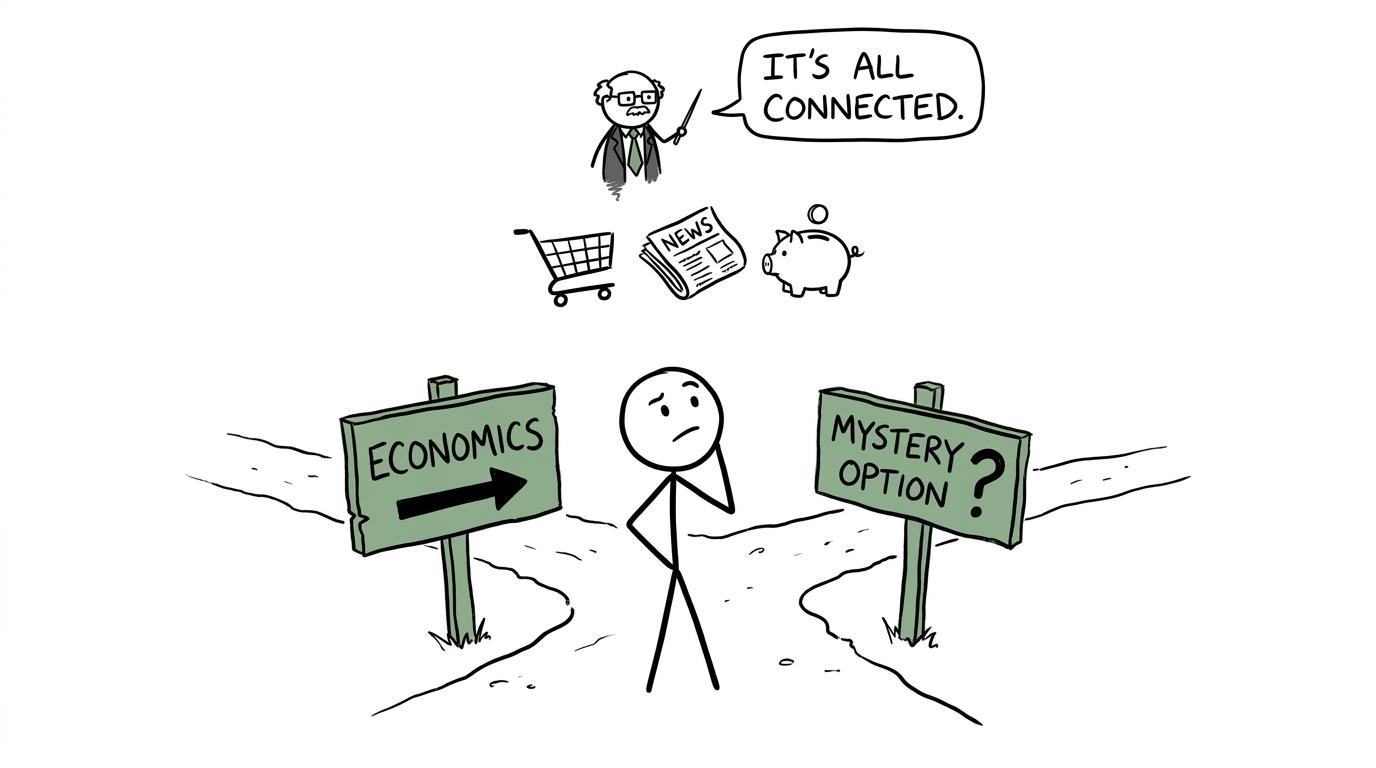 A student discovering that economics connects shopping, news and saving
Why choose GCSE Economics as an option?
It explains things you already notice
Long before learning the terminology, students encounter economics. A favourite product becomes more expensive. A local shop closes. Interest rates appear in the news. Someone discusses wages, taxes or the cost of living at home.
GCSE Economics gives these observations a framework. You study scarcity and choice, supply and demand, production, competition and the role of government. You then move into broader questions involving economic growth, inflation, unemployment, international trade and globalisation.
The appeal is not that every issue suddenly has an easy answer. Usually, it does not. The appeal is learning how to ask better questions. Who benefits? Who bears the cost? What might happen next? Is the evidence strong enough to justify the conclusion?
Official GCSE subject content is designed to develop understanding of local, national and global economic issues. It also expects students to distinguish between fact and opinion, consider different perspectives and make informed judgements using qualitative and quantitative evidence.
The subject rewards curiosity and argument
Some subjects begin with a rule and lead towards a definite answer. Economics often begins with a decision and leads towards a trade-off.
A government policy might help one group while imposing costs on another. A business decision might increase profit but reduce consumer choice. Higher wages may benefit workers, yet the wider effect can depend on costs, productivity and how firms respond.
Students who enjoy Economics often like this tension. They are not rewarded merely for stating an opinion. Strong responses use economic concepts, apply them to the information provided, develop a logical chain of reasoning and reach a supported judgement.
That makes Economics useful practice for any subject involving analysis and extended writing. It teaches you to move beyond "I agree" towards "this outcome is more likely because...".
The maths has a visible purpose
For students preparing for GCSE maths exams, one of the most useful features is that Economics places familiar mathematical skills inside real situations.
GCSE Economics quantitative skills include:
- percentages and percentage change
- interest on savings
- averages, including average cost
- totals involving revenue, costs and profit
- gross and net income
- constructing graphs from data
- interpreting charts and economic statistics
For example, the percentage-change structure is:
Percentage change=new value−original valueoriginal value×100\text{Percentage change}=\frac{\text{new value}-\text{original value}}{\text{original value}}\times 100Percentage change=original valuenew value−original value×100The relationship between revenue, cost and profit is:
Profit=total revenue−total cost\text{Profit}=\text{total revenue}-\text{total cost}Profit=total revenue−total costThese are not included as isolated arithmetic exercises. The calculation usually supports an economic explanation or decision. A numerical answer may tell you what changed; the written analysis explains why that change matters.
Ofqual's GCSE Economics conditions require at least 10%10\%10% of the qualification's marks to reward quantitative skills at a level no lower than Key Stage 3. That makes mathematical confidence genuinely useful, while also showing that Economics is much broader than calculation.
You can strengthen the foundations through MathsGenie's GCSE averages revision and the number, percentage and graph material in the MathsGenie staged learning scheme.
What students tend to value after choosing it
There is no single student experience, and enjoyment depends on the teacher, specification and individual. Still, the features below explain why many students who are well suited to Economics find the option worthwhile.
News stories start to make more sense
Words such as inflation, productivity, interest rates and exchange rates can sound distant until you understand the mechanisms behind them. Economics provides a vocabulary for interpreting those stories.
This does not mean accepting every headline. In fact, the course encourages the opposite habit: inspect the evidence, identify the affected groups and consider possible limitations in the data.
That ability to read information critically can be valuable beyond the examination. It helps students recognise that a statistic needs context and that a confident claim is not automatically a convincing one.
Graphs become arguments rather than pictures
Supply and demand diagrams are among the subject's most recognisable features. Yet drawing curves is only part of the skill. Students must understand what the axes represent, distinguish a movement along a curve from a shift of the curve and use the model to explain possible changes in price and quantity.
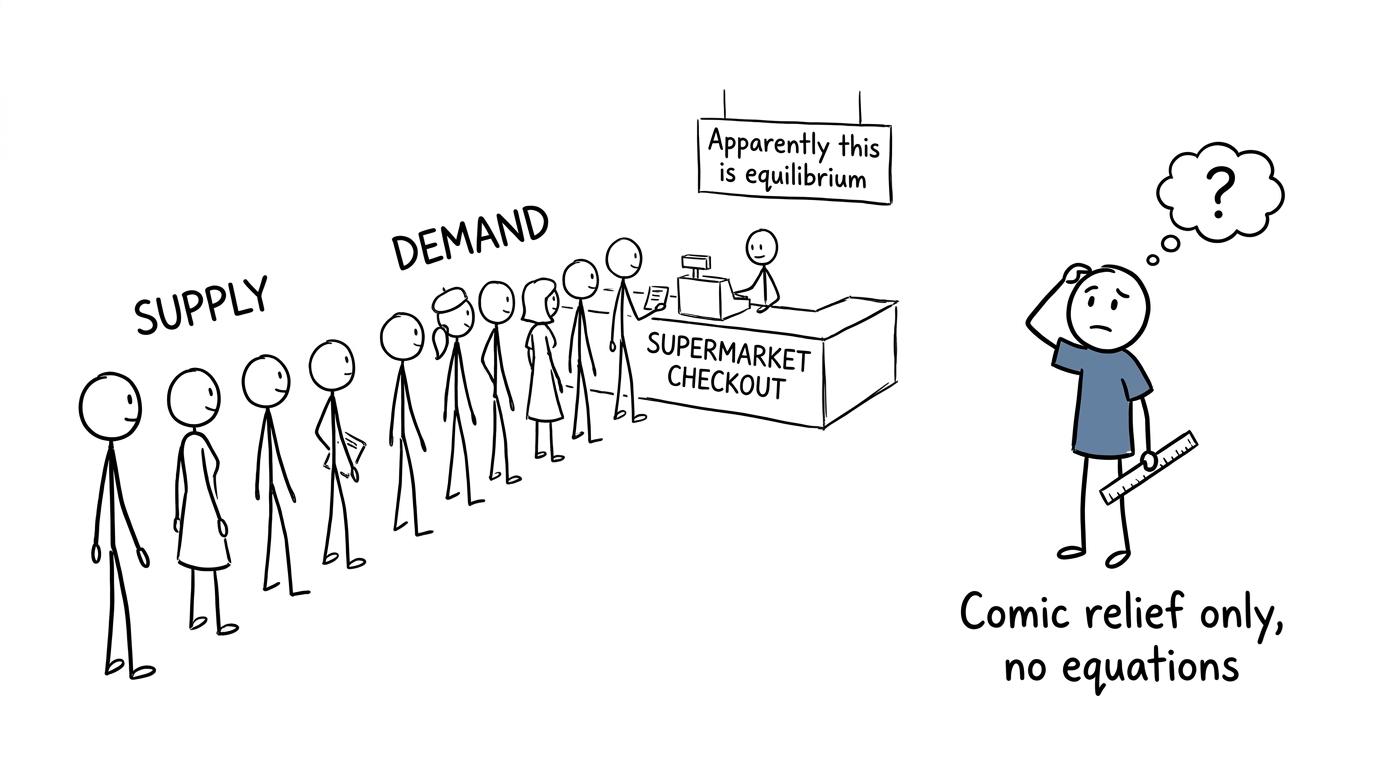 Supply and demand meet at a surprisingly busy checkout
The same discipline helps in GCSE Maths. Labels matter. Scales matter. Relationships matter. If graphs are currently a weak area, the best order for learning GCSE maths topics places number fluency, percentages and core algebra before graphs, giving you a sensible route to improvement.
It combines several kinds of thinking
Economics rarely rewards one skill alone. A question might ask you to read a case study, extract data, recall a concept, calculate a value and evaluate competing effects.
Students who like variety may appreciate this blend. The subject combines:
- precise definitions
- numerical reasoning
- diagram interpretation
- contextual application
- written analysis
- justified conclusions
That balance is also why Economics should not be treated as an easy alternative to essay subjects or maths. It demands both accuracy and judgement.
It can provide a foundation for later study
GCSE Economics is not normally required before taking A Level Economics; entry requirements are set by individual schools and colleges. However, studying it can introduce the language and habits used later, including analysing markets, using data and evaluating policy.
At A Level, the quantitative demand increases. Official requirements specify that at least 20%20\%20% of A Level Economics marks assess quantitative skills. A secure GCSE Maths foundation is therefore valuable whether or not you take Economics at GCSE.
MathsGenie's free GCSE and A Level maths revision hub can support that progression with lessons, questions, papers and solutions.
What are the GCSE Economics exams like?
The precise structure depends on your specification, so always use the information supplied by your school and exam board.
For context, AQA GCSE Economics has two written papers: How markets work and How the economy works. Each carries 808080 marks, lasts 111 hour 454545 minutes and contributes 50%50\%50% of the qualification.
OCR GCSE Economics also has two equally weighted written components: Introduction to Economics and National and International Economics. Each carries 808080 marks and lasts 111 hour 303030 minutes. Its papers include multiple-choice, case-study and extended-response questions.
Across regulated GCSE Economics qualifications, the assessment objectives broadly reward knowledge and understanding, application, and analysis and evaluation. This is important when choosing: remembering definitions is necessary, but it is not sufficient.
Who is GCSE Economics likely to suit?
Economics may suit you if you:
- ask why prices and incomes change
- enjoy discussing current affairs without relying only on opinion
- are willing to interpret numerical and written evidence
- can explain a chain of cause and effect
- like questions where the conclusion depends on context
- are prepared to learn precise terminology
You do not need to be the strongest mathematician in your year. You do need to practise core number skills and show working carefully. MathsGenie's guide to GCSE topics by exam board and tier can help you identify the relevant percentage, ratio, graph and statistics skills in your own maths specification.
Economics may be less suitable if you strongly dislike reading case studies, writing developed explanations or considering more than one side of an argument. It is also important not to choose it solely because friends are doing so or because the title sounds career-focused.
Economics is not the same as Business
The subjects overlap, but their focus differs.
Business typically concentrates on how organisations operate and make decisions, including areas such as marketing, finance, operations and human resources. Economics examines how choices and incentives operate across markets and whole economies, including the actions of consumers, producers and governments.
A student interested in running a company might enjoy Business. A student wondering why inflation changes household decisions, why governments tax certain products or how international trade affects an economy may prefer Economics. Some students enjoy both, but neither is simply a renamed version of the other.
Common mistakes when choosing and revising Economics
Choosing it because it sounds easy
Economics contains accessible ideas, but high-quality answers require accurate terminology, application and evaluation. Read a sample specification or paper before deciding.
Assuming it is mostly maths
The calculations are important, but much of the course assesses explanation and judgement. Being quick with percentages will not compensate for an unsupported conclusion.
Assuming calculations do not need interpretation
A correct value is often the beginning of an economic answer, not the end. Students must connect the result to the business, consumer, worker or government in the question.
Describing a graph without explaining it
Saying that a line rises or falls is not economic analysis. Explain the relationship, its cause and the likely consequence, using accurate labels and terminology.
Revising by rereading notes
Recognition can feel like understanding. Questions reveal whether you can actually retrieve and apply the idea. Use short topic practice, mark it, record the specific error and return to it later.
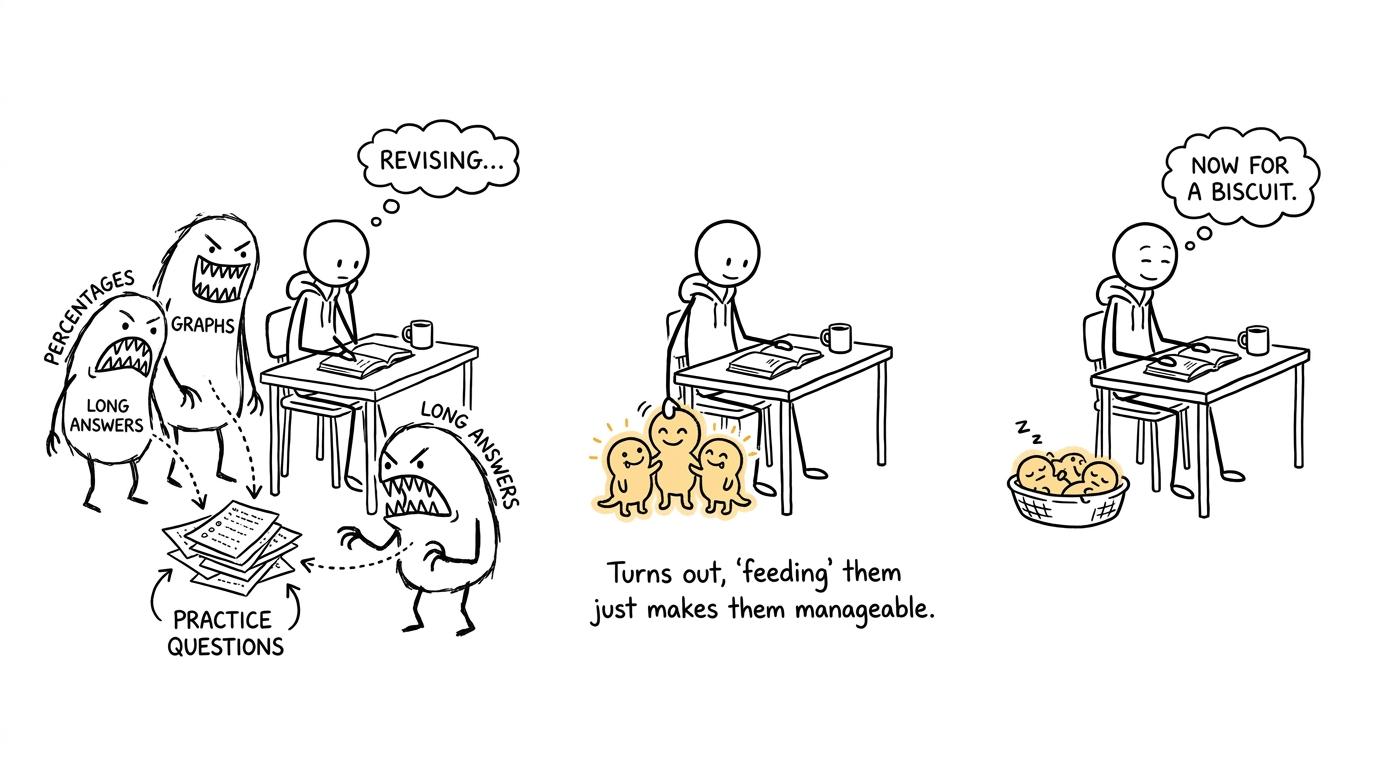 Practice questions turn revision monsters into manageable pets
Maths students can build this habit with a realistic GCSE maths revision timetable, then learn when to begin using GCSE past papers. The same attempt, mark, correct and retest cycle works well in Economics.
How to prepare before making your decision
Start with the actual course rather than its reputation.
Ask your school which exam board it uses and inspect the specification topics. Look at a recent question paper and mark scheme. Notice the balance between short questions, calculations, data interpretation and extended responses. If possible, ask the Economics teacher how lessons are structured and what independent work is expected.
Then audit the transferable maths skills you already have:
- Can you calculate and interpret percentage change?
- Can you find and compare averages?
- Can you read scales and extract values from charts?
- Can you construct and label a graph accurately?
- Can you explain what a numerical result means in context?
If some answers are no, that is not a reason to reject the subject. It is a revision plan. Use MathsGenie's lessons and practice questions to repair the underlying skill, then test it inside mixed questions. Nearer your maths exams, Edexcel GCSE Maths predicted papers can provide fresh practice alongside official past papers if Edexcel is your board.
Is GCSE Economics worth choosing?
GCSE Economics can be worth choosing if you want to understand how individual decisions become market outcomes, and how governments respond when those outcomes create wider problems. Its strength is the combination: numbers provide evidence, concepts provide structure and evaluation provides judgement.
Make the choice based on the work you will actually do, not only the subject name. Check your school's specification, explore a paper and be honest about whether you enjoy interpreting data and building arguments.
If Economics appeals to you, make its quantitative side a strength. Start with MathsGenie's free revision lessons, practise percentages, averages and graphs, and then test your wider maths performance with mini tests, past papers, predicted papers, mark schemes and video solutions. One subject choice cannot decide your future, but strong reasoning and confident maths will keep more of that future open.