

Why Choose GCSE Art and Design? Student Views
Why choose GCSE Art and Design? Explore the creative freedom, portfolio experience and practical skills that make students glad they selected it.
Choosing GCSE options can feel strangely permanent. A subject that occupies one line on a form will shape hundreds of lessons, deadlines and conversations over the next two years. It is reasonable to wonder whether you will still enjoy it when the first excitement has worn off.
So, why choose GCSE Art and Design? Students who enjoy the subject often value its creative freedom, practical way of working and opportunity to develop ideas that feel personal. It can provide a welcome contrast to subjects dominated by written examinations. But it is not an easy escape from academic work: successful portfolios require research, experimentation, annotation, refinement and steady time management.
For a student also preparing for GCSE maths, that final point matters. Art can be rewarding precisely because it feels different, but its ongoing workload must fit beside revision for foundation or higher tier papers.
A quick GCSE Art and Design checklist
The subject may suit you if you:
- enjoy making, designing, photographing or developing visual ideas;
- are curious enough to experiment without knowing exactly how the final piece will look;
- can accept constructive feedback and improve work over time;
- prefer producing a body of work to relying entirely on written examinations;
- are willing to annotate decisions and investigate artists or designers;
- can work consistently rather than leaving an entire project until the deadline;
- want to develop creative skills without assuming that art must become your career.
Before choosing it, ask your school which Art and Design title it offers, which exam board it follows and what materials or facilities are available. Fine art, photography, graphic communication, textile design and three-dimensional design can create quite different classroom experiences.
What the GCSE actually involves
Across current AQA, Pearson Edexcel, OCR and Eduqas specifications, the broad structure is similar: a portfolio component and an externally set assignment or task. In the specifications reviewed for this article, the portfolio contributes 60%60\%60% and the externally set component contributes 40%40\%40%.
The externally set component normally includes a preparatory period followed by 101010 hours of supervised work. Both components are generally marked by the school or college and externally moderated. The exact rules, available titles, starting points and submission requirements depend on the exam board, so your teacher and current specification remain the final authority.
This is important because Art and Design is not simply marked on whether a final image looks attractive. The assessment objectives consider the journey: investigating relevant sources, experimenting with media and processes, recording ideas and observations, and presenting a personal response. Written annotation and evidence of drawing also form part of current specifications.
In other words, the sketchbook is not merely storage. It is evidence of thought.
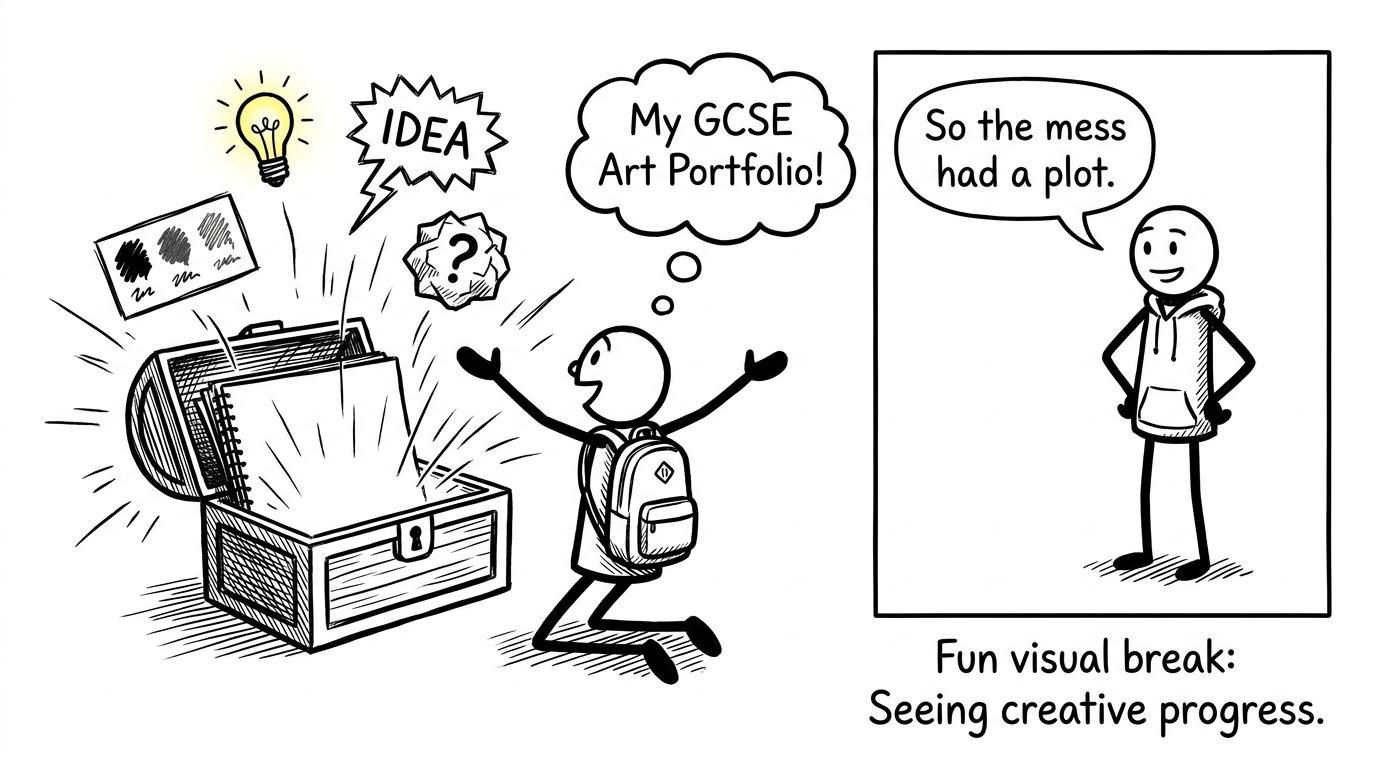 A student opens a sketchbook like a treasure chest as ideas and paint swatches escape
Why students can be glad they chose it
There is no single student experience, and enjoyment should not be confused with an effortless grade. Still, several qualities repeatedly explain why creatively inclined students find the option worthwhile.
Their ideas have somewhere to go
Many school tasks have a tightly defined destination. Art often begins with a theme or brief but leaves room for a personal interpretation.
That ownership can be deeply satisfying. Two students can investigate the same starting point and produce entirely different responses because they select different artists, materials, imagery and intentions. A project becomes more than an instruction completed for a teacher; it becomes a trail of decisions that belongs to the student.
Creative freedom is not unlimited freedom. Students still need to meet the assessment objectives and respond to feedback. Yet working within those boundaries can make creativity more purposeful. Constraints give an idea something to push against.
Progress becomes visible
In some subjects, improvement can feel hidden until a mock result arrives. A portfolio makes development easier to see. Early observational work sits beside later experiments. An unsuccessful composition leads to a stronger one. Teacher feedback becomes a visible change rather than a forgotten comment.
Students who enjoy Art and Design often appreciate this sense of accumulation. One lesson may not feel dramatic, but a term of consistent work can reveal better control of media, more thoughtful research and clearer personal intentions.
This is also a useful lesson for maths revision. Progress is rarely one heroic afternoon. It is a sequence of small corrections. The MathsGenie GCSE maths revision hub applies the same principle through lessons, exam questions, worksheets and board-specific resources.
It offers a different kind of challenge
Art is sometimes described as a relaxing subject, but that description is incomplete. Making can be absorbing, and practical lessons may offer a refreshing change from extended writing. At the same time, deciding what to make, resolving a weak composition or refining an idea can be intellectually demanding.
That difference is part of the appeal. A student may spend one lesson solving structured problems and another making judgements about colour, scale, texture, audience or visual meaning. Neither mode of thought is automatically easier. They exercise different habits.
Mistakes can become material
An algebraic error needs correcting. In art, an unexpected mark or failed experiment can sometimes suggest a better direction. That does not mean every mistake is valuable, but experimentation makes uncertainty useful.
Students who are glad they selected the subject often become more comfortable with revision in the literal sense of the word: looking again. They test, receive feedback, alter and test again. This can build patience with work that is not immediately successful.
The same mindset helps when reviewing a maths paper. Rather than treating a lost mark as a verdict, identify the missing skill, revisit the lesson and retest it. MathsGenie's guide to finding your weakest GCSE topics provides a practical way to begin that process.
It develops useful habits beyond drawing
GCSE Art and Design can involve photography, digital editing, model-making, textiles, typography, contextual research and presentation, depending on the title and facilities offered by the school.
The broader transferable habits include:
- developing an idea from a starting point;
- selecting relevant research rather than collecting everything;
- explaining creative decisions;
- responding to a brief;
- presenting work coherently;
- managing a long project;
- using feedback to refine an outcome.
These habits can support later creative education or employment, but the subject does not commit you to a particular career. It can simply be one part of a balanced set of GCSE options.
The honest part: workload and deadlines
The strongest reason to think carefully is not a lack of talent. It is time.
Portfolio work develops across many lessons, and unfinished practical work can spill into lunches, after-school sessions or home time. Materials may also be less convenient to use at home than a revision guide. If several deadlines arrive together, art can expand to fill every available evening.
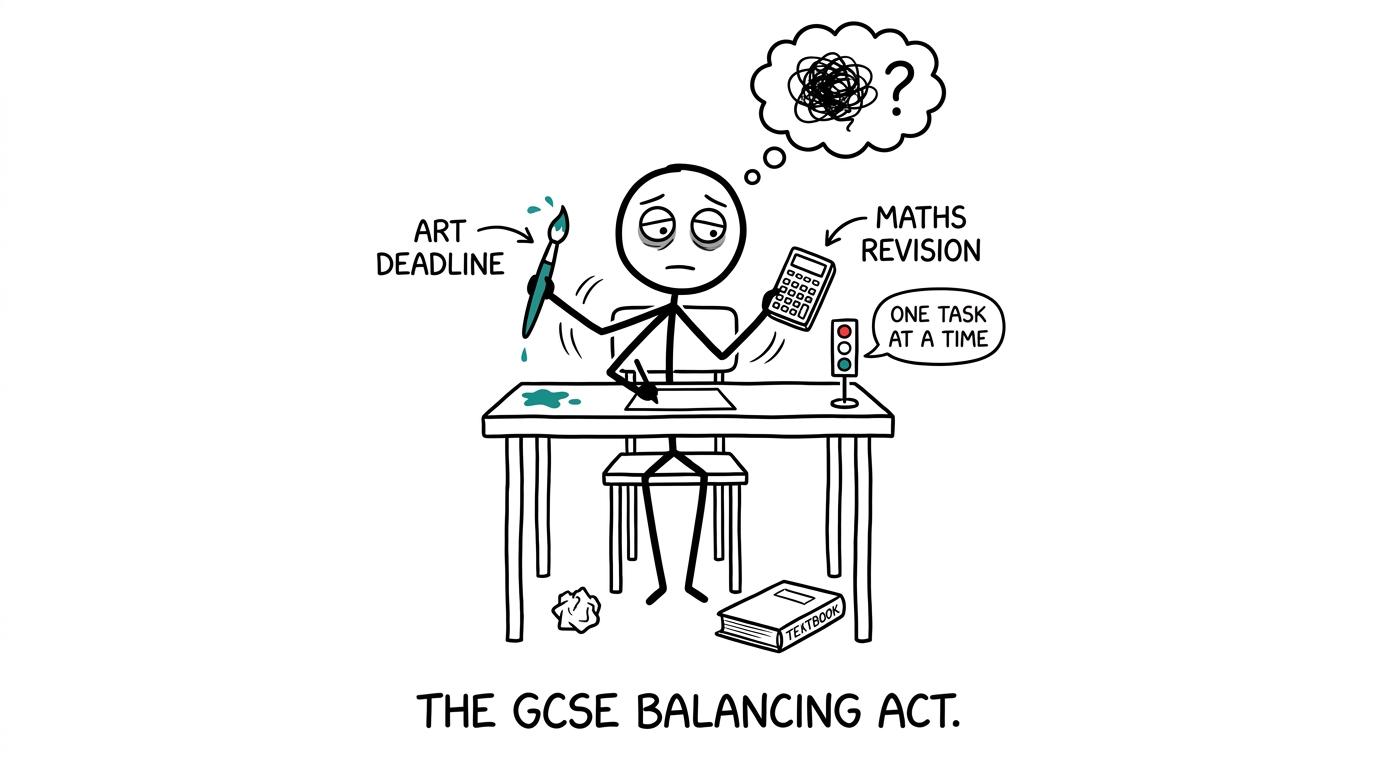 A student balances an art deadline and maths revision with a one-task-at-a-time light
A sustainable approach is to separate maintenance from rescue. Maintenance means completing a manageable amount each week, photographing work when required and recording feedback while it is fresh. Rescue means attempting to rebuild weeks of missing development just before submission. The first feels ordinary. The second feels enormous.
Maths needs protected time too. A short GCSE maths revision timetable can help you reserve regular sessions rather than revising only when art is finished. Art is rarely completely finished, so waiting for an empty evening is a poor system.
How to balance Art and Design with maths revision
Use a weekly plan based on outputs, not vague intentions. Instead of writing “do art” and “revise maths”, identify a task you can finish:
- photograph and annotate one art experiment;
- complete one planned study or design refinement;
- revise one weak maths topic;
- complete one timed question set and mark it;
- schedule the next action before stopping.
Keep the scale realistic. On a crowded school day, an effective 202020-minute maths routine is more useful than a two-hour plan you repeatedly postpone.
When time is limited, use Edexcel GCSE maths mini tests for focused practice, if Edexcel is your board. As the examinations approach, move towards Edexcel GCSE maths past papers or the appropriate board resources from the main hub. Marking matters as much as completing the questions.
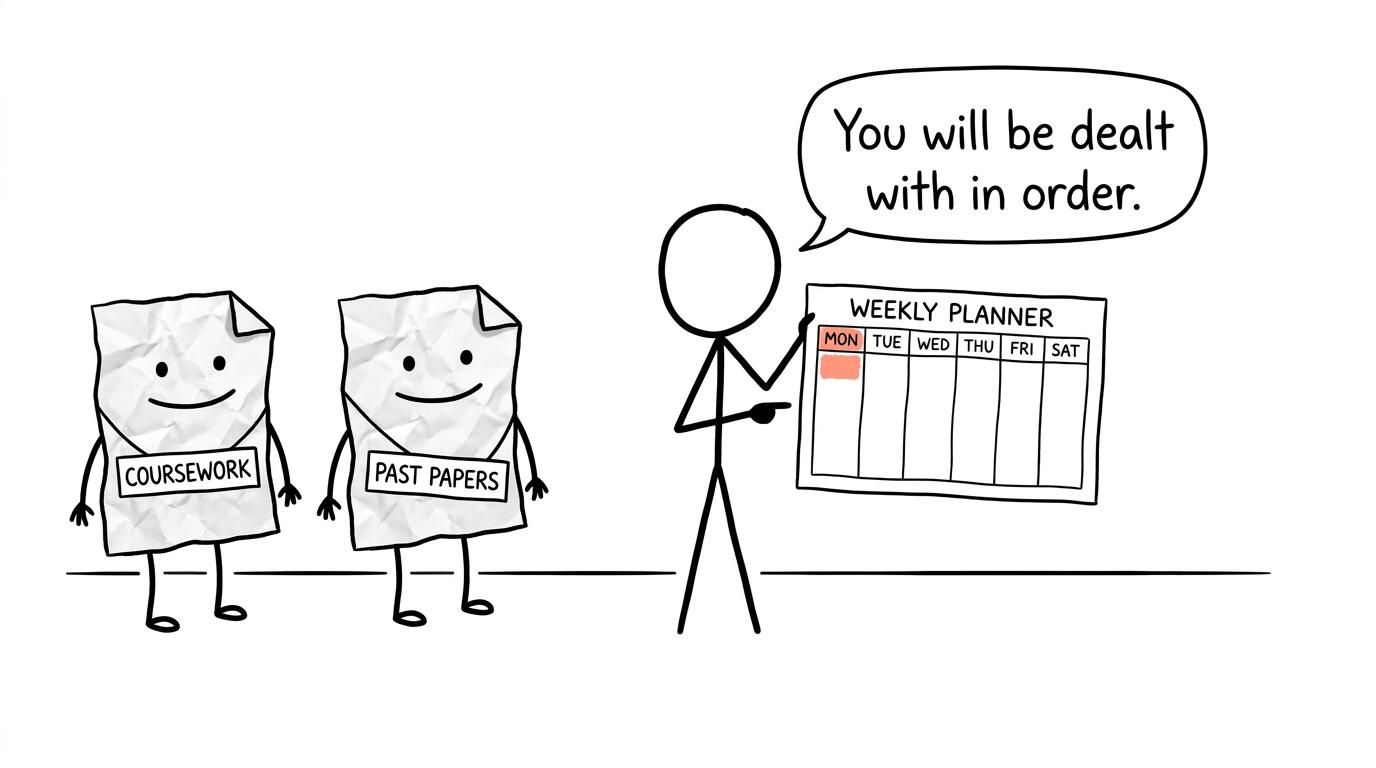 Two revision monsters wait politely while a student organises them with a weekly planner
Common mistakes when choosing GCSE Art and Design
Choosing it because it appears easy
Art replaces some conventional examination pressure with sustained project pressure. A strong final piece cannot always compensate for thin research, limited experimentation or missing development. Choose it because the process interests you, not because the timetable contains practical lessons.
Assuming natural talent is enough
Observation and technical confidence can help, but assessment rewards development and evidence. A student willing to experiment, document decisions and act on feedback may be better suited to the course than someone skilled at drawing who dislikes maintaining a portfolio.
Ignoring the specific course offered
Liking photography does not guarantee that your school offers the photography title. Ask to see the course outline, example themes and typical materials before deciding.
Leaving annotation until the end
Annotations are clearer when written close to the decision they explain. Short, specific notes about intention, influence, process and refinement are more useful than pages of rushed description added months later.
Allowing coursework to remove maths practice
Creative work can absorb an evening because there is always another adjustment available. Set a stopping point. Then keep maths active through a lesson, practice questions or a mini test. When examination season draws closer, follow a structured plan such as the one-month GCSE maths revision plan and add predicted papers only after repairing known topic gaps.
Is GCSE Art and Design worth choosing?
It can be, if you enjoy developing visual ideas and are prepared for consistent portfolio work. The students most likely to value the option are not necessarily those who can already produce flawless drawings. They are often those who enjoy looking closely, trying alternatives and turning feedback into a better response.
Speak to your art teacher, inspect the current specification for your board and ask what the weekly workload looks like at your school. Then consider the whole timetable. A good option is not merely interesting in isolation; it must coexist with English, science, maths and everything else competing for your attention.
If Art and Design earns a place in that balance, let MathsGenie make the maths side simpler. Start with the free GCSE revision hub, use revision lessons and practice questions to strengthen individual topics, then test your progress with mini tests, past papers, mark schemes, video solutions and predicted papers. Creative freedom works best when the rest of the plan has structure.











