Whiteboard Revision GCSE Further Maths: Does It Help?
Whiteboard revision GCSE Further Maths: learn when it helps, seven active methods to use, mistakes to avoid, and a focused revision routine for exams.
A whiteboard can create a reassuring feeling of progress. The desk is clear. The pens are lined up. A difficult-looking formula appears in bright ink. Yet an hour later, it is possible to have produced a beautiful board without having tested whether you can answer a single question independently.
So, is whiteboard revision GCSE Further Maths genuinely useful? Yes, provided you use the board for retrieval, problem-solving, explanation and correction rather than copying notes. Its real advantage is not the surface itself. It is how quickly you can attempt an idea, expose a gap, erase the error and try again.
That distinction matters in Further Maths, where knowing a formula is only the beginning. You must recognise when to use it, organise several algebraic steps and preserve accuracy under exam conditions.
The short answer: when a whiteboard is worth using
A whiteboard is useful when your session includes most of this checklist:
- Start without notes and retrieve a method from memory.
- Answer genuine questions rather than decorate the board with summaries.
- Keep every important algebraic step visible.
- Check your work using a mark scheme or video solution.
- Identify exactly where an error began.
- Repeat the question or skill after correcting it.
- Transfer some practice to paper under timed conditions.
It is less useful when you copy a textbook page, erase mistakes before understanding them or spend more time choosing pen colours than doing mathematics.
The evidence behind active revision is more nuanced than slogans sometimes suggest. Research reviews generally support spacing mathematical practice across separate sessions. Retrieval practice is also well supported across classroom learning, although research focused specifically on mathematical problem-solving is less conclusive. The practical lesson is sensible: recall is valuable, but it must be combined with solving unfamiliar questions and receiving accurate feedback.
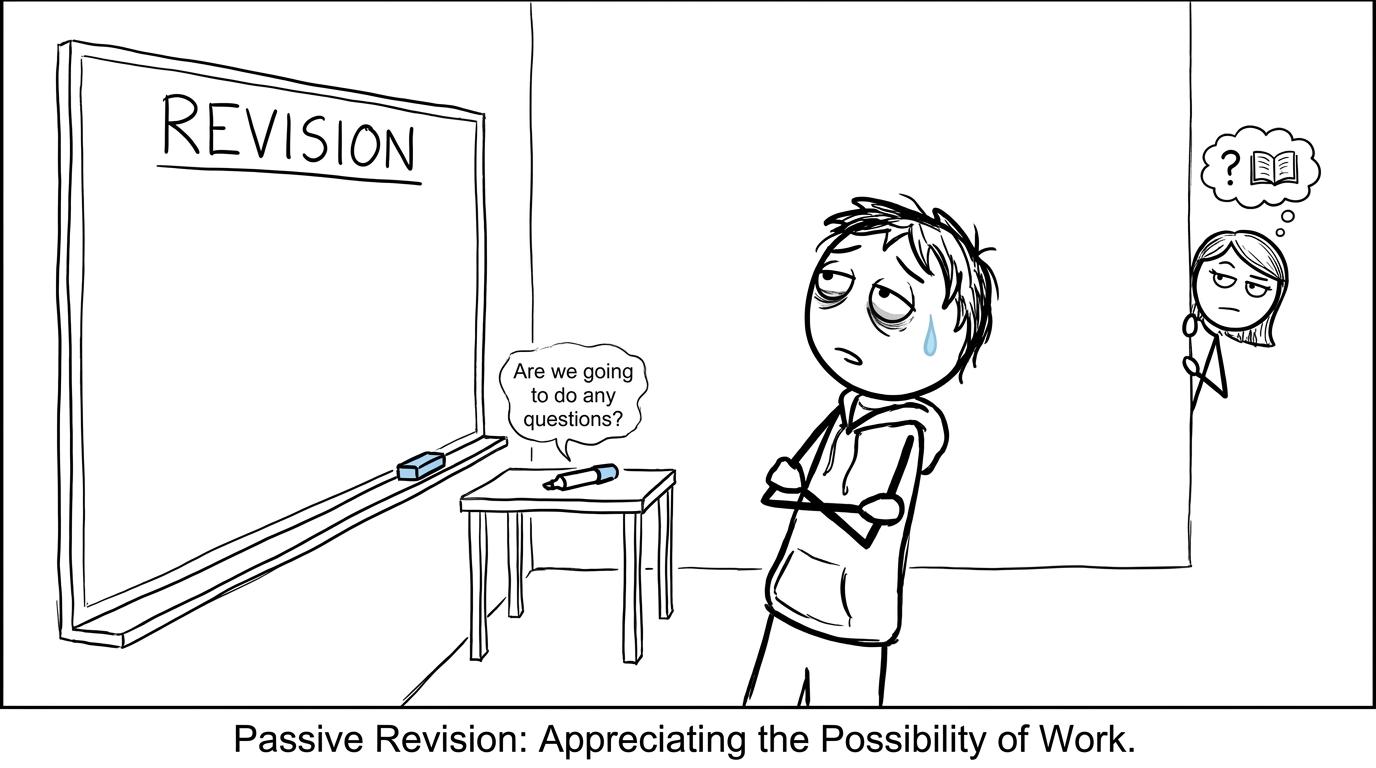 A spotless revision whiteboard waits for someone to answer a question
Why Further Maths suits whiteboard revision
The AQA Level 2 Certificate in Further Mathematics, often informally called GCSE Further Maths, develops GCSE knowledge through number, algebra, coordinate geometry, calculus, matrix transformations and geometry. Its current assessment structure has two equally weighted written papers: one non-calculator paper and one calculator paper.
That makes a large erasable surface particularly helpful for three reasons.
You can see the structure of longer algebra
Further Maths solutions often contain linked transformations rather than one isolated calculation. A whiteboard gives you enough space to keep expressions aligned, draw arrows between related statements and inspect whether each line follows from the previous one.
For instance, when revising differentiation, you might retrieve the general relationship
ddx(axn)=anxn−1.\frac{d}{dx}\left(ax^n\right)=anx^{n-1}.dxd(axn)=anxn−1.The useful activity is not writing that rule repeatedly. It is using it in different questions, checking whether coefficients, powers and signs remain correct, and explaining what the resulting gradient function represents.
Mistakes become visible rather than permanent
Paper can make an error feel expensive. Students sometimes squeeze corrections into a margin or abandon a question because the page looks untidy. A whiteboard lowers that friction. You can circle the first incorrect line, state the reason, clear the work and rebuild the solution cleanly.
The risk is that erasing becomes too easy. If the mistake disappears before you diagnose it, the board has removed evidence you needed. Record significant errors in a notebook or photograph the board for a private error log before clearing it.
Speaking and writing can happen together
Explaining a method aloud forces you to connect notation with reasoning. If you write a matrix transformation, a tangent gradient or a function composition, say what each stage is doing and why it is allowed.
This is particularly useful for notation that can look familiar without being understood. For example,
fg(x)=f(g(x))fg(x)=f\bigl(g(x)\bigr)fg(x)=f(g(x))requires the function on the right to be applied first. MathsGenie's inverse and composite functions revision guide can help you review the underlying GCSE skill before testing it from memory on the board.
Seven ways to use a whiteboard beyond copying notes
Build a blank-board brain dump
Choose one narrow topic, such as matrix transformations or equations of tangents. Set a short timer and write everything relevant from memory: definitions, notation, conditions, diagrams and method prompts.
Then compare the board with a trusted revision lesson. Add missing ideas in another colour, but do not count those additions as knowledge you had already remembered. Clear the board and repeat the task on another day.
Use the AQA GCSE Further Maths revision hub to select topics and find lessons, questions and papers matched to the course.
Create a method map
Some questions feel difficult because the student cannot identify a starting point. Divide the board into prompts:
- What information is given?
- What is the question asking for?
- Which result or method connects them?
- What must be shown for the marks?
- How can the answer be checked?
This is not a script to memorise word for word. It is a decision framework. Over time, reduce the prompts until you can organise a solution without them.
Run a two-column error clinic
Split the board vertically. On the left, reproduce the incorrect part of your work. On the right, write the corrected reasoning and label the cause: knowledge gap, sign error, algebra slip, notation problem or misread instruction.
This is more powerful than writing “careless mistake”. Carelessness is not a repair plan. “Lost the negative sign while expanding” tells you which behaviour must change.
For a wider diagnostic process, use MathsGenie's guide to finding your weakest GCSE topics. It helps turn lost marks into specific revision priorities.
 A revision detective investigates the mysterious sign error
Teach an imaginary student
Stand back and explain one method as though the listener knows ordinary GCSE Higher algebra but has not met the Further Maths idea. Your explanation should include what the notation means, why the method works, when it applies and how you would recognise an unreasonable result.
If your explanation becomes vague, place a small question mark beside that stage. Check a revision lesson, then explain the complete argument again without looking.
Use disappearing scaffolds
On your first attempt, allow yourself a small prompt box containing a relevant formula or method outline. On the second attempt, reduce it to keywords. On the third, remove it entirely.
This prevents two unhelpful extremes: depending on full notes forever or attempting questions with no support before the method has been learned. The goal is gradual independence.
Mix topics on one board
Divide the board into four areas and place a different short task in each. You might combine algebra, coordinate geometry, calculus and matrices. Moving between topics trains you to identify methods rather than being told by a chapter heading what technique to use.
Mixed practice should follow initial learning, not replace it. If a topic is genuinely new, first use a clear lesson and focused questions. MathsGenie's GCSE maths revision hub provides revision resources across Edexcel, AQA, OCR and Eduqas, which is useful when a Further Maths weakness rests on an earlier Higher-tier skill.
Reconstruct a solution after marking
Complete an exam question, check the mark scheme and then remove both your attempt and the solution. Reconstruct a full response from memory on the board.
Do not merely copy the mark scheme. Ask why each line earns its place. Afterwards, compare your reconstructed version with the official method and note any missing reasoning or notation.
The GCSE maths topics by exam board and tier guide can help you distinguish core Higher-tier knowledge from additional Further Maths content.
A practical whiteboard revision routine
A productive session can be short and structured:
| Time | Whiteboard task |
|---|---|
| First 555 minutes | Recall one rule, definition or method without notes. |
| Next 151515 minutes | Complete focused practice questions with full working. |
| Next 101010 minutes | Mark the work and diagnose each lost mark. |
| Final 555 minutes | Clear the board and reconstruct the weakest method. |
Schedule the same skill again after a gap rather than treating one fluent session as proof of permanent learning. The free MathsGenie revision planner can help you organise these revisits.
Once a week, replace the board session with a timed paper section. Whiteboard fluency can hide weaknesses in handwriting, page layout and exam timing. You ultimately need to produce readable working in the format used in the examination. MathsGenie's Edexcel GCSE past papers collection is useful for strengthening the underlying GCSE skills, while Further Maths students should choose qualification-specific papers from the Further Maths hub.
 A student tries to explain mathematical reasoning to a feline examiner
Common whiteboard revision mistakes
Copying instead of retrieving
A board full of correct mathematics can still represent passive revision. Close the notes first. Attempt the rule, diagram or question from memory, then check it.
Erasing the evidence too quickly
Do not wipe away an incorrect line the instant you notice it. Circle the first point of failure and name the cause. The diagnosis is often more valuable than the corrected answer.
Avoiding full exam questions
Tiny tasks build fluency but do not completely prepare you for multi-step problems. Use topic questions first, then mini tests, past papers and predicted papers. This progression is also central to MathsGenie's advice on stopping GCSE maths content from being forgotten.
Treating neatness as understanding
Colour can separate stages or highlight a correction. Beyond that, presentation can become procrastination. A useful board may look temporary and imperfect because it records genuine thinking.
Doing everything on the whiteboard
In the real written examination, your rough work and final response belong on the permitted exam stationery, not on a personal whiteboard. Current JCQ instructions also prohibit unauthorised notes and materials. Follow your school's exam instructions and practise regularly with pen, paper and the correct calculator conditions.
Using the wrong specification
“Further Maths” can refer to different qualifications. Confirm the exact course and specification with your teacher before choosing resources. AQA Level 2 Further Mathematics is not identical to GCSE Mathematics from Edexcel, AQA, OCR or Eduqas, and it is not the same qualification as A Level Further Maths.
The board is a tool, not the revision plan
A whiteboard is genuinely useful for GCSE Further Maths when it makes thinking visible. It gives you room to retrieve, question, explain, correct and repeat. What it cannot do is choose the right content, provide reliable feedback or recreate the full pressure of an examination.
That is why the strongest approach combines the board with structured resources. Start at the AQA GCSE Further Maths revision hub, use revision lessons to repair understanding, complete practice questions, and check your reasoning against mark schemes and video solutions. Then use mini tests, past papers and predicted papers to discover whether the method survives without prompts and under time pressure.
The goal is not to fill the board. It is to reach the point where you can clear it and still know what to do next.