GCSE Business Cross Curricular Overlap: Does It Help?
GCSE business cross curricular overlap explained: share maths, data and writing skills across subjects without wasting time revising everything twice.

You revise percentages for maths. Then you meet percentage change in Business. You interpret a graph in Geography, analyse data in Science and build an evidence-based argument in English. It can feel as if four subjects have quietly assigned the same homework.
That feeling is partly right. GCSE business cross curricular overlap genuinely helps, especially with percentages, averages, ratios, graphs, data interpretation and structured written arguments. The efficient approach is to revise each transferable skill once, then practise applying it in the language and exam style of each subject. You cannot merge the whole specifications, but you can stop rebuilding the same foundations.
The quick overlap checklist
Use this as your starting map:
- Maths: percentages, percentage change, averages, ratios, formulae, graphs and financial calculations.
- English: explaining chains of reasoning, selecting evidence and reaching justified conclusions.
- Geography: interpreting data, considering economic change and evaluating environmental or social effects.
- Economics: markets, competition, demand, costs and wider economic influences, where offered separately by your school.
- Science and Computer Science: analysing evidence, recognising variables and interpreting numerical information.
- Design and Technology: production, quality, costs, materials and decisions about meeting customer needs.
The important distinction is between a shared skill and shared subject knowledge. Calculating a percentage is transferable. Knowing which stakeholder is affected by a business decision is Business knowledge. Revise the first across subjects; learn the second within its own specification.
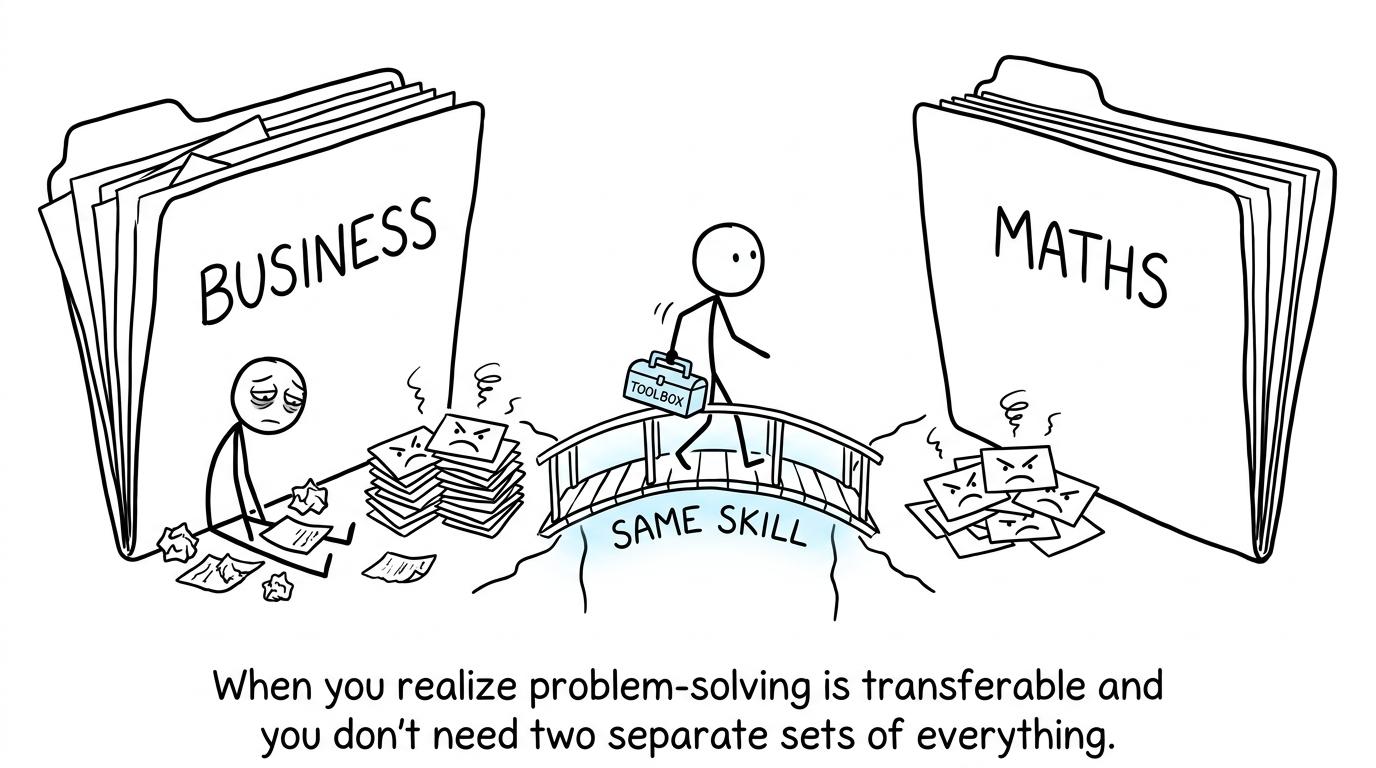 A student discovers a bridge between Business and Maths revision folders
Why the overlap with GCSE maths is real
The overlap is not just a revision trick. The Department for Education’s GCSE Business subject content includes percentages, percentage changes, averages, revenue, costs, profit, profitability ratios, average rate of return and cash-flow forecasts. It also requires students to interpret graphs, charts, financial information, market research and market data.
Ofqual’s subject requirements say that at least 10%10\%10% of the total qualification marks must reward quantitative skills at a level no lower than Key Stage 3, assessed within a business context rather than in isolation. Current specifications from Edexcel, AQA, OCR and Eduqas reflect that common requirement, although the precise treatment of topics such as break-even differs between boards.
This means your maths fluency has practical value in Business. It also means Business gives you another setting in which to practise mathematical reasoning.
Percentages and percentage change
Businesses use percentages to describe market share, changes in sales, changes in costs and profit margins. The underlying maths is the same as it is in GCSE Maths:
percentage change=new value−original valueoriginal value×100\text{percentage change}=\frac{\text{new value}-\text{original value}}{\text{original value}}\times 100percentage change=original valuenew value−original value×100The common difficulty is not the calculation itself. It is identifying the original value and interpreting whether the result represents an increase or decrease.
Use the GCSE percentages revision resources to secure the method. Then practise recognising it when the question is dressed in business language such as revenue, demand, wages or market size.
Revenue, cost and profit relationships
Business finance often turns words into simple mathematical relationships:
revenue=selling price×quantity sold\text{revenue}=\text{selling price}\times\text{quantity sold}revenue=selling price×quantity sold profit=revenue−total costs\text{profit}=\text{revenue}-\text{total costs}profit=revenue−total costsThese are not separate pieces of maths to memorise from scratch. They draw on multiplication, subtraction, substitution and rearranging relationships. The Business challenge is deciding which figures belong in the calculation and what the result means for the organisation.
Formula requirements can vary between specifications, so check your own exam board rather than assuming every break-even or finance formula is assessed in exactly the same way.
Ratios, margins and rates of return
Profit margins and average rate of return combine ratio thinking with percentages. A general profit-margin structure is:
profit margin=relevant profitrevenue×100\text{profit margin}=\frac{\text{relevant profit}}{\text{revenue}}\times 100profit margin=revenuerelevant profit×100The word relevant matters because gross profit margin and net profit margin use different profit figures. Maths supplies the division and percentage reasoning; Business supplies the correct definition and interpretation.
If proportional reasoning feels uncertain, revisit ratio in the MathsGenie Scheme of Learning. A reliable ratio method can support both foundation and higher tier maths questions, even though GCSE Business itself is not divided into foundation and higher tiers.
Averages, graphs and market research
Market research may be presented through tables, bar charts, pie charts or other graphical forms. You may need to identify a trend, compare categories or decide whether the evidence supports a recommendation.
The numerical skill transfers directly from maths and Geography. The conclusion does not. In Business, you must connect the pattern to the case study, the business objective and the limitations of the data.
Revise graph-reading through the scatter graphs revision guide, but remember that correlation alone does not prove that one variable caused the other. That caution is useful in Business, Geography, Science and GCSE Statistics.
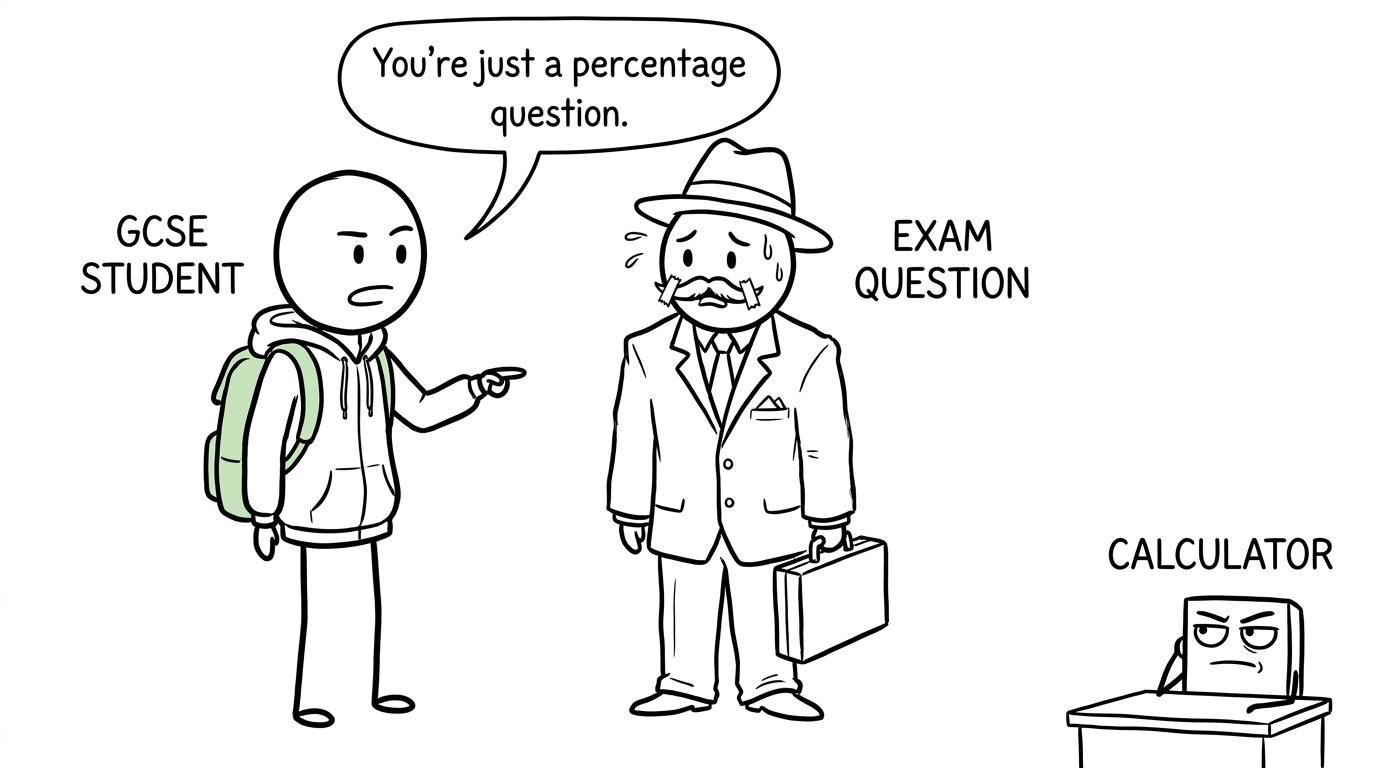 A business question is revealed to be a percentage question in disguise
Where Business overlaps with essay-based subjects
The overlap with English is less visible but just as useful. Strong Business answers often follow a disciplined chain:
- make a relevant claim;
- apply it to the business in the question;
- explain the consequence;
- consider a limitation or alternative;
- reach a judgement that answers the precise question.
That resembles analytical writing elsewhere, but Business requires business terminology and contextual evidence. A polished paragraph that could apply to any organisation is usually weaker than a clear paragraph tied to the case material.
Command words matter too. Identify, explain, analyse and evaluate do not invite identical responses. Transfer the habit of reading the command word carefully, but use the assessment guidance and mark schemes for your own Business board.
Geography, Economics and wider decision-making
Business decisions do not happen in a vacuum. Location, transport links, population, income, globalisation, sustainability and environmental pressure can connect Business with Geography. Interest rates, inflation, unemployment, competition and consumer demand may also connect with Economics or economic content encountered elsewhere.
This overlap helps when it gives you context. For example, Geography may help you recognise why location affects access to workers or customers. It does not replace the Business task of explaining the effect on costs, demand, objectives or stakeholders.
The same principle applies to sustainability. Science or Geography may explain an environmental issue in depth; Business asks how responding to it could affect reputation, costs, operations, sales or stakeholder relationships.
How to use the overlap without revising twice
The best system separates reusable skills from subject-specific application.
Build one transferable-skills list
Create a short list containing:
- percentages and percentage change;
- averages and ratios;
- interpreting tables and graphs;
- selecting relevant evidence;
- explaining cause and consequence;
- making a balanced judgement.
When one skill is weak, revise its core method once. The MathsGenie GCSE Maths revision hub lets you choose your exam board and move between lessons, questions, worksheets and papers.
Add a context switch
After practising a maths skill, ask how its use changes by subject:
- Maths: calculate accurately and show a valid method.
- Business: calculate, interpret and connect the result to a decision.
- Geography: use the statistic as evidence about a place, trend or process.
- Science: connect the data to variables, reliability or a conclusion.
The calculation may be identical. The final sentence often earns its value from context.
Keep separate error labels
Do not record every wrong answer as “bad at percentages”. Label the actual problem:
- method error;
- calculator or arithmetic error;
- misread data;
- wrong formula;
- missing unit;
- weak business interpretation;
- unsupported judgement.
This prevents unnecessary revision. If the arithmetic was correct but the interpretation was vague, doing another page of calculations will not fix the real weakness.
Plan shared sessions, not shared specifications
A useful revision block might combine one transferable skill with two applications. Learn or refresh the method, complete maths practice, then inspect a Business question using the same skill. Keep the subject mark schemes separate.
The GCSE maths revision timetable guide can help you organise short topic sessions and timed practice. Close to the exams, use Edexcel predicted papers or the equivalent page for your board to test whether those skills still work under pressure.
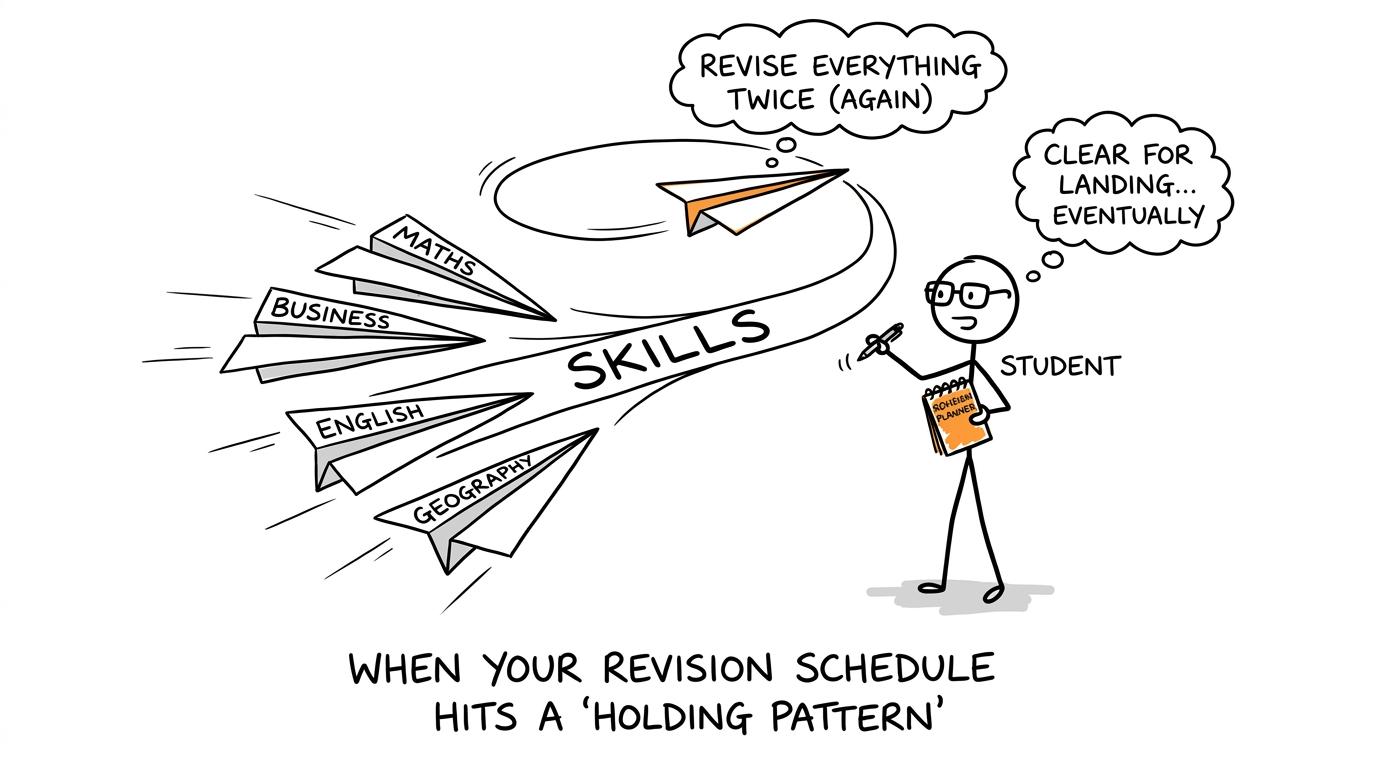 A revision planner directs several subjects onto one shared skills runway
Common mistakes when combining revision
Assuming the subjects assess the skill identically
A correct calculation may be the end of a maths question but only the beginning of a Business response. Business often requires interpretation, application and judgement after the number has been found.
Ignoring specification differences
The national subject content creates substantial common ground, but boards can treat individual requirements differently. For example, AQA, OCR and Eduqas do not all specify break-even work in precisely the same form. Use resources matched to your board and check what you are expected to calculate, construct or interpret.
Revising only the comfortable half
Some students enjoy calculations and avoid evaluation. Others write confidently but lose marks through weak arithmetic. Cross-curricular revision works only when it exposes the weaker side rather than hiding it.
Copying generic conclusions
“Therefore, profit will increase” is not automatically a justified conclusion. Costs may rise, demand may be uncertain, competitors may react and the business may have a different objective. Use the evidence supplied and recognise what is not known.
Treating papers as the final step
A paper reveals weaknesses; the improvement happens afterwards. Follow the process in MathsGenie’s guide to using past papers properly: attempt, mark, identify the gap, relearn and retest. Mark schemes and video solutions turn a score into a revision decision.
Make the overlap save time, not create more work
Cross-curricular overlap helps most when you treat it as a shared toolkit, not permission to blur every subject together. Learn percentages, ratios, averages and graph skills securely. Carry those methods into Business. Then add what Business uniquely demands: terminology, case-study application, stakeholder thinking and justified decisions.
Start at the MathsGenie GCSE revision hub, choose the skill that appears across your subjects and complete focused practice questions. Mark them carefully, use the revision lessons or video solutions to repair mistakes, and progress to mini tests, past papers and predicted papers. One strong mathematical foundation can support several subjects, provided you practise using it in each examiner’s language.