Revision notes for Edexcel GCSE Maths Inverse and Composite Functions. Open the guide for explanations and worked examples. Written against the Edexcel GCSE Maths (1MA1) specification, so the content matches what's examinable rather than general Maths background.
Inverse and Composite Functions
What you'll learn
Use function notation such as f(3)f(3)f(3) and g(−2)g(-2)g(−2).
Solve equations where a function output is given.
Find and use inverse functions, written f−1(x)f^{-1}(x)f−1(x).
Work with composite functions such as fg(x)fg(x)fg(x) and gf(x)gf(x)gf(x).
1. Function notation: inputs and outputs
Definition
Function notation
A function is a rule that takes an input and gives exactly one output. In f(x)f(x)f(x), the letter fff names the function, and xxx is the input.
Think of f(x)f(x)f(x) as “the output from function fff when the input is xxx”. To evaluate a function, substitute the given input wherever you see xxx.
Example
Evaluating a function
For h(x)=2x2−6h(x)=2x^2-6h(x)=2x2−6, find h(4)h(4)h(4) and h(−4)h(-4)h(−4).
The outputs match here because (−4)2=42(-4)^2=4^2(−4)2=42.
Common Mistake
Forgetting brackets with negatives
Use (−4)2(-4)^2(−4)2, not −42-4^2−42. The first gives 16, but the second means “negative of 424^242”.
2. Solving with function notation
When a question says solve q(x)=23q(x)=23q(x)=23, it means “find the input values that make the output 23”. Replace q(x)q(x)q(x) with the formula for the function, then solve the equation.
Key Idea
Function notation is just shorthand
A statement like f(x)=g(x)f(x)=g(x)f(x)=g(x) means “set the formula for fff equal to the formula for ggg”.
Example
Solving a function equation
Let q(x)=3x2−4q(x)=3x^2-4q(x)=3x2−4. Solve q(x)=23q(x)=23q(x)=23.
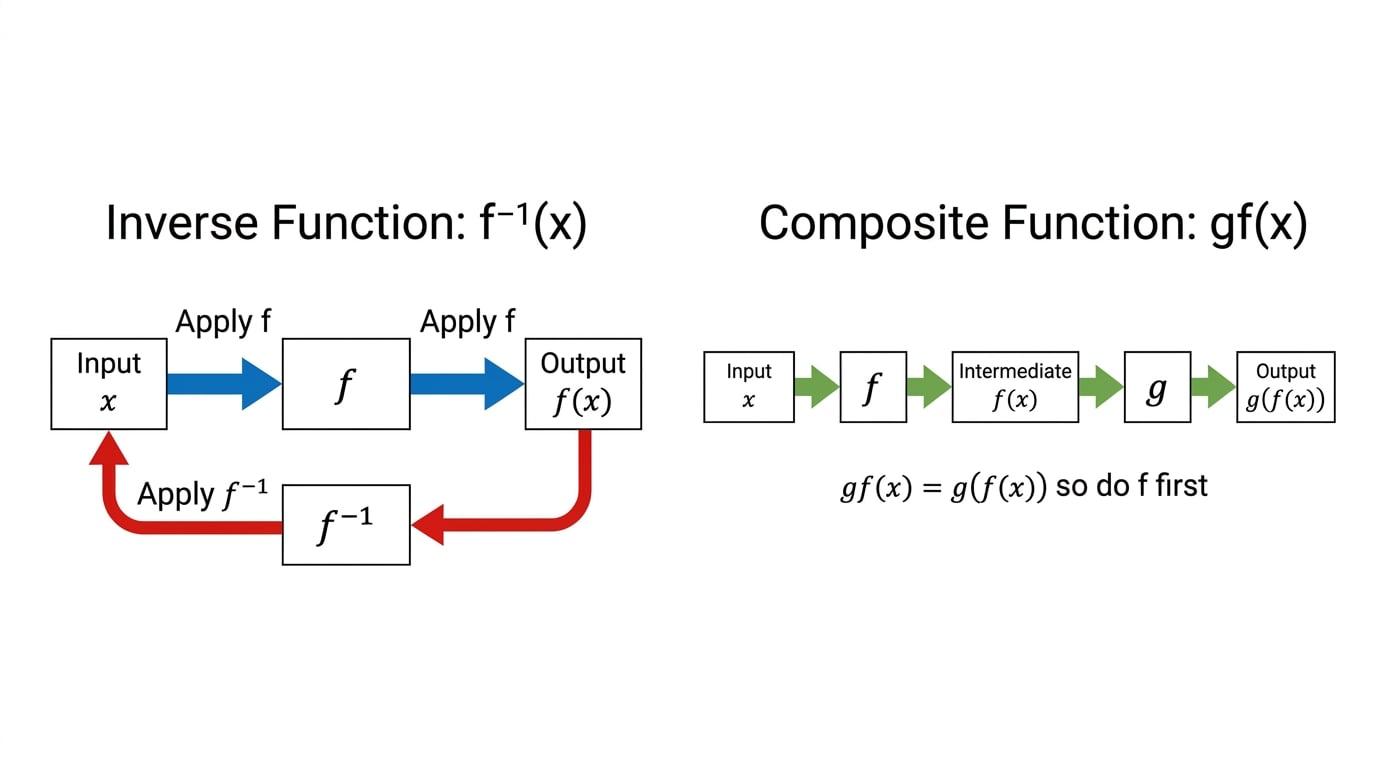
The symbol f−1(x)f^{-1}(x)f−1(x) means “undo fff”. It does not mean 1f(x)\frac{1}{f(x)}f(x)1.
Common Mistake
Quadratic inverses
A quadratic like x2−9x^2-9x2−9 gives the same output for inputs 3 and -3, so its inverse needs a restricted domain. The domain is the set of allowed inputs. If no restriction is stated, GCSE questions often use the non-negative square root, such as f−1(x)=x+9f^{-1}(x)=\sqrt{x+9}f−1(x)=x+9.
4. Composite functions: functions in a chain
Definition
Composite function
A composite function applies one function and then another. The notation gf(x)gf(x)gf(x) means g(f(x))g(f(x))g(f(x)), so you do fff first and then ggg.
Common Mistake
Composition is not multiplication
In gf(x)gf(x)gf(x), the letters are not multiplied together. The function nearest xxx is done first.
Example
Finding composites and solving them
Let f(x)=2x+1f(x)=2x+1f(x)=2x+1 and g(x)=x2g(x)=x^2g(x)=x2. Find fg(x)fg(x)fg(x), gf(x)gf(x)gf(x), and solve fg(x)=gf(x)fg(x)=gf(x)fg(x)=gf(x).
For fg(x)fg(x)fg(x), do ggg first, then put the result into fff:
An expression is a piece of algebra, such as x−3x-3x−3. If a question asks for f(x−3)f(x-3)f(x−3), substitute the whole expression wherever xxx appears.
Tip
Use brackets first
When substituting an expression, put it in brackets before expanding. This prevents sign and squaring mistakes.
Example
Finding f(x−3) and solving
Let f(x)=x2+2f(x)=x^2+2f(x)=x2+2. Find f(x−3)f(x-3)f(x−3), then solve f(x−3)=11f(x-3)=11f(x−3)=11.
Substitute x−3x-3x−3 into the rule:
f(x−3)=(x−3)2+2f(x-3)=(x-3)^2+2f(x−3)=(x−3)2+2
Use the equation f(x−3)=11f(x-3)=11f(x−3)=11:
(x−3)2+2=11(x-3)^2+2=11(x−3)2+2=11
Rearrange:
(x−3)2=9(x-3)^2=9(x−3)2=9
Square root both sides:
x−3=3 or x−3=−3x-3=3 \text{ or } x-3=-3x−3=3 or x−3=−3
Solve each equation:
x=6 or x=0x=6 \text{ or } x=0x=6 or x=0
6. Constants inside function questions
A constant is a value that does not change. In function questions, a constant may be shown as a letter such as kkk.
Example
Finding an unknown constant
Let a(x)=3x−4a(x)=3x-4a(x)=3x−4 and b(x)=kx2b(x)=kx^2b(x)=kx2. Given that ab(2)=20ab(2)=20ab(2)=20, find kkk.
Start with the inside function because ab(2)=a(b(2))ab(2)=a(b(2))ab(2)=a(b(2)).