Whiteboard Revision GCSE Business: Is It Useful?
Whiteboard revision GCSE Business advice: use active recall, calculations and answer planning to turn a simple board into focused, effective exam practice.
The danger of a whiteboard is that it can make revision look productive. You copy a polished page of notes, underline the heading and stand back from something impressively tidy. Yet little has been retrieved, tested or corrected.
That is why whiteboard revision GCSE Business students use genuinely helps only when the board becomes a place to think rather than another place to copy. Used well, it supports active recall, calculation practice, case-study application and answer planning. Used passively, it is simply a larger notebook.
The useful question is not, “Should I buy a whiteboard?” It is, “What will I make my brain do when I use it?”
The quick whiteboard revision checklist
A productive GCSE Business whiteboard session should usually involve:
- closing your notes before writing;
- retrieving ideas from memory;
- applying knowledge to a business context;
- planning answers rather than decorating notes;
- completing calculations without looking at a formula sheet;
- checking your work against trusted material;
- correcting errors before erasing the board;
- returning to weak material on another day.
If you only copy textbook paragraphs, a whiteboard adds little. If you recall, check and repair your knowledge, it can be extremely useful.
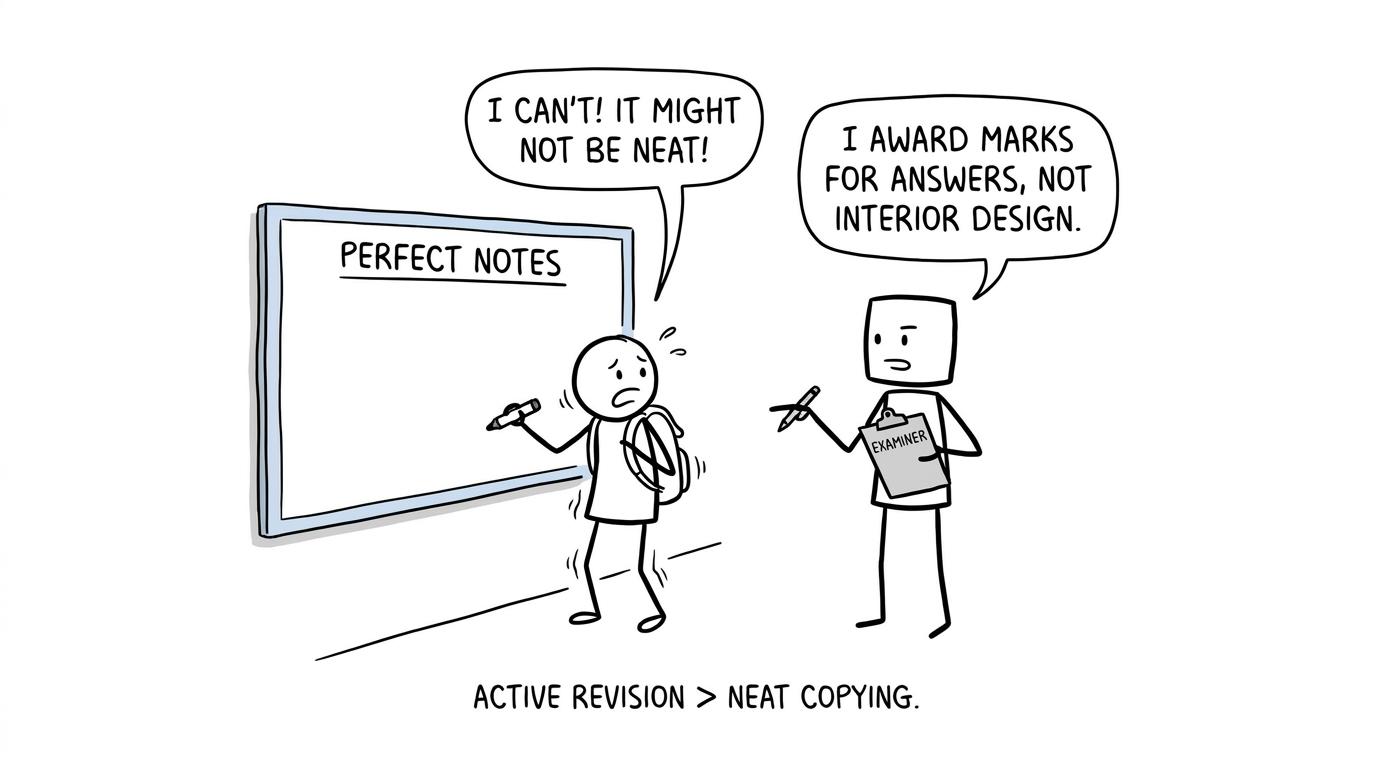 A student discovers that examiners reward answers rather than perfect-looking whiteboards
Why a whiteboard can work for GCSE Business
Research on retrieval practice consistently supports the value of bringing information to mind instead of repeatedly rereading it. A whiteboard does not create that effect by itself. It simply makes retrieval quick, visible and easy to repeat.
This matters because GCSE Business assesses more than remembered definitions. Across specifications from boards such as Edexcel, AQA, OCR and Eduqas, students are expected to demonstrate knowledge, apply it to contexts, analyse information and make justified judgements. Exact paper structures differ, so always check your own current specification.
A board can reflect those demands:
- Knowledge: recall a definition without notes.
- Application: connect the idea to details from a case study.
- Analysis: show a chain of consequences.
- Evaluation: compare arguments and reach a supported conclusion.
- Quantitative skills: calculate and interpret business data.
The surface is temporary, which is part of its value. You can make an uncertain attempt, discover what is missing and change it. Revision should expose imperfect knowledge. A beautiful page sometimes hides it.
Better uses than copying out notes
Begin with a blank-board brain dump
Choose one narrow topic, such as cash flow, market research or methods of motivation. Close everything and write what you can remember for three to five minutes.
Then check your class materials or specification. Add missing ideas in a different colour and correct anything inaccurate. Before finishing, photograph only the corrected version or transfer the important gaps to a revision list.
The difference between this and copying is sequence: memory first, feedback second. That first attempt reveals what you actually know.
Build cause-and-consequence chains
Business answers often need more than a valid statement. They need a developed explanation.
Write one business decision on the left of the board, then draw arrows through its likely consequences. For example, a change in price might affect demand, revenue, cash flow or competitive position. Beside every arrow, ask:
- Why might this happen?
- What detail from the case supports it?
- Is there a condition that could change the outcome?
Do not memorise one chain as though it always applies. Business decisions depend on context. The board should help you see that dependence rather than remove it.
Turn the board into a case-study map
Divide the surface into four areas:
- facts given in the case;
- relevant business concepts;
- possible advantages;
- possible disadvantages or limitations.
Now connect specific case facts to appropriate concepts. This is more useful than listing generic advantages because application marks depend on using the context supplied in the question.
A small retailer with limited finance, for instance, should not receive exactly the same recommendation as a multinational business. The board lets you keep the context visible while you decide which knowledge matters.
Plan extended answers under time pressure
Use the whiteboard to produce a brief skeleton rather than writing an entire essay every time. Record the command word, your main argument, one developed counterargument, relevant evidence and a provisional judgement.
Then compare the plan with the question and mark scheme. Ask whether each paragraph answers the precise issue or merely displays remembered knowledge.
Occasionally, you still need to write complete responses on paper. A whiteboard is excellent for generating and organising thought, but it cannot replace practice in writing a clear answer within the available time.
Teach the board aloud
Pick a concept and explain it as if the board were a student who keeps asking, “Why?” Write only the key terms and links needed to support your explanation.
When you hesitate, circle that point. Hesitation is useful information: it identifies where recognition has been mistaken for understanding. Check the gap, erase the explanation and attempt it again later without prompts.
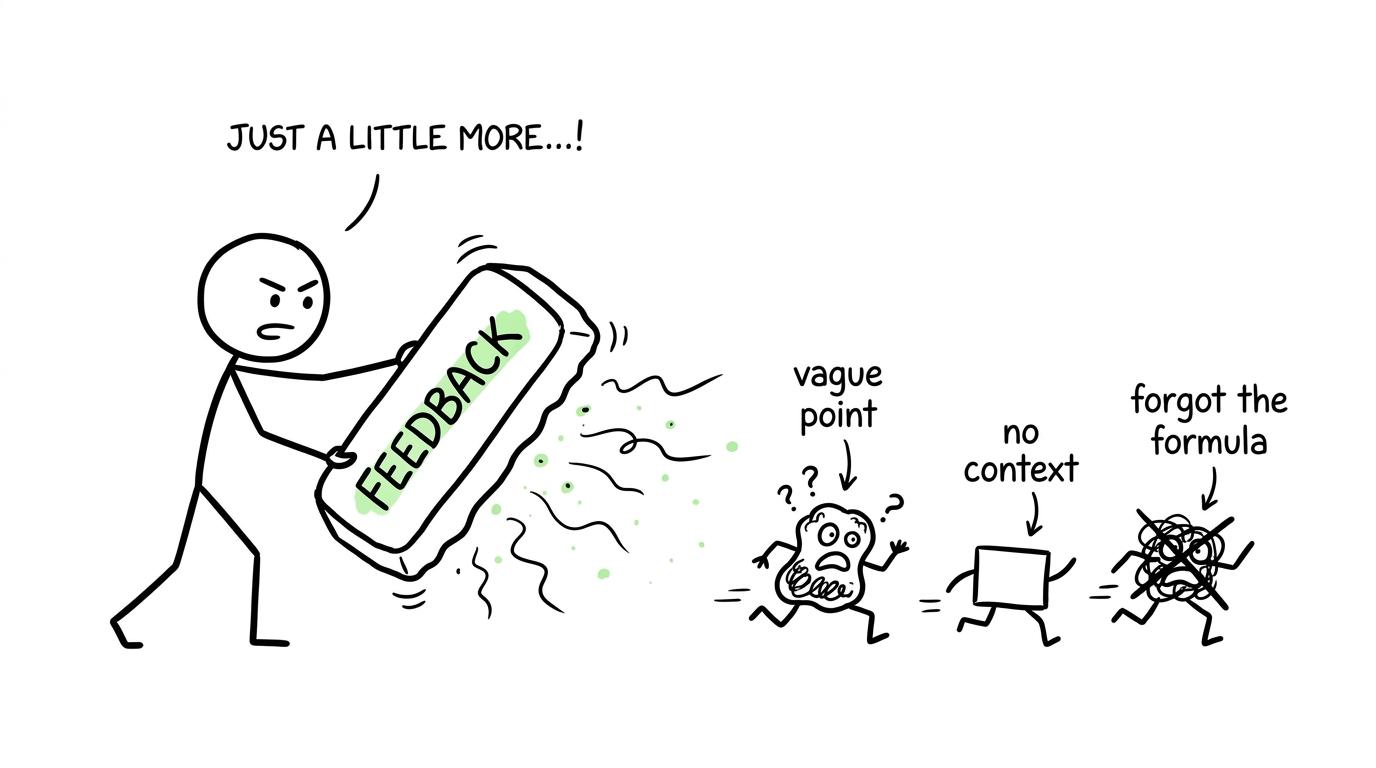 A whiteboard eraser called feedback chases away common revision errors
Use the whiteboard for Business calculations
Quantitative skills form a meaningful part of GCSE Business assessment. Depending on the specification, these can include percentages, averages, revenue, costs, profit, cash-flow data, profitability ratios, market share and average rate of return.
Create a formula-retrieval section and write each relationship from memory. Useful examples include:
revenue=selling price×quantity sold \text{revenue}=\text{selling price}\times\text{quantity sold} revenue=selling price×quantity sold profit=revenue−total costs \text{profit}=\text{revenue}-\text{total costs} profit=revenue−total costs percentage change=new value−original valueoriginal value×100 \text{percentage change}=\frac{\text{new value}-\text{original value}}{\text{original value}}\times 100 percentage change=original valuenew value−original value×100 market share=business salestotal market sales×100 \text{market share}=\frac{\text{business sales}}{\text{total market sales}}\times 100 market share=total market salesbusiness sales×100Check the names and formulae required by your exam board, particularly for profitability and investment calculations.
For stronger numerical foundations, MathsGenie provides free lessons and questions on GCSE percentages and GCSE averages. These maths skills transfer naturally into Business when you also explain what the result means for the organisation.
That final interpretation matters. A correct figure is not automatically a complete business judgement.
A repeatable 20-minute whiteboard routine
A short structure prevents the session from becoming vague:
- Three minutes: retrieve definitions or formulae from memory.
- Five minutes: create one cause-and-consequence chain.
- Five minutes: apply the topic to a short case or question.
- Four minutes: plan an extended response or complete calculations.
- Three minutes: check, correct and record the next action.
Revisit the topic after a gap rather than repeating it immediately until it feels familiar. Familiarity can disappear quickly once the notes are closed.
This rhythm also works alongside maths revision. The GCSE one-month revision plan explains how retrieval, focused practice and mark-scheme checking can fit into a manageable schedule. If planning is the problem, use the structure in the GCSE maths revision timetable and adapt individual sessions for Business.
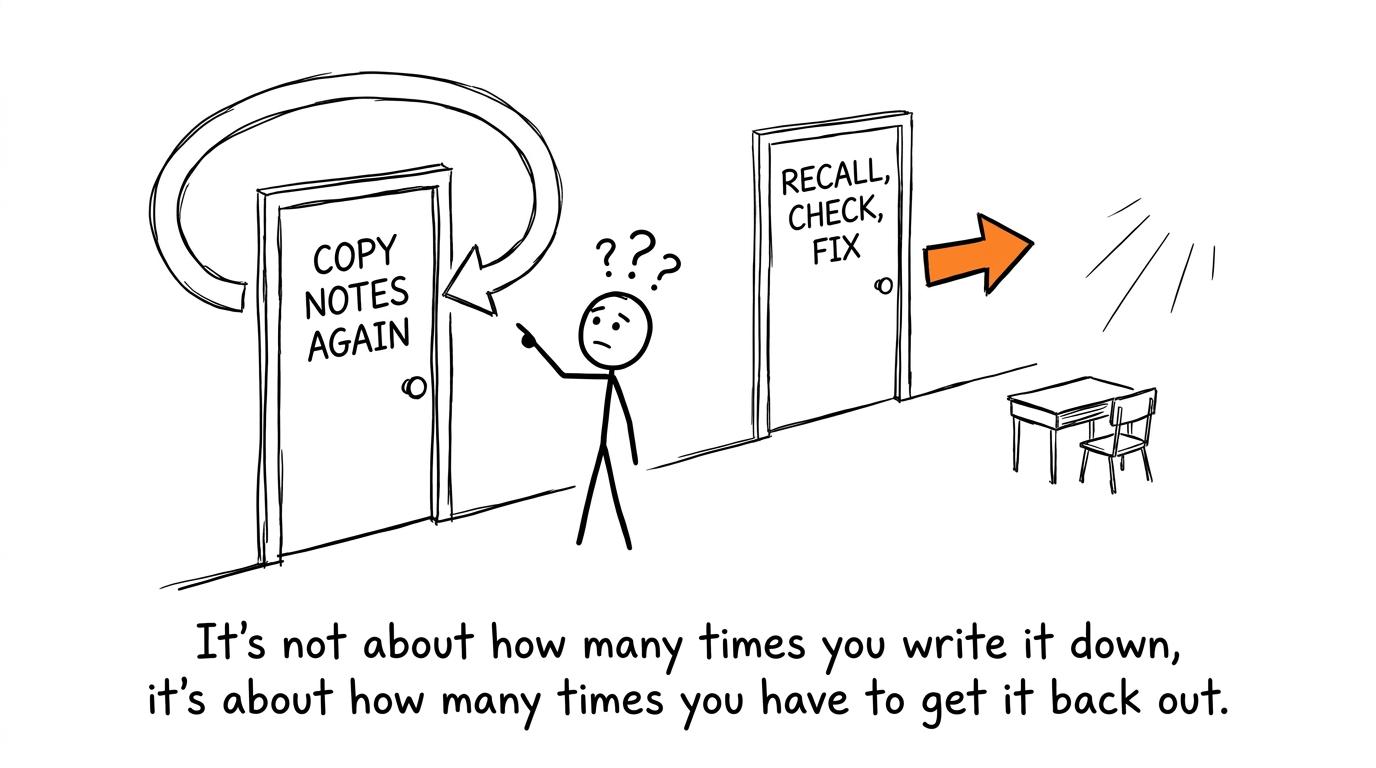 A student notices that copying notes leads in a circle while recall, checking and fixing leads forward
Common whiteboard revision mistakes
Making the board too neat
Presentation can consume time without testing knowledge. Your board should be readable, but it does not need to look publishable. Arrows, crossings-out and corrected thoughts are evidence of active work.
Keeping notes open
If the answer remains visible, you are copying or recognising rather than retrieving. Close the source, make an attempt and then check it.
Erasing errors without recording them
The convenience of wiping a board is also a weakness. Keep a paper or digital “marks leak” list containing the concepts, calculations and question types that need another attempt.
Revising definitions alone
Definitions matter, but GCSE Business also requires application, analysis and evaluation. For every recalled idea, ask how it might influence a particular business and what could limit the effect.
Avoiding full exam practice
Whiteboard plans are preparation, not proof that you can produce a finished response. Use official questions from your board and practise complete answers too. The same principle applies in maths: past papers should be introduced deliberately, then marked and reviewed rather than merely completed.
Treating Business like a tiered maths paper
GCSE Maths commonly has foundation and higher tiers. GCSE Business is not revised through those tiers, although it uses mathematical skills. Follow your Business exam board's specification while using maths resources at the level needed to strengthen weak numerical techniques.
Is a whiteboard worth buying?
A whiteboard is worth considering if you like thinking visually, want a low-friction way to test yourself and will use it regularly. A small board is enough. Paper, a tablet or the back of an old worksheet can support the same learning processes.
Do not confuse the tool with the method. The real value comes from retrieval, application, feedback and repeated practice. If those behaviours are absent, a new board will not rescue the session.
Make the board part of a wider revision system
A whiteboard is best used for short, active bursts between more permanent forms of practice. Retrieve a method on the board, complete questions on paper, mark them and return to the board to explain the error.
MathsGenie can provide that wider structure for the numerical side of your GCSE preparation. Start at the free GCSE and A Level maths revision hub, strengthen topics in a sensible sequence with the guide to ordering GCSE maths revision, and test your performance using Edexcel GCSE Maths predicted papers where appropriate for your course.
Use the revision lessons to understand, practice questions to build accuracy, mini tests to diagnose gaps, and past papers or predicted papers with mark schemes and video solutions to become exam-ready. Then let the whiteboard do what it does best: make your thinking visible long enough to improve it.