

University GCSE Modern Hebrew Requirement Explained
University GCSE Modern Hebrew requirement explained: learn when your grade is visible, when courses may consider it and which GCSE results usually matter most.
A GCSE result can feel permanent when you are waiting for it. One difficult listening paper, one forgotten phrase or one answer changed in the final minute can begin to look like a verdict on your entire future.
The short answer to the university GCSE Modern Hebrew requirement question is reassuring: UK university courses rarely specify a particular GCSE Modern Hebrew grade. However, the qualification and grade will normally appear on your UCAS application, and it may matter as part of your wider academic record or for a course with a relevant language requirement.
For most applicants, GCSE English Language and maths are more likely to be explicit requirements. Your Level 3 qualifications, such as A Levels, are usually central to the offer. The detail depends on the university, course and year of entry, so the current course page is always the final authority.
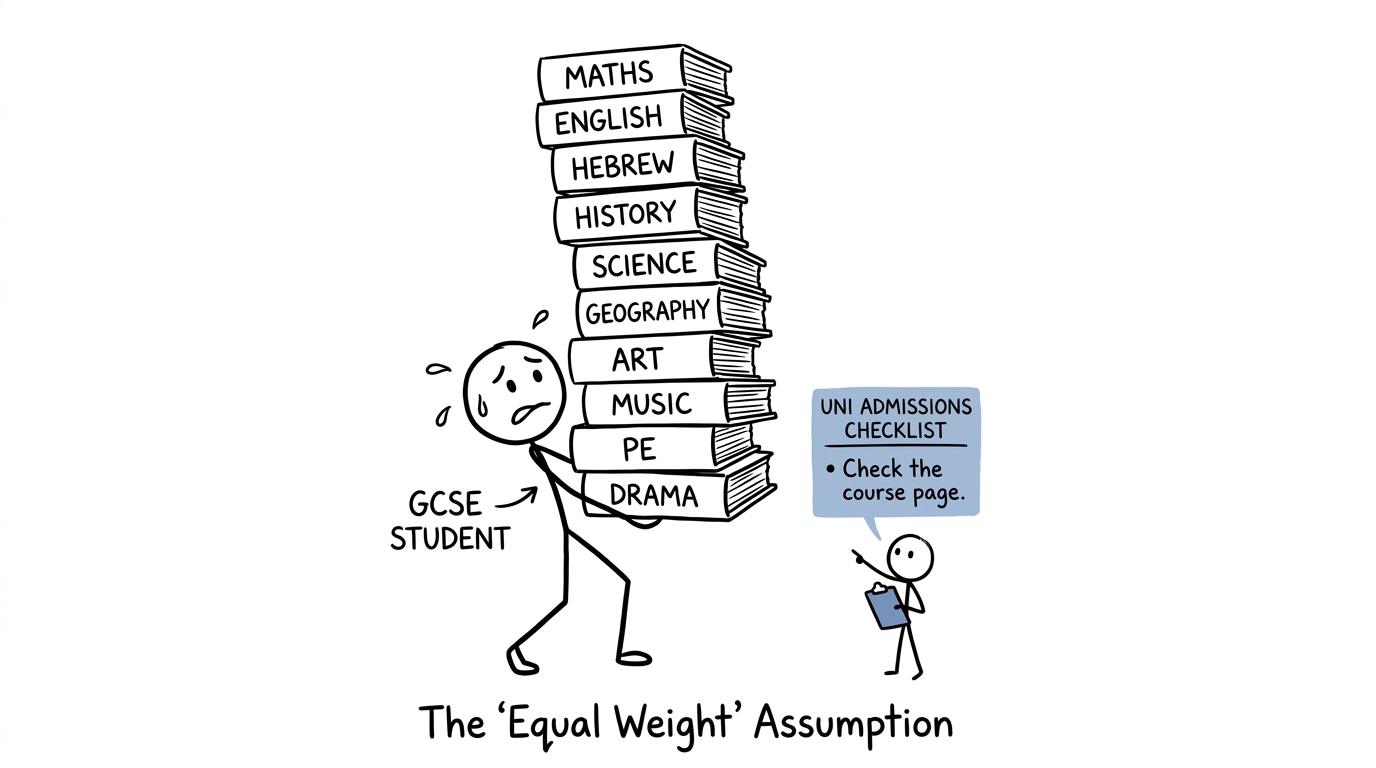 A student carrying an alarming tower of GCSE subject folders while a small university checklist offers a simpler answer
The quick answer
Here is the practical checklist:
- You must normally declare all completed and pending qualifications requested in your UCAS application, including GCSE Modern Hebrew.
- A university can therefore see the grade even when it is not an entry requirement.
- Most courses do not name GCSE Modern Hebrew specifically.
- Language, linguistics, cultural studies or related courses may give the qualification more relevance.
- Some courses accept a modern language at GCSE as evidence that a broader language condition has been met.
- GCSE English Language and maths are much more commonly specified.
- Selective universities may consider your overall GCSE profile alongside other evidence.
- Requirements can change, so check each course page for your intended entry year.
The useful distinction is between a grade being visible, considered and required. These are not the same thing.
Will universities see your GCSE Modern Hebrew grade?
Yes, in most ordinary applications they will. UCAS instructs applicants to enter their previous and current qualifications from secondary education onwards, including all GCSEs, resits and unsuccessful results where applicable. You should enter qualifications accurately and use the title shown on your certificate.
That does not mean an admissions tutor isolates every GCSE and treats it as a separate hurdle. A grade can be present on the form without controlling the decision.
Think of the application as a complete academic map. GCSE Modern Hebrew is one location on it. The course requirements tell you which locations the admissions team particularly needs to inspect.
A typical course may focus on:
- required A Level subjects and predicted grades;
- GCSE English Language and maths;
- an admissions test, portfolio or interview where relevant;
- the academic reference and other application information;
- contextual information used under the provider's admissions policy.
The weight given to each element varies. UCAS is clear that universities and colleges set their own requirements, so there is no single rule covering every UK degree.
When can GCSE Modern Hebrew actually matter?
When a course asks for a modern language
A language-related course may require prior language attainment. Sometimes the condition is attached to an A Level language; in other cases, particular combinations of GCSE languages can satisfy or alter the requirement.
This is where Modern Hebrew could matter directly. The wording might refer to “a modern language” rather than listing every accepted language. Never assume that Modern Hebrew is included or excluded solely from that phrase. Ask the university admissions team for written confirmation if the course page is unclear.
The qualification itself is well established. AQA GCSE Modern Hebrew is a linear qualification with listening, speaking, reading and writing assessment. It has foundation tier grades 111 to 555 and higher tier grades 444 to 999. It is therefore a formal GCSE result rather than an informal indication that you speak another language.
When it supports a relevant academic story
For degrees involving languages, linguistics, Jewish studies, theology, Middle Eastern studies or related cultural fields, GCSE Modern Hebrew may be more relevant than it would be for engineering or accountancy.
Relevance is not the same as a guaranteed advantage. Admissions decisions are based on the published criteria and the application as a whole. Still, a strong result can provide evidence of language learning, communication and sustained engagement with a relevant subject.
When universities review the overall GCSE profile
Some selective providers consider GCSE results as one part of a broader assessment. Oxford, for example, states that GCSEs are considered alongside predicted grades, references, admissions assessments and other course-specific evidence. It also explains that prior attainment may be considered in context.
In that situation, GCSE Modern Hebrew can form part of the overall profile. Yet it is unlikely to operate as a hidden standalone requirement unless the course information says so. One lower grade also needs to be understood beside the rest of the record rather than treated as the entire application.
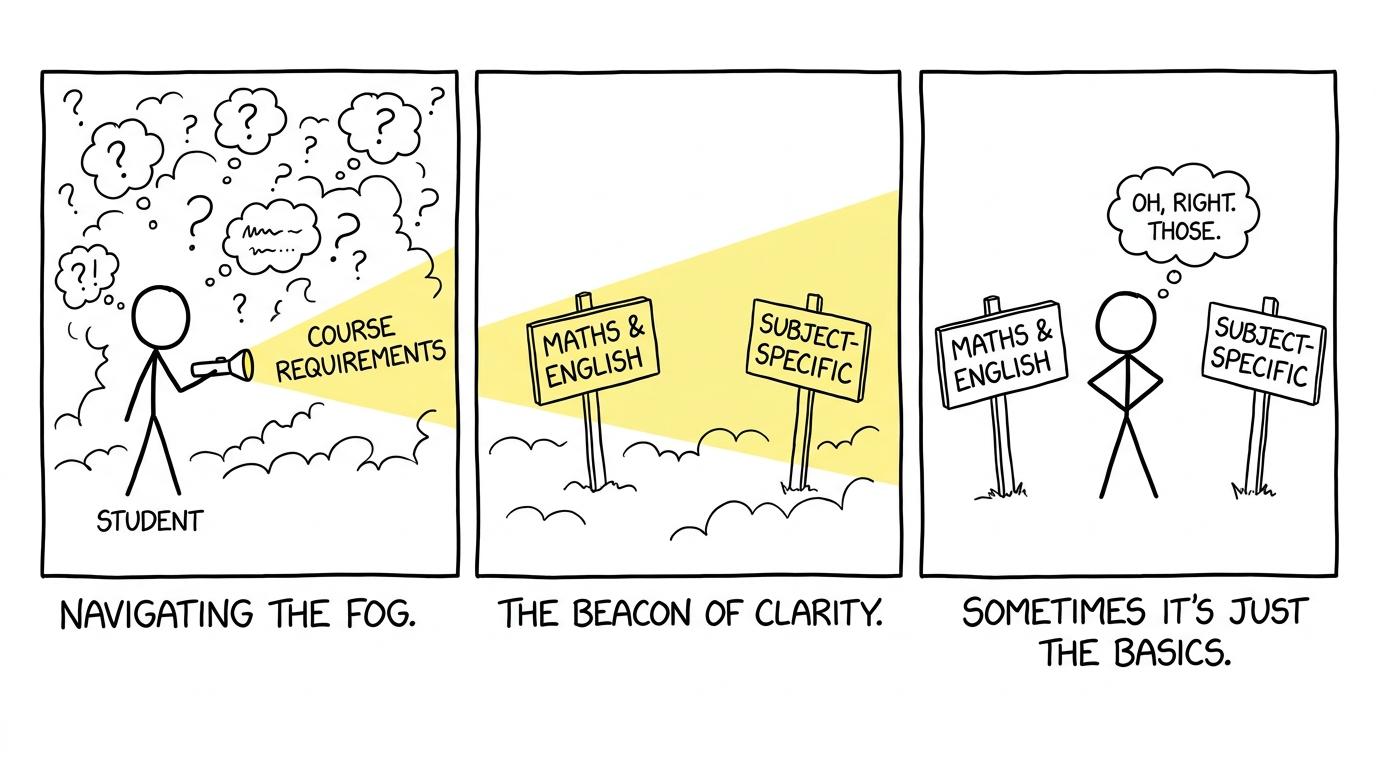 A student using a course-requirements torch to find clear signposts through a fog of anxious questions
Which GCSE requirements are more common?
Most course searches lead repeatedly to two subjects: English Language and maths. UCAS notes that many courses expect pre-sixteen qualifications such as GCSE English and maths or accepted equivalents. Individual universities may demand particular grades, and some programmes set higher thresholds than their general institutional minimum.
Subject-specific GCSE requirements also occur. A teacher-training route, science-related degree or competitive professional course may impose conditions beyond the general minimum. The exact wording matters: “required”, “preferred” and “considered” describe different things.
For a prospective maths student, later qualifications usually become especially important. A university maths course is far more likely to focus on A Level Mathematics, and sometimes Further Mathematics, than on GCSE Modern Hebrew. That is one reason to build secure foundations now through the free GCSE maths revision hub, then progress to demanding Level 3 work rather than allowing anxiety about one unrelated GCSE to consume all your attention.
How to check a course properly
University requirements are specific to a course, provider and entry year. A general internet answer cannot replace that course's current admissions page.
Read the complete entry requirements
Do not stop after seeing the headline A Level offer. Look for sections covering:
- required subjects;
- GCSE or equivalent qualifications;
- English language requirements;
- admissions tests and interviews;
- contextual offers;
- resit policies;
- alternative qualifications.
Check all courses on your shortlist separately. Two degrees with similar titles can apply different rules.
Ask a precise question
If the wording is ambiguous, contact undergraduate admissions. State the exact course, entry year, qualification title, exam board, tier and grade achieved or expected. Ask whether it satisfies the published language condition.
A precise question is easier to answer accurately than “Do my GCSEs matter?” Keep the reply so that you can refer back to it.
Recheck before applying
A requirement viewed early in GCSE study may not be the requirement applying when you submit UCAS. Return to the official course page in your application year. Your school or college adviser can help, but the university remains the authority on its own criteria.
What this means for GCSE maths revision
Questions about university can quietly steal time from the work that improves your options. Research matters, but repeated checking rarely changes a published requirement. Once you have recorded the answer, return to what you can influence.
For many courses, maths is one of the GCSEs most likely to be named explicitly. A calm revision system is therefore more useful than treating every subject worry as equally urgent.
Start by identifying where marks are being lost. The GCSE maths revision timetable guide explains how to combine topic learning with regular exam practice. If the exam is closer, use the one-month GCSE maths revision plan to create a manageable weekly rhythm.
Then use a simple loop:
- learn or refresh one weak topic;
- complete practice questions without relying on notes;
- mark the work carefully;
- record the exact reason for each lost mark;
- practise that skill again before attempting another full paper.
Past papers become valuable when they expose gaps rather than merely produce a score. The guide to when to start GCSE past papers helps you choose the right balance between topic work and timed practice. Nearer the exams, GCSE predicted topics and revision guidance can focus your preparation, but predicted material should supplement rather than replace specification-wide revision and official past papers.
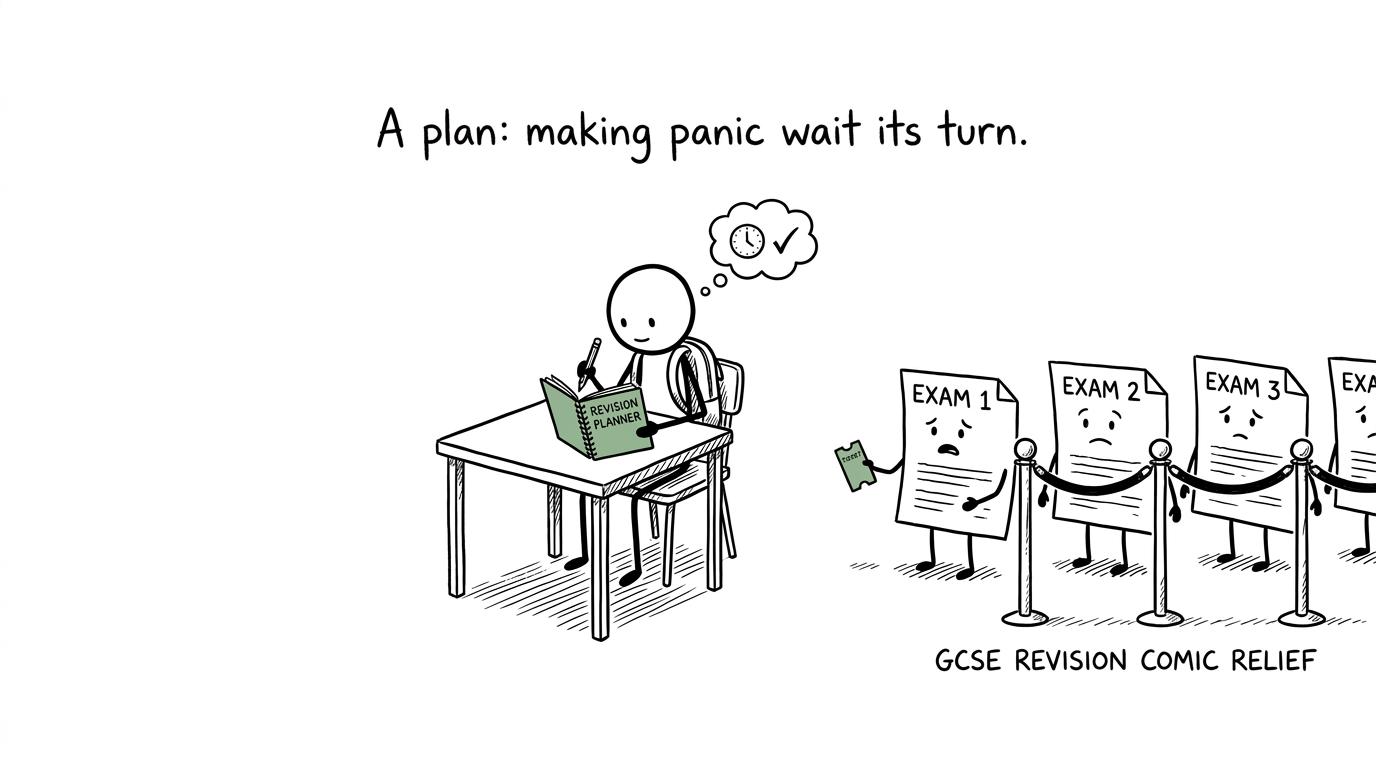 A calm student with a revision planner while exam papers wait politely in a queue
Common mistakes when interpreting GCSE requirements
Assuming visible means required
Universities can see qualifications declared through UCAS. That alone does not make every result a minimum entry condition. Read the course's published GCSE section.
Treating every university as identical
There is no universal university GCSE Modern Hebrew rule. Requirements vary by provider and course, even where degree titles appear similar.
Reading an old course page
Admissions policies and course requirements can change. Check the page for your intended entry year rather than relying on a screenshot, discussion thread or old prospectus.
Hiding or omitting a result
Follow UCAS instructions and declare the qualifications requested accurately, including resits and unsuccessful grades where required. An inconvenient grade is not a reason to submit incomplete information.
Assuming one grade decides everything
A relevant minimum must be met unless the university confirms otherwise. Beyond explicit conditions, however, admissions teams may consider multiple forms of evidence. Do not turn one GCSE result into a prediction of the whole decision.
Neglecting the GCSEs courses commonly specify
Worrying about Modern Hebrew while postponing maths or English revision reverses the likely priorities for many courses. Use the actual requirements to allocate your effort intelligently.
Keep the requirement in proportion
Your GCSE Modern Hebrew grade will normally be disclosed, and there are circumstances in which it can matter. It may support a language-related application, contribute to an overall GCSE profile or satisfy wording that accepts an appropriate modern language. But most UK university courses do not set a specific GCSE Modern Hebrew threshold.
The sensible response is neither to dismiss the grade nor to fear it. Check each current course page, clarify ambiguous wording with admissions and then focus on the qualifications most relevant to your intended route.
For maths, that means converting uncertainty into practice. Begin with MathsGenie's free GCSE maths resources, using revision lessons, practice questions, mini tests, mark schemes, video solutions, past papers and predicted papers. If A Level Mathematics later becomes part of your route, timed resources such as the Edexcel A Level Maths past papers can continue the same learn, practise, mark and improve cycle.
A university requirement is a boundary to understand. Revision is the part where you still get to move.











