University GCSE Arabic Requirement: Does It Matter?
University GCSE Arabic requirement explained: learn when your grade matters, when it probably will not, and how to check individual UK course criteria.
A GCSE result can feel strangely permanent. You sit the paper at 161616, receive a number months later, and may wonder whether an admissions tutor will still be examining it years from now. The short answer to the university GCSE Arabic requirement question is reassuring: most UK university courses do not specify a particular GCSE Arabic grade. However, universities may still see and consider the qualification, and it can matter for language degrees, courses that assess your wider GCSE profile, or programmes requiring a GCSE language.
The important distinction is between a university seeing your Arabic result and making it a specific condition of entry. Those are not the same thing.
The quick answer
Use this checklist before worrying about your grade:
- Most degree courses do not name GCSE Arabic as a requirement.
- GCSE English Language and maths are requested much more frequently, sometimes at grades above the standard pass.
- Arabic and modern-language courses vary: some are designed for beginners, while others require evidence of previous language achievement.
- Some selective courses assess an overall GCSE profile, meaning Arabic could contribute as one of your stronger or weaker results.
- A requirement for “a language other than English” may include Arabic, but universities can impose restrictions, particularly where Arabic is your first or native language.
- Entry requirements change, so always check the page for your exact course and intended year of entry.
Your Arabic grade is therefore neither irrelevant nor universally decisive. Its importance depends on the wording used by the individual university.
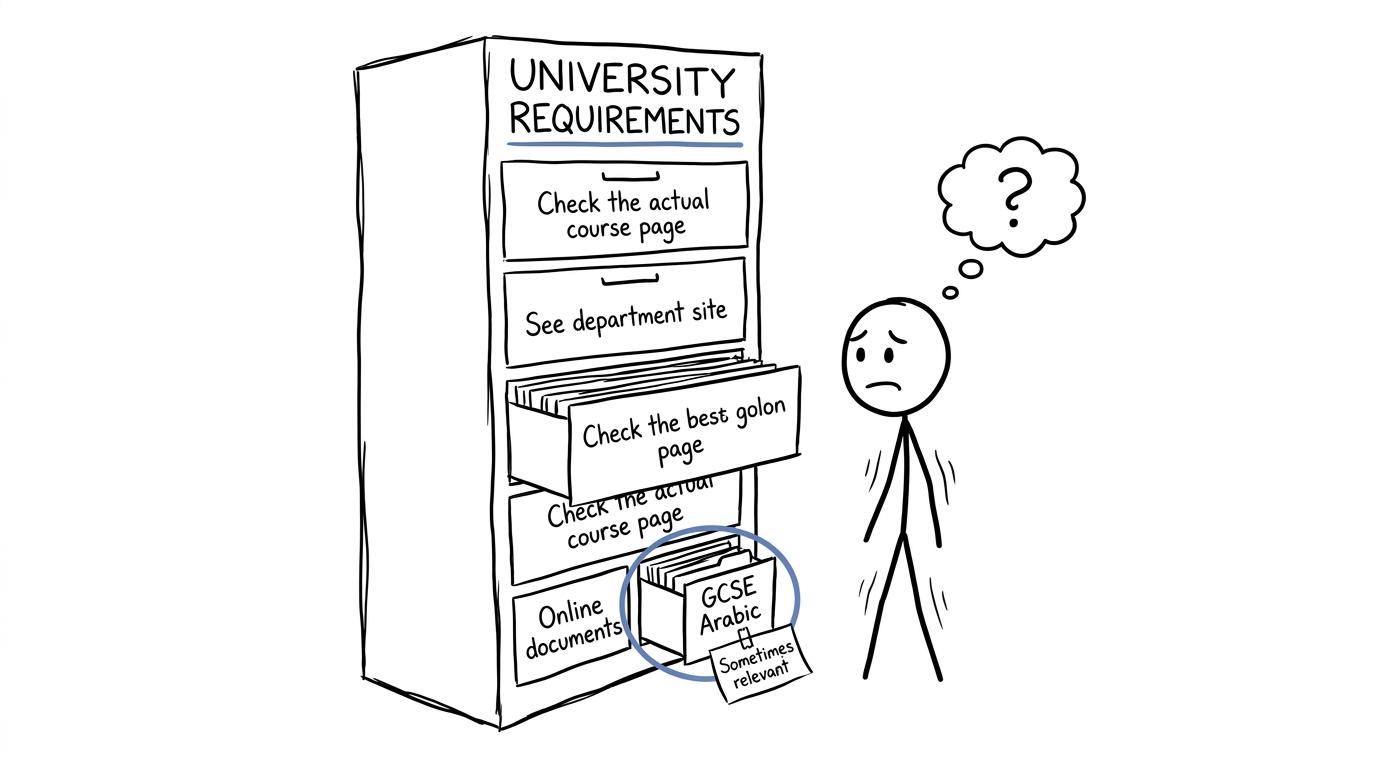 A student explores a filing cabinet of university requirements
Do universities look at all your GCSE grades?
Universities can consider the qualifications declared in your application, but each provider decides how it uses them. UCAS explains that universities and colleges set their own entry requirements. These can include qualifications, named subjects, particular grades and other course-specific conditions.
For many degrees, the main academic offer is based on Level 333 qualifications such as A Levels. GCSEs still provide evidence of your earlier academic record, but universities commonly give particular attention to English Language, maths and, where relevant, science.
That means an admissions tutor might be able to see your GCSE Arabic grade without using it as a separate selection hurdle. A course asking for GCSE maths at grade 666 and English Language at grade 666, for example, has not automatically created an Arabic requirement simply because Arabic appears elsewhere in your qualifications.
The safest approach is to read the criteria literally:
- “GCSE Arabic at grade…” is a direct subject requirement.
- “A GCSE language at grade…” may allow Arabic, subject to the university's rules.
- “Five GCSEs at grades…” means Arabic might count towards the total.
- “Your highest GCSE results” means a strong Arabic result could enter the assessment.
- No reference to Arabic or languages usually means it is not a specific requirement.
When a GCSE Arabic grade can matter
Applying for Arabic or modern-language courses
This is the most obvious situation, but even here there is no single national rule.
Current published course information shows considerable variation. Some Arabic degrees begin from complete beginner level and do not require previous Arabic study. The University of Manchester's Arabic Studies course for 2026 entry, for example, is designed for beginners. Exeter also publishes Arabic routes for which no previous knowledge of Arabic is required.
Other language programmes may require achievement in a modern language, either at GCSE or A Level. The University of Edinburgh currently publishes Arabic-related courses requiring a language other than English at GCSE grade 777, while also stating that an applicant's native language cannot be used to satisfy that particular condition. Details such as these are why the course page matters more than a general internet answer.
If you already speak Arabic confidently, do not assume that a beginners' Arabic degree is automatically the right route. Some universities separate beginners' study from programmes intended for students with existing proficiency. Contact the admissions team if the published wording does not match your circumstances.
Meeting a general language requirement
A course does not always need to mention Arabic by name. If it requests “a modern foreign language”, “a language other than English” or an equivalent qualification, GCSE Arabic may be relevant.
Check three details:
- whether Arabic is included among accepted languages;
- whether the qualification must be a full GCSE from an accepted awarding body;
- whether a first or native language is allowed to meet the condition.
Do not rely on the course title alone. The precise wording under entry requirements, required subjects and additional GCSE requirements is what counts.
Applying to a course that scores GCSEs
Some highly competitive programmes do more than check minimum grades. They may score a set number of GCSEs or assess your overall profile.
Medicine is a useful illustration of the principle, although policies differ sharply between medical schools. Current 2026 entry information from Nottingham says that its Medicine selection process scores eight GCSE results, including specified core subjects and four other high results. In a system like that, GCSE Arabic could potentially help if it is among the results considered. Other medical schools focus on named subjects or use GCSEs differently.
The lesson is not that every competitive course cares deeply about Arabic. It is that a supposedly “extra” subject can matter when a selection method counts several GCSE grades.
Demonstrating broader academic strengths
A strong Arabic result can support the wider picture of your abilities. Language qualifications involve reading, writing, listening and speaking, as well as accuracy and sustained preparation. Those qualities may complement an application, particularly for humanities, languages, international relations or area studies.
But avoid overstating what one result proves. A good grade does not replace a required A Level subject, admissions test or GCSE maths condition. It is part of the evidence, not a universal shortcut.
When your Arabic grade probably will not decide the outcome
For many maths, engineering, computing, business and science courses, the stated conditions focus on A Level subjects and minimum GCSE grades in English Language and maths. Arabic may appear in your academic record without carrying a separate threshold.
The same is often true for Arabic degrees designed for beginners. Previous success in Arabic may not be required at all, and students with substantial existing proficiency may need to discuss the suitable route with the university.
A lower Arabic grade is therefore unlikely to block an application where:
- the course does not specify Arabic or a GCSE language;
- you meet every named GCSE condition;
- you satisfy the required Level 333 subjects and grades; and
- the university does not rank applicants using a broad GCSE score.
“Unlikely” is more accurate than “never”. Admissions policies are course-specific, and apparently similar degrees at different universities can use GCSEs in different ways.
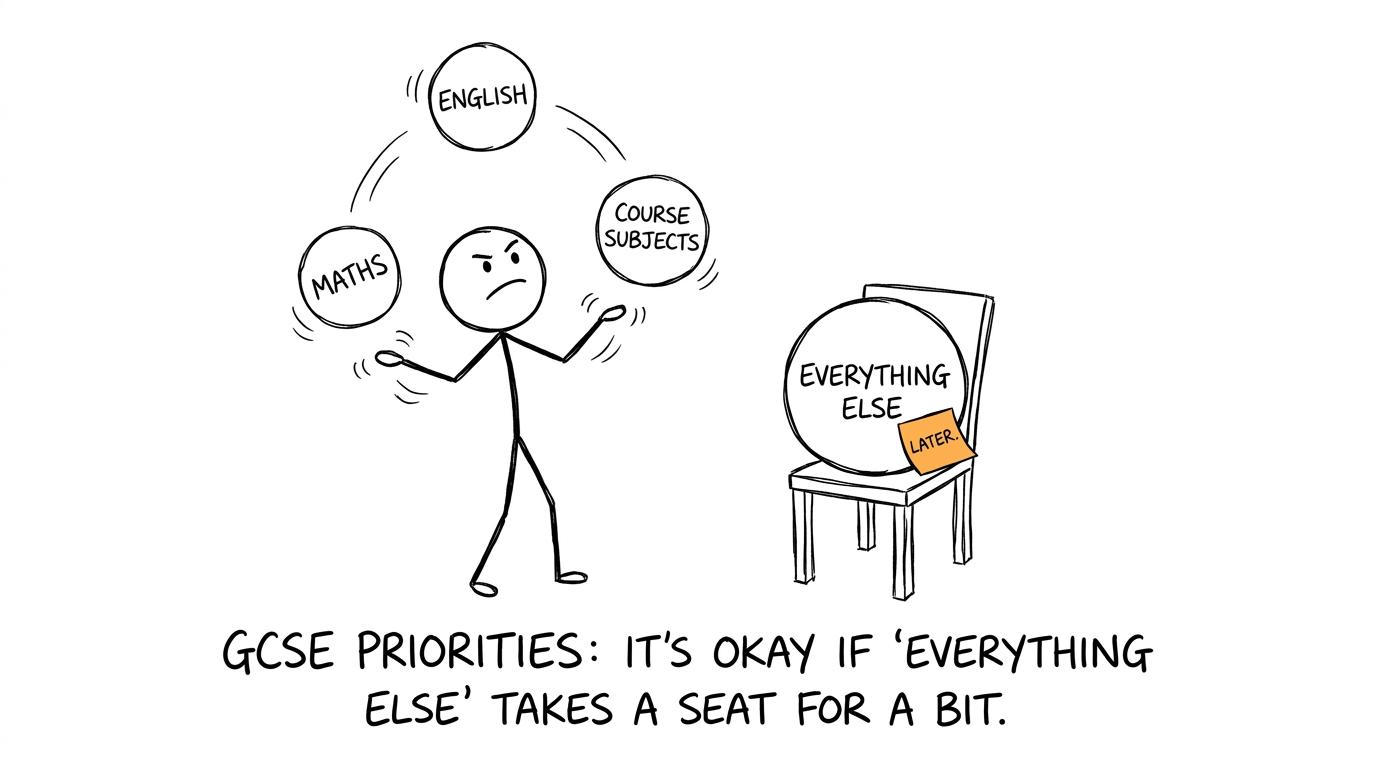 A student juggles the main GCSE priorities
Why GCSE maths deserves particular attention
If university is somewhere in your future, GCSE maths usually deserves more strategic attention than trying to predict whether every optional subject will matter. UCAS notes that most courses expect some pre-161616 qualifications such as GCSE English and maths, while individual universities may set higher course-specific thresholds.
A pass is not always the final target. Some courses request grade 555, 666 or above in maths, especially where the degree includes substantial numerical work. Competitive courses may also assess the broader GCSE profile.
That does not make Arabic unimportant. It means your revision priorities should reflect the doors each subject can open. Begin with the free GCSE Maths revision hub, where topics are organised with lessons, questions and exam resources for foundation and higher tier students.
If revision feels too large to manage, build a repeatable week using the GCSE maths revision timetable. A modest plan followed consistently is more useful than a perfect plan abandoned after two days.
How to check a university's exact policy
 A student finds the answer in the course-page small print
Start with the official page for the exact degree, university and entry year. Then look for these headings:
- entry requirements;
- GCSE or Level 222 requirements;
- required subjects;
- language requirements;
- selection process;
- accepted qualifications;
- resit and equivalency policies.
Next, separate minimum eligibility from competitive selection. Meeting a minimum grade may allow an application to be considered, while scoring or shortlisting rules can determine how applicants are compared.
If “language” is mentioned without a complete list, ask admissions whether your GCSE Arabic qualification is accepted. Give the exam board, qualification title, year and grade. Edexcel and AQA offer GCSE Arabic qualifications, but a university should confirm how it treats the particular certificate you hold.
Check again before applying. Requirements published for one admissions cycle may not remain identical for the next.
Common mistakes to avoid
Assuming every university follows the same rule
There is no universal UK requirement for GCSE Arabic. Policies vary by provider, course and admissions year.
Confusing visibility with importance
A qualification can appear in your application without being a named entry condition. Read how GCSEs are actually assessed.
Treating a general language condition as automatic acceptance
Arabic may satisfy a language requirement, but restrictions can apply to native languages, qualification types or grades. Confirm rather than guess.
Ignoring maths while worrying about one optional GCSE
Maths is explicitly required by many courses. Use MathsGenie's guide to starting past papers to move from topic revision into timed practice at a sensible stage.
When you complete a paper, the real improvement comes afterwards. The guide to using Edexcel GCSE Maths past papers properly explains how to mark, diagnose errors and turn lost marks into targeted practice.
Checking requirements only once
Course criteria can change. Recheck them when choosing A Levels, creating your shortlist and preparing the final application.
Keep the bigger picture in view
One GCSE grade rarely tells the entire story. University entry is normally a collection of conditions: required subjects, minimum grades, Level 333 achievement and, for some courses, tests, interviews or wider selection rules.
So, do universities ever ask about your GCSE Arabic grade? Yes. It can matter for a named language requirement, an overall GCSE total, a scored academic profile or an Arabic-related course. But for most degrees, there is no standalone GCSE Arabic condition, and English Language and maths are more commonly specified.
Check the exact course rather than letting uncertainty consume revision time. Then return to what you can control. Use MathsGenie's free GCSE maths resources for revision lessons, practice questions, mini tests, past papers, predicted papers, mark schemes and video solutions. If the exam is close, follow the calm GCSE maths night-before plan. Later, if you continue with maths, the Edexcel A Level Maths past papers can support the same cycle of practice, marking and improvement.
Your future application will be built from many results. The best response is not panic over one of them. It is informed choices now, followed by steady preparation for the next paper.