Typing vs Handwriting Notes for GCSE ICT
Typing vs handwriting notes GCSE ICT: discover what memory research suggests and how to turn either method into effective, active GCSE revision.
A page of handwritten notes can feel slow. A typed document can feel productive because the words arrive quickly, line up neatly and remain easy to search. But the important question is not which method looks better. It is which one helps you remember when the notes are closed and the exam paper is open.
For typing vs handwriting notes GCSE ICT, the research suggests a measured answer: handwriting has a small average advantage for learning and recall, probably because it encourages selection and processing rather than word-for-word transcription. Typing remains valuable for speed, organisation and accessibility. Neither method, however, is as important as what happens next: active recall, practice questions, feedback and spaced review.
That answer applies whether your course is called ICT, digital technology or GCSE Computer Science. It also matters greatly in GCSE maths, where remembering a method is only useful if you can recognise when and how to apply it.
The short answer: which method should you choose?
Use this checklist:
- Handwrite when learning a new concept, summarising an explanation, drawing connections or recording a short method.
- Type when organising a large specification, producing searchable summaries, editing information or keeping an error log.
- Avoid copying entire slides, textbooks or revision pages in either format.
- Close the notes and retrieve the main ideas without looking.
- Apply the knowledge through exam questions, then check your answer with a mark scheme.
- Return later rather than completing all your revision in one sitting.
The best choice is often a hybrid: use handwriting to think, typing to organise, and questions to test whether anything has actually stuck.
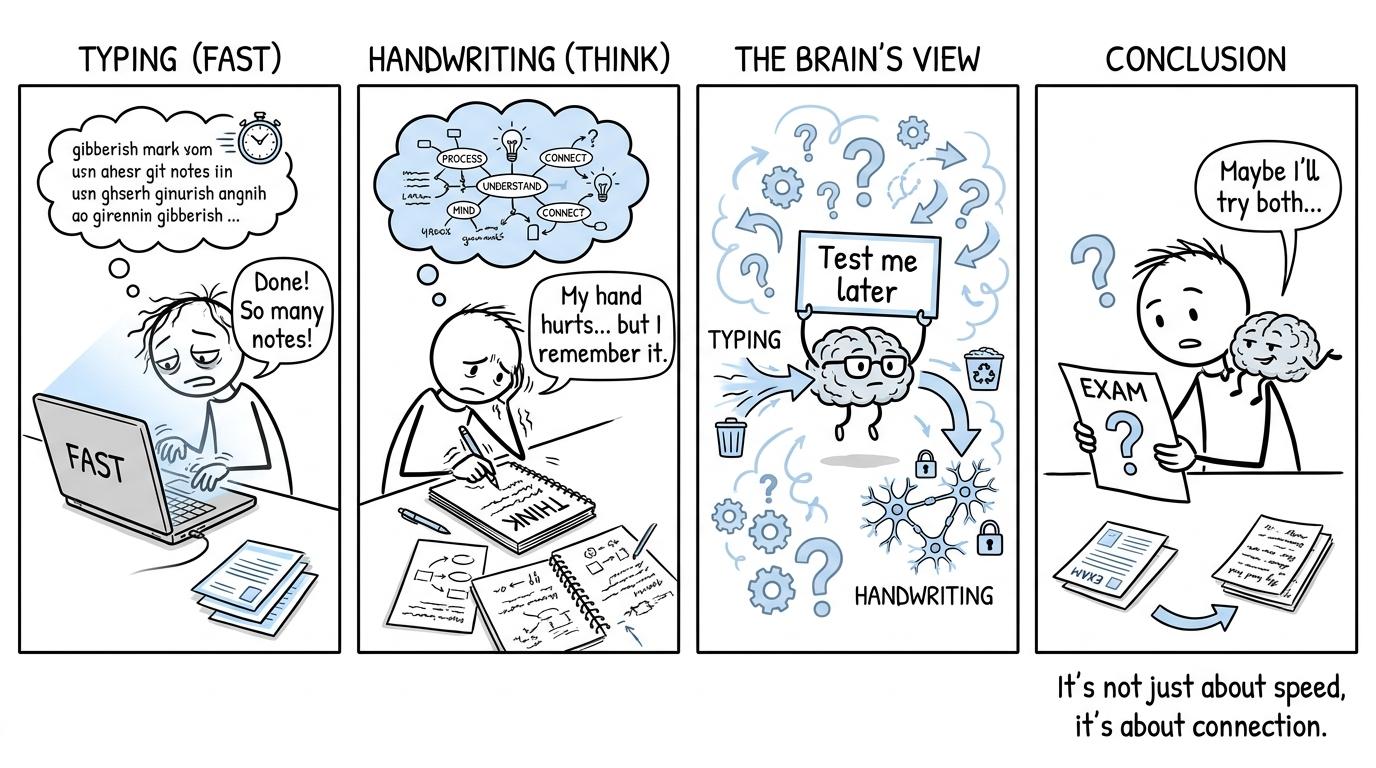 A student choosing between a fast laptop and a thoughtful notebook while their brain asks to be tested later
What memory research actually tells us
A recent meta-analysis published in 202420242024 combined 242424 studies involving 3,0053,0053,005 university students. On average, students who took and reviewed handwritten lecture notes achieved better results than those who typed. The advantage was modest, while typing produced substantially more notes.
That distinction matters. More words do not automatically create more learning.
Because handwriting is slower, the writer often has to choose what matters, shorten an explanation and connect it to existing knowledge. Those decisions can strengthen encoding, the process through which information becomes a memory. A fast typist, by contrast, may record a sentence accurately without fully considering what it means.
There are important limits to this evidence. Much of the research concerns university lectures, not UK GCSE students revising independently. Other reviews have reported smaller differences or found that the advantage changes when students can review their notes. It would therefore be misleading to claim that handwriting always wins.
A safer conclusion is this: how deeply you process and later retrieve information matters more than the device or stationery you use.
Encoding is only the beginning
Notes can support memory in two ways. Making them can help you process information, while keeping them creates an external record for later review. But an external record is not the same as knowledge in long-term memory.
Retrieval practice completes the loop. This means trying to recall knowledge before looking at the answer. The attempt should require some thought, and it should be followed by feedback so that mistakes are not left uncorrected.
For ICT or Computer Science, that could mean explaining a network concept, security risk or algorithm from memory. For maths, it could mean writing the steps of a method before attempting questions. The MathsGenie GCSE maths revision hub supports this progression through revision lessons, active-recall resources, practice questions and exam papers.
Why handwriting can help GCSE recall
Handwriting naturally introduces friction. That may sound undesirable, but useful revision is not always the revision that feels easiest.
When you cannot write every spoken or displayed word, you must decide:
- what the central idea is;
- which technical terms must remain exact;
- how two ideas are connected;
- which diagram or brief label would make the idea clearer;
- what you still do not understand.
That selection encourages active processing. A short handwritten summary in your own words may therefore be more memorable than a polished typed page copied from a source.
Handwriting can also reduce the temptation to open unrelated tabs, messages or videos. This is not an automatic benefit, a phone beside the notebook can still interrupt you, but paper offers fewer built-in distractions.
For GCSE maths, handwritten practice has another practical advantage: the examination normally requires you to produce working on paper. Writing formulae, diagrams and method steps by hand makes revision resemble the performance required in the exam. Notes should still remain brief, though. The real learning comes when you use the method independently.
When typing is the better tool
Typing is not the weaker option in every situation. It solves several genuine revision problems.
Digital notes are easier to search, reorder and update. That makes them useful for mapping a specification, collecting definitions, maintaining a list of misconceptions or grouping mistakes by topic. If your teacher corrects an explanation, you can revise it without rewriting a whole page.
Typing may also be the sensible choice when handwriting is unusually slow, painful or difficult to read. Students who normally use assistive technology or approved access arrangements should practise in a way that reflects their needs and the arrangements agreed with their school.
The danger is not the keyboard itself. It is verbatim transcription. If your fingers can copy faster than your mind can judge, the document grows while understanding stays still.
To prevent that:
- read or listen to a short section;
- pause the source;
- type a summary without copying;
- add one question that the notes should help you answer;
- close the document and answer that question from memory.
Typed notes become effective when they require decisions rather than dictation.
A hybrid system that makes notes stick
The handwriting-versus-typing debate can distract from a more useful question: what job should each tool perform?
Capture and compress
During a lesson or revision video, handwrite only the essential idea, key vocabulary and anything you found confusing. Do not try to create a finished resource. Your purpose is to think while the explanation is happening.
Later, compress the material into a small digital summary. Remove repetition, correct errors and organise concepts under specification headings. This second encounter is useful because you must decide what deserves to survive.
Do not simply type every handwritten sentence. Translation requires thought; transcription often does not.
Retrieve without notes
After a delay, hide both versions. Write or say everything you can remember, then compare your answer with the source. Mark omissions and inaccuracies clearly.
Retrieval should include application as well as definitions. Knowing what a term means is different from recognising it in an unfamiliar exam scenario. In maths, recalling a formula is different from selecting and using it correctly.
MathsGenie's short GCSE revision routine shows how to combine active recall, exam-style questions and immediate marking in a manageable session.
Turn gaps into practice
A forgotten detail is not a verdict on your ability. It is information about what to do next.
Keep a short error log, typed or handwritten, containing:
- the topic;
- what you could not recall or apply;
- the correct idea;
- the next question or action;
- the date you will test it again.
If you are unsure where to begin, use the weak-topic diagnostic process to turn lost marks into a focused revision list. This is more valuable than repeatedly rewriting material you already know.
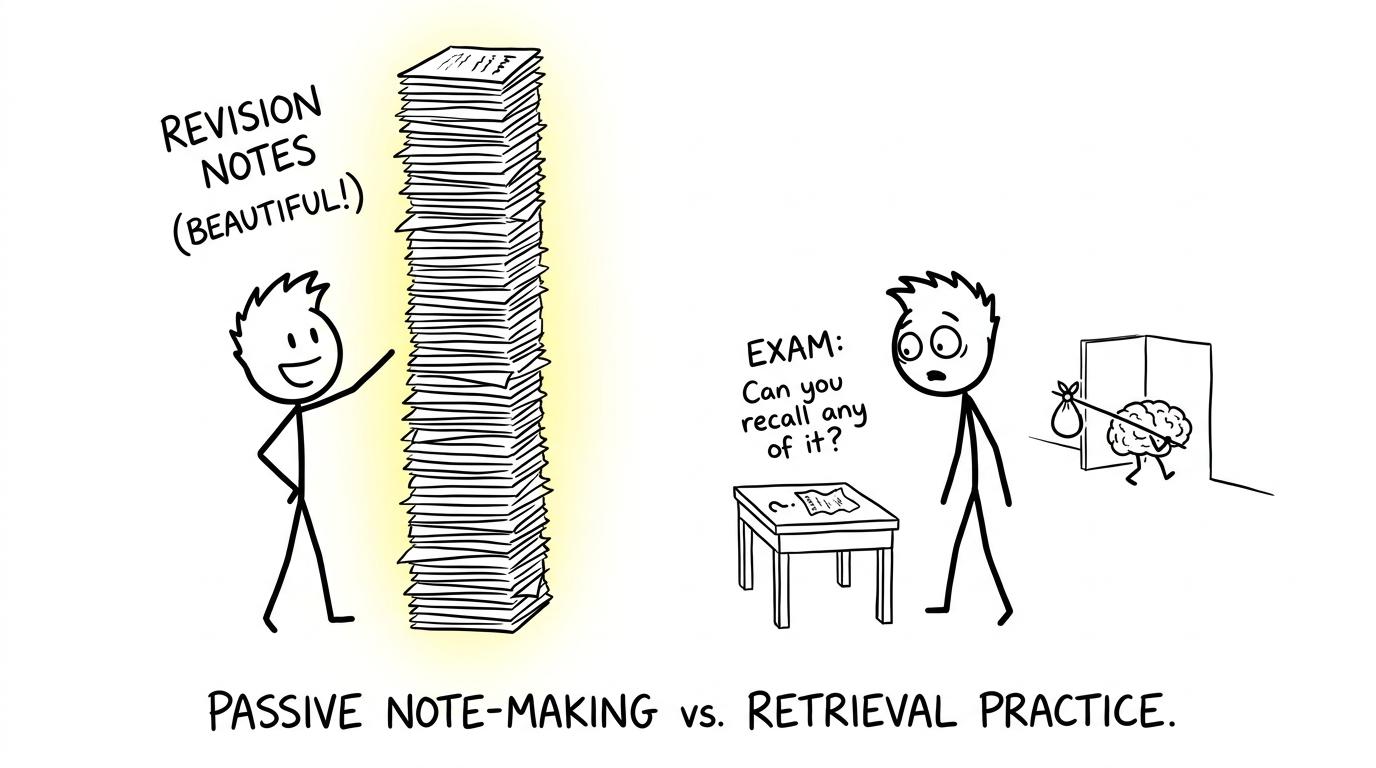 A huge tower of beautiful notes meets an exam paper asking whether anything can actually be recalled
How this applies to GCSE maths revision
Maths is not primarily a note-copying subject. You need some concise records, formulae, definitions, diagrams, method prompts and common errors, but marks are earned by solving problems.
A productive maths session therefore moves through four stages:
- Learn: use a revision lesson or video solution to understand one method.
- Compress: record only the decisions and steps you are likely to forget.
- Practise: answer questions without following the notes line by line.
- Check: use solutions or a mark scheme, record the cause of each error and try again later.
The recommended order for learning GCSE maths topics can help you choose a sensible starting point. Once individual topics are secure, move towards timed questions and papers.
For instance, Edexcel GCSE maths past papers let you practise under realistic conditions and inspect how marks are awarded. Students following AQA, OCR, Eduqas, WJEC or CCEA should select the corresponding board from the main GCSE revision hub.
Past papers should not be used as reading material. Attempt them, mark them and revisit the questions that exposed a gap. The guide to using GCSE past papers properly explains how to diagnose mistakes instead of merely recording a total mark.
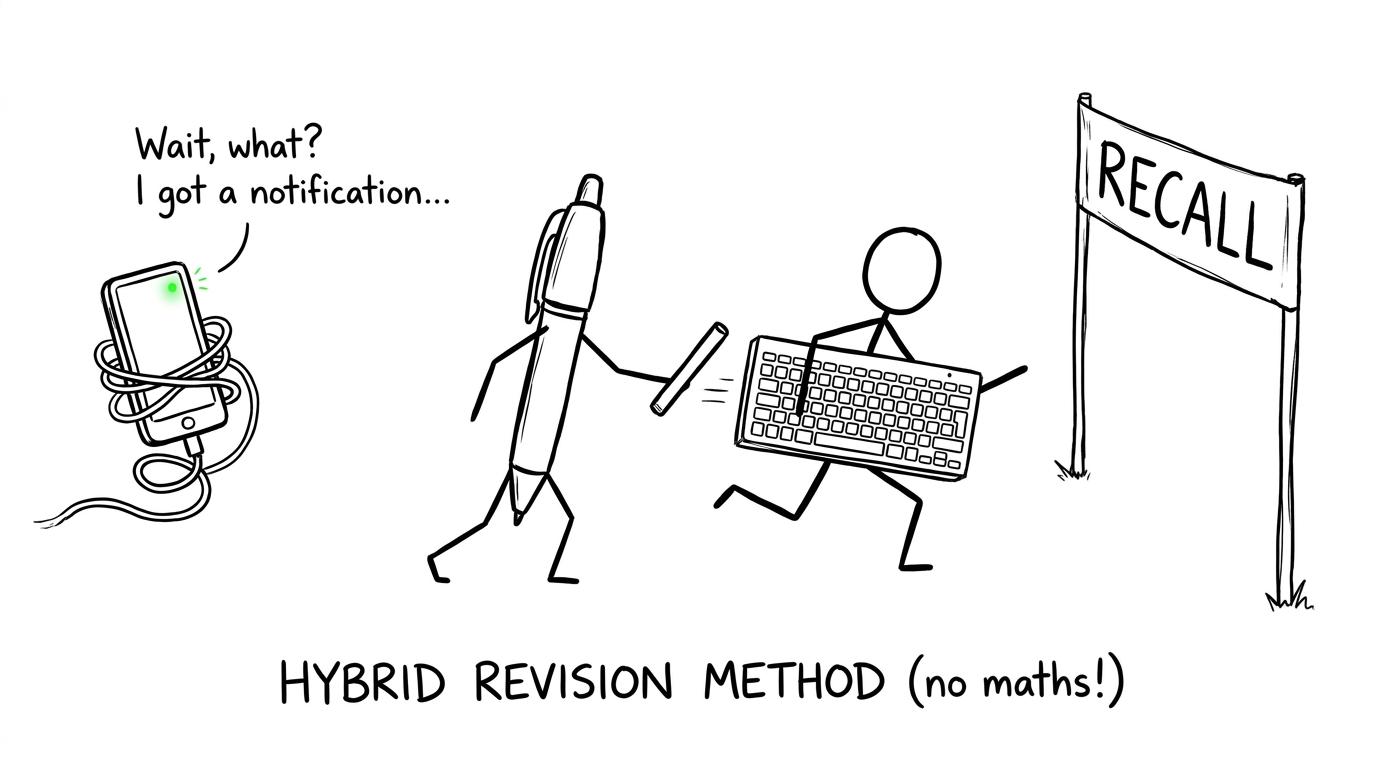 A pen and keyboard running a relay race towards recall while a distracted phone gets tangled up
Common mistakes with typed and handwritten notes
Making notes too complete
A beautiful set of notes can become a hiding place from difficult practice. If producing the notes consumes most of the session, reduce them to prompts and begin testing yourself sooner.
Copying without changing the information
Switching a paragraph from screen to paper does not guarantee deeper processing. Summarise, organise, question or explain the material instead.
Mistaking recognition for recall
Information can look familiar while you read it but disappear when the page is closed. Familiarity feels fluent; an examination requires independent retrieval and application.
Reviewing immediately but never later
Recalling something seconds after reading it mainly shows that it remains in working memory. Revisit it after a delay and across several sessions. Spacing makes retrieval less comfortable, but more informative.
Ignoring feedback
Retrieval without checking can reinforce an incorrect definition or method. Use trusted notes, solutions and mark schemes to correct your response. When preparing for maths papers, it is wise to start past-paper practice while there is still time to fix gaps.
Choosing a method because it looks productive
Colour coding, formatting and page design can support organisation, but they are not evidence that learning has occurred. Judge a method by what you can recall and apply later.
Make the method serve the memory
Handwriting has a small average advantage in current note-taking research, but it is not magic. Typing is quick and flexible, but speed can encourage shallow copying. The strongest approach gives each tool a defined purpose and then moves beyond notes altogether.
Handwrite to slow down and select. Type to organise and search. Retrieve to strengthen memory. Practise to turn knowledge into marks.
For GCSE maths, begin with the free MathsGenie GCSE revision resources. Choose your exam board and tier, learn a topic through revision lessons, test it with practice questions and mini tests, then build exam confidence with past papers, predicted papers, mark schemes and video solutions. Your notes are the map. The questions tell you whether you can make the journey.