Typing vs Handwriting Notes for GCSE Business
Typing vs handwriting notes GCSE Business: learn what memory research suggests, when each method helps, and a practical revision routine for better recall.
A page of immaculate notes can feel reassuring. The headings line up, the colours make sense and every definition is safely recorded. Yet when the notes are closed, the mind sometimes goes quiet. That is the real issue behind typing vs handwriting notes GCSE Business students need to consider: not which method produces the neatest pages, but which one helps you remember and use knowledge in an exam.
The short answer is that handwriting appears to have a small overall advantage for learning, especially when it forces you to select, organise and rephrase ideas. Typing is faster and easier to edit, so it can be better for collecting information and maintaining an organised master document. Neither method, however, is as important as what happens afterwards. Notes begin learning; retrieval practice, application and exam questions make it stick.
The quick decision checklist
Choose handwriting when you need to:
- condense a lesson into essential ideas;
- explain a concept in your own words;
- draw links between causes, consequences and business decisions;
- create short recall prompts;
- plan an analytical or evaluative response.
Choose typing when you need to:
- organise a large amount of specification content;
- search, rearrange or update your notes;
- combine information from several lessons;
- create reusable question banks;
- type more comfortably or accessibly than you write.
Whichever method you choose, finish by closing the notes and recalling the content without help. That final step matters more than whether your first draft appeared on paper or a screen.
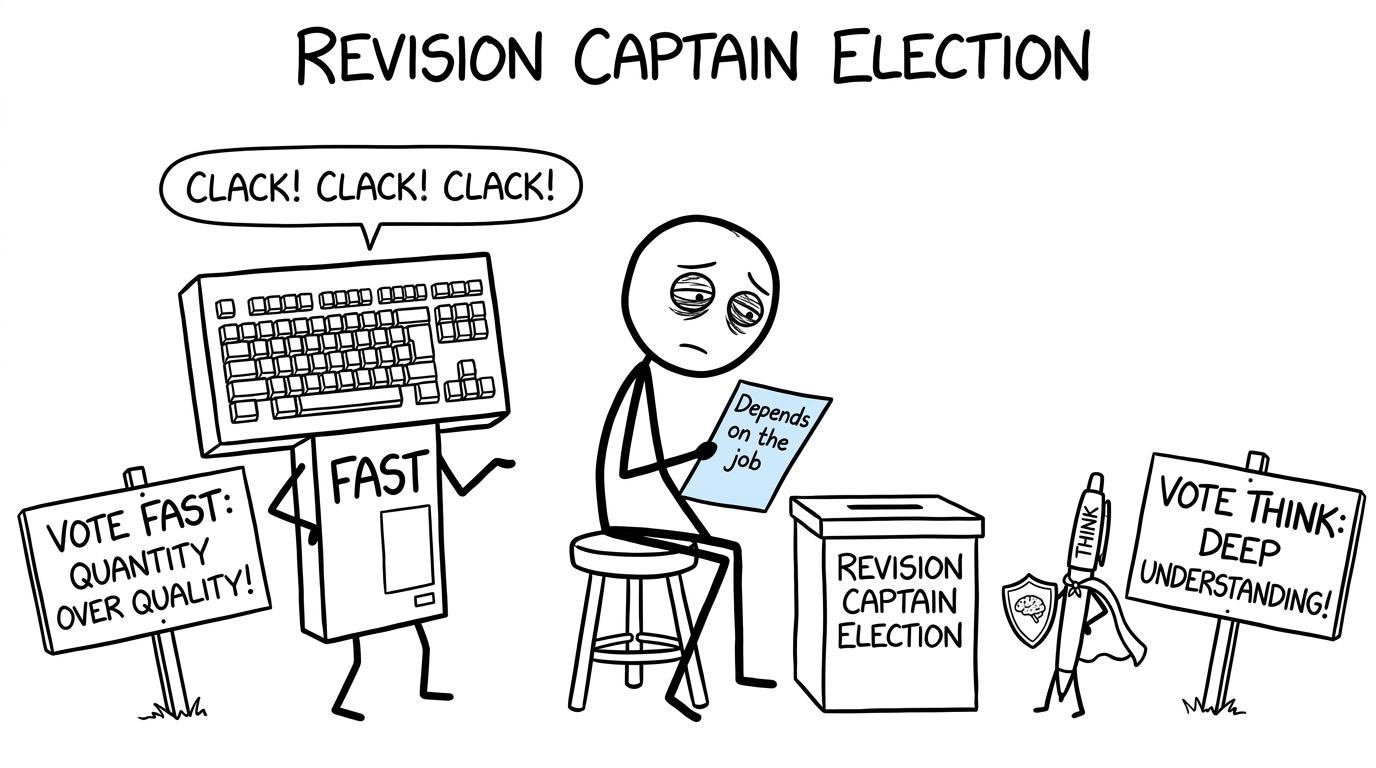 A GCSE student choosing between a fast keyboard and a thoughtful pen
What research says about handwriting and recall
The strongest recent synthesis is a 2024 meta-analysis of studies involving university students. Across 24 studies, students who took and reviewed handwritten lecture notes achieved better assessment results on average than those who typed, although typists recorded substantially more information.
That distinction is useful. More words are not automatically more learning.
A slower writer cannot capture every sentence, so they often have to decide what matters, connect it to prior knowledge and express it more briefly. These mental decisions can support encoding, the process through which new information becomes a memory. A fast typist may instead copy language almost word for word without fully processing it.
The evidence should not be exaggerated. The reported handwriting advantage was modest, and much of the research concerns university lectures rather than GCSE Business classrooms. Other studies have found little or no meaningful difference between handwriting and typing. There is not enough direct evidence to promise that changing pens will transform a GCSE grade.
The sensible conclusion is narrower: handwriting can encourage deeper processing, but the benefit depends on how you take notes. Thoughtful typed notes can outperform mindlessly copied handwritten ones.
How memory actually makes notes stick
Memory is not a filing cabinet where information remains untouched after being stored. Access changes it. Each serious attempt to retrieve an idea makes that route easier to use again.
This is why reading a definition repeatedly may create familiarity without dependable recall. The words look obvious while they are visible. In the exam, however, you must produce and apply the idea without the page in front of you.
Research reviews on retrieval practice consistently support making an active attempt to remember. Feedback matters too, because confidently recalling an inaccurate definition can strengthen a misconception. A dependable revision cycle is therefore:
- learn or review a small section;
- close the notes;
- retrieve the key ideas;
- check for omissions and inaccuracies;
- correct the response;
- retrieve it again after a delay.
This is equally important in maths. Looking at a completed method can feel fluent, but fluency is not the same as being able to begin an unfamiliar question. MathsGenie's guide to stopping forgotten GCSE maths content applies the same principle through active recall, spaced practice and exam questions.
Why GCSE Business needs more than factual notes
GCSE Business is not simply a memory test. Across GCSE specifications, the assessment objectives cover knowledge and understanding, application, and analysis and evaluation. For AQA and Edexcel, for example, the overall weightings are 35%35\%35% for AO1, 35%35\%35% for AO2 and 30%30\%30% for AO3.
That means knowing a definition is necessary but insufficient. You must also use business information in context, trace consequences, compare choices and support judgements.
Your notes should reflect those demands. For each important concept, include prompts that make you think about:
- what the term means;
- which businesses or situations it could affect;
- why its impact may be positive or negative;
- which factors could change the outcome;
- what evidence would support a judgement.
A page that only stores definitions mainly prepares you for one part of the course. A page built around questions prepares you to retrieve, apply and reason.
The same idea explains why GCSE past papers matter in maths. Revision becomes exam-ready when knowledge is used under the conditions in which it will eventually be assessed.
The best approach is usually a hybrid system
The typing versus handwriting debate sounds as if one tool must win. In practice, they are good at different jobs.
Type the library
Create a concise digital master document arranged around your exam board's specification. Use it to store accurate definitions, teacher corrections and links between topics. Its purpose is organisation, not repeated passive reading.
Keep it lean. If the document becomes a transcript of every lesson, finding an idea may be easy while remembering it remains difficult.
Handwrite the thinking
Use paper for the work that requires selection and recall. Reduce a digital section to a small summary, sketch a cause-and-consequence chain, plan an argument or write everything you can remember before checking.
Do not copy the master document. Transformation is the useful part. If you reduce a long section to a handful of connected ideas, you have made decisions about meaning.
Test without either
Eventually, remove both tools. Answer a recall question, annotate a business case, plan an extended response or complete an exam question without looking. Then use your notes to diagnose what was missing.
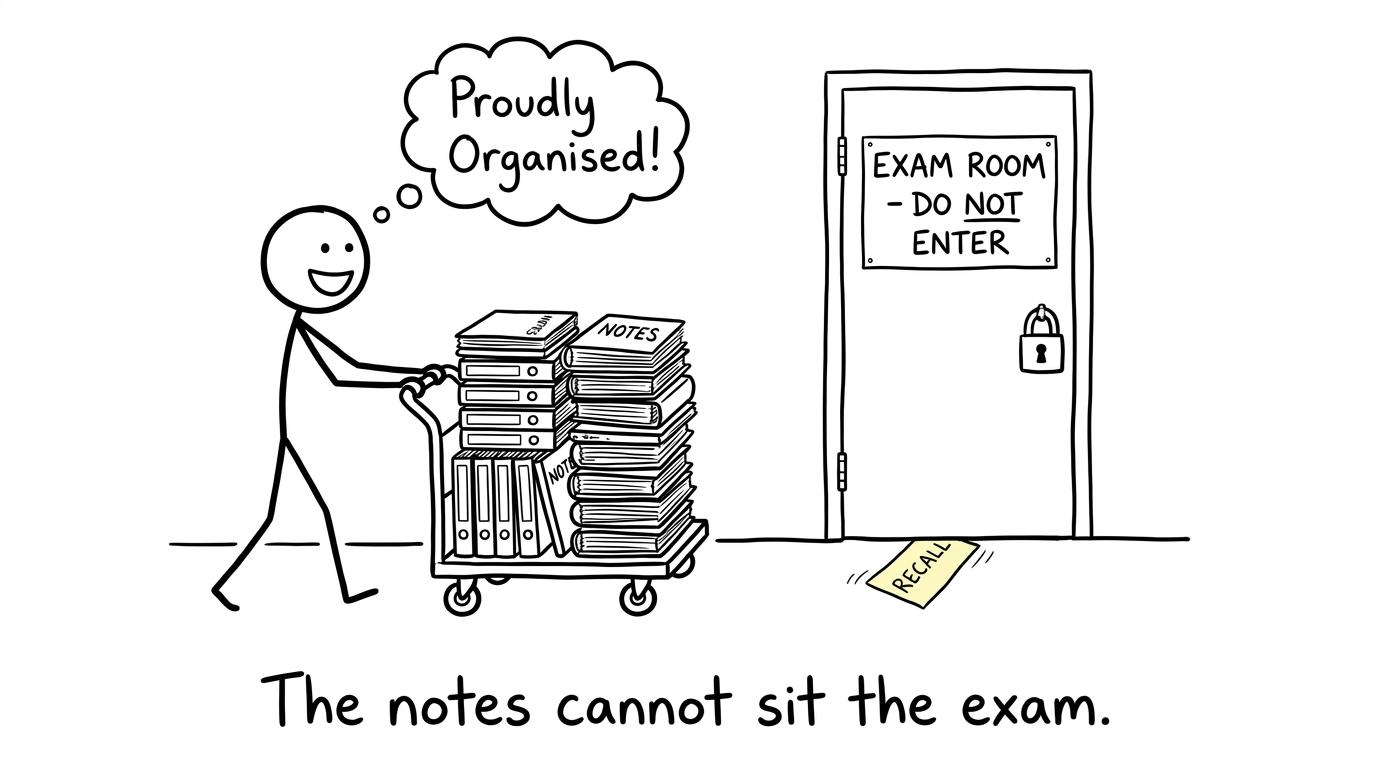 A trolley of beautiful notes stopped outside the exam while recall slips through
A revision routine that works with either method
Begin with one narrow area of the specification rather than an entire unit. Spend a short period reading your existing notes and checking that the content is accurate. Then put the source away.
Write or type a summary from memory. Add a few questions that require application or explanation, not just definitions. Check your attempt against your class materials and correct it in a different colour or clearly labelled section.
Return to the same topic on later days. Spacing creates useful difficulty: retrieval feels less comfortable after a delay, but that effort gives you better evidence about what is available in memory.
A practical pattern is:
- first session: understand, condense and retrieve;
- next session: retrieve before opening notes;
- later session: apply the knowledge to an unfamiliar context;
- final session: complete a timed exam question and mark it.
If you are balancing Business with maths, the 20-minute GCSE maths revision routine uses a similar learn, practise, mark and improve structure. A realistic GCSE revision timetable can help you space these short sessions across the week.
Make your notes generate questions
A strong set of notes should become smaller over time because more of the knowledge is moving into memory. It should also produce questions.
Turn headings into prompts. Replace visible definitions with question cards. Convert a list of advantages into a request to compare their importance in a particular context. After marking, record only the missing idea or reasoning step rather than rewriting the entire topic.
This creates a useful loop:
notes to retrieval to feedback to targeted practice to delayed re-test
MathsGenie's GCSE maths revision hub is organised around the same movement from revision lessons to practice questions and papers. Short GCSE maths mini tests are particularly useful when you need a quick check rather than another long revision session.
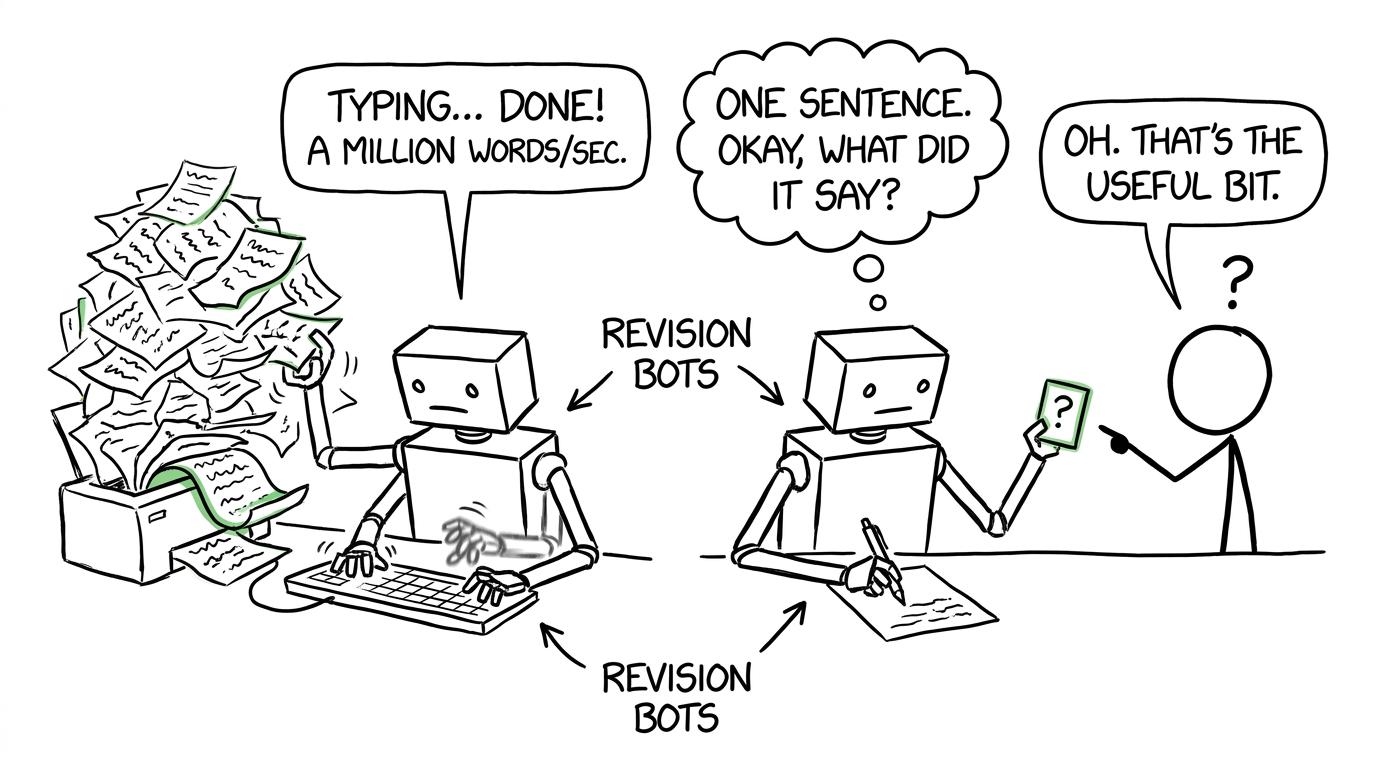 A typing robot discovers that the small self-quiz is the useful part
Common mistakes when making GCSE Business notes
Copying without making decisions
Copying may keep your hands busy while asking very little of memory. Pause regularly and summarise without looking. If you cannot explain a section simply, return to it before adding more notes.
Confusing neatness with learning
Clear notes are helpful, but decorative work can absorb time without improving recall. Use colour only when it communicates a distinction, such as knowledge, application and analysis.
Making notes but never answering questions
The exam rewards performance, not the volume of your folder. Move to recall and exam questions early enough to expose gaps.
Using the same method for every task
Typing may suit an organised specification checklist; handwriting may suit a concise argument plan. Accessibility and comfort also matter. Choose according to the cognitive job, not a universal rule.
Checking answers too quickly
Looking at notes before making a genuine retrieval attempt removes the very difficulty that strengthens learning. Commit to an answer first, then check it carefully.
Ignoring feedback
Mark schemes reveal the difference between a plausible answer and a mark-worthy one. Maths students can use MathsGenie's guide to using GCSE mark schemes effectively, then identify recurring gaps with the weakest-topics revision method.
Choose the method that leads to action
Handwriting has a small research-backed edge in many note-taking studies, probably because its slower pace can encourage selection and processing. Typing remains excellent for accessible, searchable organisation. But neither medium can replace retrieval, feedback, spacing and exam practice.
So do not ask only, "Which notes should I make?" Ask, "What will these notes make me do tomorrow?"
For GCSE Business, build concise notes that lead into recall, contextual application and justified decisions. For maths, use MathsGenie's free revision lessons and practice questions to rebuild weak topics, then test them with past papers, predicted papers, mini tests, mark schemes and video solutions. Start with one topic today, close the notes and find out what genuinely remains.