Typing Answers Under a Timer: GCSE Further Maths
Typing answers under timer GCSE Further Maths practice can sharpen recall and structure, but not handwriting fluency. Build a smarter hybrid routine today.
A timer starts. You know the mathematics, but your answer develops slowly: one line is rewritten, notation takes longer than expected, and the final conclusion arrives just after time runs out.
If you have searched for typing answers under timer GCSE Further Maths, the short answer is yes: timed typing can improve retrieval speed, answer planning and concise mathematical structure. But it will not automatically make you faster at writing algebra, drawing diagrams or laying out working by hand. Unless you are approved to use a word processor in the exam, typing should support your revision rather than replace realistic handwritten practice.
That distinction matters. Speed is not one skill. It is several smaller skills working together.
The quick verdict
Use this checklist to decide whether timed typed practice belongs in your revision:
- Use it for retrieval: recalling methods, identities and the next step without notes.
- Use it for structure: planning proofs, explanations and multi-stage solutions.
- Use it for diagnosis: discovering whether hesitation comes from weak knowledge or slow writing.
- Do not use it as your only practice: most students still need handwritten exam fluency.
- Match your real arrangement: if you will type in the exam, practise with the approved setup; if you will handwrite, complete most timed papers by hand.
- Always mark afterwards: speed without feedback can make mistakes more automatic.
Start with questions from the AQA GCSE Further Maths past papers, where papers, mark schemes and solutions can be used together.
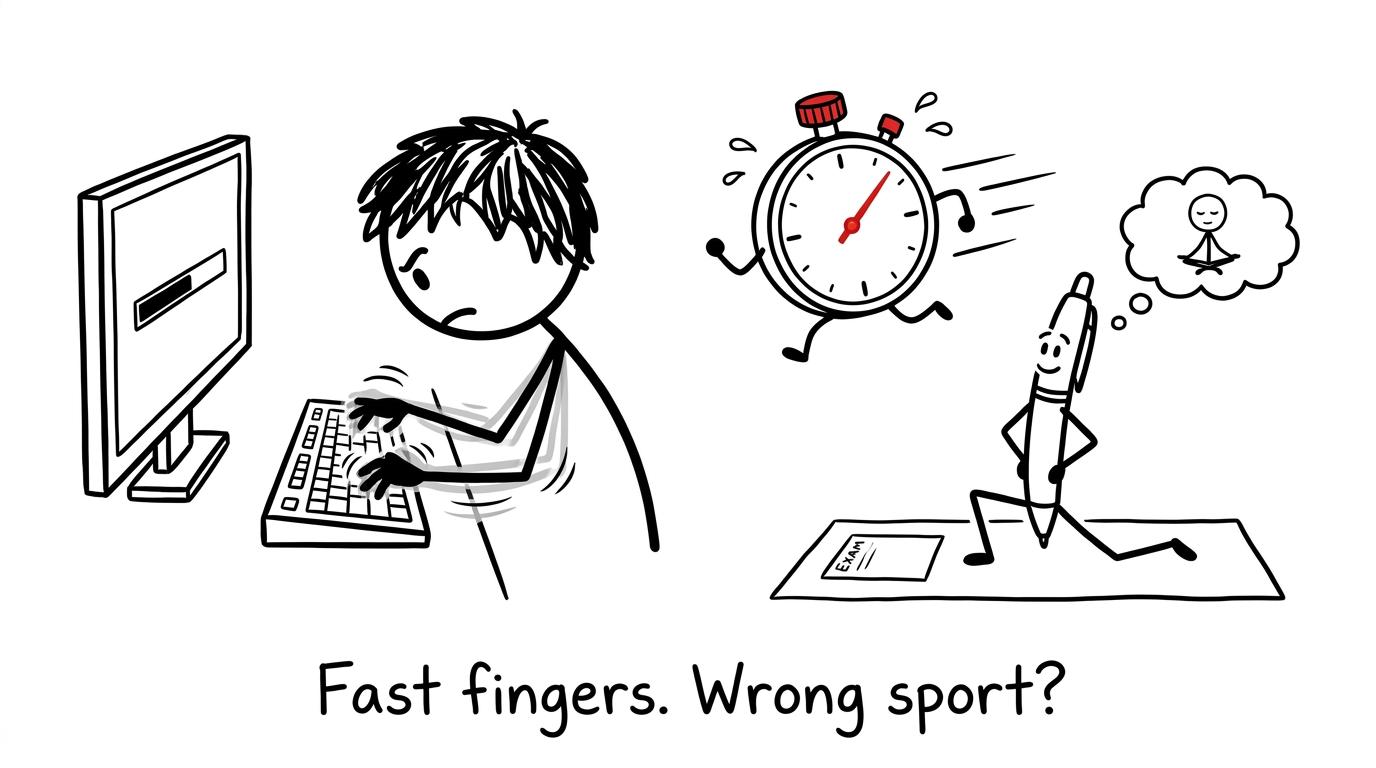 A keyboard races a stopwatch while a pen prepares for the real event
What timed typing can genuinely improve
Timed practice is useful because it forces decisions. You must recognise the topic, retrieve a method and organise a response before the clock expires. Research on retrieval practice consistently supports testing yourself rather than relying only on rereading, especially when feedback follows the attempt.
However, research comparing typing with handwriting often concerns lecture notes, memory or language learning rather than GCSE Further Maths solutions. It cannot prove that typing algebra under a timer will directly improve handwritten examination speed. The sensible conclusion is narrower: timed typing can train the mental parts of performance, while the physical exam format must be practised separately.
Faster retrieval of methods
A student may appear to write slowly when the real delay happens before the pen moves. They are deciding whether to factorise, use a matrix, differentiate or form an equation.
Typing short method outlines under time pressure can reveal this delay. If you cannot quickly state the first valid step, the problem is probably not handwriting speed. It is recognition or recall.
This makes timed typing particularly useful early in revision. Use a short block to answer prompts such as:
- Which method is required?
- What information should be written first?
- Which result needs justification?
- How will the conclusion answer the question?
These are planning prompts, not substitutes for complete solutions.
Cleaner answer structure
Further Maths questions can require chains of reasoning. A strong response usually has a visible sequence:
- state or select the relevant method;
- substitute the given information;
- show the essential transformations;
- preserve accurate notation;
- finish with an explicit conclusion.
Typing makes editing easy, so it can help you notice where an argument jumps over a necessary step. It is valuable for proof, function, matrix and calculus questions where the route matters as much as the final result.
Yet easy editing can also hide poor first-pass organisation. During timed typed practice, avoid endlessly polishing sentences. Aim for a clear answer that could have been produced once, from top to bottom.
More honest pacing information
A timer turns a vague feeling of being slow into evidence. Track:
attempt rate=marks attemptedmarks available×100%\text{attempt rate}=\frac{\text{marks attempted}}{\text{marks available}}\times 100\%attempt rate=marks availablemarks attempted×100%and
mark rate=marks earnedminutes used.\text{mark rate}=\frac{\text{marks earned}}{\text{minutes used}}.mark rate=minutes usedmarks earned.The first measure shows whether you reached enough of the paper. The second includes accuracy, which matters more than raw typing speed. Producing many lines quickly is not progress if the mathematical notation is ambiguous or the method is wrong.
What typing does not train well
The exam does not reward fingers for moving quickly. It rewards correct mathematics communicated in an acceptable form.
Handwritten algebra and notation
Keyboard fluency does not rehearse the physical spacing needed for fractions, powers, matrices, graphs or multi-line algebra. Typing something like dydx\frac{dy}{dx}dxdy may require an equation editor or notation commands, whereas writing it by hand is a different action.
If your examination will be handwritten, you must practise:
- keeping equals signs aligned;
- writing indices and roots unambiguously;
- separating rough work from the final method;
- drawing and labelling diagrams;
- fitting a solution into the available space;
- writing quickly while remaining legible.
Timed handwritten sections and full papers therefore remain essential. The guide to starting GCSE past papers explains how to move from small sections towards complete exam-condition practice.
Exam-format transfer
Practice tends to transfer best when its demands resemble the final task. A typed response and a handwritten response share mathematical retrieval, but they do not share every physical or visual demand.
That is why a hybrid method is stronger than choosing one format for everything. Typing can isolate thought and structure. Handwriting then converts that thinking into the format most candidates will use on exam day.
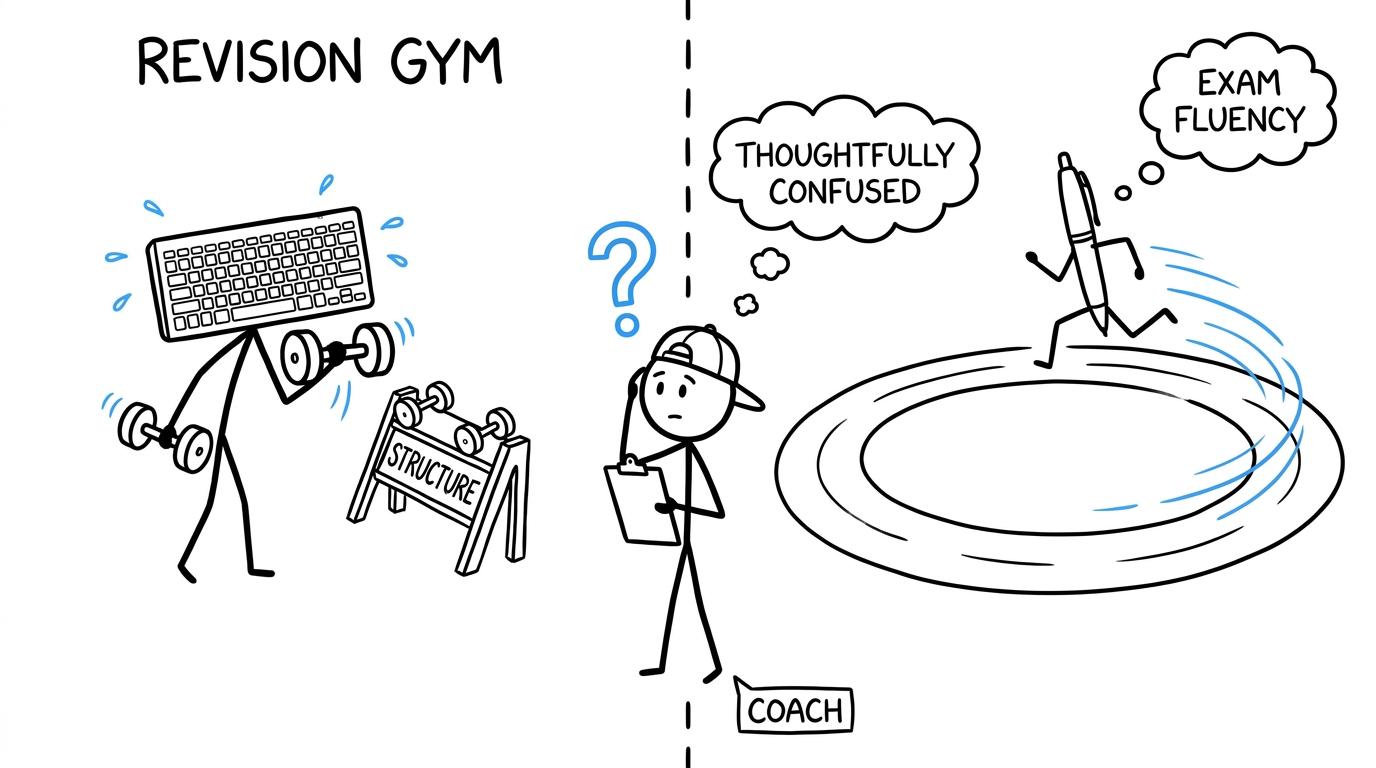 A keyboard trains structure while a pen runs exam-fluency laps
A practical hybrid routine
A useful session should separate learning, speed and exam realism rather than muddling all three together.
Begin without the timer
First make sure the method is secure. Use a MathsGenie revision lesson, video solution or practice set, then complete questions accurately without artificial pressure. Timing an unfamiliar technique often trains rushing rather than fluency.
If your GCSE foundations need checking, the GCSE topics by exam board and tier can help you identify the algebra, graphs and geometry that support Further Maths.
Type a short timed planning set
Choose several unseen questions. Give yourself a brief, fixed period to type the intended method and answer structure for each one. Include the equations or notation needed to make the plan mathematically meaningful, but do not turn this into a typing-speed test.
Afterwards, ask:
- Did I recognise the topic promptly?
- Was the first step valid?
- Did I include enough reasoning for the available marks?
- Did I reach a conclusion rather than stopping at working?
Complete equivalent questions by hand
Now use different questions at a similar level. Write full answers under time pressure. Using fresh questions matters because repeating the same set can create an illusion of speed: you may remember the route rather than retrieve it independently.
For shorter timed blocks, the structure behind GCSE Maths mini tests is useful even when your chosen questions come from a Further Maths paper. Short tests build pacing without the fatigue of a complete paper.
Mark, classify and repair
Use the mark scheme and, where available, video solutions. Put each lost mark into one of four categories:
- knowledge;
- method selection;
- mathematical communication;
- time management.
Then repair the cause. A knowledge gap needs a revision lesson and practice questions. Weak structure may need another typed planning set. Slow handwriting needs handwritten repetition. Poor pacing needs a timed section or full paper.
The twenty-minute GCSE Maths revision routine offers a compact learn, practise and mark cycle for busy days.
How to test whether typing is helping you
Do not judge the method by whether it feels efficient. Run a simple comparison over several sessions.
Use equivalent unseen question sets and record:
| Measure | What improvement looks like |
|---|---|
| Time before the first valid step | It becomes shorter |
| Marks attempted | It increases without reckless guessing |
| Method and reasoning marks | They rise or become more consistent |
| Notation errors | They decrease |
| Handwritten completion | It improves after typed planning practice |
Keep the question difficulty and timing reasonably similar. Alternate typed-planning sessions with fully handwritten sessions, then compare the handwritten results. The important outcome is not whether your typed answers become faster. It is whether your real exam performance improves.
A structured plan helps you repeat this comparison consistently. MathsGenie’s one-month GCSE Maths revision plan shows how timed work, topic repair and paper practice can fit together.
Word processors and access arrangements
Typing at home does not, by itself, mean you may type in a public examination. Under JCQ rules, a word processor must normally reflect the candidate’s established way of working within the centre and be appropriate to their needs. It cannot simply be granted because typing feels preferable or faster.
Arrangements are decided by the school or college under the current regulations. Speak to your SENCO, access arrangements co-ordinator or exams officer well before the examination series. Rules and individual circumstances can change, so rely on your centre rather than assumptions from online advice.
Where a word processor is approved, examination settings are controlled. Features such as predictive text and automatic spelling or grammar checking are normally disabled, and the device must not perform the mathematical skills being assessed. Maths can also require a mixed approach, with some work typed and diagrams or shorter responses handwritten, depending on the approved arrangement and centre instructions.
If you will type in the real assessment, practise the exact routines your centre permits: mathematical input, saving, page identification, moving between the question paper and screen, and attaching any handwritten working. Keyboard speed alone is not enough.
Common mistakes with timed typed practice
Measuring words instead of marks
A long answer can still omit the decisive equation or conclusion. Compare your response with the mark scheme, not a word count.
Typing only comfortable topics
Speed on familiar algebra says little about your response to an unfamiliar proof or matrix question. Use mixed, unseen material from the AQA GCSE Further Maths paper collection.
Starting the timer too early
Pressure cannot repair an insecure method. Learn accurately first, then add a gentle time limit, and finally use full exam conditions.
Never transferring back to paper
If you will handwrite the examination, every typed session should eventually lead to handwritten questions. Otherwise, you may improve planning without improving execution.
Marking only the final answer
GCSE and Level 222 mathematics assessments reward method, reasoning and communication where the mark scheme specifies them. Look for missing substitutions, unjustified jumps and unclear notation as well as incorrect final results.
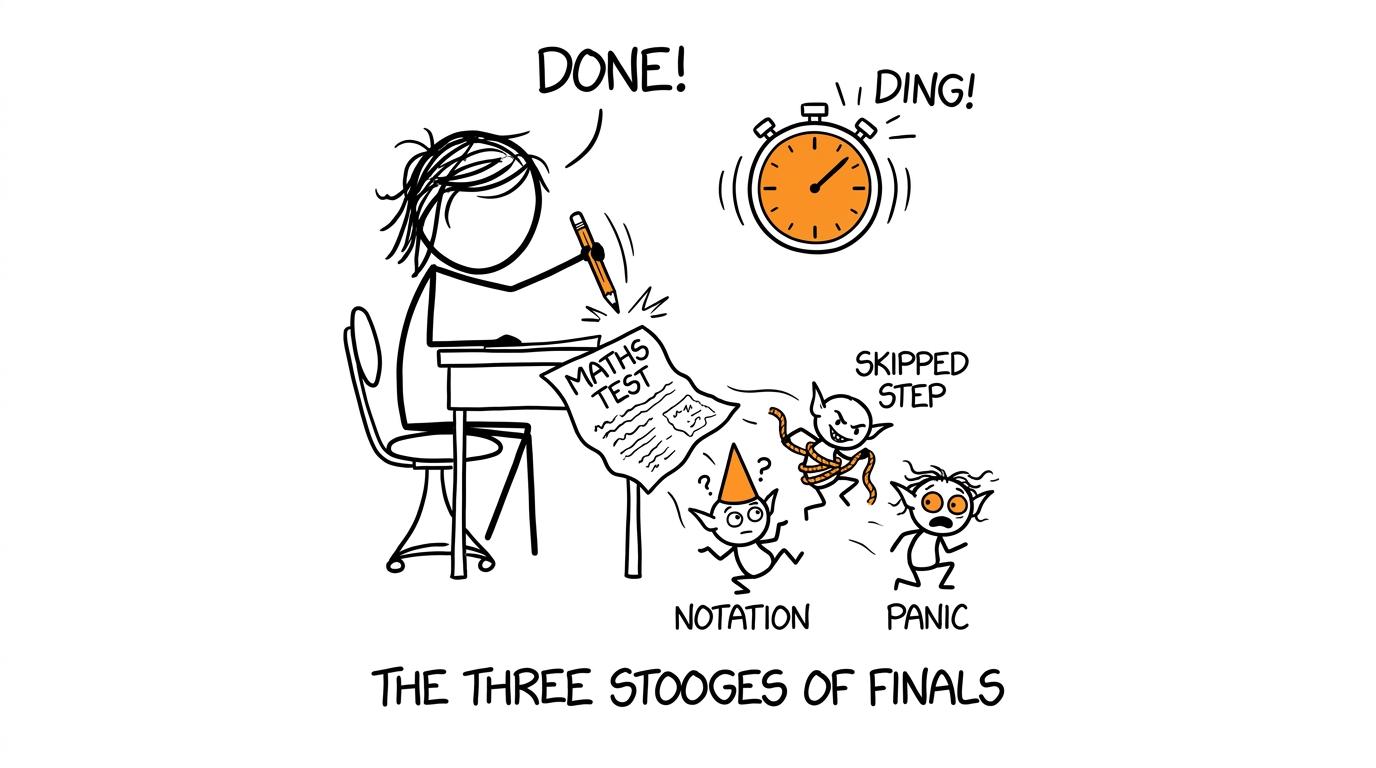 A timer exposes notation, skipped-step and panic gremlins
Build speed that survives the exam
Timed typing can be a sharp diagnostic tool. It can improve recall, reduce hesitation and teach you to organise mathematical arguments economically. But it is not a complete simulation of a handwritten Further Maths paper.
The strongest routine is simple: learn the method, type short plans under a timer, complete fresh answers by hand, mark them carefully and repair the specific cause of every lost mark. As the exam approaches, increase the proportion of work completed in your real exam format.
MathsGenie gives you the full revision loop for free: revision lessons when a method is uncertain, practice questions and mini tests for fluency, and past papers, predicted papers, mark schemes and video solutions for exam realism. Start with the AQA Further Maths past papers, choose one manageable timed section, and let the evidence tell you what to practise next.