Typing Answers Under Timer GCSE Arabic: Does It Help?
Typing answers under timer GCSE Arabic can improve planning speed, but handwriting matters. Build faster, clearer responses with this practical revision plan.
The timer starts. You know the vocabulary, you recognise the topic and several useful sentences are already forming in your head. Yet producing a complete answer still feels slow. This is the problem behind typing answers under timer GCSE Arabic practice: can a keyboard help you organise ideas quickly enough to improve your performance in the written exam?
The short answer is yes, but only partly. Timed typing can strengthen recall, planning, response structure and decision-making under pressure. It does not automatically improve the handwriting speed, Arabic letter formation or physical stamina required in a handwritten examination. Unless you have an approved arrangement that allows you to type, the strongest approach is a hybrid one: type to train thought, then handwrite to train performance.
The quick answer and revision checklist
Use timed typed practice to improve:
- rapid retrieval of vocabulary and sentence structures;
- coverage of every bullet point;
- planning before writing;
- paragraph organisation;
- decisions about tense, opinion and justification;
- confidence when the clock is visible.
Do not expect it to replace:
- handwritten Arabic practice;
- accurate spelling without digital assistance;
- fluent joining and formation of letters;
- checking work on paper;
- full practice under your board's real examination conditions.
A reliable weekly balance is to complete several short typed drills, one handwritten answer and, when appropriate, a longer timed paper section. The principle is familiar from GCSE maths: learn a method, practise it, test it under pressure, mark it and repair the weakest part. The MathsGenie guide to using past papers properly explains that feedback loop clearly.
What timed typing actually trains
Speed in an Arabic writing examination is not one skill. It is a chain of smaller skills:
- understanding the task;
- selecting relevant vocabulary;
- recalling accurate grammatical structures;
- deciding which tense is required;
- arranging ideas logically;
- producing the Arabic script;
- checking that the response communicates what was intended.
Typing can accelerate the middle of this chain. Because many students can type more quickly than they handwrite, the keyboard reduces the physical effort of transcription. That leaves more attention available for choosing ideas and structuring the response.
This can be especially useful if you tend to stare at a blank page despite knowing the language. A short timer forces a decision. You stop searching for the perfect opening and begin assembling a response that covers the task.
Research comparing handwriting and typing does not establish that one method is universally superior. Findings vary according to the learner, task and outcome being measured. Typing practice tends to improve typed fluency, while handwriting contributes motor and visual information that can support letter and spelling learning. There is not strong direct evidence showing that typed timed answers alone improve handwritten GCSE Arabic performance.
That distinction matters. Practice often becomes specific to the conditions in which it happens.
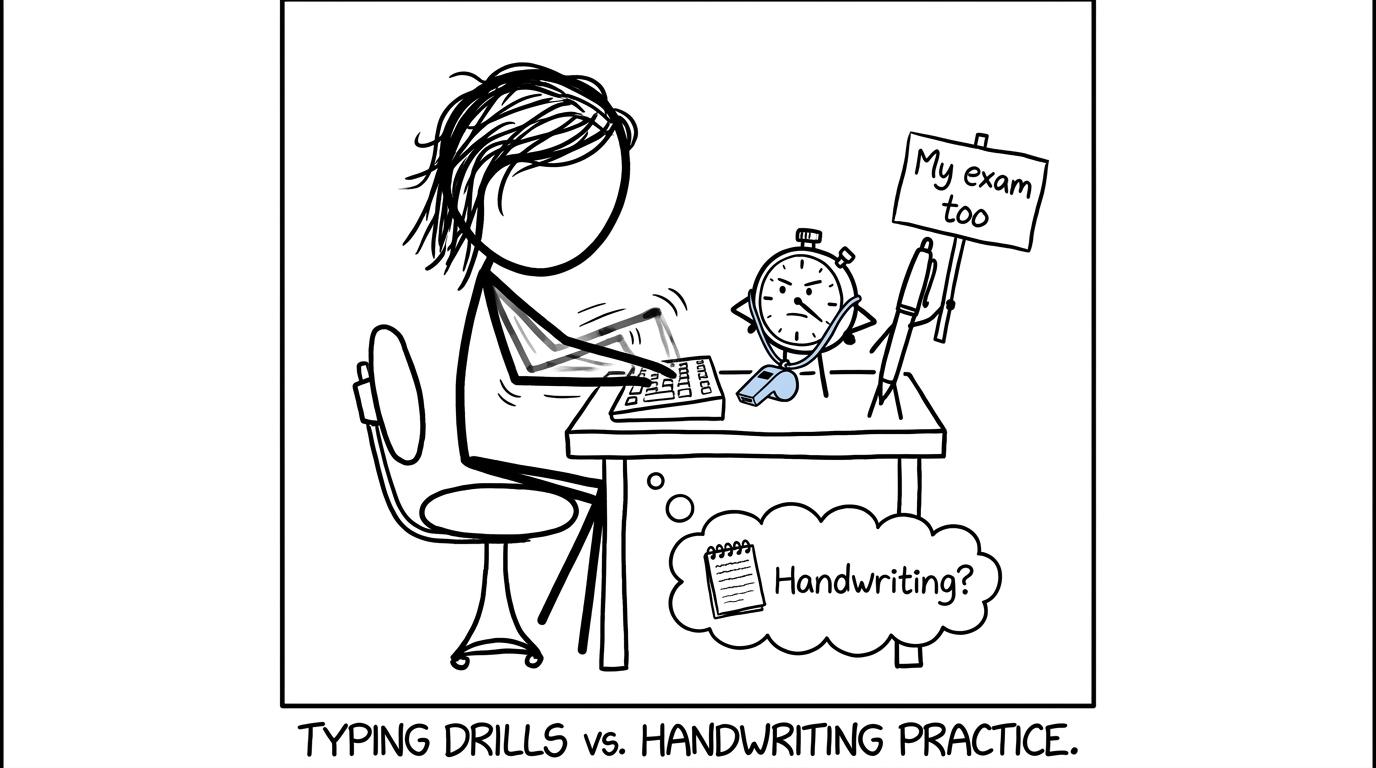 A stopwatch referees between a fast keyboard and the pen needed for the real exam
Why the timer can improve structure
A timer is useful because it turns a vague goal, “write faster”, into an observable process. It reveals where time disappears.
Perhaps you spend too long planning. Perhaps you produce an impressive first paragraph but miss the final bullet point. Perhaps the translation takes longer because you repeatedly rewrite difficult phrases. Without timing, these habits are easy to overlook.
Track three simple measures after each response:
Writing rate=words producedminutes used\text{Writing rate} = \frac{\text{words produced}}{\text{minutes used}}Writing rate=minutes usedwords produced Bullet coverage=bullet points answeredbullet points set\text{Bullet coverage} = \frac{\text{bullet points answered}}{\text{bullet points set}}Bullet coverage=bullet points setbullet points answered Accuracy rate=accurate checked featuresfeatures checked\text{Accuracy rate} = \frac{\text{accurate checked features}}{\text{features checked}}Accuracy rate=features checkedaccurate checked featuresWriting rate should never be considered alone. A faster answer that misses half the task is not an improvement. Look for a combination of better coverage, clear communication and increasing accuracy.
This is the same reason a raw mark is not enough when reviewing maths. MathsGenie's advice on finding your weakest GCSE topics focuses on identifying the reason behind each lost mark. For Arabic, your categories might be vocabulary recall, tense, spelling, task coverage, structure or handwriting speed.
Match practice to the real GCSE Arabic paper
Your exact practice must reflect your specification. Check the qualification, tier and paper used by your school rather than relying on a generic online routine.
For the current Pearson Edexcel GCSE Arabic qualification, writing is Paper 444 and contributes 25%25\%25% of the qualification. The specification gives Foundation tier 111 hour 202020 minutes and Higher tier 111 hour 252525 minutes, with 606060 marks available. Foundation includes three open-response tasks and a translation, while Higher includes two open-response tasks and a translation.
Those details explain why speed is only useful when it is attached to task control. The examination assesses communication through written Arabic for different purposes and audiences. A large quantity of loosely relevant language is less valuable than a controlled response that addresses what was requested.
Before each drill, therefore, identify:
- the required content or bullet points;
- the intended purpose and audience;
- the time frame or tense suggested by each prompt;
- the approximate response length;
- time reserved for checking.
Do not import timings or question structures from another language, tier or exam board without checking them. Specifications change, and International GCSE Arabic is not the same qualification as UK GCSE Arabic.
The best hybrid practice routine
Begin without a timer
If you cannot yet build accurate sentences on the topic, time pressure arrives too early. Start by retrieving vocabulary, planning the bullet points and producing a careful answer without digital correction.
This is learning mode. Its purpose is accuracy and understanding, not speed. In maths, you would not race through a method you have not understood. The same principle applies here.
Add short typed sprints
Once the language is reasonably secure, type a response under a modest time limit. Disable predictive text, automatic translation and spelling assistance where possible. The goal is to retrieve Arabic independently, not to measure how efficiently software can repair it.
At the end, stop immediately. Record whether every part of the prompt was covered and highlight any place where you paused because vocabulary or grammar was missing.
Short drills work because they make repetition manageable. MathsGenie's GCSE revision resources include mini tests and shorter papers for the same reason: a compact task can expose a weakness without requiring a full examination session.
Rewrite selected responses by hand
Do not handwrite every typed answer. Choose the ones that revealed useful structures or repeated errors, then reproduce them on paper under a timer.
This second version tests whether the improvement transfers. Ask:
- Can you form and join the Arabic letters fluently?
- Does handwriting slow your recall?
- Do spelling errors appear when digital prompts disappear?
- Can you maintain legibility as the timer runs down?
- Can you leave enough time to check?
If typed speed rises while handwritten performance stays unchanged, the keyboard is training the wrong bottleneck. Shift more practice to paper.
Finish with authentic conditions
At regular intervals, complete a full writing paper or substantial section using the permitted equipment and correct time limit. No pausing. No online dictionary. No switching tabs.
Maths students already understand the value of this progression. The MathsGenie GCSE maths revision hub moves from lessons and topic questions towards mini tests, predicted papers and full past papers. Arabic practice should follow a similar path: build accuracy first, add controlled pressure, then rehearse the complete performance.
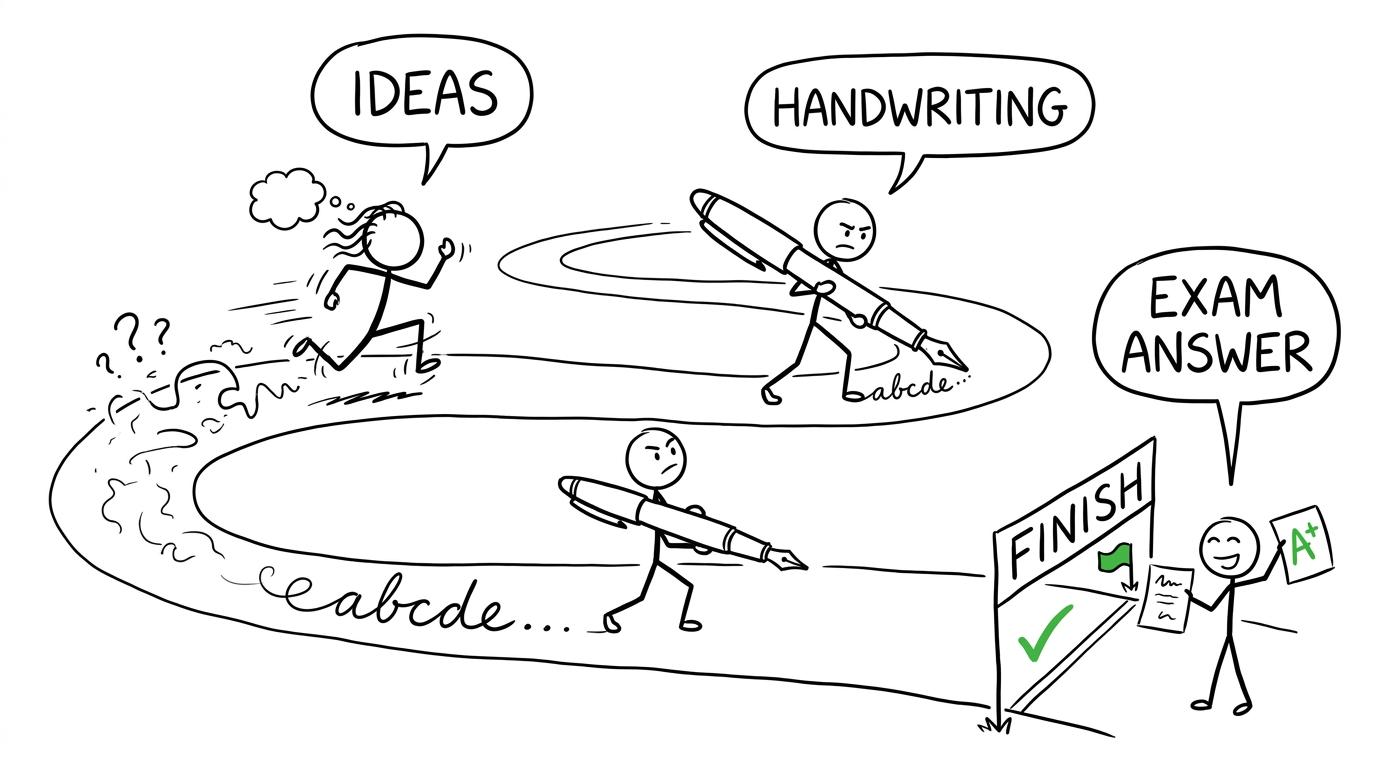 Two revision lanes for ideas and handwriting meet at the same exam-answer finish line
How to review a timed Arabic response
Finishing the answer is only the attempt. Improvement happens during the review.
Use the official assessment criteria and available mark scheme for your qualification. Then classify each problem:
- Knowledge: missing vocabulary or an unknown grammatical form.
- Accuracy: spelling, agreement, pronoun or verb errors.
- Communication: an idea is difficult to understand.
- Coverage: a required point is absent or incomplete.
- Timing: too much time was spent on one section.
- Transcription: handwriting or keyboard fluency interrupted the response.
Write one precise correction. “Revise Arabic” is too broad. “Practise recalling past-tense verbs for holiday topics” gives the next session a purpose.
MathsGenie's article on using GCSE mark schemes to improve uses the same idea: separate knowledge, method, communication and accuracy gaps instead of treating every error as identical.
A balanced weekly plan for maths students
Students preparing for several GCSEs need a routine that protects maths revision rather than allowing one subject to consume the week. A practical cycle could include:
- one untimed Arabic accuracy session;
- two short timed typed responses;
- one handwritten timed response;
- one review session using the assessment criteria;
- one longer examination-style task every few weeks.
Keep the sessions in a revision planner alongside maths. MathsGenie's GCSE maths revision timetable shows how to combine focused topic work, marking and timed practice without turning every evening into a full mock examination.
The same lesson applies to A Level students managing several demanding subjects: the usefulness of a session is determined less by its length than by the quality of its feedback. A short drill that identifies one recurring problem can be more valuable than an hour of comfortable copying.
Common mistakes with timed typed practice
Measuring only words per minute
More words do not necessarily mean better communication. Track task coverage and accuracy alongside speed.
Using autocorrect or translation tools
Digital support can conceal the exact spelling and recall problems that will appear in the examination. Keep assisted drafting separate from exam practice.
Never transferring to handwriting
If the real paper will be handwritten, paper practice is essential. Train the movement, legibility and stamina the assessment requires.
Starting the timer before accuracy exists
Time pressure can automate errors as easily as it automates good habits. Learn and correct the language first, then increase speed.
Repeating answers without reviewing them
Volume without feedback creates familiarity, not necessarily progress. Mark each response, identify one priority and retest it.
Practising generic prompts
Use tasks that match your exact qualification and tier. The command, response length and assessment focus should resemble the paper you will sit.
Turn speed into examination control
Typing answers under a timer can make GCSE Arabic ideas arrive faster and organise them more clearly. Its value is real but limited: it trains retrieval and structure better than it trains the handwritten act required by most students in the examination.
Use the keyboard as a rehearsal room, not as a substitute for the stage. Type to expose hesitation. Handwrite to test transfer. Complete authentic papers to build stamina. Then review every attempt until you know whether the lost time came from knowledge, accuracy, planning or transcription.
For your maths preparation, run the same disciplined loop with MathsGenie. Start from the free GCSE maths revision hub, use past papers with mark schemes and worked solutions, and build towards mini tests and predicted papers through the MathsGenie resources collection. Revision becomes calmer when every practice session tells you exactly what to do next.