

GCSE Mark Schemes: Improve Fast (Even in Biology)
GCSE mark schemes can boost your marks fast. Learn how to read method marks, spot patterns, and turn mistakes into a maths revision plan.
It usually starts the same way. You open a paper, you turn to the question you thought you knew, and the mark scheme stares back like a stranger. Your answer is “basically right”… but the marks don’t agree.
That moment matters, and not just for science. Learning to use GCSE mark schemes properly is one of the quickest ways to improve your results across every subject, including GCSE Biology and GCSE Maths. The skill isn’t “marking”. It’s learning how examiners reward evidence. Once you can see what evidence looks like, you stop guessing what to revise and start practising what earns marks.
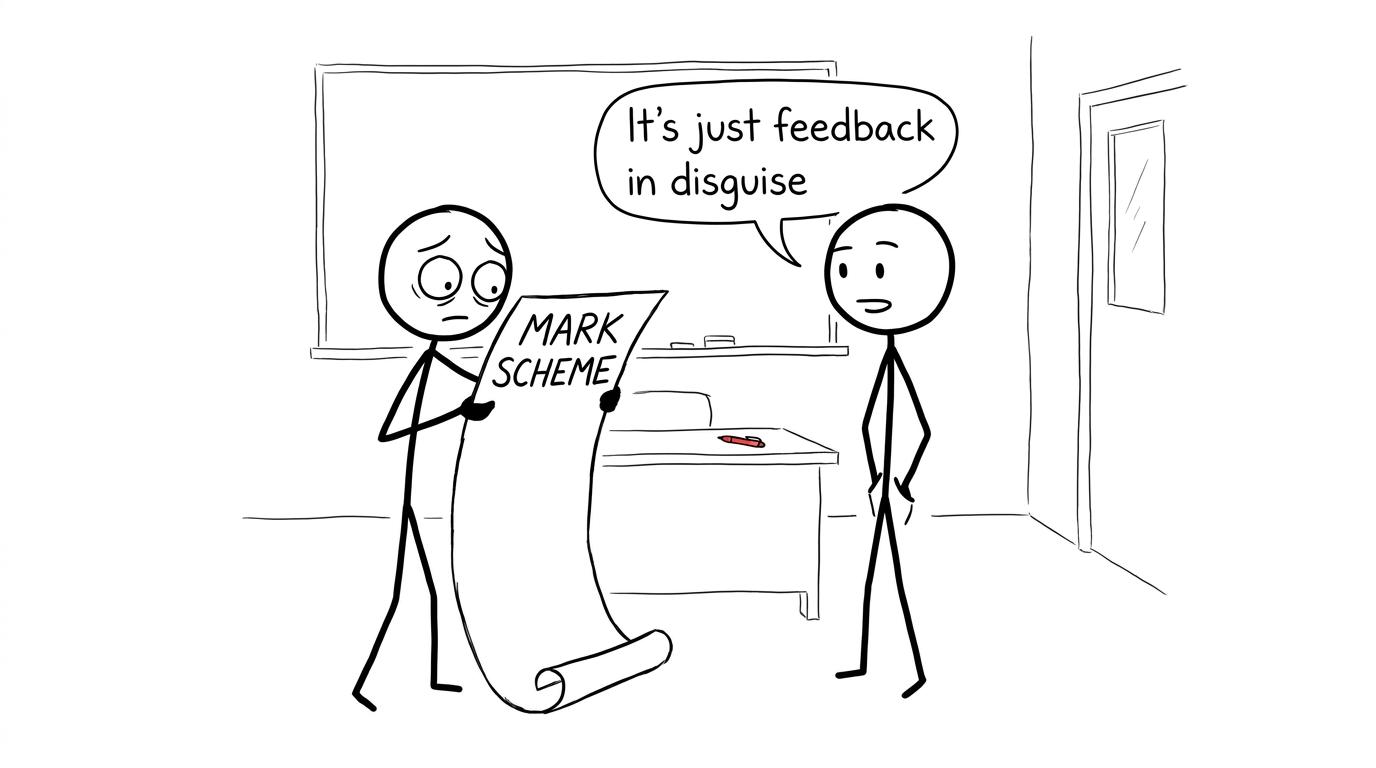 A student faces a huge mark scheme scroll
A quick checklist for using GCSE mark schemes
Keep this simple. When you finish a question, your mark scheme routine should answer five things:
- What did I do right (and should repeat)?
- What did I miss (a fact, a step, a keyword, a unit, a conclusion)?
- Were there method marks available?
- What’s the smallest change that would have gained the next mark?
- What topic should I practise next (and where can I practise it)?
For maths practice immediately after marking, YesGenie’s GCSE resources make this loop easy: start with GCSE Past Papers and then target weaknesses using a topic question bank.
Why GCSE mark schemes feel harsh (and why they’re actually helpful)
A mark scheme isn’t a list of “nice-to-haves”. It’s a contract between you and the examiner: show me X, and you get Y marks. In GCSE Biology that often means specific keywords and clear cause-and-effect. In GCSE Maths it often means a valid method, accurate computation, and a final answer in the correct form.
The strange comfort is this: mark schemes are repetitive. Examiners don’t reinvent what counts as evidence each year. The same ideas get rewarded again and again.
On YesGenie you can see that repetition clearly because papers and mark schemes sit side-by-side. For example, you can open a paper view like Paper 2 Mark Scheme (Edexcel GCSE Maths) and train your eyes to spot what earns marks.
GCSE Biology mark schemes: what they’re really testing
In GCSE Biology, many mark schemes are “point-based”: you gain marks for distinct statements. They often accept alternatives (wording may vary) but they’re strict about meaning.
Translate “explain” into a chain of evidence
A surprising number of GCSE Biology answers lose marks because they describe what happens but not why it causes the result. Mark schemes typically reward:
- a correct scientific term,
- a correct relationship (increase/decrease, cause/effect),
- a clear link to the question context.
If you’re revising maths, you can borrow a maths habit: write your reasoning as a sequence of tiny justified steps. In maths, we might write:
2x+3=11 ⇒ 2x=8 ⇒ x=4 2x+3=11\;\Rightarrow\;2x=8\;\Rightarrow\;x=4 2x+3=11⇒2x=8⇒x=4In GCSE Biology, the structure is similar (even though it’s words, not algebra): statement ⇒\Rightarrow⇒ consequence ⇒\Rightarrow⇒ conclusion.
Use the mark scheme to build your “keyword bank”
A GCSE Biology mark scheme often contains the exact phrasing that repeatedly earns credit: diffusion, osmosis, active transport, surface area to volume ratio, respiration, enzymes, homeostasis. The fastest improvement method is to collect these phrases into a short list and practise using them in full sentences.
Then you do what maths students already do: you practise until you can produce the method on demand.
GCSE Maths mark schemes: method marks are your best friend
If you’re a UK GCSE maths student, the biggest “hidden” lesson inside mark schemes is that you can often earn marks without the final answer. That’s what method marks are for.
YesGenie makes this practical because you can practise with Edexcel GCSE Maths Predicted Papers and then immediately compare your working to the mark scheme patterns you’ve seen before.
Worked example: turning a mark scheme into a method
Suppose a common GCSE maths question is:
Solve 3(x−2)=153(x-2)=153(x−2)=15.
A typical mark scheme logic is:
- Method: expand or divide correctly.
- Accuracy: reach the correct value of xxx.
A clean solution is:
3(x−2)=15 3(x-2)=15 3(x−2)=15 x−2=5 x-2=5 x−2=5 x=7 x=7 x=7If you wrote 3x−2=153x-2=153x−2=15, the mark scheme would likely award 000 for method because the expansion is wrong. The point isn’t to feel punished. The point is to learn what the examiner counts as a valid step.
What “cao”, “ft” and “oe” teach you about GCSE marks
When you look at GCSE mark schemes you’ll see shorthand. Even if it’s not written on every scheme, the ideas are consistent:
- cao (correct answer only): no working, no marks if wrong.
- ft (follow through): if you make an earlier slip but your later method is correct, you can still earn marks.
- oe (or equivalent): alternative correct forms are accepted.
This is a mindset shift: you’re not just revising topics. You’re revising how to show your thinking.
The “mark scheme loop” that improves GCSE results in any subject
Here’s a routine that works whether you’re marking GCSE Biology or GCSE Maths.
Mark in two passes
Pass 1: award marks strictly. Don’t argue with it. Your goal is to see your current score honestly.
Pass 2: annotate why. Next to each missed mark, write one of these labels:
- Knowledge gap (I didn’t know the fact)
- Method gap (I knew the topic but not the steps)
- Communication gap (I had it, but didn’t show it)
- Accuracy gap (careless arithmetic, units, rounding)
That single label tells you what to do next.
Turn missed marks into targeted practice on YesGenie
If your label is method gap or accuracy gap in maths, go straight to topic practice before you do another full paper. For example, if you keep dropping marks in ratio, practise using a question bank page such as Eduqas GCSE Maths Question Bank (even if you’re not Eduqas, the skills are transferable).
If your issue is exam stamina or timing, switch to paper practice using GCSE Past Papers and build up.
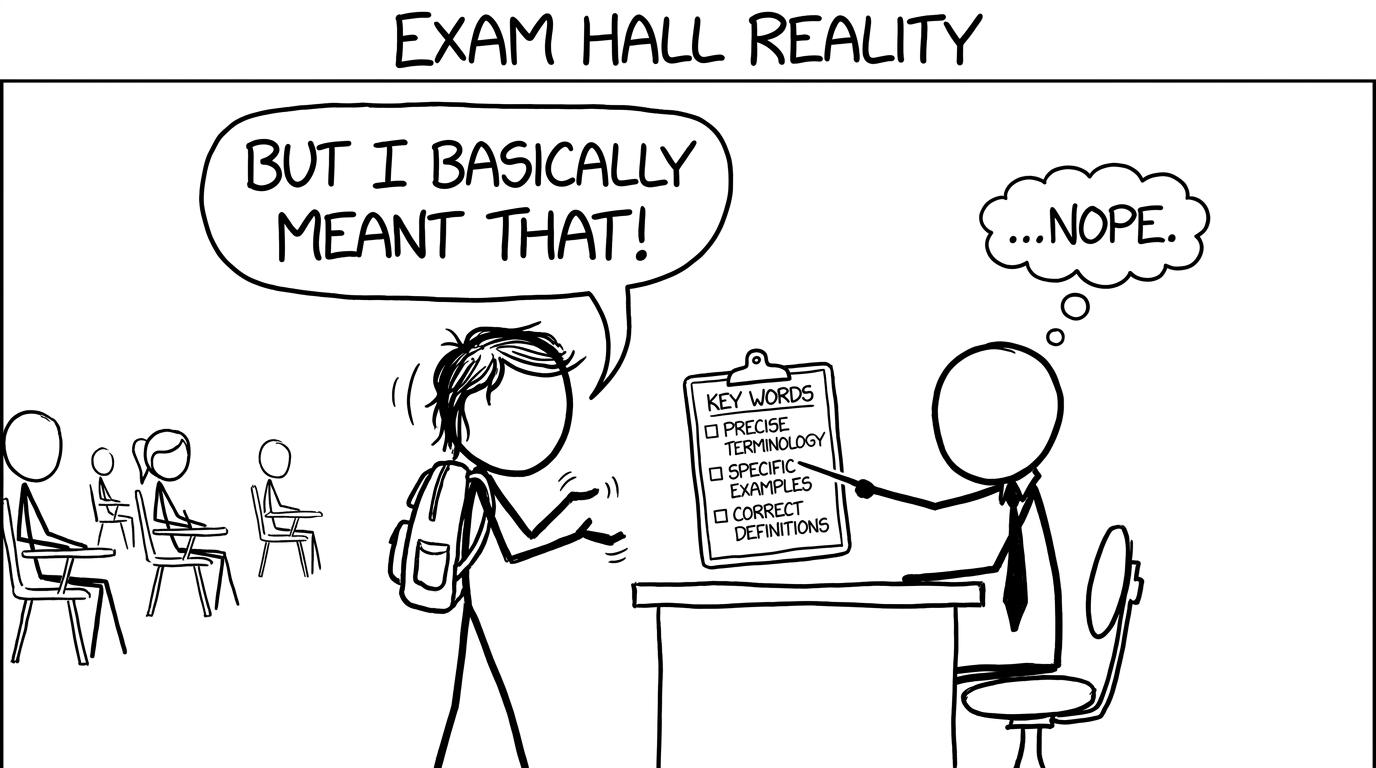 Student argues “I basically meant that!”
How to use GCSE mark schemes without memorising them
You’re not trying to memorise every mark scheme line. You’re trying to notice repeated structures.
In Biology, spot the “two-part” answers
Many GCSE Biology 2-mark questions are really:
- Point (a correct statement)
- Because (a reason linking to the scenario)
When students lose a mark, it’s often because they gave two points with no explanation, or one explanation with no correct scientific point.
In maths, spot where marks are “locked” behind a method
Some GCSE maths questions are effectively:
- Mark for setting up the correct equation
- Mark for solving it accurately
So if you skip the setup and just write an answer, you might lose marks even if your final number is right (especially if the scheme requires working). That’s why watching worked solutions can help: you’re learning the shape of a full-mark response. Use a paper view with video support like Paper 1 Video Solutions (Predicted Paper).
A worked “maths-style” method for GCSE Biology calculations
GCSE Biology includes required practicals and calculations (for example, magnification). The maths is usually accessible, but the marks often depend on layout, units, and substituting correctly.
Worked example: magnification
If an image measures 36 mm36\text{ mm}36 mm and the actual size is 9 mm9\text{ mm}9 mm, magnification is:
magnification=image sizeactual size=369=4 \text{magnification}=\frac{\text{image size}}{\text{actual size}}=\frac{36}{9}=4 magnification=actual sizeimage size=936=4A mark scheme often rewards:
- using the correct formula,
- correct substitution,
- correct final value.
If you wrote 936\frac{9}{36}369 you might lose the method mark because you’ve shown the wrong relationship. Again, it’s evidence, not vibes.
Common mistakes when using GCSE mark schemes
- Only checking the final answer. In GCSE maths, method marks are often where your grade moves. In GCSE Biology, missing one keyword can cost you the mark even if your idea is close.
- Treating the mark scheme like a judgement. It’s a training tool. Your job is to extract patterns, not take it personally.
- Not rewriting the “ideal answer”. Improvement happens when you rewrite your answer in mark-scheme language, then practise producing that style next time.
- Ignoring units and rounding. In maths and science, accuracy marks are commonly lost to presentation rather than difficulty.
- Doing another paper too soon. If you miss three questions on the same topic and then attempt a new paper, you’re practising the same mistake.
Closing: let GCSE mark schemes tell you what to do next
If you want a simple definition of progress, it’s this: fewer surprises when you open the mark scheme. Not because you got “luckier”, but because you learned what examiners reward and you practised showing it.
Use GCSE mark schemes like a coach, not a critic. Mark strictly, label the reason, then practise the exact weak spot until it stops being a weak spot.
Your next step on YesGenie:
- Do a timed paper from GCSE Past Papers.
- Use the mark scheme patterns to diagnose method vs accuracy.
- Fix the gaps with topic practice via pages like GCSE Maths OCR or Edexcel GCSE Old Maths Revision.
- Then pressure-test your improvement with Edexcel GCSE Maths Predicted Papers.
That loop, practise, mark, learn, repeat, is how GCSE grades move. And it’s exactly what YesGenie is built to support, free, whenever you’re ready.










