Tracking Revision Progress GCSE History: Does It Help?
Tracking revision progress GCSE History can expose weak topics, but only active recall and exam practice improve learning. Build a simple, useful tracker.
Revision can look impressive without achieving very much. A colour-coded spreadsheet fills up, progress bars move, and every topic receives a reassuring shade of green. Yet when the notes are closed, the dates blur and the explanation will not come.
So, does tracking revision progress GCSE History actually help? Yes, but only when the tracker records evidence of learning and changes what you practise next. Logging hours or colouring cells does not itself improve memory. A spreadsheet or app is useful as a compass, not as the journey.
That distinction matters for students balancing History with GCSE Maths. Both subjects reward accurate knowledge, but improvement ultimately has to survive an exam question. Your tracking system should therefore lead towards retrieval, practice, feedback and another attempt.
The short answer: tracking helps when it changes your actions
A revision tracker can help you:
- see which topics have been neglected;
- schedule repeated retrieval across several weeks;
- record performance on exam questions;
- distinguish confidence from demonstrated knowledge;
- notice recurring mistakes;
- decide what the next revision session should contain.
It becomes unhelpful when maintaining it consumes time that should be spent recalling knowledge or answering questions.
A good rule is simple: if updating the spreadsheet takes longer than deciding what to revise next, the system is probably too complicated.
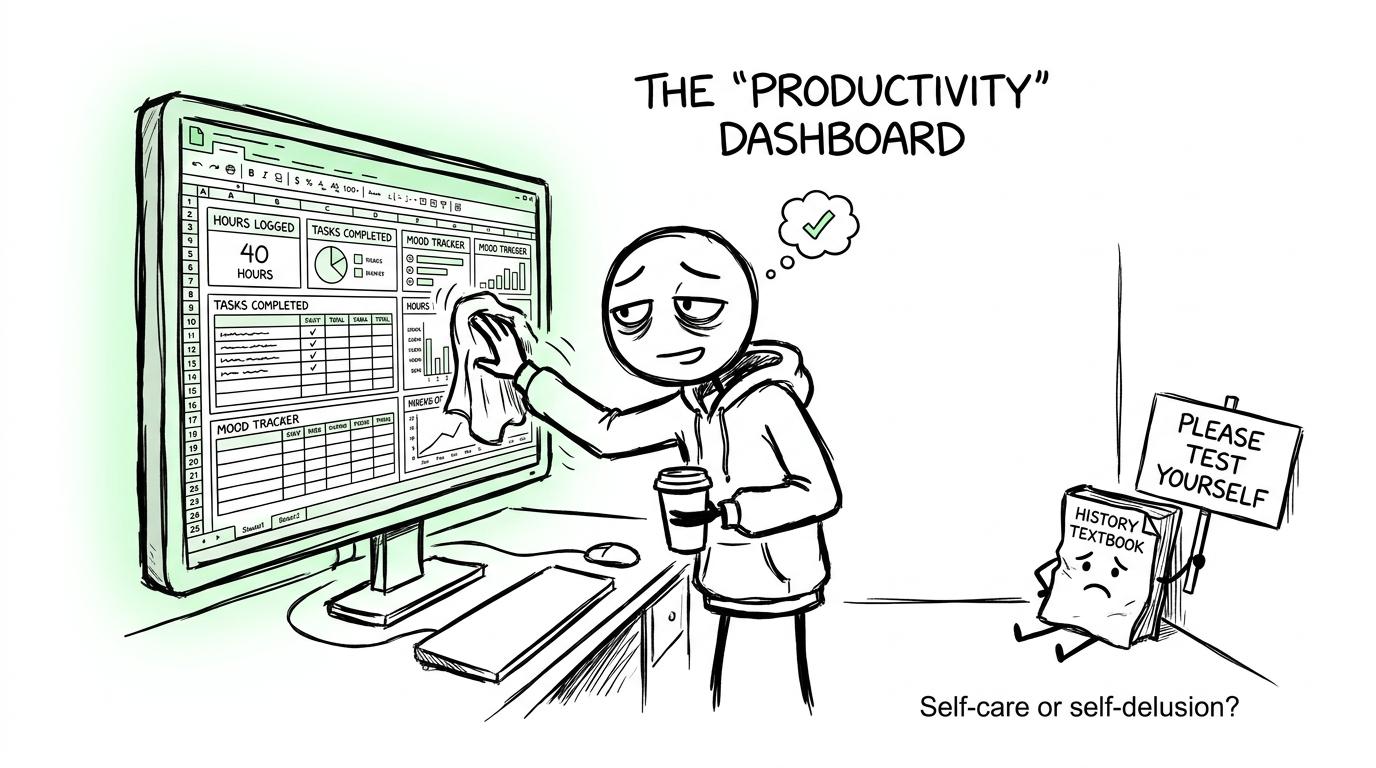 A student polishes a revision spreadsheet while a neglected textbook asks to be tested
What the research says about monitoring revision
There is good evidence for the wider learning behaviours that a tracker can support, rather than for spreadsheets as a magical intervention in themselves.
The Education Endowment Foundation describes effective self-regulated learning as a cycle of planning, monitoring and evaluating. A student sets a goal, checks whether the chosen strategy is working and then adapts the plan. A revision log can provide the record needed for that cycle, but the judgement and adaptation still belong to the student.
Research reviews led by John Dunlosky have also identified practice testing and distributed practice as particularly useful learning techniques. In practical terms, that means trying to retrieve knowledge without notes and returning to it over time. A tracker can schedule these actions and record their results. It cannot replace them.
This is why logging “History revision: 606060 minutes” is weak evidence. It tells you that time passed. It does not tell you whether you could explain the causes of an event, support a judgement or evaluate a source.
What should a GCSE History spreadsheet track?
Keep the spreadsheet small enough to use after every meaningful revision session. One row per topic, subtopic or exam skill is usually clearer than one row per day.
Useful columns include:
- Topic: the precise specification area, not simply “History”.
- Exam skill: knowledge, causation, consequence, significance, change, source evaluation or interpretation.
- Last tested: when you last attempted retrieval or an exam question.
- Evidence: the question, quiz or task completed.
- Score or mark: the result from honest marking.
- Error: the exact missing fact, weak explanation or structural problem.
- Next review: when you will retrieve the material again.
- Next action: one specific task rather than “revise more”.
Your topic list should come from the specification for your own exam board and options. Edexcel, AQA, OCR and Eduqas do not all teach identical periods or use identical paper structures. Avoid downloading a generic template and assuming its content matches your course.
Track what GCSE History examinations assess
Across GCSE History specifications, assessment covers more than factual recall. Students need knowledge and understanding, analysis using historical concepts, evaluation of contemporary sources and judgements about interpretations. The exact questions and paper arrangements depend on the exam board.
That means “I know this topic” is too broad to be a useful entry. You might recall the chronology accurately but struggle to explain why an event was significant. Alternatively, your knowledge may be secure while your source evaluation remains general.
Record the particular weakness. Precision makes the next session easier to design.
Track evidence, not feelings
Confidence is useful information, but it is not proof. Familiar notes can produce the feeling that knowledge is secure because every sentence looks recognisable. The real test begins when the notes disappear.
Replace a confidence-only rating with evidence such as:
- recalled key facts from memory;
- produced a timeline without notes;
- planned an answer to a specific question;
- completed a timed response;
- marked the response using the correct mark scheme;
- corrected the answer and attempted a similar task later.
You may still include a confidence column, but compare it with performance. A topic rated highly and answered poorly deserves attention because your judgement is over-optimistic. A low-confidence topic answered accurately may need occasional maintenance rather than a complete restart.
For maths, the same principle applies. The MathsGenie GCSE Maths revision hub provides lessons, practice questions, papers and solutions, but your tracker should record what you can do independently after using them.
Use a revision loop rather than a completion list
Tick-box systems encourage a dangerous idea: that topics become permanently “done”. Memory does not work that way. Even well-understood material needs to be retrieved again.
A more useful cycle is:
- choose a precise topic or skill;
- retrieve what you know before opening notes;
- check and repair gaps;
- answer an exam-style question;
- mark it carefully;
- record one specific weakness;
- schedule another attempt.
This turns tracking into a decision-making tool. The next review date creates spacing, while the score and error note determine what you should do when that date arrives.
If managing several GCSE subjects feels overwhelming, the principles in MathsGenie's GCSE maths revision timetable guide can help you build a repeatable weekly rhythm. For a shorter planning horizon, the one-month GCSE maths revision plan shows how diagnosis, retrieval and paper practice can fit together.
Spreadsheet or revision app: which is better?
The best tool is the one you will update briefly and use to make decisions.
A spreadsheet offers flexibility. You can filter by paper, topic, skill, date or performance. It is also easy to add an error log. Its main danger is endless customisation: formulas, colours and charts can become attractive substitutes for revision.
An app may offer reminders and automatic scheduling. That can reduce planning effort, especially for spaced retrieval. However, streaks and notifications often measure attendance rather than understanding. Opening an app every day does not prove that your historical knowledge is becoming more precise.
Paper can work too. A notebook containing weak topics, marks, corrections and next-review dates performs the same essential job. The platform matters less than the loop it supports.
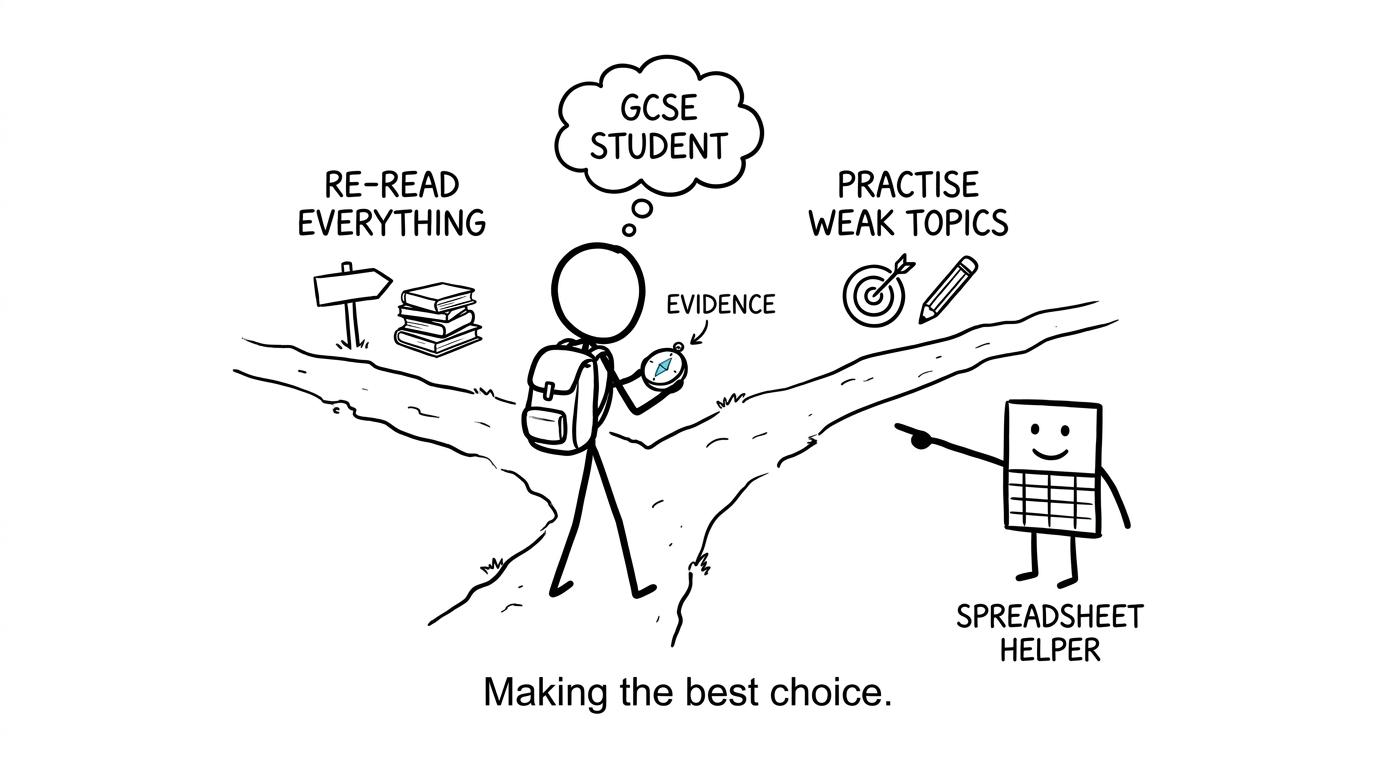 A spreadsheet points towards practice while a student follows a compass labelled evidence
How to stop tracking from becoming productive procrastination
Set firm boundaries around administration:
- build the tracker once rather than redesigning it weekly;
- update it immediately after marking, while the evidence is fresh;
- write brief error notes;
- use only a few status labels;
- review priorities once a week;
- hide charts that do not change your decisions.
You could classify a topic as not tested, needs repair, developing or secure for now. The phrase “for now” matters. It reminds you that the label is temporary and should be supported by a future retest.
For busy evenings, MathsGenie's twenty-minute maths revision routine demonstrates the value of keeping setup and logging short. Most of the session should remain active practice.
Applying the same system to GCSE Maths
Although History answers rely heavily on argument, contextual knowledge, sources and interpretations, the tracking principle transfers directly to maths.
Do not log only “algebra revised”. Record the precise skill, the questions attempted, marks lost and the point where the method failed. The guide to finding your weakest GCSE topics explains how an evidence-based error log can direct revision more effectively than guesswork.
Once a weak maths topic is identified, use a MathsGenie revision lesson, complete the accompanying practice questions and check the solutions. Then test whether the method survives in mixed or timed work. Edexcel GCSE Maths past papers include official mark schemes and worked solutions where available, while students on other boards can choose the appropriate collection from the main GCSE hub.
A total mark is only the headline. The useful information sits underneath it: which topic failed, why marks were lost and what should happen next. MathsGenie's guide to using GCSE past papers properly develops this paper, mark, fix and retest cycle.
Common mistakes when tracking revision progress
Recording time instead of learning
Hours can help you monitor workload, but they are a poor measure of knowledge. Pair any time record with an output: a recall task, essay plan, marked response or corrected question.
Marking a topic complete after reading it
Reading may introduce or clarify content, but it does not show that you can retrieve and use it. Change the status only after a closed-book check or exam-style task.
Using vague topic labels
“Medicine” or “algebra” is too broad. Name the exact content or skill so that the next action is obvious.
Trusting self-ratings without testing
A green cell based on confidence can hide a serious gap. Let performance evidence determine priority.
Tracking every possible detail
Too many columns create friction. Keep only information that affects what, when or how you revise.
Never returning to the data
A tracker that is filled in but never consulted is only an archive. Use it to choose weekly priorities and schedule retests.
Make the tracker earn its place
A spreadsheet does not improve GCSE History results by itself. Its value lies in the choices it prompts: returning to forgotten material, practising a weak exam skill, correcting an unsupported judgement or replacing passive rereading with retrieval.
Keep the system plain. Record evidence. Let mistakes determine the next task. Then close the spreadsheet and do the revision it recommends.
Use the same discipline for GCSE Maths by starting at the free MathsGenie GCSE revision hub. Choose your exam board and tier, learn through revision lessons, practise with topic questions and mini tests, and then test progress using past papers or predicted papers. Mark schemes and video solutions will show where marks were lost; your tracker should make sure you return and fix them.