

Tracking Revision Progress GCSE French: Does It Help?
Tracking revision progress GCSE French can reveal weak skills, schedule retrieval and reduce busywork. Build a simple system that supports GCSE maths too.
A revision spreadsheet can feel wonderfully reassuring. The colours are tidy, every topic has a row, and the percentage completed rises each week. Yet the exam does not award marks for organisation.
So, does tracking revision progress GCSE French genuinely help? Yes, if the tracker leads you towards retrieval, feedback and repeated practice. No, if maintaining it replaces the difficult work of recalling vocabulary, speaking aloud, listening carefully and correcting mistakes.
The same distinction matters when you are preparing for GCSE maths. A tracker is a map, not the journey. Its value lies in helping you decide what to practise next.
The short answer: when progress tracking works
A useful GCSE revision tracker should help you:
- separate French listening, speaking, reading and writing rather than treating French as one topic;
- record performance, not simply time spent;
- identify weak vocabulary, grammar or exam skills;
- schedule another attempt after a gap;
- compare recent results with earlier attempts;
- turn mistakes into specific actions;
- keep French revision balanced alongside GCSE maths and other subjects.
Research on metacognition and self-regulated learning supports planning, monitoring and evaluating your work. Evidence also consistently favours retrieval practice and spaced practice over passive rereading. However, this does not prove that spreadsheets themselves improve grades. The learning comes from what the spreadsheet prompts you to do.
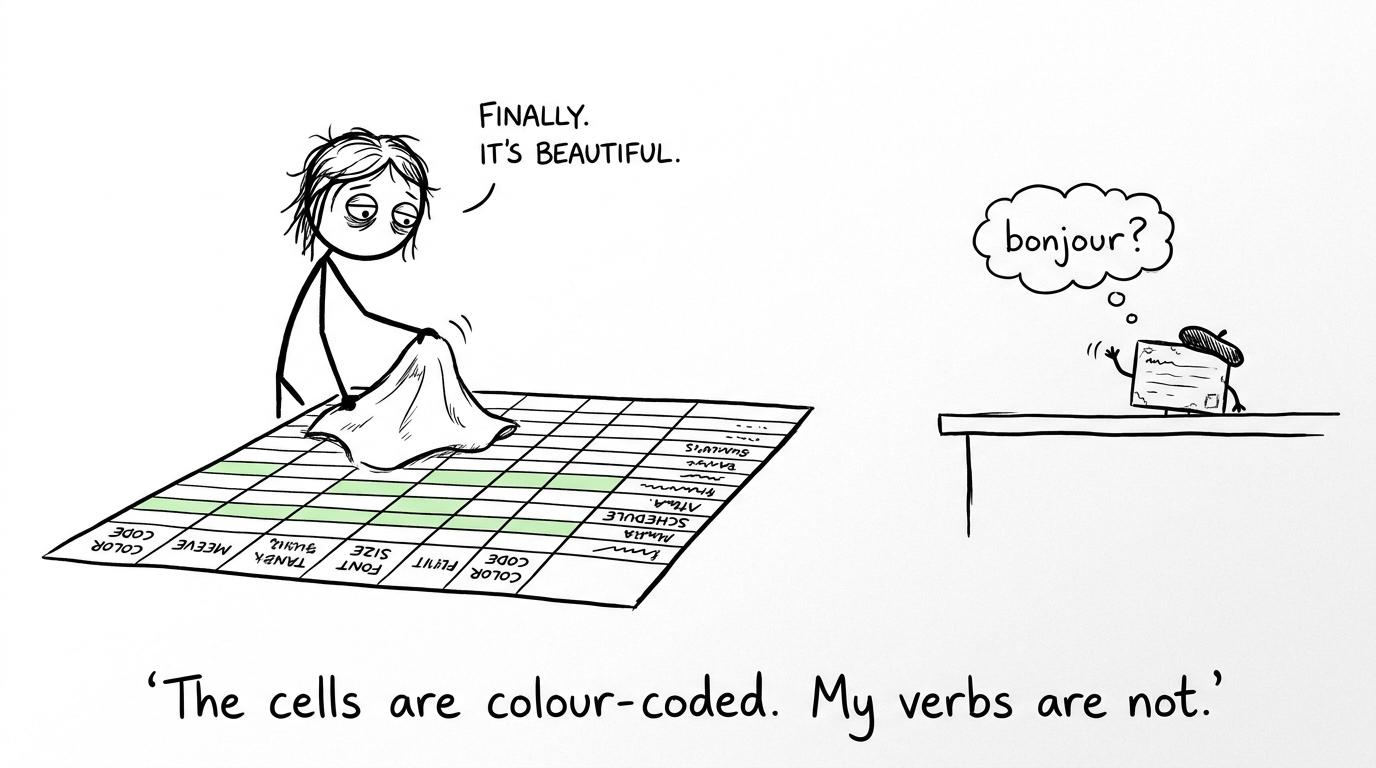 A student colour-coding a spreadsheet while a neglected French flashcard waits nearby
What should a GCSE French tracker measure?
GCSE French specifications vary between AQA, Edexcel, OCR and Eduqas, and students sitting examinations from summer 202620262026 may follow reformed specifications. Check your exam board, tier and specification with your teacher before building a topic list.
Whatever your board, progress needs to reflect the language skills actually assessed. A single label such as “French revision completed” hides too much.
Skill and topic
Record both the content and the activity. “School vocabulary” tells you the theme, but not whether you can recognise it in speech, use it spontaneously or spell it accurately.
More useful entries include:
- school vocabulary retrieval;
- present-tense verb forms;
- listening for negatives;
- reading inference;
- dictation and sound-symbol links;
- translation into French;
- speaking without prepared notes;
- extended writing under timed conditions.
This level of detail turns the tracker into a diagnostic tool. It shows the difference between knowing what a word means on a flashcard and recognising it inside a fast spoken sentence.
A measurable result
Time is worth recording, but it does not prove learning. A distracted hour can produce less progress than a focused fifteen-minute retrieval task.
Where a task has clear marks, record the result as a percentage:
Accuracy=marks achievedmarks available×100%\text{Accuracy}=\frac{\text{marks achieved}}{\text{marks available}}\times 100\%Accuracy=marks availablemarks achieved×100%For speaking or writing, use teacher feedback, a relevant mark scheme or a short checklist linked to your specification. Avoid inventing precise scores for qualities you cannot assess reliably. A note such as “frequent verb errors” is more honest and useful than an unsupported confidence rating of 87%87\%87%.
Confidence and evidence
Confidence can still be recorded, provided it sits beside evidence. Use a simple label such as red, amber or green, then ask whether the task result agrees.
If you feel confident but perform poorly without notes, familiarity may be misleading you. If you feel uncertain but repeatedly answer accurately, your tracker can reveal that your knowledge is stronger than it feels.
The next review date
A completed task should not disappear. Add a date for another attempt, preferably using fresh questions or prompts. Spacing learning across several sessions helps you test whether the knowledge remains available after the immediate feeling of fluency has faded.
Spreadsheet or revision app: which is better?
Neither format changes outcomes automatically. The better tool is the one that creates the least administrative work while reliably prompting useful practice.
Why a spreadsheet can help
A spreadsheet is flexible. You can build separate sections for French skills, maths topics and other GCSE subjects, filter weak areas and calculate broad progress measures.
For example, a dashboard might show:
Completion rate=tasks attemptedtasks planned×100%\text{Completion rate}=\frac{\text{tasks attempted}}{\text{tasks planned}}\times 100\%Completion rate=tasks plannedtasks attempted×100%But completion rate must never be confused with mastery. Finishing every planned task badly still produces a completion rate of 100%100\%100%.
A spreadsheet works particularly well when you want to:
- compare first attempts with later attempts;
- filter tasks that need revisiting;
- maintain an error log;
- plan several subjects in one place;
- retain control over categories and review dates.
Why an app may be easier
An app may reduce friction through reminders, built-in flashcards or automatically scheduled reviews. That can be useful for French vocabulary, where frequent retrieval is important.
However, an app can also encourage shallow measures such as streaks, tasks opened or cards viewed. These are signs of activity, not necessarily durable learning. Ask the same question of every feature: does it make me retrieve, apply, check or correct something?
The minimum viable tracker
Start small. Use only these fields:
- subject and skill;
- specific task;
- date attempted;
- result or feedback;
- mistake to fix;
- next review date.
Do not add graphs, formulas or decorative formatting unless they help you make a revision decision. The best tracker is often slightly boring. It is quick to update and clear about what happens next.
How to make tracking lead to real learning
The tracker should sit inside a repeating cycle: plan, attempt, check, correct and retest.
Begin with an unaided attempt
Test what you can produce without looking at notes. In French, that might mean recalling vocabulary, answering listening questions, translating sentences or recording a speaking response. In maths, it means attempting questions before watching the solution.
The MathsGenie GCSE maths revision hub provides board-specific revision materials, practice questions and papers that can supply this evidence for your maths rows.
Record the precise problem
“French was bad” is not actionable. “Missed negatives in listening” is. Likewise, “algebra weak” tells you very little, while “cannot rearrange when the subject appears twice” gives your next session a purpose.
This is why a tracker can help across subjects. It turns a disappointing result into a smaller, solvable problem.
Correct using reliable feedback
Check answers promptly. Use your teacher's feedback and the correct exam-board materials for French. For maths, mark schemes and video solutions show both the answer and the method examiners reward.
The guide to using Edexcel GCSE maths past papers properly explains how to log mistakes, repair weak topics and reattempt difficult questions rather than merely collecting paper totals.
Schedule a genuine retest
A retest should require retrieval again. Do not copy yesterday's correction while it is still visible. Close the notes, change the prompt and test the same knowledge after a delay.
Short assessments are useful here. Edexcel GCSE maths mini tests provide focused, timed practice without requiring a full paper. For French, use short vocabulary, dictation, translation or speaking checks that match your specification.
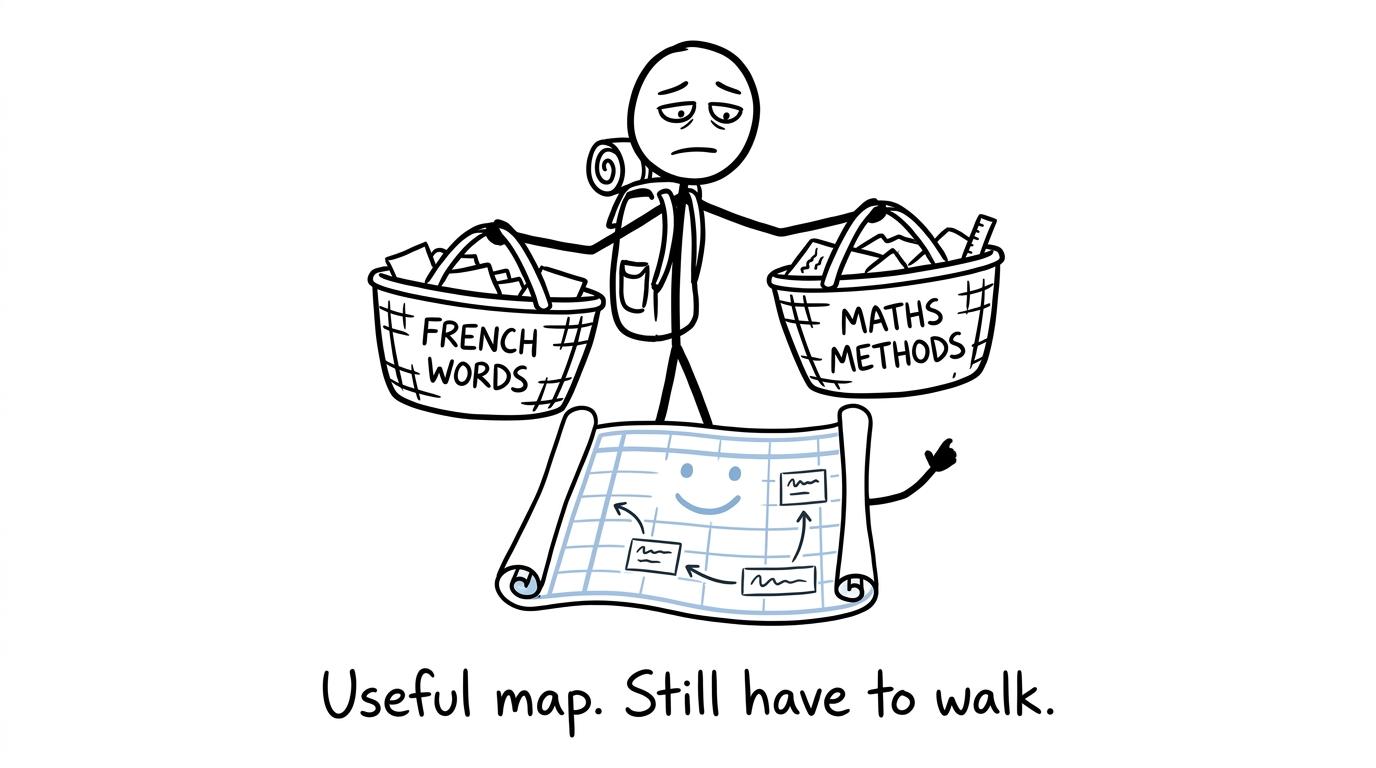 A spreadsheet acting as a map while a student carries French and maths revision baskets
Using one tracker for GCSE French and maths
Students rarely revise one subject in isolation. A French tracker can be valuable partly because it makes the overall revision workload visible.
Maths and French need different activities. French requires frequent contact with vocabulary, grammar and spoken language. Maths requires methods to be recalled and applied to unfamiliar questions. Yet both benefit from a similar feedback loop:
- retrieve without support;
- attempt an exam-style task;
- mark or review it;
- identify the exact error;
- practise the weakness;
- return later and retest.
Build the schedule around decisions rather than equal-looking boxes. If a French speaking assessment is approaching, speaking may need more attention. If a maths diagnostic paper exposes repeated probability errors, your maths plan should respond.
For a sustainable weekly structure, use the GCSE maths revision timetable guide. If examinations are closer, the one-month GCSE maths revision plan offers a tighter sequence of diagnosis, topic repair and paper practice.
Common mistakes when tracking revision progress
Measuring hours instead of learning
Hours describe input. Marks, accurate recall and improved responses provide stronger evidence of progress. Record time only to help with planning.
Colouring a topic green after one good attempt
Immediate success may not survive a delay. Require at least one later, unaided attempt before treating a skill as secure.
Tracking topics too broadly
“French”, “grammar” or “maths” cannot guide tomorrow's revision. Use specific skills and error patterns.
Spending too long maintaining the system
If updating the tracker takes longer than the retrieval task, simplify it. Formatting can feel productive because it is comfortable. Learning often feels less comfortable because it exposes what you cannot yet do.
Ignoring exam conditions
Vocabulary scores and topic worksheets matter, but they do not measure timing, stamina or question selection. Introduce realistic papers gradually. The guide on when to start GCSE past papers explains how to progress from shorter diagnostics to timed papers.
Treating predicted papers as predictions of your result
Predicted papers provide fresh exam-style practice; they do not guarantee what will appear or what grade you will receive. Use them after building topic knowledge and alongside official past papers.
A tracker should make the next action obvious
Tracking revision progress can help with GCSE French, but only indirectly. The spreadsheet does not teach vocabulary, improve pronunciation or correct grammar. It helps when it exposes a gap, schedules another attempt and directs your attention towards the work most likely to matter.
Use the same discipline for GCSE maths. Open the MathsGenie GCSE revision hub, choose your board and tier, and gather evidence through free revision lessons, practice questions and mini tests. Then build towards past papers, mark schemes, video solutions and predicted papers.
Update the tracker briefly. Spend the saved time practising. A good system should eventually become almost invisible, leaving you focused on the knowledge, decisions and working that earn marks.











