Tracking Revision Progress GCSE Chinese: Does It Help?
Tracking revision progress GCSE Chinese: learn when a spreadsheet improves revision, when it wastes time, and how to build a simple evidence-led tracker.
Revision can look impressively organised without becoming more effective. A spreadsheet fills with green cells. A revision app celebrates a streak. Yet the uncomfortable question remains: can you remember the vocabulary, understand the recording or answer the exam question?
Tracking revision progress GCSE Chinese can help, but only when the tracker changes what you practise next. Recording hours, colouring topics and maintaining streaks will not improve your result by themselves. A useful tracker captures evidence from retrieval, exam tasks and corrected mistakes. It then directs you towards the weakest skill.
That distinction matters for maths students too. Whether you are preparing for Chinese or GCSE maths, the tool is not the revision. It is the dashboard. Practice is the engine.
The quick verdict
A spreadsheet or app is worth using if it helps you:
- separate listening, speaking, reading and writing performance;
- identify vocabulary, grammar or question types that need attention;
- schedule another attempt after a gap;
- record evidence from marked work rather than feelings alone;
- spend less than a few minutes updating it;
- decide exactly what your next revision session should contain.
It is probably becoming productive procrastination if you spend longer designing the system than retrieving vocabulary, listening, speaking, writing or completing exam-style tasks.
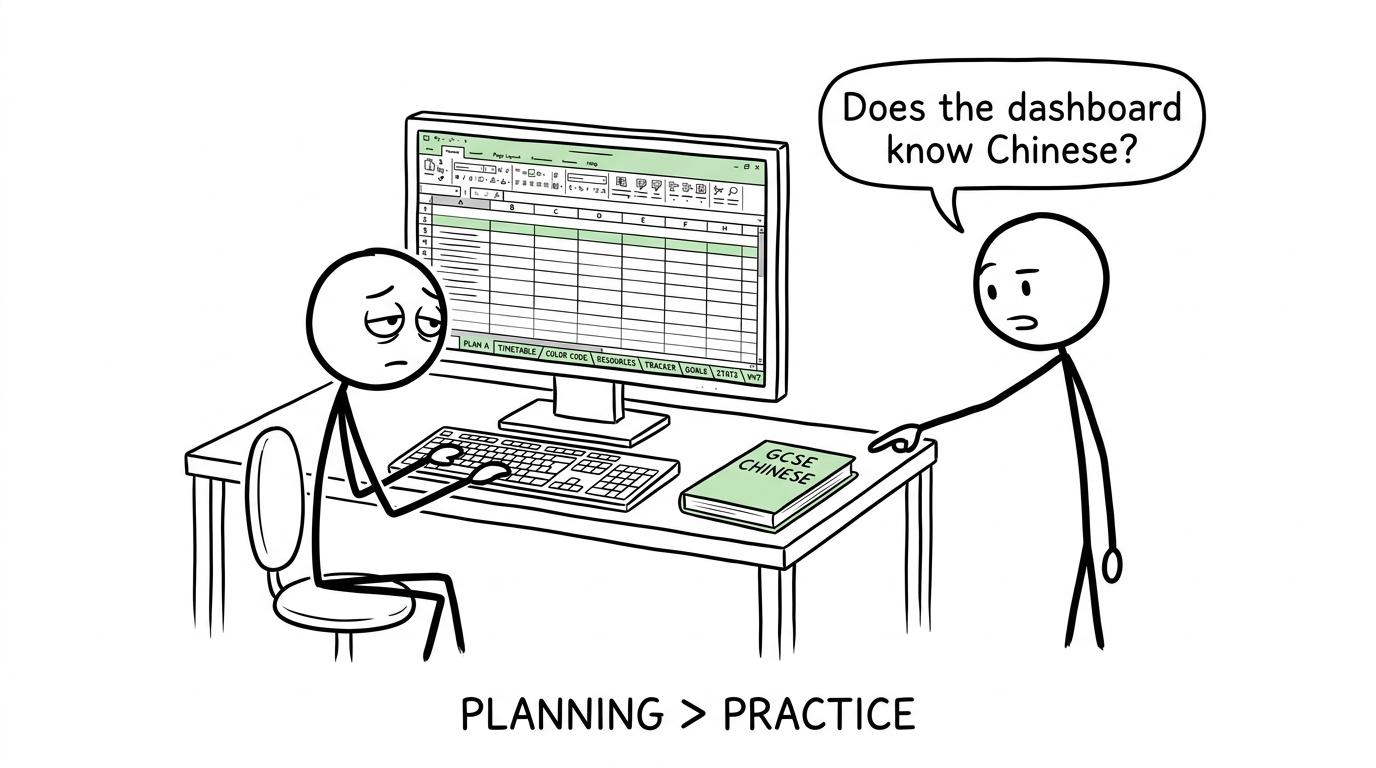 A student wonders whether an elaborate dashboard can revise Chinese
Why tracking can support GCSE Chinese revision
The strongest argument for tracking is not that spreadsheets possess a special educational power. They do not. It is that a simple record can support planning, monitoring and evaluation.
Research into metacognition and self-regulated learning supports teaching students to set goals, monitor performance and evaluate the strategies they use. Crucially, this should happen alongside subject content. A beautifully maintained tracker detached from real Chinese practice misses the point.
The same principle appears in effective maths revision. The MathsGenie GCSE revision timetable guide recommends prioritising the topics on which you actually lose marks, revisiting them and using feedback to shape later sessions. The timetable matters because of the work it prompts, not because making a timetable is inherently valuable.
It turns a large subject into visible skills
For common GCSE Chinese specifications, assessment covers four distinct language skills: listening, speaking, reading and writing. On the current AQA GCSE Chinese specification, each contributes 25%25\%25% of the qualification. Pearson Edexcel GCSE Chinese also assesses these four areas, although students should always follow the specification and guidance supplied by their own school and exam board.
A single label such as “Chinese: amber” is therefore too vague. You might recognise characters confidently but struggle to understand unfamiliar speech. You might know plenty of vocabulary yet lose marks through incomplete written responses.
A useful tracker keeps those differences visible.
It can reveal the gap between familiarity and recall
Reading a vocabulary list can create a comforting sense of recognition. Close the book, however, and the situation may change. Retrieval practice requires you to produce an answer from memory, while spaced practice returns you to material across separate sessions. Reviews of learning research generally support both approaches for building durable knowledge.
Your tracker can reinforce these methods by recording the result of a closed-book test and setting a future review date. It should not award progress merely because a page was read.
It provides a memory of your mistakes
Revision often fails quietly. A student marks a task, notices an error and moves on. Two weeks later, the same error returns.
A small error log interrupts that cycle. For Chinese, the entry might identify a missed tone, an unknown character, an incorrect word order, a listening distractor or an incomplete bullet point. For maths, it might identify an algebraic sign error or a formula used in the wrong context.
MathsGenie's guide to finding your weakest GCSE topics uses the same underlying idea: lost marks should become specific priorities for future practice.
What should a GCSE Chinese spreadsheet track?
The best tracker is deliberately plain. It needs enough information to guide a decision, but not so much that maintaining it becomes a second subject.
| Column | What to record |
|---|---|
| Date | When the task was completed |
| Skill | Listening, speaking, reading or writing |
| Topic | The specification theme or vocabulary area |
| Task | Retrieval quiz, recording, translation or exam question |
| Evidence | Mark, recall result or precise teacher feedback |
| Main error | One specific reason performance broke down |
| Next action | The smallest useful piece of follow-up practice |
| Review date | When you will attempt related material again |
You can calculate a simple recall rate where the task produces countable results:
Recall rate=items recalled correctlyitems tested×100%\text{Recall rate} = \frac{\text{items recalled correctly}}{\text{items tested}} \times 100\%Recall rate=items testeditems recalled correctly×100%For a marked assessment, use:
Mark percentage=marks awardedmarks available×100%\text{Mark percentage} = \frac{\text{marks awarded}}{\text{marks available}} \times 100\%Mark percentage=marks availablemarks awarded×100%These figures are signals, not verdicts. A high vocabulary score does not automatically demonstrate fluent speaking, and marks from different tasks may not be directly comparable. Keep the task type beside the result so the number retains its meaning.
Record performance before confidence
Confidence is useful, but it is noisy. A familiar topic may feel secure because you revised it yesterday. A difficult listening task may feel disastrous even when your answers were reasonably accurate.
Record objective evidence first. Confidence can be an additional column, perhaps using “low”, “medium” and “high”, but compare it with actual performance. A mismatch is informative: high confidence with weak recall suggests overestimation, while low confidence with strong results may show that the skill is more secure than it feels.
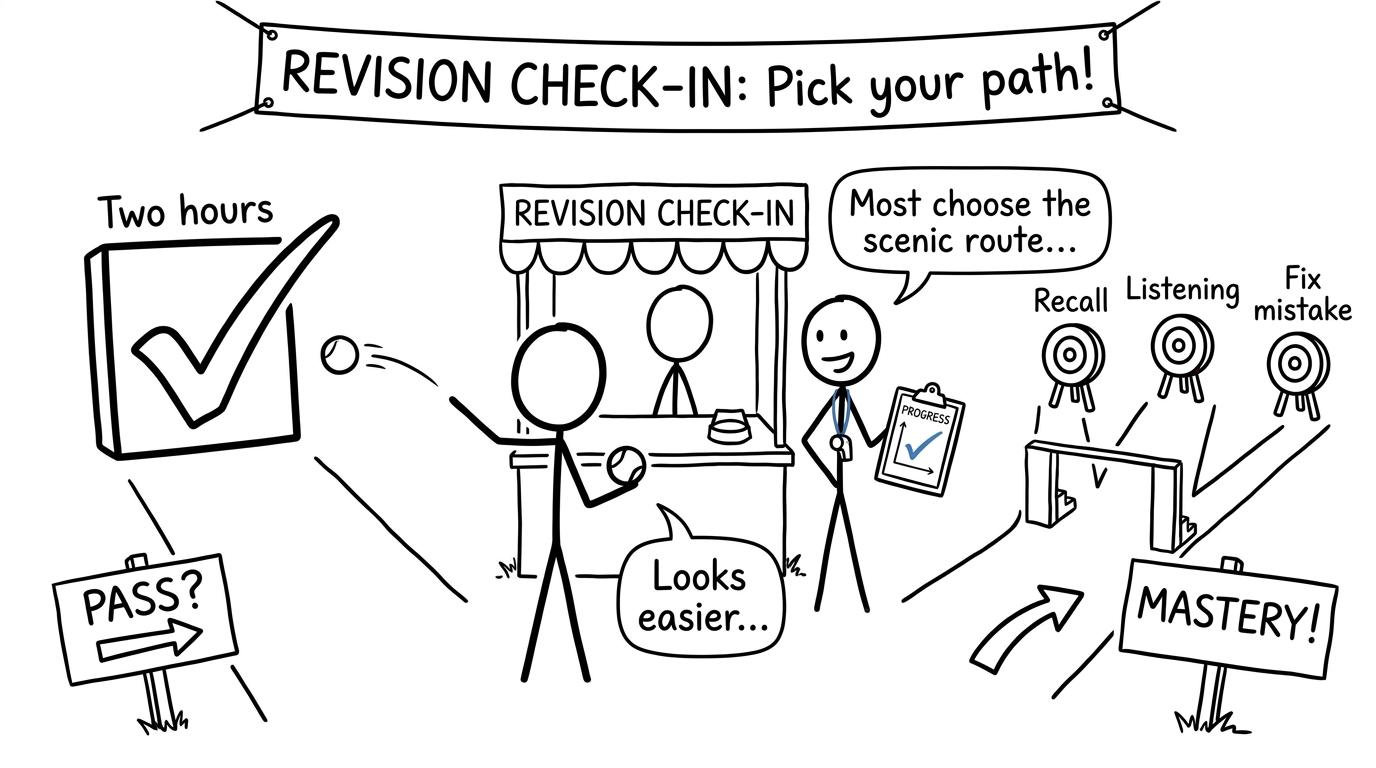 Revision evidence defeats the giant hours tick-box
When tracking only feels productive
The danger is subtle because organisation feels responsible. Changing cell colours creates immediate completion. Difficult practice does not. It exposes uncertainty, which can feel like going backwards even when it is producing the information you need.
Logging time without logging learning
Time matters for building a consistent routine, but “revised Chinese for one hour” says very little. The hour might contain active listening and corrected writing, or it might contain rearranging folders.
If you record duration, pair it with an output: vocabulary retrieved, questions attempted, marks earned, errors corrected or a speaking task completed. The output is closer to what the examination demands.
Building an elaborate scoring system
Complex weighted formulas can make a dashboard look scientific without making it accurate. Listening, speaking, reading and writing are not interchangeable units, and one short quiz cannot reliably summarise an entire skill.
Prefer separate recent evidence for each area. Look for patterns over several tasks rather than forcing everything into one “readiness score”.
Protecting a streak instead of fixing a weakness
Apps often make consistency visible, which can be motivating. But a streak measures whether you checked in, not whether you improved. It can encourage an easy task simply to preserve the chain.
Keep the streak if it helps you begin. Then ask a harder question: what can you now retrieve, understand or produce that you could not do before?
Spreadsheet, app or paper tracker?
There is no universally superior format. The best choice creates the least friction while preserving useful evidence.
A spreadsheet works well when you want sortable skills, review dates and a compact error log. An app may be better for reminders and spaced vocabulary retrieval. A paper checklist can be ideal if opening a device leads to distraction.
The decision rule is simple: choose the system you can update quickly and leave quickly.
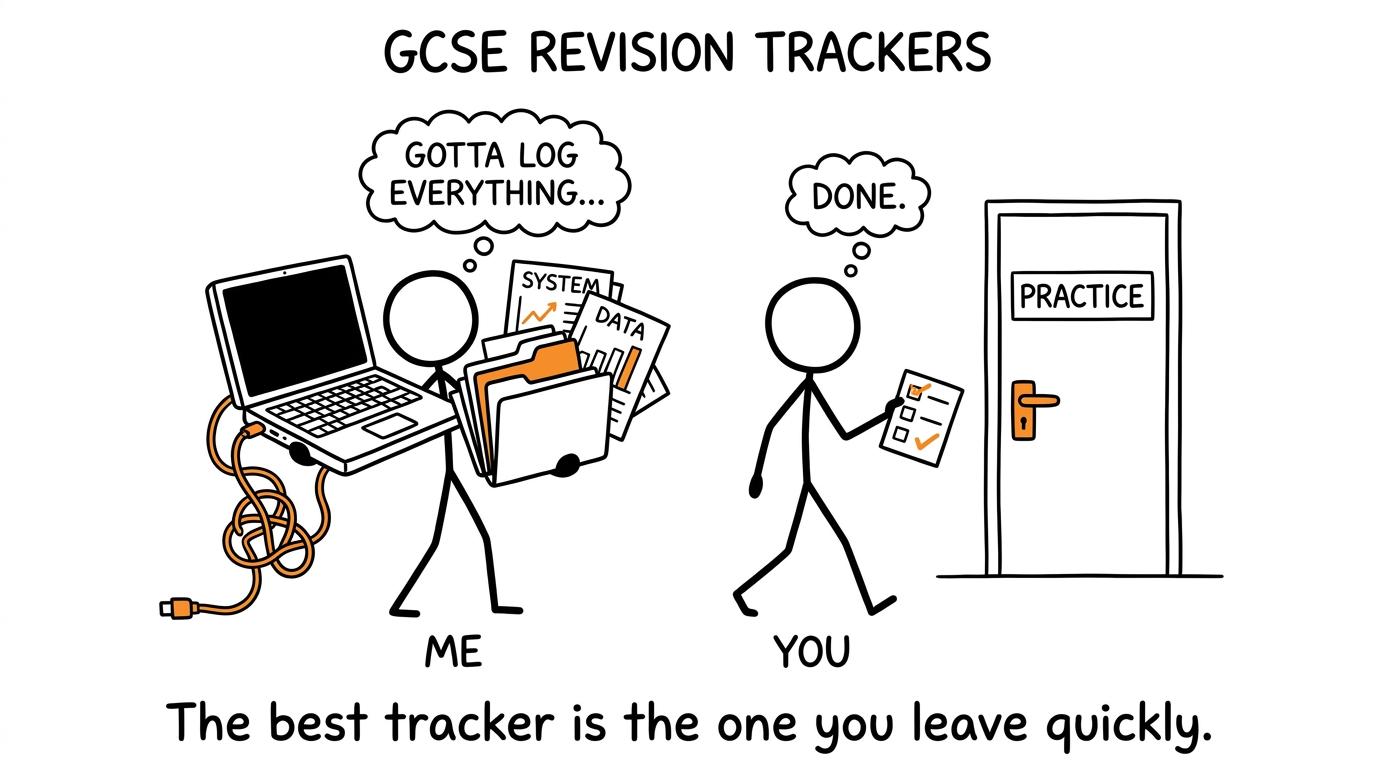 The light revision tracker reaches practice first
Try the system for a week, then evaluate it. Did it identify your next task? Did it cause you to revisit mistakes? Did your later performance provide evidence of improvement? If not, simplify or abandon it.
Turning the tracker into a revision cycle
A tracker becomes useful when every entry belongs to a repeatable cycle:
- Attempt: complete a closed-book or exam-style task.
- Check: mark it or obtain precise feedback.
- Diagnose: identify the narrow reason marks were lost.
- Repair: practise that vocabulary, structure or skill.
- Schedule: choose a later review date.
- Retest: use a fresh task rather than rereading the old answer.
This resembles MathsGenie's recommended paper cycle: attempt, mark, fix and retest. The guide to using GCSE past papers properly explains why the learning often happens after the initial paper, when errors are classified and repaired.
Keep each update brief. If you want a short routine that leaves most of the session for active work, adapt the structure in the MathsGenie twenty-minute revision routine.
Applying the same system to GCSE maths
Students preparing for maths exams can use almost the same columns, replacing the four language skills with mathematical topics and error types.
Start with the free GCSE maths revision hub, select your exam board and work at the correct foundation or higher tier. Record the topic, resource, mark, reason for each lost mark and next review date.
Short assessments such as the Edexcel GCSE maths mini tests can provide quick evidence. Full Edexcel GCSE maths past papers test broader recall, timing and exam technique. Students following AQA, OCR or Eduqas should choose the matching resources through the main GCSE hub.
In both subjects, colour should follow evidence. Do not turn a topic green because you watched a lesson. Turn it green only after you can perform the skill independently and repeat it later.
Common mistakes when tracking revision progress
Tracking activity rather than outcomes
Pages read, videos watched and hours logged are inputs. Recall, corrected errors and marks from suitable tasks provide stronger evidence of learning.
Using broad topic labels
“Listening” or “algebra” is too wide to guide tomorrow's session. Record the precise difficulty so you can select focused practice.
Never scheduling a retest
Correcting an answer immediately can produce short-term familiarity. A later attempt is more informative because it checks whether the correction lasted.
Comparing unrelated scores
A vocabulary quiz, speaking assessment and full past paper measure different things. Keep the task type and marks available beside every result.
Spending too long on administration
Your tracker should remove decisions, not create another elaborate task. If updating it regularly consumes more than a few minutes, delete columns until it becomes useful again.
Make the spreadsheet earn its place
Tracking revision progress for GCSE Chinese is worthwhile when it tells the truth gently: what is secure, what remains fragile and what you should practise next. It does not improve outcomes merely by existing. The improvement comes from the retrieval, feedback, spaced review and exam practice that the record prompts.
Use the same standard for maths. Begin with MathsGenie's GCSE maths revision resources, complete revision lessons and practice questions, then collect evidence through mini tests, past papers and predicted papers. Mark carefully with the mark schemes, use video solutions where a method remains unclear, and let each mistake choose the next task.
Build the smallest tracker that keeps that cycle moving. Then close it and revise.