Too Late to Revise GCSE Food and Nutrition?
Too late to revise GCSE Food and Nutrition? Learn what late revision can still change, which topics to prioritise and how to protect exam marks.
The uncomfortable moment usually arrives when the exam suddenly feels close. You look at nutrition, food science, safety, provenance and practical knowledge, then wonder how any of it can fit into the time left.
If you are asking whether it is too late to revise GCSE Food and Nutrition, the honest answer is no. Focused revision can still improve your recall, written explanations, numerical accuracy and exam technique. What changes is the strategy. You may no longer have time to revise everything equally, but you do have time to make better decisions about the marks still available.
Late revision is not magic, and nobody can promise a particular grade. Its impact depends on your current knowledge, completed non-exam assessment, remaining time and quality of practice. But late is different from pointless.
Your late-revision checklist
Start with these actions rather than trying to build the perfect timetable:
- Confirm your exam board and read its current specification.
- List the topics as secure, uncertain or weak.
- Test yourself before rereading notes.
- Prioritise recurring content and weak areas.
- Practise short and extended exam responses.
- Mark every question and record specific corrections.
- Include calculations, units and data interpretation.
- Protect sleep and stop unproductive all-night revision.
The same disciplined cycle works across subjects: recall, practise, mark, fix and retest. MathsGenie's GCSE one-week revision plan shows how to organise that cycle when time is limited.
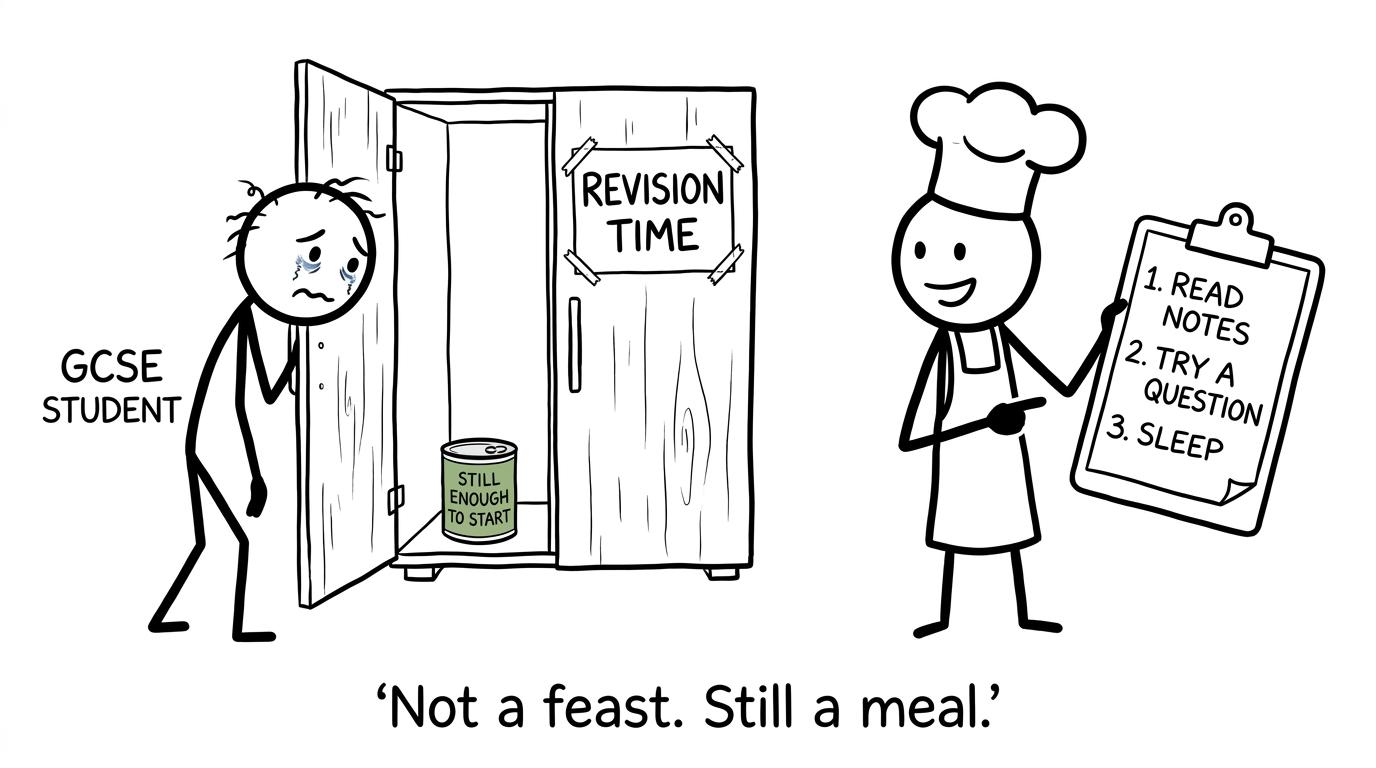 A student discovers that a small amount of revision time is still useful
How much difference can late revision realistically make?
The answer depends less on the calendar than on what you do with the remaining sessions.
If you have several weeks
You can still cover the specification broadly, revisit weak topics more than once and complete timed questions. Begin with a diagnostic test, then divide the course into manageable areas. Return to mistakes after a gap instead of assuming that one successful session means the knowledge is secure.
Several weeks also gives you time to improve extended answers. Food Preparation and Nutrition is not only a memory test. Questions may require you to apply knowledge, analyse information, justify choices or evaluate a decision. Those skills become stronger through repeated writing and marking.
If you have one or two weeks
Your revision must become selective. Identify the largest gaps rather than spending equal time on every chapter. Secure the core relationships connecting nutrients, health, food choice, food science, safety and preparation.
Use short topic sessions followed by mixed questions. A session should produce evidence: corrected answers, a recall sheet or a short list of misunderstandings. Simply spending time near a textbook does not provide that evidence.
The principles in MathsGenie's guide to starting GCSE past papers transfer well here. A paper is most useful when you mark it, identify the cause of each lost mark and repair the relevant knowledge afterwards.
If you have only a few days
A few days can still improve accessible marks, but broad relearning is unlikely. Concentrate on high-value recall, familiar question structures, precise terminology and your most common errors.
Complete short timed sections rather than repeatedly attempting entire papers. Check whether you are answering the command word. A question asking you to explain needs linked reasoning; one asking you to evaluate needs a supported judgement, not a list of facts.
If the exam is tomorrow
Do not attempt to relearn the whole course overnight. Review a compact set of key facts, correct a few recurring mistakes and practise planning answers without writing pages unnecessarily. Then stop at a sensible time.
MathsGenie's night-before GCSE plan is written for maths, but its central idea applies here too: fewer decisions, short practice and careful correction are more valuable than a panicked tour of every topic.
Know what can still affect your result
For widely taken AQA, OCR and Eduqas GCSE Food Preparation and Nutrition qualifications, the written assessment accounts for 50%50\%50% of the overall qualification, with the other 50%50\%50% coming from non-exam assessment. Exact paper duration and component details vary by board, so check your own specification and school information.
This matters when revision begins late. Your NEA may already have been completed, but the written paper still represents a substantial part of the qualification. Revision cannot change submitted work. It can change how effectively you answer the exam in front of you.
Do not confuse Food Preparation and Nutrition with a tiered maths qualification. There is no foundation or higher paper choice in these food qualifications. However, you must still know whether you follow AQA, OCR or Eduqas because content organisation, paper structure and mark schemes differ.
What should you revise first?
Use the specification as a boundary
A specification prevents two expensive mistakes: overlooking examinable material and revising interesting details that are not required. Turn each specification statement into a question. If you cannot answer it without notes, it belongs on your revision list.
Across the main specifications, important areas include:
- nutrition, health and dietary needs;
- food science and the functional properties of ingredients;
- food safety, storage and contamination;
- food choice and influences on consumers;
- food provenance, sustainability and production;
- preparation methods, cooking techniques and sensory qualities.
The labels and organisation vary, so use your board's wording rather than treating this as a substitute for its specification.
Prioritise connections, not isolated lists
A memorised nutrient list is useful, but connected knowledge earns more marks. You should be able to link a nutrient to its function, suitable sources, relevant groups and possible consequences of deficiency or excess.
The same is true of food science. Learn what happens, why it happens and how the change affects a finished product. This structure prepares you for application questions where the food or context is unfamiliar.
Revise command words
Students sometimes know the content but answer a different question from the one asked. Build a small command-word guide:
- Identify or state: give a concise fact.
- Describe: communicate relevant features or changes.
- Explain: connect a cause to an effect.
- Analyse: examine information and develop relationships.
- Evaluate: consider relevant factors and reach a supported conclusion.
Check your board's mark schemes to see how these demands appear in real questions.
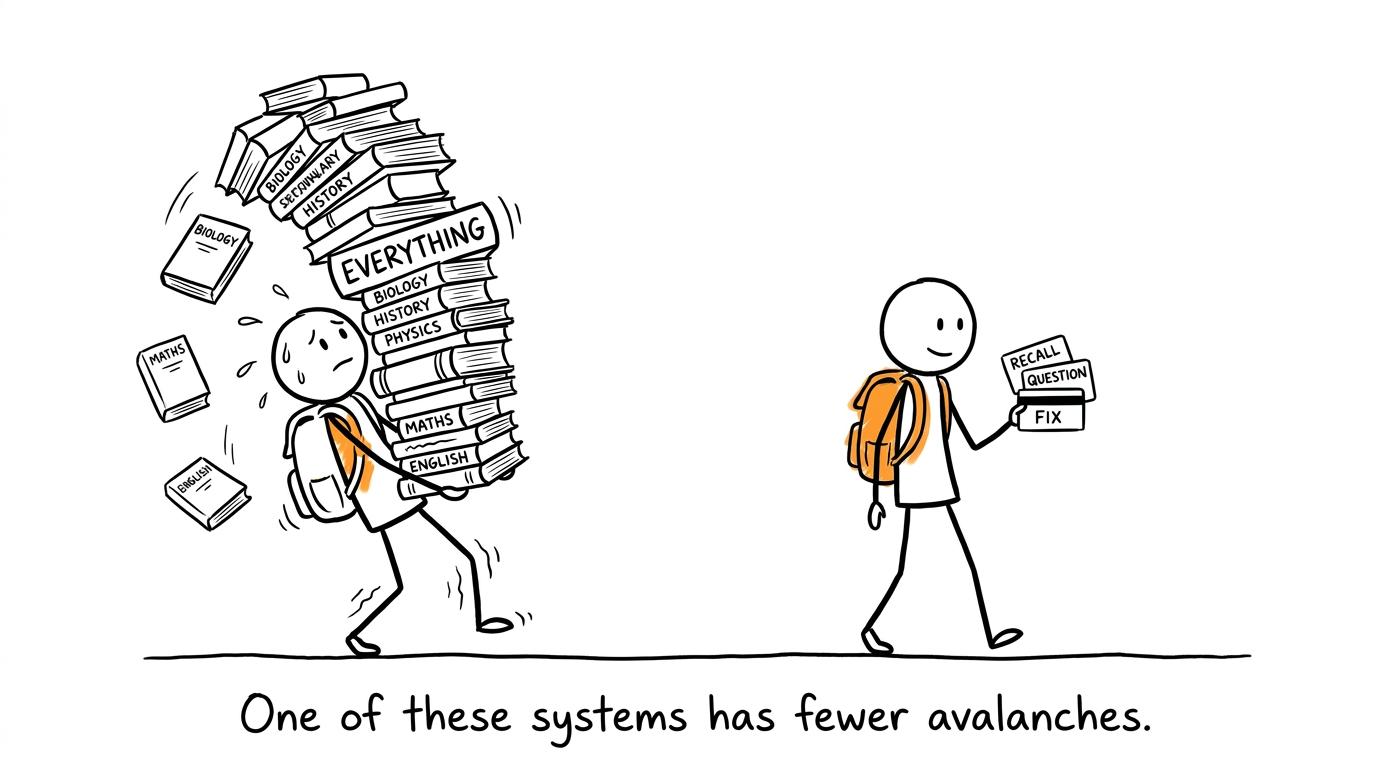 One focused revision system avoids a tower of unnecessary books
Do not ignore the maths inside Food and Nutrition
Food Preparation and Nutrition contains numerical work even though it is not a maths GCSE. You may need to work with recipes, quantities, proportions, percentages, units, tables, charts or nutritional information.
These are often efficient areas to improve because the underlying skills are reusable. Check that you can:
- scale ingredient quantities proportionally;
- interpret nutritional labels and numerical data;
- compare amounts using fractions, ratios or percentages;
- convert common mass, volume and energy units when required;
- read axes, scales, tables and charts accurately;
- include appropriate units and sensible rounding.
MathsGenie's free GCSE maths revision hub covers Edexcel, AQA, OCR and Eduqas maths. For targeted crossover skills, use the conversions and units revision guide and the ratio and proportion self-assessment.
Food questions usually place these skills inside a practical context. Read carefully before calculating: identify what the value represents, choose the required operation and check whether the final answer is realistic.
A revision routine that works when time is short
Each session should have a clear job.
Recall
Close your notes and write what you remember about one defined topic. You might create a diagram, answer flashcards or explain the topic aloud. Retrieval exposes gaps that rereading can hide.
Check
Compare your recall with the specification, trusted class materials and teacher guidance. Add only what was missing or inaccurate. Your notes should become shorter and more useful, not endlessly larger.
Practise
Answer exam questions immediately. Include a mixture of brief recall, application and extended responses. Use timed practice once you understand the content, but do not let the timer replace careful thinking during the learning stage.
Mark and repair
Use the mark scheme to identify the exact weakness. Was the fact missing? Was the explanation incomplete? Did you ignore data from the question? Did you make a calculation or unit error?
Write one correction, then answer another question requiring the same knowledge. This is where practice begins to change performance.
Common mistakes in late Food and Nutrition revision
Trying to cover everything equally
Equal time feels organised but ignores your starting point. Spend more time where knowledge is both weak and examinable, while briefly maintaining secure areas.
Rereading instead of retrieving
Recognition is not recall. If a page looks familiar, that does not mean you can reproduce or apply its content under exam conditions. Close the book before testing yourself.
Memorising facts without explanations
Knowing that a process occurs is not always enough. Practise linking cause, process and consequence so that your answers develop rather than stop after one statement.
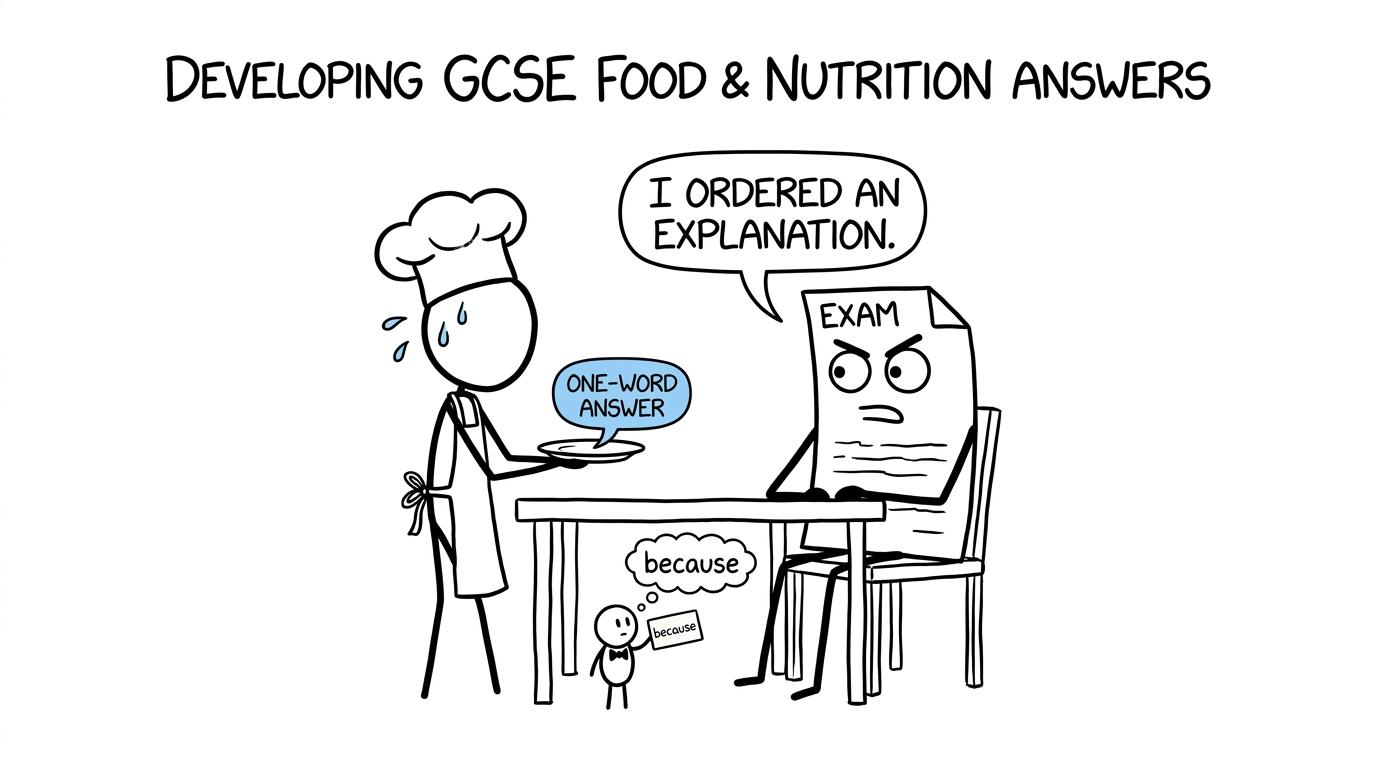 An exam paper asks for an explanation but receives a one-word answer
Completing papers without reviewing them
A completed paper measures performance once. A reviewed paper can improve the next attempt. Mark it, classify mistakes and revisit the responsible topics.
Neglecting calculations and units
Students sometimes treat numerical questions as separate from food knowledge. Practise both together and check every unit. The direct and inverse proportion questions can strengthen proportional reasoning when this is a weakness.
Sacrificing sleep for one more chapter
Late revision encourages heroic-looking plans that produce tired, inaccurate work. A shorter focused session followed by rest is a better final strategy than continuing after concentration has disappeared.
It is late, so make the next action small
The most useful question is no longer, "When should I have started?" It is, "What can I improve in the next session?"
Choose one specification area. Retrieve what you know, answer questions, mark them and record the correction. Tomorrow, retest it. That process cannot guarantee a grade, but it gives the remaining time a clear purpose.
MathsGenie can support the numerical side of Food and Nutrition while keeping your wider maths revision moving. Use the free revision lessons, practice questions, mini tests and video solutions to repair individual skills. Then build exam confidence with past papers, mark schemes and predicted papers, organised through a realistic revision planner.
Start at the MathsGenie GCSE maths revision hub, select your exam board and turn today's first small revision block into something you can mark, correct and improve.