

Tell Parents You're Struggling with GCSE German
Tell parents you're struggling with GCSE German calmly. Use a practical script to explain the problem, ask for support and avoid an unhelpful lecture at home.

There is a particular kind of worry that grows when nobody else can see it. Your German teacher moves on to another tense, your latest listening score is lower than expected, and at home everyone assumes revision is going reasonably well.
Trying to tell parents you're struggling with GCSE German can feel harder than admitting the problem to yourself. The most useful approach is simple: choose a calm moment, explain precisely what is difficult, show what you have already tried and ask for one or two specific forms of support. You do not need a perfect speech. You need an honest starting point and a practical next step.
This guide will help you begin that conversation without turning it into an argument or a lecture. It will also help you protect enough time and energy for maths and your other GCSE subjects.
A quick conversation checklist
Before speaking to your parents or carers, prepare five things:
- Choose a calm time, rather than starting the conversation during an argument or just before school.
- Name the exact difficulty, such as listening, vocabulary, grammar, speaking or balancing revision.
- Bring some evidence, perhaps a marked assessment, teacher feedback or your recent scores.
- Explain what you have tried so far without pretending it has worked.
- Ask for specific help, such as contacting your teacher, creating a realistic timetable or finding a quieter revision space.
The aim is not to prove that the situation is disastrous. It is to make the problem visible while there is still time to act.
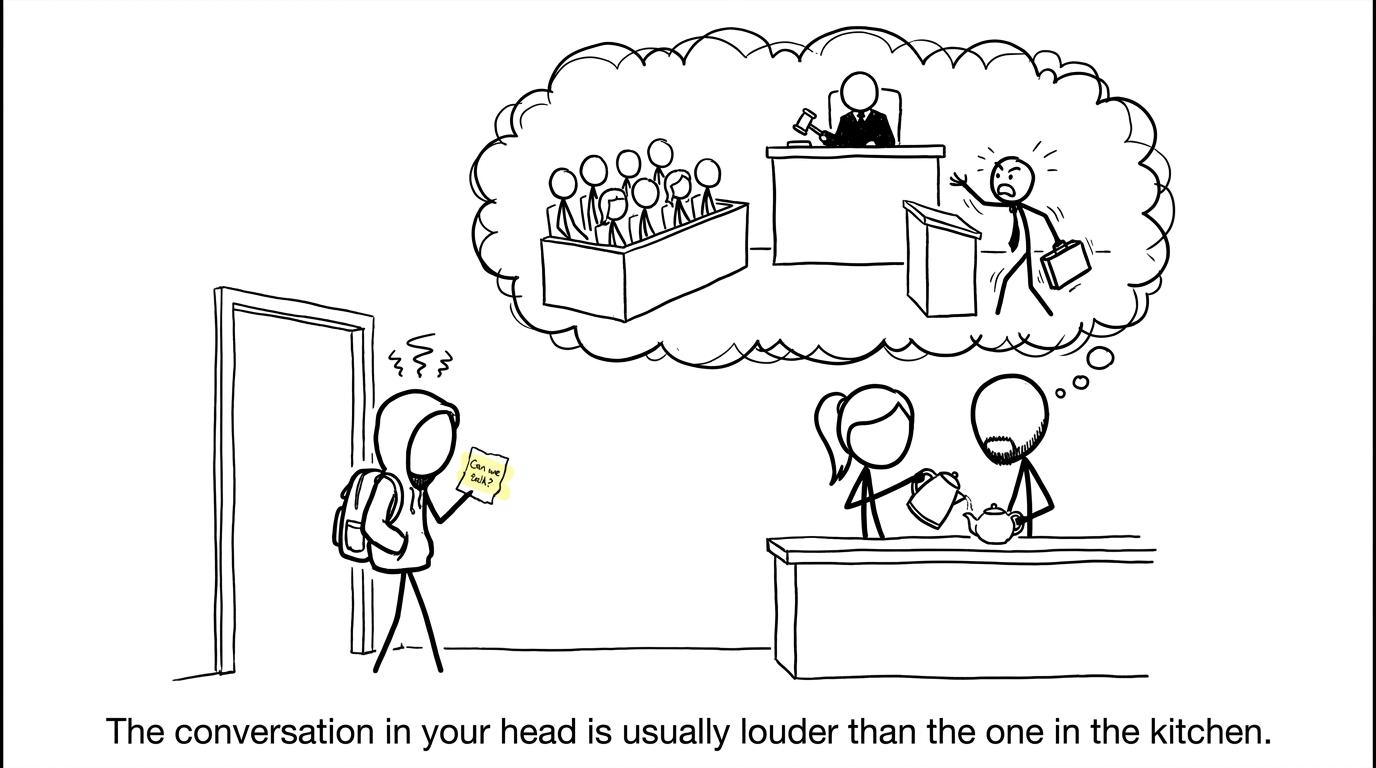 A nervous student discovers that the imagined conversation is louder than the real one
Work out what struggling actually means
"I'm bad at German" feels true when you are worried, but it does not give your parents much to work with. A useful conversation begins with diagnosis.
GCSE German assesses several connected skills, including listening, speaking, reading, writing, vocabulary and grammar. Current qualifications differ in their detailed tasks and paper structures, so check the specification for your exam board and course. Revised GCSEs in French, German and Spanish were introduced for first teaching in England from September 2024, with first examinations in summer 2026. Students taking a resit may follow an earlier specification.
Ask yourself where the difficulty appears:
- Do spoken answers seem too fast to separate into words?
- Can you recognise vocabulary but not recall it when writing?
- Are word order, cases or verb forms causing repeated mistakes?
- Does speaking make you freeze even when you know the content?
- Are you missing homework because maths and other subjects are taking over?
- Is anxiety making it difficult to begin any revision?
You do not need to solve these problems before speaking. You only need to describe them accurately. "I understand reading better than listening, but I lose track when the recording continues" creates a much better discussion than "German is impossible".
Choose a moment that lowers the temperature
Important conversations often go wrong because of timing rather than content. Avoid raising the subject when somebody is rushing, tired or already frustrated. If possible, ask in advance:
"Could we talk about German after dinner? I am finding part of the course difficult, and I want your help making a plan."
This sentence does three useful things. It gives your parents time to listen, signals that the subject matters and makes clear that you want a plan rather than an argument.
If speaking face to face feels overwhelming, send a short message first or write down your opening sentence. A note is not avoidance. It can be a bridge into the conversation.
Use a simple structure to prevent a lecture
Parents sometimes respond with a stream of advice because they hear the word "struggling" and immediately try to fix everything. You can make a lecture less likely by giving the conversation a clear shape.
Explain what is happening
Start with the facts:
"My recent German work shows that I am falling behind in listening and grammar. I am spending time on revision, but the way I am doing it is not improving those areas."
Be honest about missed revision or homework if that is part of the problem. Hiding it makes the eventual conversation harder. Honesty does not mean describing yourself as lazy or hopeless; it means identifying what happened.
Say how it is affecting you
Your parents may see a grade while you are experiencing worry, embarrassment or exhaustion. Explain the effect without exaggerating it:
"I have started avoiding German revision because I do not know where to begin, and then I feel more stressed because I know I am avoiding it."
That describes a pattern rather than making a judgement about your ability.
Show what you have already tried
Mention genuine attempts: revising vocabulary, completing homework, asking a classmate or reviewing teacher feedback. If you have not tried much yet, say so plainly:
"I kept putting it off because I felt behind. I know that has made it worse, and I want to change it now."
Taking responsibility often lowers defensiveness on both sides. It also keeps the conversation focused on what happens next.
Ask for one specific action
Try asking for something concrete:
- Help me email my German teacher.
- Help me plan three short German sessions each week.
- Please listen first before suggesting solutions.
- Could we discuss whether extra support is available at school?
- Can I revise somewhere quieter at home?
- Could we review the plan together next weekend rather than discussing it every evening?
A clear request gives concern somewhere useful to go.
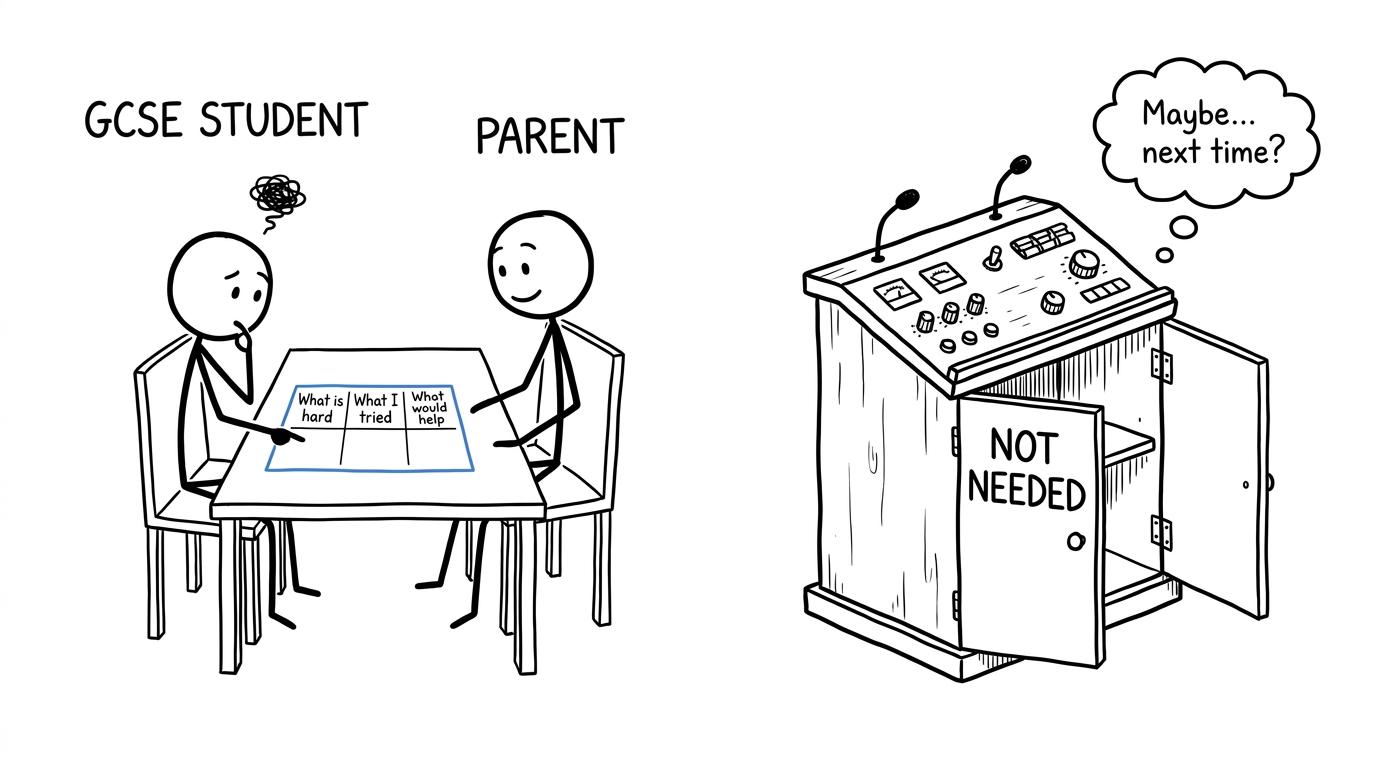 A plan sheet replaces the enormous lecture podium
Bring evidence, but do not put yourself on trial
A marked assessment, progress report or teacher comment can make the issue easier to explain. Use evidence to locate the difficulty, not to build a case against yourself.
Separate three kinds of information:
- Current position: your recent marks, feedback and unfinished work.
- Likely cause: weak vocabulary recall, limited speaking practice, poor revision structure or anxiety.
- Next action: teacher guidance, targeted practice and a manageable timetable.
This is the same diagnostic mindset that helps in maths. A low paper score is not a personality test; it is information about where marks were lost. MathsGenie's guide to finding your weakest GCSE topics explains how to turn broad worry into specific areas for action.
Your German teacher can provide the most relevant subject advice. Ask which skill should take priority, which resources match your exam board and whether your current foundation or higher tier entry remains appropriate. Do not make assumptions about changing tier from one disappointing assessment.
Agree on a plan that includes every subject
A German recovery plan should not quietly consume all the time intended for maths, English and science. Equally, concentrating only on maths because it feels more familiar can allow German to slide further.
Build a weekly plan around small, named tasks rather than vague promises. "Revise German" is difficult to start. "Practise this week's vocabulary and complete one listening task" is clearer.
For maths, the GCSE maths revision hub keeps lessons, exam questions, revision resources and papers together. That reduces the time spent searching for what to do. On busy days, the 20-minute maths revision routine can help you maintain momentum without crowding out German.
A balanced plan might include:
- short German sessions directed at one weak skill;
- regular maths topic practice;
- time for homework in other subjects;
- breaks, meals, exercise and sleep;
- one weekly check-in rather than daily questioning.
NHS guidance on exam stress recommends practical support such as realistic revision schedules, past-paper practice and speaking to supportive school staff. It also warns against all-night cramming. A plan is meant to make revision sustainable, not fill every available minute.
For a broader structure, use MathsGenie's GCSE maths revision timetable guide. You can adapt the planning principles across your subjects while using your German teacher's advice for the language content.
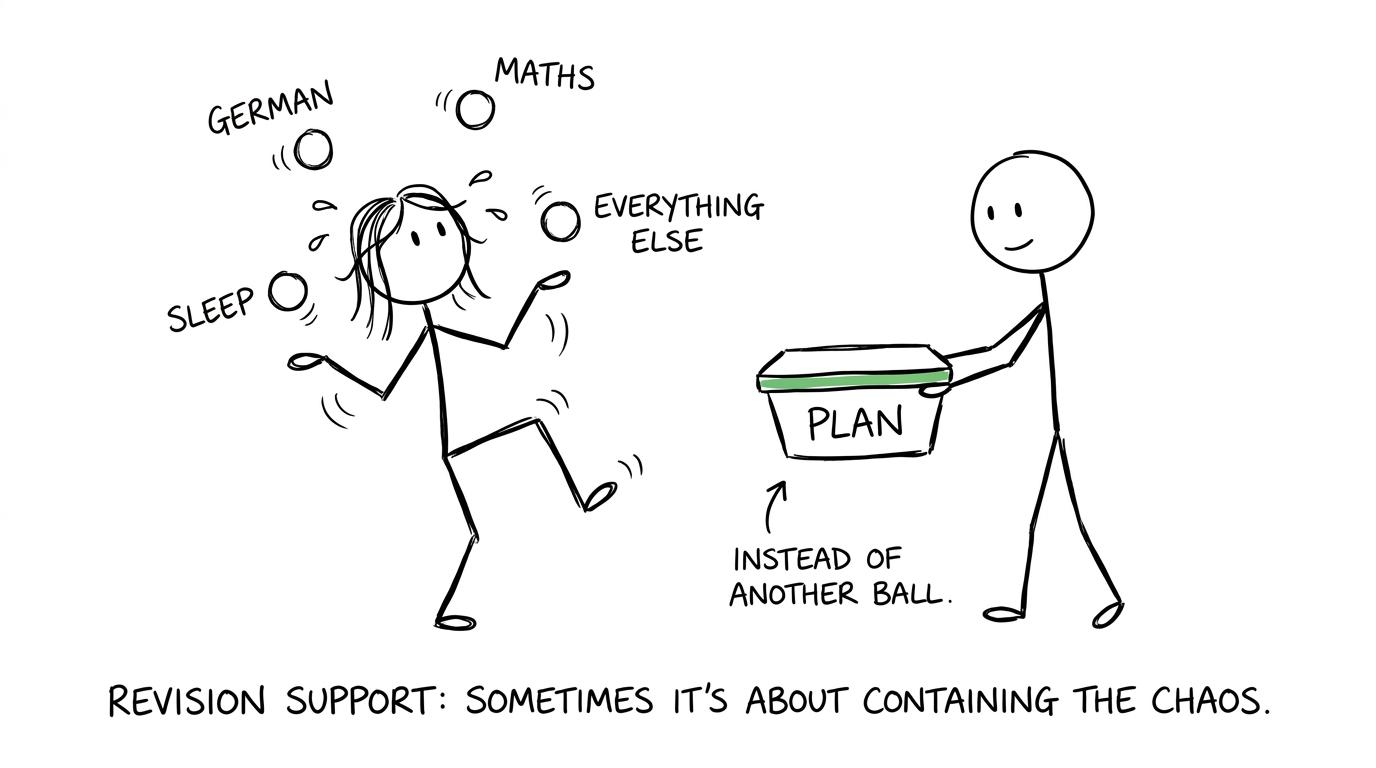 A parent offers a planning basket instead of another revision ball
What to do if the conversation starts becoming a lecture
Even careful conversations can drift. Your parents may repeat the importance of GCSEs, compare your effort across subjects or propose ten changes at once.
Do not try to answer every point immediately. Bring the discussion back to its purpose:
"I understand why you're concerned. Could we choose the first two actions for this week and review them afterwards?"
If voices rise, suggest a pause:
"I want to continue this, but I am finding it hard to explain myself while we are both frustrated. Can we take a break and come back to the plan later?"
You can also ask a trusted adult to help. A German teacher, form tutor, head of year or another family member may be able to explain the academic position and keep the conversation practical.
If your parents dismiss the problem, speak to somebody at school anyway. You are allowed to ask for educational and emotional support even when the first conversation at home does not go well.
Keep maths revision steady while you repair German
Falling behind in one subject can create a domino effect. Worry takes time, and unstructured revision takes even more. MathsGenie helps contain the maths part of the workload by giving you a direct route from diagnosis to practice.
Use GCSE maths past papers to identify gaps, then return to focused lessons and questions. Edexcel students can use the Edexcel GCSE maths past-paper collection, including mark schemes and worked solutions where available. Nearer the exams, Edexcel GCSE maths predicted papers provide fresh exam-style practice.
The principle is the same across subjects: diagnose, practise, check and adjust. The resources will differ, but the habit remains valuable.
Common mistakes when talking to parents
Waiting for a crisis
You do not need to wait for a failed mock or missed deadline. Earlier conversations usually leave more options for teacher support and gradual improvement.
Beginning with a verdict
Statements such as "I am going to fail" can pull the conversation towards reassurance or panic. Begin with what has actually happened and what you need.
Choosing the worst possible moment
A rushed school morning or an existing argument gives neither side much room to listen. Ask for a separate conversation.
Asking parents to guess what would help
"Help me" is honest but broad. Request a timetable, teacher contact, quiet space or weekly review.
Promising an unrealistic transformation
Do not promise hours of revision every night. A smaller plan you can repeat is more useful than an impressive plan abandoned after two days.
Treating the first conversation as the final one
Your plan may need changing after teacher feedback or another assessment. Agree on a review point and look at evidence together.
Make the next step small and visible
The hardest part is often the sentence before the conversation begins. Once the problem is shared, it can become a set of decisions rather than a private fear.
Choose a calm moment today. Write down the skill you are struggling with, one piece of evidence and one request. Then ask to talk.
While your German teacher helps you address the language course, let MathsGenie make the maths side simpler. Start with the free GCSE maths revision resources, use revision lessons and practice questions to repair weak topics, and build confidence with mini tests, past papers, predicted papers, mark schemes and video solutions. One honest conversation will not fix everything, but it can give the next week a much better direction.










