

Teach Back Method GCSE Biblical Hebrew: Does It Work?
Teach back method GCSE Biblical Hebrew guide: discover how explaining aloud reveals gaps, strengthens recall and improves revision without replacing exam practice.

Revision can feel convincing when everything is in front of you. You read a translation, recognise a grammatical form and think, “Yes, I know this.” Then someone asks you to explain why the translation works. Suddenly, the certainty becomes harder to find.
The teach back method GCSE Biblical Hebrew approach is useful precisely because of that moment. Explaining vocabulary, grammar or a set text aloud forces you to retrieve knowledge, organise it and make it understandable. This can expose gaps that quiet rereading misses. However, it should complement written translation, analysis and exam-question practice rather than replace them.
That principle also matters if your main concern is GCSE maths. Saying why a method works can reveal fragile understanding, but marks still depend on applying it accurately in written questions.
The short answer and revision checklist
Yes, teaching GCSE Biblical Hebrew to someone else can be a strong revision method when you:
- choose one narrow topic rather than attempting an entire unit;
- explain without reading directly from notes;
- ask your listener to interrupt when something is unclear;
- check every claim against reliable notes, the specification or a mark scheme;
- record gaps immediately;
- follow the explanation with written exam practice;
- revisit the topic after a gap.
It is less effective when “teaching” means reading a prepared page aloud. The valuable part is not performing like a teacher. It is retrieving, connecting and checking what you know.
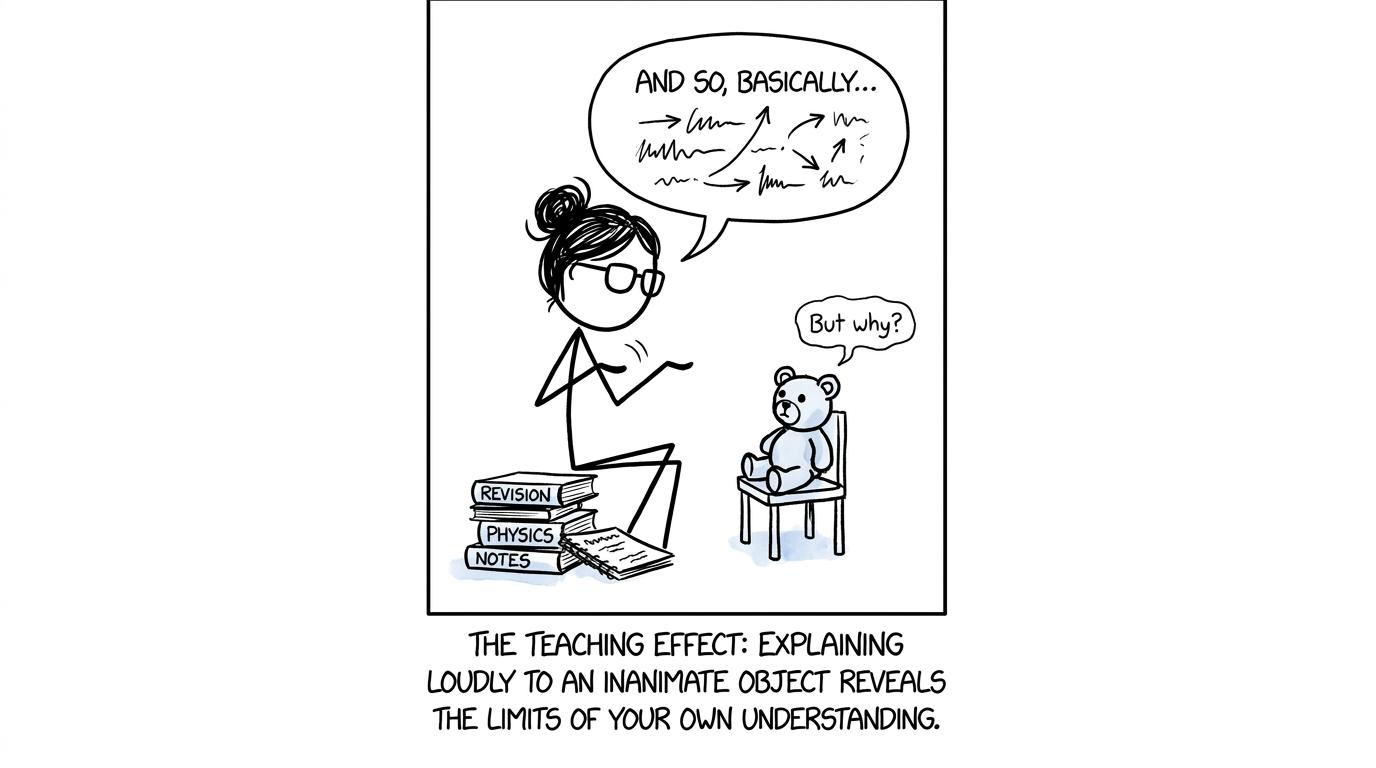 A GCSE student teaching a teddy bear that keeps asking why
Why explaining Biblical Hebrew aloud exposes hidden gaps
Recognition and recall are not the same experience. A vocabulary list can make a word look familiar because the answer is visible beside it. A completed translation can make a grammatical decision seem obvious because somebody else has already made it.
Close the book and the task changes. You must retrieve the information from memory.
Current education guidance identifies retrieval practice as more effective for long-term retention than repeated rereading. It also stresses the importance of feedback and spaced review. Research specifically comparing teaching others with ordinary retrieval is more mixed: explaining may help, but it is not consistently better than every other form of active recall. The safest conclusion is that teach back works largely because it makes passive knowledge active and makes uncertainty visible.
Suppose you are explaining a verb form. You may remember its broad meaning but struggle to justify the person, number, gender, stem or tense-aspect interpretation. That hesitation is useful evidence. It tells you exactly what to revise next.
There is another benefit. Teaching requires structure. To explain a passage clearly, you need to separate:
- what the language says;
- how the grammar supports that reading;
- what the passage contributes to its literary context;
- where interpretation begins.
That distinction matters for Pearson Edexcel GCSE Biblical Hebrew, where students are assessed on knowledge and understanding of the language as well as their engagement with literature or ancient sources. Biblical Hebrew should not be confused with Modern Hebrew GCSE, which has a different specification and different assessment demands. Always work from the qualification entered by your school and the current set texts confirmed by your teacher.
How to use the teach back method properly
Choose a teachable unit
A whole chapter or grammar system is usually too broad. Choose something small enough to explain accurately, such as:
- one grammatical feature;
- a short section of a set text;
- a group of easily confused vocabulary items;
- the reasoning behind a translation choice;
- the structure of a literature response;
- one recurring mistake from marked work.
Small units reduce the temptation to hide uncertainty behind general statements. They also make it easier to check whether the session improved your performance.
Start with closed-book retrieval
Spend a few minutes recalling the topic before opening your notes. Create a brief plan from memory, then begin explaining.
Use prompts such as:
- What is this feature?
- How would I recognise it?
- What evidence supports my interpretation?
- Which similar form might I confuse it with?
- What would an examiner expect me to show?
If you cannot answer one of these questions, mark the gap rather than improvising. Confidently teaching an incorrect rule can strengthen the wrong memory.
Teach a real person, an object or a recording
Your listener does not need to know Biblical Hebrew. In some ways, a beginner is helpful because they will not silently fill in missing steps for you. A parent, sibling or friend can ask simple but revealing questions: “How do you know?” and “Could it mean something else?”
If nobody is available, explain to an empty chair, a soft toy or a voice recorder. The key is producing the explanation without copying it. Listening back can reveal vague wording, circular reasoning and places where you relied on “it just is”.
Check immediately and correct precisely
After teaching, compare your explanation with your class materials, teacher feedback and the current specification. For exam responses, use an appropriate mark scheme to see whether your explanation contains what is rewarded.
Create a short correction log with three entries:
- Gap: what you could not explain.
- Correction: the accurate rule or interpretation.
- Next test: how you will retrieve it again.
Feedback matters because retrieval alone does not guarantee accuracy. A fluent explanation may still be wrong.
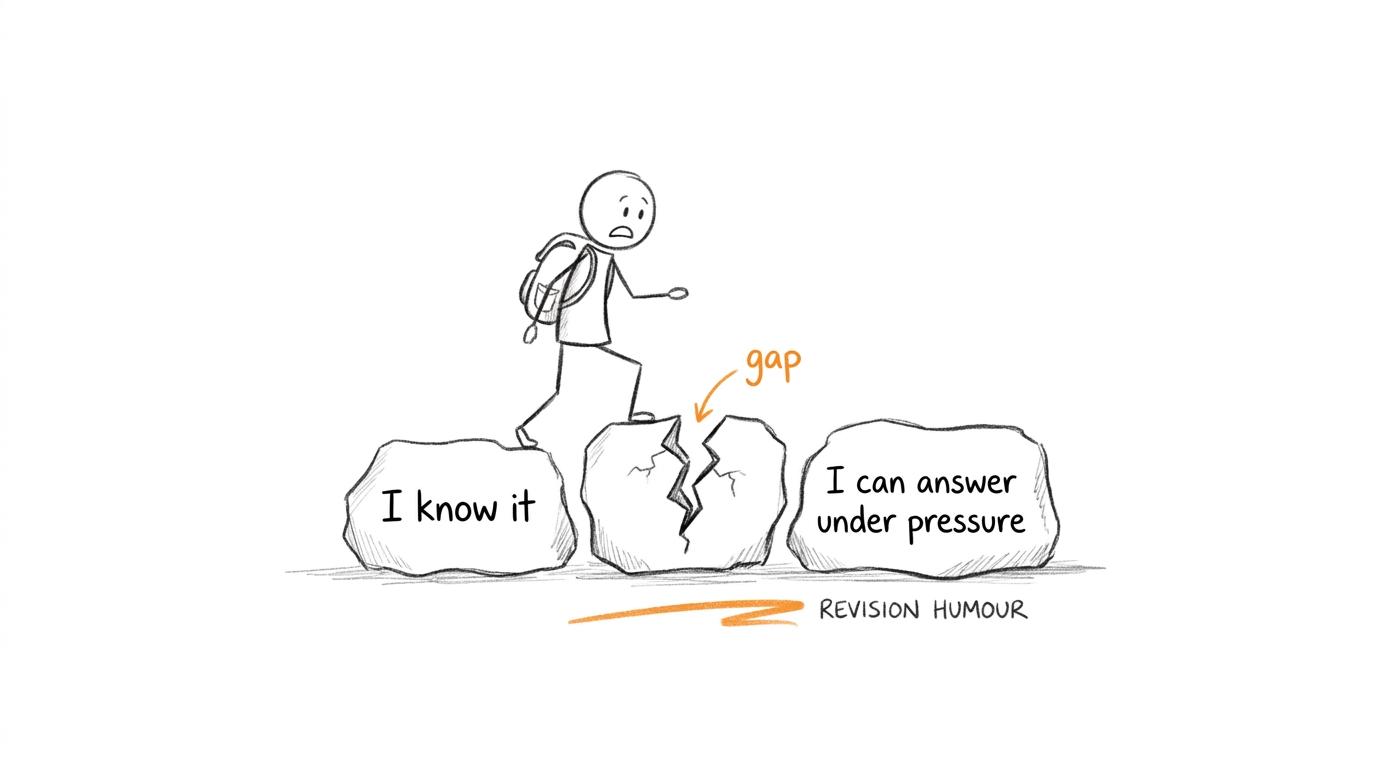 A student crossing from knowing to explaining while discovering a gap
Turn the explanation into exam performance
Teaching aloud checks understanding, but GCSE Biblical Hebrew is not assessed through an informal conversation with a friend. You must still translate, analyse language, respond to texts and communicate appropriately on paper according to your specification.
Use this revision sequence:
- Retrieve: recall the topic without notes.
- Teach: explain the idea and your reasoning aloud.
- Check: correct inaccuracies using authoritative material.
- Apply: complete a relevant written question.
- Mark: compare your response with the mark scheme or teacher guidance.
- Space: return to the same idea on another day.
The written stage is essential. You may explain a grammatical principle accurately but fail to recognise it inside an unfamiliar passage. You may discuss a set text confidently but omit the precise evidence needed in an exam response. Application tests whether the knowledge survives a change of context.
Why the same method helps with GCSE maths
The subject changes, but the illusion of familiarity does not. A GCSE maths student can watch a video solution and feel that every line makes sense, then face a similar question and not know how to begin.
Teach back can test whether you understand the decision behind a method. For instance, instead of merely reciting A=πr2A=\pi r^2A=πr2, you might explain what each symbol represents, when the formula applies, which measurement must be squared and how units affect the final answer. That is explanation, not a worked solution.
Use the GCSE Maths Revision hub to choose resources for Edexcel, AQA, OCR, Eduqas and other boards. After a revision lesson, close it and explain the method in your own words. Then complete practice questions without support.
If the explanation breaks down, return to the relevant lesson. If the explanation is clear but your written answers lose marks, the issue may be accuracy, notation, interpretation or exam technique. The guide to finding your weakest GCSE topics can help you diagnose the difference.
For shorter checks, use Edexcel GCSE Maths mini tests. For a manageable daily structure, combine teach back with the 20-minute GCSE maths revision routine.
Build teach back into a realistic revision week
Teach back works best as a recurring checkpoint, not a single dramatic session. Space the explanations across several days so that you must retrieve the topic after some forgetting has occurred.
A practical pattern is:
| Session | Main purpose |
|---|---|
| First contact | Learn the topic accurately and identify its structure |
| First teach back | Explain from memory and record gaps |
| Written practice | Apply the knowledge under exam-style conditions |
| Delayed teach back | Retrieve the corrected explanation after a gap |
| Mixed review | Recognise and use the topic among other material |
Keep each explanation focused. Ten careful minutes can be more revealing than an hour spent delivering a polished lecture from notes.
For maths, place these sessions inside a broader GCSE maths revision timetable. As exams approach, move from individual topics towards timed GCSE predicted papers and authentic paper practice. Maths students continuing beyond GCSE can apply the same cycle through the A Level Maths revision hub.
 One student over-highlighting while another teaches an unimpressed houseplant
Common mistakes with the teach back method
Reading notes aloud
This tests pronunciation and attention more than retrieval. Use notes to prepare, then close them before teaching.
Choosing a topic that is too large
“Teach the entire set text” invites vague summaries. Choose a passage, feature or decision that can be checked precisely.
Mistaking fluency for accuracy
Speaking smoothly can feel like mastery. It is not proof. Verify grammar, translation and textual claims afterwards.
Using an outdated specification
Set texts and assessment arrangements belong to a particular qualification. Confirm that you are revising Pearson Edexcel GCSE Biblical Hebrew rather than Modern Hebrew, and use the current materials supplied by your school or exam board.
Avoiding written questions
Oral explanation cannot reproduce every pressure of an exam. Follow it with translation, analysis or another relevant written task. For maths, use past papers properly: attempt, mark, diagnose, repair and retest.
Explaining only comfortable material
The method is most valuable where your knowledge feels fragile. Start with mistakes from marked work, not the topic you can already discuss confidently.
Make your revision prove something
Good revision is not the activity that looks most serious. It is the activity that gives you honest information and changes what you can do next.
Teaching GCSE Biblical Hebrew to somebody else can expose missing vocabulary, uncertain grammar and unsupported interpretations that quiet reading allows you to pass over. Its strength comes from retrieval, organisation, feedback and delayed review. Its limitation is equally clear: explanation must lead back to the written tasks on which you will be assessed.
The same lesson applies to GCSE and A Level maths. Explain the method, then prove that you can use it. Start at MathsGenie with a free revision lesson, close the notes and teach the idea back. Follow it with practice questions, mark your work carefully, and build towards mini tests, past papers and predicted papers. Use mark schemes and video solutions to correct the precise step where your understanding stops.
Do not ask only, “Does this look familiar?” Ask, “Can I explain it, apply it and retrieve it again next week?” That is where revision becomes dependable.










