Switch GCSE Alternative Option to Chemistry Mid-Year
Switch GCSE the alternative option to Chemistry with a realistic mid-year plan covering school approval, catch-up work, practicals and maths skills needed.
A subject choice can feel permanent the moment it appears on your timetable. Then a few weeks pass, your plans change, and Chemistry starts to look like the course you should have chosen.
If you want to switch GCSE the alternative option to Chemistry after the course has started, the short answer is: it may be possible, but your school decides. There is no universal national right to change GCSE options mid-year. Approval usually depends on the timetable, space in the class, the science pathway your school offers, how much teaching you have missed and whether the Chemistry department believes you can catch up safely.
Ask immediately. A difficult request made early is more realistic than an easy request left until next term.
Your mid-year switching checklist
Before asking for a change, find out:
- whether you mean separate GCSE Chemistry or Chemistry within Combined Science
- whether Chemistry is available in your current option block
- whether the class has space
- which exam board and specification the school uses
- which topics and practical activities you have missed
- whether your current science results support the move
- how much independent catch-up work will be required
- who must approve the request
- what happens if the request is declined
The decision is not simply about whether you like Chemistry. It is about whether the switch can work academically, practically and within the school timetable.
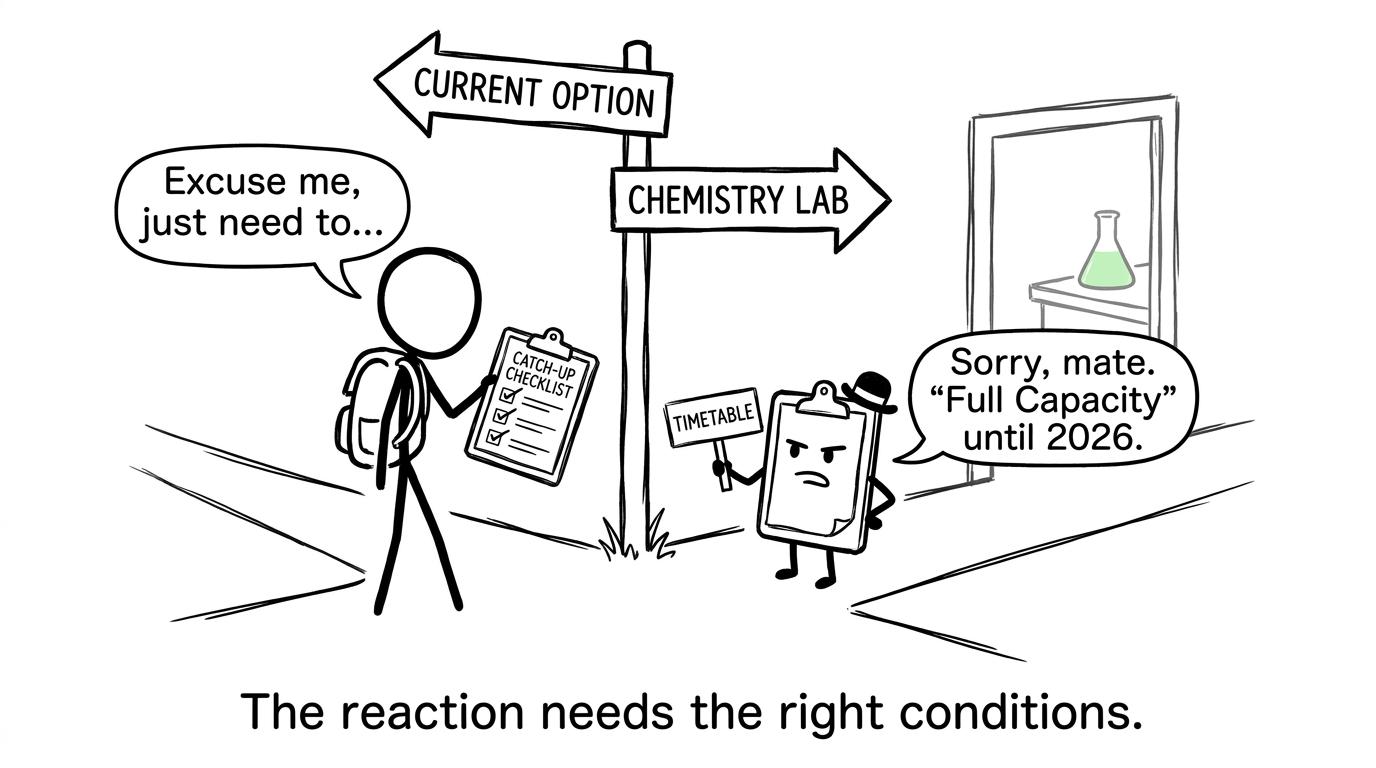 A student negotiating with a timetable on the path to the Chemistry laboratory
First, clarify what GCSE Chemistry means at your school
This matters more than it initially seems.
In Combined Science, students study Biology, Chemistry and Physics and receive two GCSE grades. On a separate science pathway, often called triple science, students normally work towards three GCSEs: Biology, Chemistry and Physics.
Some schools teach separate science through an option block. Others select students for it or decide the final entry route later in the course. A school may not offer standalone Chemistry as an isolated option alongside Combined Science. In that case, requesting GCSE Chemistry could really mean requesting a move onto the entire separate science pathway.
Ask the head of science these questions:
- What qualification am I currently entered for?
- Would the change lead to one additional GCSE or a different science pathway?
- Would I need to catch up Biology- and Physics-only material too?
- Would my tier of entry change?
Foundation and higher tier entry also matters. Students normally sit all papers for a science qualification at the same tier rather than mixing tiers within that qualification. Your teacher can explain how a move would affect your likely entry.
Is a mid-year GCSE option change actually possible?
Schools set their own option-change procedures. Published school policies vary considerably: some permit changes only during the opening weeks of Year 10, some use October or November half-term as a cut-off, and others consider later requests only in exceptional circumstances.
That variation tells you something important. “Is it allowed nationally?” is not the decisive question. The useful question is “Can my school make this particular change work?”
The timetable must fit
GCSE option blocks are constructed around staffing, rooms and student choices. If Chemistry is taught while one of your compulsory subjects takes place, enthusiasm cannot remove the clash. A full laboratory class may create another barrier because practical science requires appropriate supervision and facilities.
The department must judge catch-up as achievable
A Chemistry teacher needs to know that you can join without being permanently one chapter behind. They may consider your attendance, current science attainment, work habits and mathematical confidence. They may also set an assessment or ask you to complete introductory work before approving the move.
This is not gatekeeping for its own sake. A switch only helps if it puts you in a course you can complete successfully.
Parents and senior staff may need to approve it
The normal route may involve your parent or carer, head of year, options lead, current subject teacher and head of science. Some schools use a formal course-change form. Do not rely on an informal conversation in a corridor; ask what the official process is and request written confirmation of the final decision.
What it takes to catch up with GCSE Chemistry
Changing the timetable is the administrative part. Catching up is the real work.
GCSE Chemistry is linear, meaning the written examinations assess the course at the end rather than allowing you to leave early units behind. Depending on the board, content includes atomic structure, bonding, quantitative chemistry, chemical changes, energy changes, rates, organic chemistry, chemical analysis, the atmosphere and resource use.
Your first task is to obtain a precise catch-up list. “Revise the first term” is too vague. Ask for:
- specification references for every missed section
- lesson resources and textbook chapters
- required or core practical activities already completed
- assessments taken by the class
- a catch-up deadline
- the name of the teacher who will check your progress
Turn that list into weekly tasks. A sensible sequence is to learn the underlying idea, retrieve it without notes, answer topic questions, mark them and record what still needs attention. The GCSE Chemistry revision guide for students near a pass grade explains how to separate knowledge gaps, application errors and maths mistakes.
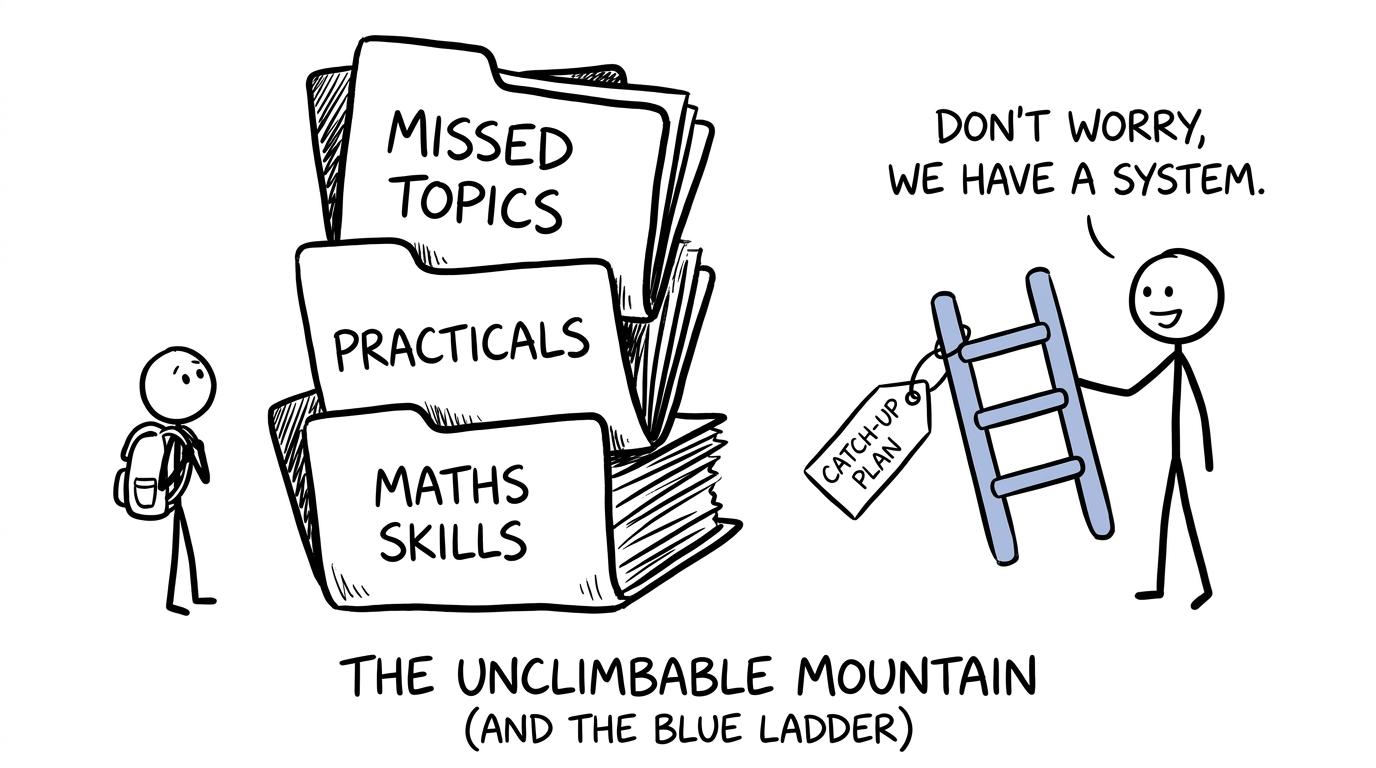 A teacher offers a catch-up ladder beside a pile of missed Chemistry folders
Practical work can decide whether the switch is feasible
Chemistry is not only a collection of facts. Practical experience is built into GCSE specifications, and written papers assess understanding of experimental methods, variables, measurements, errors and conclusions.
In England, individual GCSE science qualifications must include at least eight defined practical activities, while Combined Science has a broader practical requirement across the three sciences. Exact activities and terminology differ between AQA, Edexcel and OCR. Eduqas arrangements also depend on whether you are following an English or Welsh qualification, so use your school’s specification rather than somebody else’s checklist.
For example, the AQA GCSE Chemistry specification contains eight required practicals. Several overlap with Combined Science, while some are Chemistry-only. If you already study Combined Science, you may therefore have completed part of the relevant practical experience. That can make a move more manageable, but only your department can audit what is missing.
Ask whether you can join a practical with another class, complete an approved catch-up session or cover the necessary experience through the department’s planned teaching. Watching an online demonstration can help understanding, but it should not be assumed to replace whatever participation or observation your school and specification require.
The maths you need before moving to Chemistry
A mid-year Chemistry switch does not require perfect maths. It does require enough fluency that every calculation does not become a second catch-up project.
In English GCSE Chemistry assessments, at least 20%20\%20% of the marks are designed to assess mathematical skills. Common demands include:
- ratios from balanced equations
- fractions, percentages and percentage yield
- rearranging formulae
- converting units
- standard form
- gradients and rates
- interpreting tables and graphs
- mass, volume, concentration and density
Useful relationships include:
density=massvolume\text{density}=\frac{\text{mass}}{\text{volume}}density=volumemassand
mean rate=quantity changedtime taken.\text{mean rate}=\frac{\text{quantity changed}}{\text{time taken}}.mean rate=time takenquantity changed.These are not separate worlds called “maths” and “Chemistry”. Chemistry supplies the context; maths supplies the language used to describe it.
Use MathsGenie’s GCSE Maths revision hub to choose resources for Edexcel, AQA, OCR or Eduqas. Prioritise the ratio revision guide, standard form revision, changing the subject of a formula and speed and density revision.
For direct Chemistry preparation, the rates of reaction revision guide connects gradients, graphs and units to scientific meaning. Higher-tier students can also review amounts of substances in equations.
How to make a convincing request
Approach the conversation with evidence rather than a promise that you will “work really hard”. Explain why Chemistry fits your academic plans, acknowledge the missed work and bring a proposed catch-up routine.
Your request should cover:
- why you want to change
- what you understand about the course
- how you will catch up without neglecting other subjects
- when you can attend additional support
- how your progress can be reviewed
Ask for a short trial task if the department is uncertain. Completing it accurately and on time says more than a long speech.
Do not claim that separate Chemistry is always required for A Level Chemistry. Sixth-form entry requirements vary, and many providers accept strong Combined Science results. Check the specific sixth forms or colleges you may apply to before treating the switch as essential.
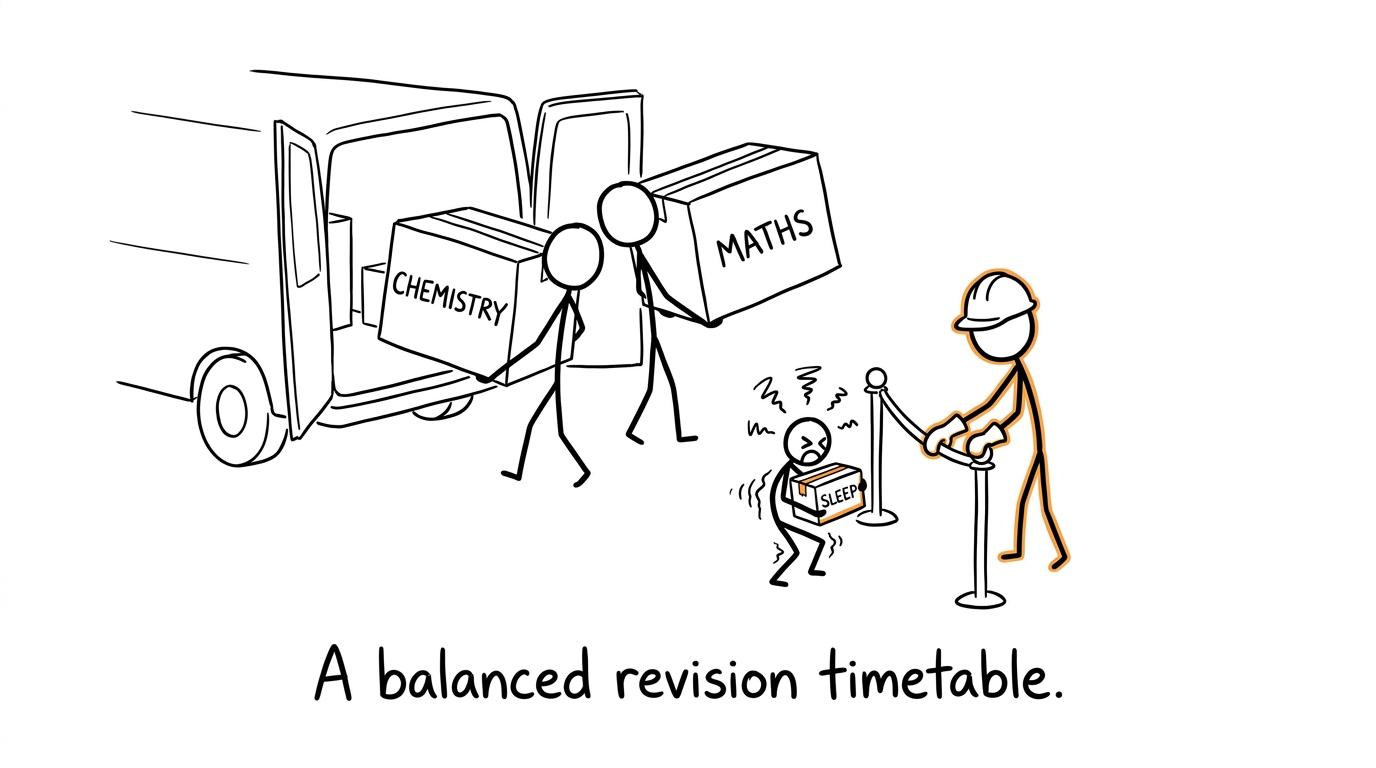 Students carefully balance Chemistry, maths and sleep in a revision timetable
Protect your maths revision while catching up
The danger of changing subjects is not only falling behind in Chemistry. It is allowing Chemistry to consume every evening until progress in maths, English and your other GCSEs begins to slide.
Build a bounded plan. Give Chemistry several focused catch-up blocks each week, but retain regular maths practice. Short, repeated sessions are usually easier to sustain than sacrificing an entire weekend and then avoiding the subject for six days.
Use GCSE predicted papers and mini tests to monitor your maths without creating another large workload. Revision lessons can repair a weak method, practice questions build fluency, and mark schemes or video solutions show where your reasoning stopped earning marks.
The point is balance. A successful subject switch should improve your programme, not destabilise the rest of it.
Common mistakes when requesting the switch
Waiting for the next report
Every additional week creates more content to recover. Ask now, even if the first conversation is only to learn the procedure.
Assuming Chemistry is a normal option subject
At your school, it may form part of triple science rather than exist as a standalone option. Clarify the qualification before planning around it.
Ignoring missed practical activities
Notes alone may not address the practical experience and experimental understanding required by the specification. Request a practical audit from the department.
Underestimating the mathematical content
Students sometimes focus entirely on chemical facts and then struggle with formulae, ratios, graphs and units. Diagnose those maths gaps early.
Dropping the current subject before receiving approval
Continue attending lessons and completing work until the change is formally confirmed. A request is not the same as a timetable change.
Creating an impossible catch-up schedule
A plan that requires several hours every night will probably collapse. Agree realistic weekly milestones and review them with a teacher.
A realistic next step
Switching from an alternative GCSE option to Chemistry mid-year is possible in some schools, but it requires more than changing one line on a timetable. You need an available course, departmental approval, a practical-work solution and a credible plan for missed content. The later the request, the stronger that plan must be.
Speak to your head of year or options lead today. Then ask the head of science for the exact specification, missed-topic list and practical requirements.
While your school considers the request, start strengthening the transferable maths behind Chemistry. MathsGenie gives you free revision lessons, practice questions, mini tests, past papers, predicted papers, mark schemes and video solutions. Build one skill, check it honestly and repeat. Whether the switch is approved or not, that work will continue paying marks back across your GCSEs.