

How to Stop Procrastinating GCSE Further Maths
Stop procrastinating GCSE Further Maths with a practical revision system: smaller starts, focused questions, honest marking and calmer exam preparation.
Procrastination rarely looks dramatic. It looks like reorganising your desk, checking one message or deciding that tomorrow will be a more sensible day to begin. If you want to stop procrastinating GCSE Further Maths, the answer is not to wait for stronger motivation. Make the first task smaller, decide exactly when it will happen and finish each session by answering and marking real questions.
That is the useful answer. The deeper problem is that Further Maths can feel unusually easy to postpone. It is difficult, often taught alongside an already busy GCSE timetable and sometimes treated as an additional qualification. The work can therefore feel important without feeling urgent.
The pattern breaks when revision becomes specific enough to start and short enough to repeat.
Your anti-procrastination checklist
Use this whenever Further Maths has slipped down your revision list:
- Choose one specification topic rather than writing “Further Maths” in your planner.
- Set a start cue: a particular time, place and first action.
- Begin with a 101010-minute task or one question.
- Put your phone beyond arm's reach.
- Mark your work before finishing.
- Record one gap and choose the next task.
- Return to the topic after a gap instead of attempting one enormous session.
- Ask your teacher which qualification and specification you are following.
MathsGenie's AQA GCSE Further Maths revision hub brings together lessons, questions, papers and solutions, removing much of the effort involved in deciding where to begin.
 A student discovers that the Further Maths syllabus looks smaller once opened
Why GCSE Further Maths gets procrastinated on
It can feel like an extra subject
“GCSE Further Maths” is commonly used as a convenient label, but the precise qualification depends on your school. For example, AQA offers an untiered Level 2 Certificate in Further Mathematics as an additional qualification rather than a replacement for GCSE Mathematics. Other centres may follow a different Level 2 course, so check the title and specification with your teacher before choosing resources.
For some students, that additional status quietly changes its priority. English homework has a deadline. A GCSE Mathematics mock has a date. Further Maths revision can appear optional until the exam becomes close enough to feel frightening.
The solution is to create earlier deadlines of your own. “Finish algebra” is too vague. “Complete one factor theorem question at 17:0017{:}0017:00 on Tuesday” gives the task a visible edge.
The first step is often unclear
Further Maths extends familiar areas such as algebra, coordinate geometry and trigonometry, while courses such as AQA's also introduce calculus and matrices. A topic can therefore feel half-familiar and half-new. You recognise the symbols but do not immediately know what to do with them.
That uncertainty creates friction. The brain prefers an easier task with a clear finishing point.
Replace a broad intention with a physical first action:
- open the correct topic lesson;
- write the date and topic on paper;
- attempt one question without notes;
- check the solution;
- identify the first missing step.
You are not promising to master calculus tonight. You are promising to begin a defined task.
Difficulty can feel like evidence about ability
Standard GCSE Mathematics may provide reassuring stretches of questions you can complete quickly. Further Maths is designed to offer greater challenge, particularly through algebraic reasoning and problem solving. Consequently, a short session can produce several mistakes.
It is easy to misread those mistakes as a verdict: “I am not ready for this.” In revision, however, an error is information about the next action. It might reveal weak algebra, an unfamiliar notation or a method that needs to be retrieved again.
If the underlying GCSE skill needs attention, use the GCSE Maths revision hub before returning to the Further Maths question. Repairing a prerequisite is not retreating. It is shortening the route forward.
What actually breaks the pattern
Research on procrastination does not support one magical cure, and much of the intervention research involves university students rather than GCSE pupils. The evidence is mixed for simple goal-setting on its own. More promising approaches combine clear planning with reduced task aversion, while official exam-pressure guidance recommends manageable topics, short-term targets, testing and regular review.
In practice, that means changing the structure around revision rather than arguing with yourself about motivation.
Use a start rule, not a mood
Create an if-then plan:
If I finish eating at 18:3018{:}3018:30, then I will put my phone in another room, open my Further Maths topic and attempt one question.
A useful plan names the cue, location and behaviour. “Revise later” names none of them.
The plan should also survive an imperfect day. Add a fallback:
If I miss the main session, then I will do a 101010-minute restart before preparing for bed.
This prevents one missed session becoming a lost week. Planning helps, but it is not a guarantee; the task must still be easy enough to begin.
Lower the entry cost
The first session should feel almost too small. Try one of these:
- watch part of a revision lesson and write three key prompts;
- answer one exam-style question;
- mark five questions completed in class;
- list the steps of a method from memory;
- spend 101010 minutes correcting one previous error.
Small starts work because the commitment is limited. You may continue, but continuing is optional. Repeating a modest routine is more valuable than repeatedly designing heroic plans that never begin.
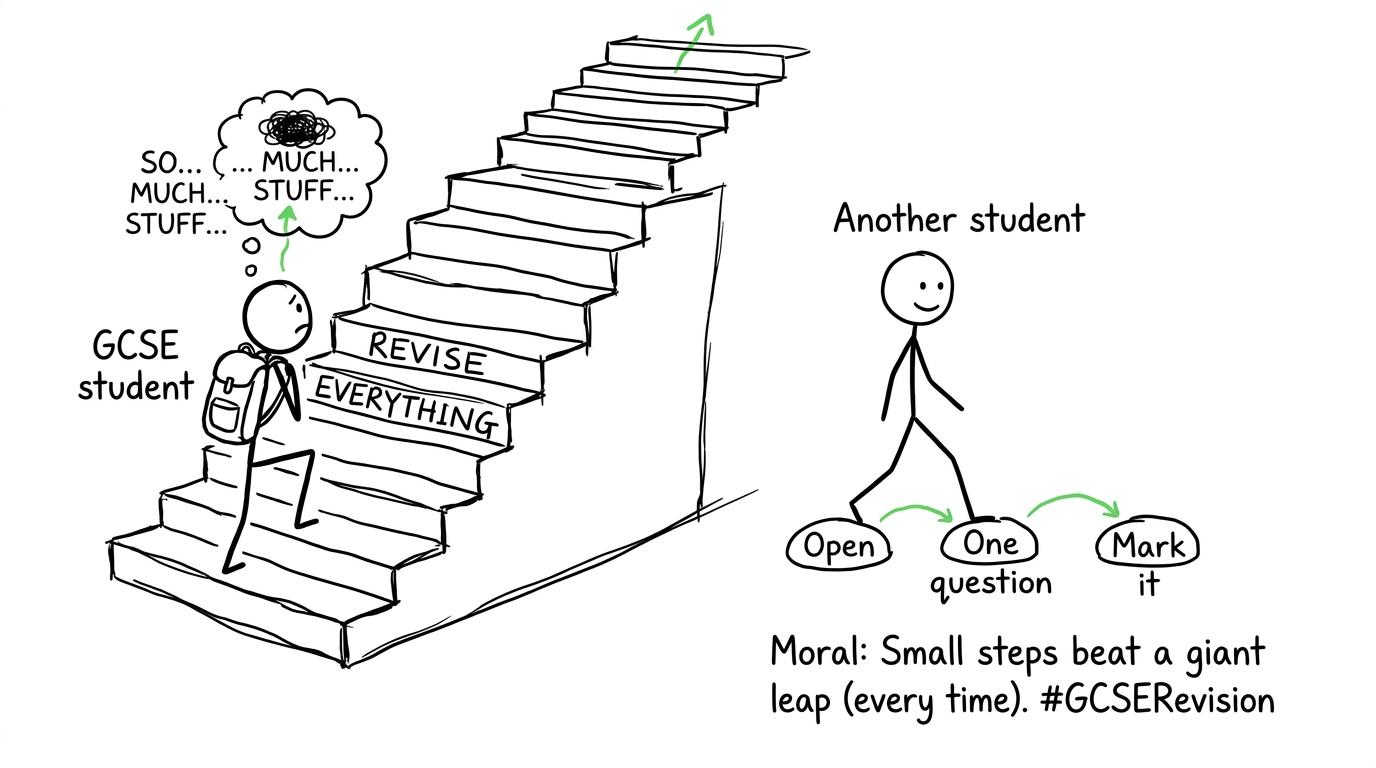 Two revision routes compare an overwhelming staircase with three small starting steps
Separate learning from proving
Students often open a full paper when they still need to learn a method. The resulting struggle feels unpleasant, so they avoid the next session.
Use three distinct modes:
- Learn: use a revision lesson or video solution to understand the method.
- Practise: answer focused questions with decreasing support.
- Perform: attempt mixed or timed questions without notes.
Do not judge a learning session by examination standards. Equally, do not let watching videos replace answering questions. Retrieval practice requires you to bring knowledge to mind, while spaced practice means returning after a gap. Both are more useful for durable recall than repeatedly rereading the same page.
For a broader explanation of this diagnose-and-retest process, read MathsGenie's guide to finding your weakest GCSE topics.
Finish with evidence
A session is not complete when the timer rings. It is complete when you know what happened.
Mark the questions and label each lost mark:
- method not known;
- algebraic slip;
- notation misunderstood;
- question misread;
- incomplete justification;
- calculator or arithmetic error.
Then write one next action. “Revise more” is not actionable. “Redo two matrix transformation questions on Thursday” is.
As your confidence grows, move from topic questions towards timed sections and papers. MathsGenie's guidance on when to start GCSE past papers explains how to use shorter diagnostic work before relying on full papers. The GCSE predicted topics guide also explains why predictions should focus revision rather than replace specification coverage.
A weekly system that is difficult to avoid
Keep the routine light enough to fit beside your other GCSE subjects.
Early in the week: diagnose
Attempt a short set from one Further Maths topic. Mark it immediately and choose the most important gap. Do not create a list of twenty weaknesses; one or two are enough for the week.
Midweek: repair
Use a revision lesson, then complete focused practice questions. Close the notes for at least part of the session so that you must retrieve the method. If the difficulty comes from ordinary GCSE algebra, repair that skill first.
Later in the week: retest
Answer a different question on the same skill without help. Compare your method with the mark scheme or video solution. If you can now begin independently and complete the essential reasoning, schedule the topic again after a longer gap.
At the weekend: mix
Complete a short mixed set containing an older topic as well as the week's focus. Interleaving is useful once the individual methods are reasonably secure because you must decide which technique a question requires.
If your exams are close, adapt the structure using the one-week GCSE maths revision plan. Keep your own Further Maths specification at the centre of the plan.
Remove the decisions that feed delay
Procrastination grows in the gap between “I should revise” and “What exactly should I do?” Prepare the answer in advance.
Before leaving each session:
- keep the next worksheet or page open;
- place your calculator, pen and paper together;
- write the next topic on a visible note;
- decide the start time;
- move distracting devices away from the desk.
A timer can help, but it should define a finish line rather than become another ritual. If you spend 202020 minutes choosing an app for a 151515-minute session, the system is serving the delay.
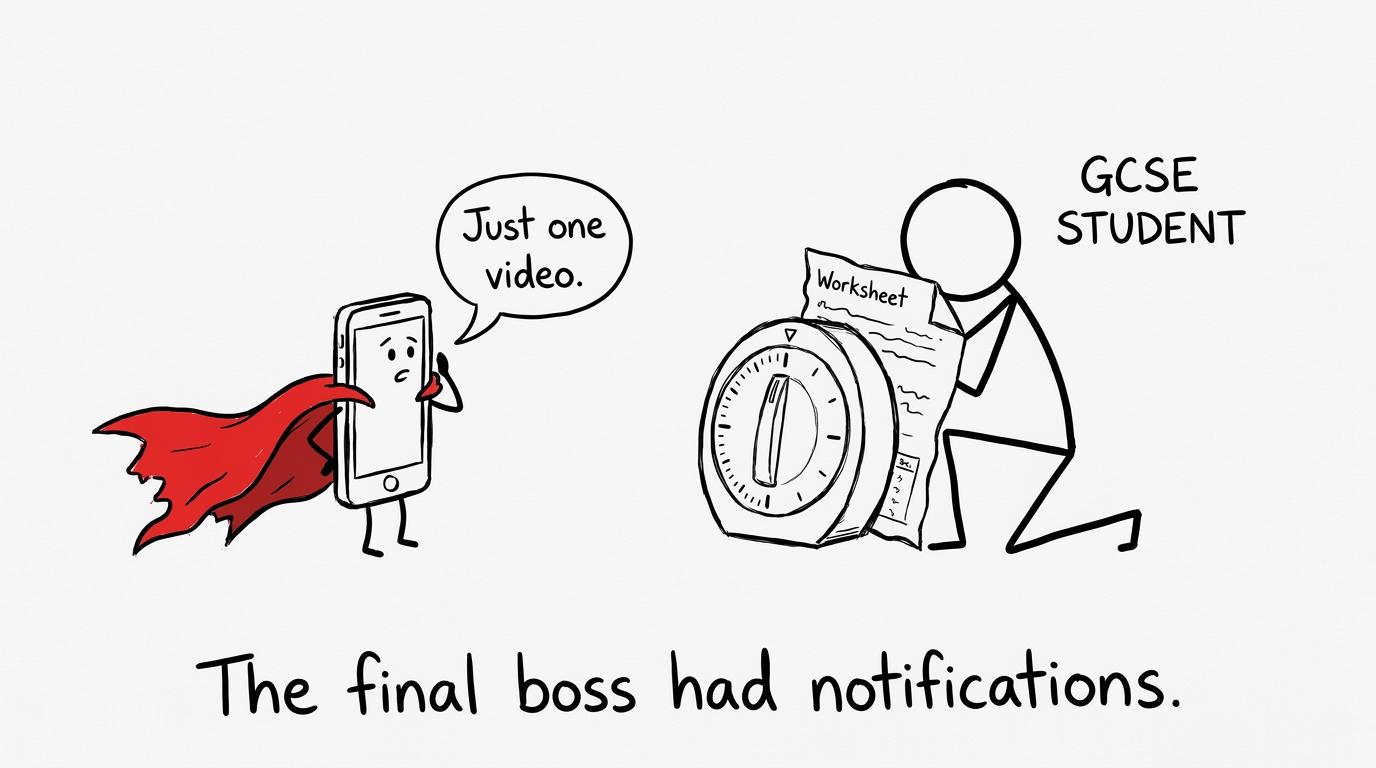 A student defends revision time from a villainous phone notification
Common mistakes when trying to stop procrastinating
Planning the whole course before doing any questions
A beautiful timetable can provide the feeling of control without producing evidence of learning. Limit planning, then answer something.
Starting with the hardest available question
Challenge matters, but an impossible opening task increases avoidance. Begin with a question that lets you retrieve the core method, then increase the difficulty.
Revising only comfortable GCSE topics
Core skills are important, but familiar work can become productive-looking avoidance. Give Further Maths a named slot rather than hoping spare time appears.
Watching solutions passively
A clear solution can create recognition without independent recall. Pause, cover the method and reconstruct it yourself before answering a fresh question.
Using one poor session as proof that the plan failed
Consistency is not perfection. Use the fallback start, record what interrupted the session and return at the next cue.
Treating predicted papers as the entire specification
Predicted papers are useful practice, not promises about what will appear. Use them alongside topic revision, past papers and your official course content.
Start before you feel ready
Further Maths becomes less intimidating when it stops being one enormous promise. Name one topic. Choose one question. Decide when you will begin and mark what you produce.
Then repeat the loop: learn, practise, mark, repair and retest.
MathsGenie is built to reduce the friction between those stages. Start with the free AQA Further Maths revision resources, use revision lessons and practice questions for focused improvement, and move into past papers, mark schemes and video solutions when you need exam realism. For your wider course, MathsGenie's GCSE revision resources also provide predicted papers, mini tests and board-specific material.
You do not need to feel completely motivated. You need a first action small enough to do today.










