

Revising GCSE Engineering With Music: Does It Help?
Revising GCSE engineering with music can help routine practice but hinder demanding work. Learn when to press play, choose silence and test your focus.
Revision sometimes begins with a strangely difficult decision: open the textbook, or perfect the playlist first. Music can make the desk feel less intimidating, but feeling productive and learning effectively are not always the same thing.
The short answer is that revising GCSE engineering with music can be helpful for familiar, repetitive tasks, particularly when quiet feels uncomfortable. However, lyrics, loud volume and unpredictable songs can interfere with reading, calculations and problem solving. For demanding work, silence is usually the safer choice.
This matters beyond engineering. The same principles apply when preparing for GCSE maths, where attention must move between formulae, diagrams, units and multi-step reasoning. Music is not automatically good or bad. It is another condition to manage.
The quick music-and-revision checklist
Before pressing play, ask:
- Is the task familiar, or am I learning something new?
- Does it involve careful reading or several calculation steps?
- Does the music contain lyrics?
- Am I working at a low, steady volume?
- Can I complete the same task more accurately in silence?
- Am I listening continuously, or repeatedly choosing songs?
- Have I practised without music for the real exam?
A useful default is simple: use silence for difficult learning and exam questions; consider quiet instrumental music for routine practice. Then test whether that advice actually works for you.
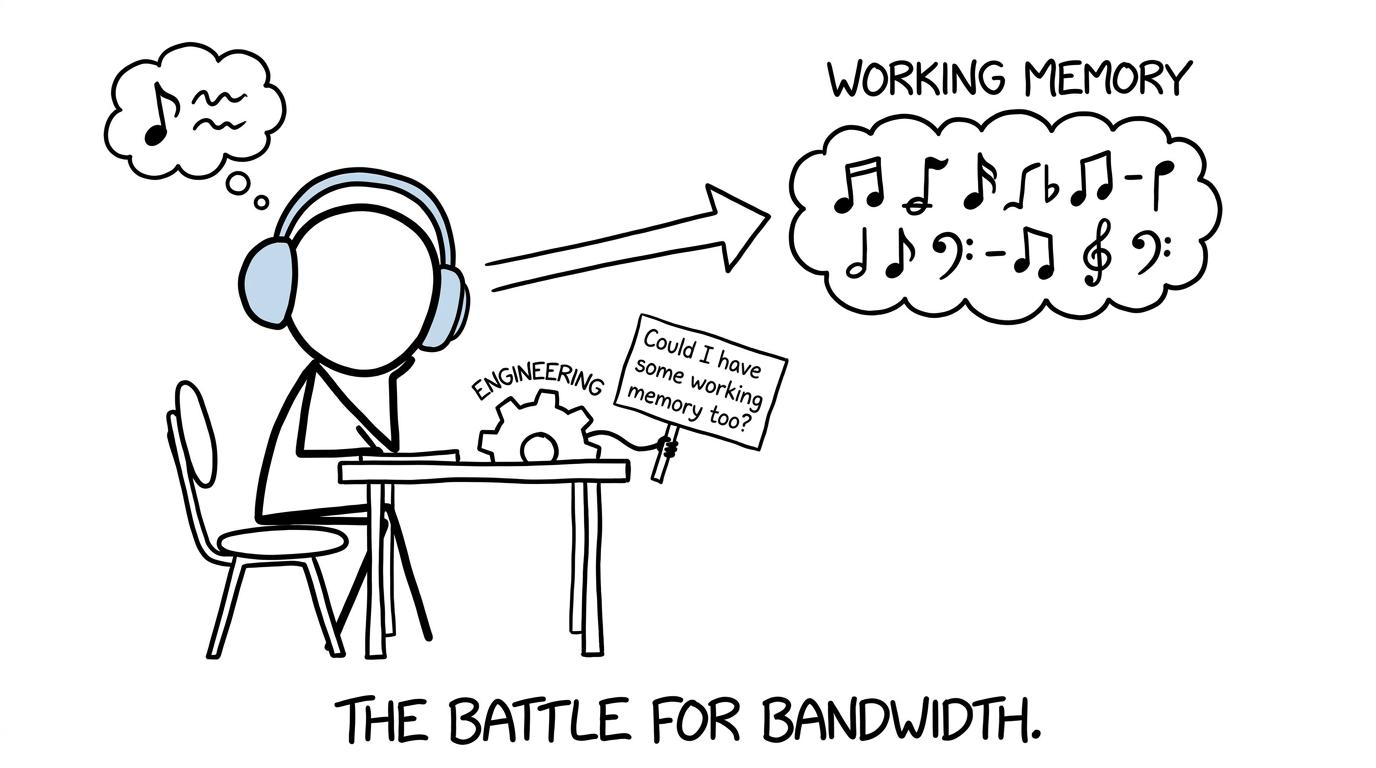 A student discovers that headphones and engineering drawings both want access to working memory
How background music affects concentration
Your attention is limited. During an engineering or maths problem, you might need to hold a measurement in mind, select a formula, substitute accurately and check the unit. Psychologists often describe the system supporting this temporary processing as working memory.
Music can compete for some of that capacity. The competition is usually more noticeable when the work itself is mentally demanding.
Lyrics are particularly likely to distract during tasks involving language. If you are reading a technical description, learning terminology or writing an explanation, your brain is processing words from two sources at once. Familiar lyrics can still capture attention, even when you believe you are ignoring them.
Instrumental music removes that verbal competition, but it is not distraction-free. Sudden changes in tempo, dramatic sections and high volume can still pull attention away from a calculation.
Research on background music does not support one universal rule for every student and every task. Results vary with the type of music, the difficulty of the activity, individual preferences and the outcome being measured. Music may improve mood or make a revision session feel easier without improving recall or accuracy by the same amount.
That distinction is important. Enjoyment can help you begin. Accuracy determines whether the session is working.
When music may help GCSE engineering revision
Engineering revision includes several kinds of activity. They do not all make the same demands on attention.
Familiar and repetitive practice
Low-volume music may be reasonable when you are:
- organising notes or equipment;
- reviewing familiar flashcards;
- labelling diagrams you already understand;
- repeating straightforward unit conversions;
- completing routine calculations whose method is secure;
- checking completed work against a mark scheme.
The music can make repetition feel less monotonous. That may help you remain at the desk long enough to finish a useful block of practice.
Even here, the work must remain the priority. If you are singing, tapping constantly or wondering what song comes next, the playlist has become the main activity.
Getting started when silence feels uncomfortable
Some students find complete silence unsettling. A predictable instrumental track, quiet ambient sound or steady background noise may reduce the temptation to notice every chair movement or sound elsewhere in the house.
This is a practical benefit rather than evidence that music makes the brain learn faster. Removing an irritating distraction can still be valuable, provided the replacement does not create a larger one.
If beginning is the difficult part, use music as a starting cue. Open the relevant GCSE maths revision lessons, choose one defined task and begin immediately. A reliable routine usually matters more than finding a supposedly perfect genre.
When silence is the better option
Silence is generally preferable when the task requires close reading, unfamiliar reasoning or several connected decisions.
For engineering and maths revision, that includes:
- learning a new formula or process;
- interpreting an unfamiliar technical drawing;
- reading a long problem carefully;
- completing multi-stage calculations;
- writing extended explanations;
- correcting a method you previously misunderstood;
- attempting timed exam questions or full papers.
These tasks place a heavier load on working memory. Removing optional sound leaves more attention available for the question.
Silence also helps you notice hesitation. Music can make a session flow pleasantly enough that uncertainty goes unnoticed. Without it, the moment when you cannot recall a formula or choose the next step becomes more obvious. That discomfort is useful information: it identifies what to revise next.
For targeted practice, MathsGenie's free GCSE revision resources let you move from lessons and practice questions to video solutions and mark schemes. Use sound only if it does not interfere with that cycle.
Choose music that is less likely to distract
If music helps you settle, make it easier for your attention to stay on the page.
Prefer instrumental and familiar tracks
Instrumental music avoids lyrics competing with technical language. Familiar tracks are also less likely to surprise you than a new album or an automatically generated playlist.
There is no scientifically guaranteed GCSE revision playlist. Classical, electronic, film music and ambient sound can all be distracting if they are loud or dramatic. Genre matters less than predictability, volume and your response to it.
Keep the volume low
Background music should remain in the background. If you cannot easily read a question internally or explain your method aloud, reduce the volume or turn it off.
Headphones can also mask how loud the music has become. Protect your hearing by keeping the level comfortable and taking regular breaks.
Prepare one playlist before revising
Searching, skipping and checking notifications create repeated interruptions. A pre-selected playlist removes those decisions.
Set it playing, place the phone out of reach and open the exact resource you intend to use. If you are preparing specifically for the maths component of your work, choose a topic from the GCSE maths grade-based revision programme rather than vaguely deciding to “do some maths”.
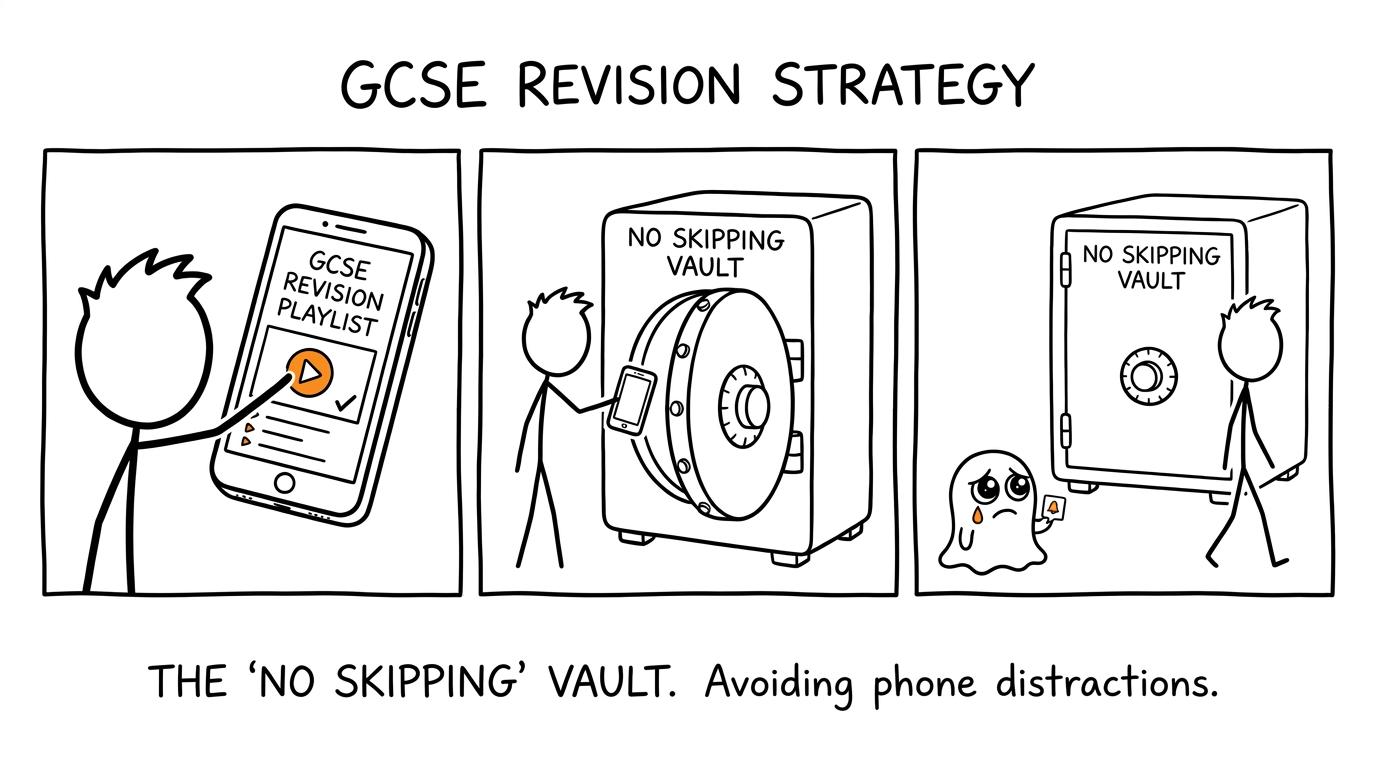 A notification monster is defeated by a pre-made playlist and a phone vault
Test whether music actually works for you
Preference is not the same as performance. The best way to decide is to run a small, fair comparison.
Choose two sets of questions that are similar in topic and difficulty. Complete one in silence and the other with your usual background music. Keep the working time and conditions as consistent as possible.
Record:
- the number of marks earned;
- the time taken;
- the number of careless errors;
- how often you checked or changed the music;
- how well you could explain the method afterwards.
Your accuracy rate can be recorded as:
Accuracy rate=marks earnedmarks available×100%.\text{Accuracy rate}=\frac{\text{marks earned}}{\text{marks available}}\times 100\%.Accuracy rate=marks availablemarks earned×100%.Repeat the comparison across several sessions before drawing a conclusion. One unusually easy question set, a bad night's sleep or a favourite song can distort a single result.
Use GCSE exam papers for realistic questions and check your answers carefully with the available mark schemes. If music consistently produces lower accuracy, slower completion or more misread questions, it is hurting your revision even if the session feels enjoyable.
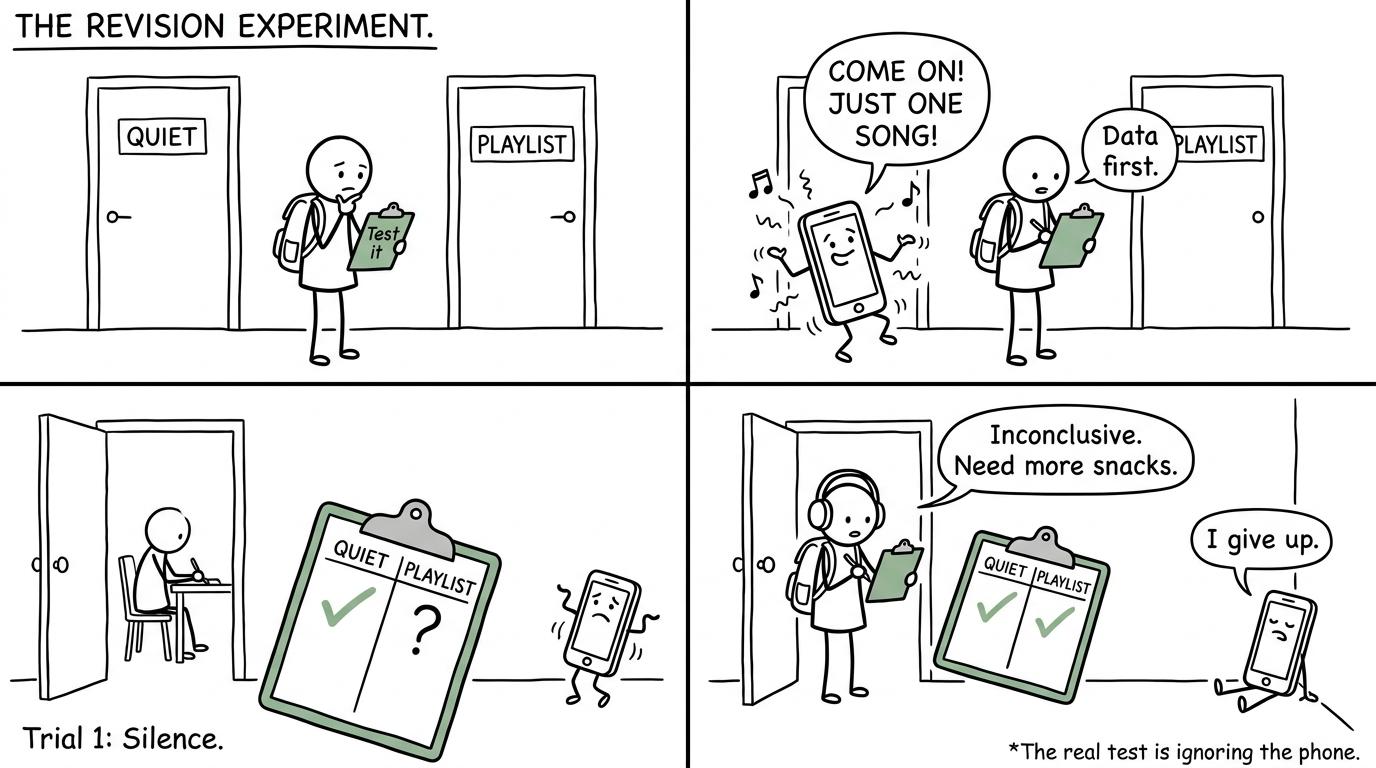 A student runs a calm comparison between the doors marked Quiet and Playlist
Match the sound to the stage of revision
A sensible approach changes as the work becomes more demanding.
Learning and understanding
When watching a revision lesson, reading an explanation or meeting a method for the first time, turn other audio off. Listen fully to the teaching and pause when you need to process a step.
Independent practice
For familiar questions, try quiet instrumental music if it helps you continue. Stop it as soon as the topic becomes difficult enough that you are rereading sentences or losing your place.
Marking and correcting
Music may be acceptable while ticking straightforward answers. Turn it off when diagnosing an error. Understanding why a method failed requires more attention than noticing that the final answer differs from the mark scheme.
Timed exam preparation
Complete regular sessions in silence. GCSE maths and engineering assessments will not normally provide your personal playlist, so your revision should include realistic conditions.
MathsGenie's GCSE predicted papers can help you practise selecting methods under timed pressure. They should complement, rather than replace, official past-paper practice for your exam board and specification.
Keep engineering and maths revision connected
The exact content of an engineering qualification depends on its title, exam board and specification. For example, AQA offers GCSE Engineering, while other engineering-related qualifications may use different structures and names. Always check the specification provided by your school.
Common mathematical demands can include measurement, scale, ratio, percentages, graphs, area, volume and rearranging formulae. Those skills become more reliable through active practice, not passive listening.
If a calculation exposes a gap, leave the engineering context briefly and repair the underlying maths skill. The free GCSE maths course organises topics by grade, while students progressing beyond GCSE can use the A Level maths revision resources when the time is right.
The goal is not to make every revision session look identical. It is to choose conditions that fit the task.
Common mistakes when revising with music
Choosing songs throughout the session
Every search or skip breaks concentration. Prepare the audio beforehand and keep the controlling device out of reach.
Assuming enjoyable revision must be effective
A pleasant session can still produce weak recall. Judge the method using marked questions, error patterns and what you can explain without notes.
Using lyrics for reading-heavy work
Songs with words are a poor match for technical definitions, extended responses and complicated instructions. Switch to instrumental sound or silence.
Playing music during every practice paper
This makes your revision conditions unlike the exam. Complete enough full papers in silence to make quiet concentration familiar.
Ignoring the real source of distraction
Sometimes music is not the problem. Notifications, tiredness, an unclear task or a cluttered desk may be doing more damage. Change one condition at a time so that you know what helped.
Revising only what feels comfortable
A playlist can make familiar questions easy to repeat while harder topics remain untouched. Use mark schemes and video solutions to identify the weaknesses that deserve your attention.
Make music serve the revision
There is no prize for revising in silence, and no special advantage to owning the perfect playlist. The useful question is narrower: which condition helps you understand more, remember more and earn more marks?
For routine work, quiet instrumental music may help you settle. For new ideas, technical reading, demanding calculations and timed papers, silence is the stronger default. Test both conditions honestly and let your results decide.
Then make the next step concrete. Choose a lesson from MathsGenie's free GCSE revision course, answer the practice questions, check the mark scheme and use the video solution where your method breaks down. Build towards past papers and predicted papers in realistic conditions. Music can shape the atmosphere, but careful practice is what shapes the grade.










